AWS Pioneers Autonomous Incident Remediation with DevOps Agent and Kiro CLI Integration, Dramatically Reducing MTTR for Cloud Operations

In a significant advancement for cloud operations and site reliability engineering (SRE), Amazon Web Services (AWS) has announced a groundbreaking integration between its AWS DevOps Agent and Kiro CLI, creating a fully automated, closed-loop incident remediation pipeline. This innovation is set to revolutionize how organizations manage operational incidents in their distributed AWS environments, moving from manual, time-consuming fixes to autonomous resolution with minimal human intervention. The collaboration addresses a critical bottleneck in incident response: the manual effort required to translate diagnostic findings into deployed code fixes, a process that historically consumed hours and often involved engineers responding to alerts in the middle of the night.
The complexity of modern distributed cloud architectures has steadily increased, making incident management a formidable challenge. Traditional incident response typically involves an on-call engineer, often alerted at off-hours, sifting through disparate telemetry data from services like Amazon CloudWatch, application logs, and deployment pipelines. This correlation process is followed by the manual writing, testing, and deployment of a fix – an arduous journey that can extend Mean Time To Resolution (MTTR) into several hours. Industry reports consistently highlight that extended downtime due to incidents can cost businesses anywhere from thousands to millions of dollars per hour, depending on their scale and sector. Furthermore, the constant pressure of manual incident resolution contributes significantly to engineer burnout and reduces time available for innovation.
The Evolution of Automated Incident Response
The journey towards autonomous incident response has been incremental, beginning with advanced monitoring and alerting systems, evolving into automated runbooks, and now reaching the frontier of agentic Artificial Intelligence (AI). AWS DevOps Agent emerged as a pivotal tool in this evolution, designed to autonomously investigate incidents, pinpoint root causes, and generate comprehensive mitigation plans within minutes. During its preview phase, customers and partners reported remarkable improvements: up to a 75% reduction in MTTR, an 80% acceleration in investigation times, and an impressive 94% accuracy in root cause identification. This represented a monumental leap forward in diagnosing problems, but the subsequent step—the actual implementation of the fix—remained largely a manual endeavor.
The critical missing piece was the automation of the "second half" of the incident response lifecycle: taking the agent-generated mitigation plan and translating it into deployable code without human toil. This is where the integration with Kiro CLI becomes transformative. By connecting AWS DevOps Agent’s intelligent mitigation outputs with Kiro CLI’s code generation and application capabilities, AWS has effectively closed the loop, paving the way for end-to-end automated remediation.
A New Paradigm: The Integrated Solution Architecture
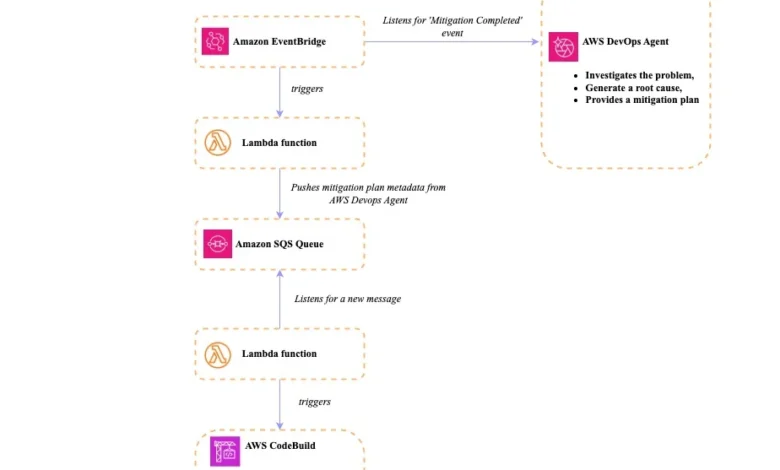
The newly unveiled solution establishes a robust, serverless, event-driven bridge between these two frontier agents. Imagine a typical web application hosted on AWS, comprising a frontend served by an Application Load Balancer (ALB), backend compute on Amazon EC2, and an Amazon RDS database, with all source code and infrastructure-as-code (CloudFormation templates) managed in AWS CodeCommit. When an anomaly occurs in this environment, the integrated system orchestrates a sequence of autonomous actions:
-
Incident Detection and Intelligent Diagnosis: The process begins with an anomaly triggering an Amazon CloudWatch alarm. This alarm, acting as the initial signal, automatically invokes AWS DevOps Agent. The agent then performs an autonomous investigation, correlating vast amounts of operational data, identifying the root cause, and formulating a detailed mitigation plan. This plan includes the specific action to take and the rationale behind it, along with step-by-step instructions.
-
Event-Driven Bridging: Upon successful completion of a mitigation analysis, AWS DevOps Agent publishes a "Mitigation Completed" lifecycle event to the Amazon EventBridge default event bus. This event, sourced as
aws.aidevops, contains crucial metadata such asagent_space_id,task_id, andexecution_id. An Amazon EventBridge rule, specifically configured to match thisMitigation Completeddetail-type, triggers an AWS Lambda function. -
Payload Extraction and Routing: The invoked AWS Lambda function interacts with AWS DevOps Agent using the provided metadata to extract two key objects from the completed mitigation: the
mitigation summary(outlining the required action and its justification) and theexecution plan(detailing the step-by-step instructions for implementation). This structured payload is then published to an Amazon SQS queue, serving as a reliable buffer for downstream processing. -
Headless Remediation with Kiro CLI and AWS CodeBuild: The arrival of a message in the Amazon SQS queue initiates the next critical phase. A second trigger AWS Lambda function is invoked, which, in turn, starts an AWS CodeBuild execution. The Amazon SQS message body, containing the mitigation plan, is passed to CodeBuild as an environment variable. AWS CodeBuild, chosen for its on-demand compute capabilities and native integration with AWS CodeCommit, provides the ideal environment for Kiro CLI to operate.
Kiro CLI 2.0’s headless mode is central to this automation. It allows the tool to run programmatically within CI/CD pipelines without requiring an interactive terminal. Authenticated via an API key securely stored in AWS Secrets Manager, Kiro CLI receives the mitigation prompt and executes its remediation capabilities end-to-end. The CodeBuild
buildspecoutlines a precise sequence:- The application and infrastructure code repository is checked out from AWS CodeCommit.
- The Kiro CLI agent is installed.
- Kiro CLI is invoked in headless mode, utilizing the extracted mitigation plan as its directive.
- Upon successful remediation, Kiro CLI commits the changes to a new feature branch.
- A pull request is automatically created against the main branch, detailing the changes.
The Indispensable Role of the Steering File
A cornerstone of Kiro CLI’s effectiveness in automated remediation is its "steering file." Unlike generic code generation, the steering file provides Kiro with persistent, project-specific knowledge. Committed directly to the repository, this file acts as the guardrails for automated remediation, ensuring that Kiro CLI makes targeted, predictable, and contextually appropriate changes. It defines critical aspects such as:
- Repository Structure: Understanding where different types of files (e.g., application code, CloudFormation templates, configuration files) reside.
- Coding Conventions: Adhering to the project’s established style guides, naming conventions, and best practices.
- Decision Frameworks: Guiding Kiro CLI on preferred approaches for certain types of fixes or architectural patterns.
- Safety Protocols: Defining boundaries for automated modifications to prevent unintended consequences.
This embedded intelligence ensures that the automated fixes are not only technically correct but also align with the organization’s development standards and architectural principles, fostering trust in the autonomous system.
The Critical Human-in-the-Loop Gate: Pull Request Approval
While the pipeline orchestrates an impressive degree of automation, the solution deliberately incorporates a human-in-the-loop gate: the pull request (PR) approval. After Kiro CLI modifies the relevant files and creates a feature branch, it automatically generates a pull request. The PR description is meticulously crafted, including a clear explanation of what was changed, the precise reasoning for the change (directly from AWS DevOps Agent’s analysis), and the agent space and execution IDs for complete traceability back to the original incident.
This human review step is paramount. A developer or SRE reviews the pull request, verifying the correctness, scope, and safety of the proposed changes before they are merged into the main branch. This deliberate approval step acknowledges that while AI agents excel at diagnosis and proposing fixes, the ultimate responsibility for deploying changes to production systems rests with human operators. Once approved and merged, the organization’s existing CI/CD pipelines take over, deploying the validated changes to the target environment.
Quantifiable Impact and Broader Implications
This end-to-end automated remediation cycle promises a paradigm shift for enterprise operations, delivering measurable impact across several fronts:
- Dramatic Reduction in MTTR: Incidents that previously took hours to resolve can now go from detection to a deployed fix in minutes, with the only manual step being a quick pull request review. For L1 and L2 incidents, which often constitute a significant portion of operational alerts, this can translate into near-instantaneous recovery.
- Significant Operational Efficiency: On-call engineers are freed from the drudgery of manual incident investigation and coding fixes. This reduction in operational toil allows them to focus on higher-value tasks, such as proactive system improvements, architectural enhancements, and innovation.
- Enhanced System Reliability and Resilience: Faster recovery times directly translate to reduced downtime and improved service availability, safeguarding business continuity and customer satisfaction.
- Cost Savings: The financial implications of reduced downtime and optimized engineering effort are substantial, contributing to a healthier operational budget.
- Improved Developer Experience: Reducing the burden of 2 AM pages and repetitive manual fixes contributes to a better work-life balance for engineering teams, mitigating burnout.
Industry analysts are quick to point out that this integration is a significant leap forward in the practical application of AIOps. An AWS spokesperson, commenting on the announcement, emphasized the company’s commitment to empowering developers and operations teams: "Our goal is to democratize advanced operational capabilities, making highly resilient and efficient cloud operations accessible to all. By integrating AWS DevOps Agent with Kiro CLI, we’re not just offering tools; we’re delivering a complete solution that fundamentally alters the economics and experience of incident management." Similarly, Kiro CLI leadership underscored their platform’s role in making AI-generated insights actionable. "Our headless mode was designed precisely for this kind of integration," stated a Kiro executive, "to bridge the gap between intelligent diagnosis and tangible code changes, ensuring that AI can directly contribute to improving system health without human translation."
This development pushes the boundaries of autonomous operations, indicating a future where cloud environments are increasingly self-healing. The ability to automatically generate and deploy code fixes, governed by a human approval gate, sets a new standard for operational excellence and scalability. As distributed systems continue to grow in complexity and scale, such automated mechanisms will become indispensable for maintaining stability and agility.
For organizations eager to embrace this new frontier, AWS has made the solution readily accessible. A comprehensive sample repository on aws-samples provides all the necessary infrastructure code, anomaly generation scripts, event routing configurations, and the critical Kiro CLI steering configuration. Teams can clone the repository, configure their AWS DevOps Agent spaces, and begin experimenting with closed-loop incident remediation, paving the way for a more resilient and less toil-intensive future in cloud operations. This integration is not merely an enhancement; it represents a foundational shift in how incidents are managed, marking a pivotal moment in the ongoing evolution of DevOps and cloud reliability engineering.
Related posts: