Every website exists in a state of perpetual decline from the moment it launches. The day a site goes live, it represents the absolute pinnacle of its design, technical performance, and messaging alignment. Yet, as the digital ecosystem evolves—with new browser standards, shifting market trends, and changing brand identities—the site remains static. Over time, this stagnation transforms a once-perfect project into a "period piece," a digital relic that no longer reflects the company it is meant to represent. While this decay is often treated as an inevitable law of web development, a new shift toward autonomous web management is challenging this status quo, proposing a future where websites continuously optimize themselves.
The core of the problem lies in the disconnect between the speed of digital change and the limitations of human maintenance. For years, development teams have operated on a project-based lifecycle: build, ship, and move on. In this model, maintenance is an afterthought, often delayed until a site becomes visibly broken or functionally obsolete. Industry data consistently shows that technical debt accumulates at an accelerating rate after launch. Studies in web performance indicate that after just six months of inactivity, the average commercial website experiences a 15% degradation in core web vitals, often due to unoptimized image assets, outdated third-party scripts, or evolving accessibility compliance standards.
The Rise of Autonomous Web Operations
The concept of an "autonomous website" aims to address this cycle of neglect by utilizing artificial intelligence agents that act as continuous monitors and optimizers. Instead of requiring a human developer to manually push updates for minor issues—such as propagating a design system change to a legacy page or compressing a newly uploaded image—these agents function as a background utility.
Pierre Burgy, co-founder of the autonomous platform Fimo, suggests that the primary hurdle in adopting this technology is not technical feasibility, but rather a profound psychological and professional resistance to total automation. When developers and designers first encounter the prospect of an autonomous agent, the immediate fear is the loss of control over the site’s identity and output. However, the experience of building and deploying Fimo revealed a more nuanced reality: most stakeholders do not actually want a fully autonomous site that makes high-level creative decisions. They want a system that handles the "eighty percent" of work that is rule-bound and tedious.
Defining the Boundary of Autonomy
The transition to an autonomous web model requires a fundamental restructuring of how tasks are categorized within a development team. The work involved in maintaining a website generally falls into three distinct tiers, each requiring a different level of human intervention:
- Rule-Bound Maintenance (The Chores): This category encompasses the vast majority of web maintenance. It includes tasks such as verifying accessibility compliance (WCAG standards), fixing broken internal links, optimizing asset performance, and ensuring meta-tag consistency. These tasks are defined by objective rules rather than subjective creative intent. Agents are exceptionally well-suited for this, as they can execute these corrections without human oversight, effectively eliminating the primary sources of site decay.
- Strategic Creative Judgment (The Untouchables): This represents the small but critical fraction of work that defines the brand. It involves decisions about tone, aesthetic, user experience philosophy, and the "feel" of the interface. This domain is where human talent is most valuable. No AI agent currently possesses the capacity to determine if a design choice aligns with a brand’s long-term vision. Protecting this space is essential, and it is here that the resistance to "full autonomy" is most justified.
- Context-Dependent Decisions: This is the gray area where the line between "chore" and "judgment" shifts based on the individual’s role. For example, implementing a dark-mode default theme is a technical task for a developer, but a strategic branding decision for a designer. Because this line is subjective, a "one-size-fits-all" approach to automation is doomed to fail.
Chronology and Evolution of the Autonomous Web
The shift toward autonomous infrastructure began in earnest with the maturation of LLM-based agents capable of interpreting web design systems. Historically, automated tools were limited to static code linting. The new wave of agents, however, can understand the relationship between a design token and a rendered component.
- Phase 1 (Pre-2022): Web maintenance relied on manual audits and scheduled deployments. "Decay" was a recognized but accepted cost of doing business.
- Phase 2 (2022–2024): The introduction of AI-assisted coding tools allowed developers to write code faster, but did not solve the post-launch maintenance problem.
- Phase 3 (2025–Present): The emergence of autonomous platforms like Fimo marks the transition toward persistent, agent-led management. In this model, the agent remains active post-deployment, learning from the specific design system of the organization to maintain parity between code and visual intent.
Implications for Development Teams
The integration of these agents necessitates a change in the relationship between humans and their tools. Developers are moving from being "builders" of static assets to "architects" of agentic systems. In this new workflow, the developer defines the rules and constraints under which an agent operates. As trust is established, the developer can delegate more autonomy to the agent, effectively shrinking the scope of their manual intervention.
This approach transforms the role of the developer from a bottleneck into a supervisor. If an agent identifies a potential accessibility regression, it can present the issue to the developer with a proposed fix, allowing the human to simply review and approve the change rather than investigating and coding it from scratch. This drastically reduces the time-to-remediation for common site issues.
Broader Economic and Industrial Impact
The broader implication for the digital industry is a shift away from the "frozen site" model. A website that never changes is a liability; it is an outdated storefront in an era of rapid information consumption. Organizations that adopt autonomous maintenance report higher agility, as their internal teams are freed from the "tyranny of the mundane." By offloading the maintenance of 80% of the site’s technical requirements, teams can refocus their energy on high-value initiatives—such as new product features, user research, and advanced creative work—that directly impact the company’s bottom line.
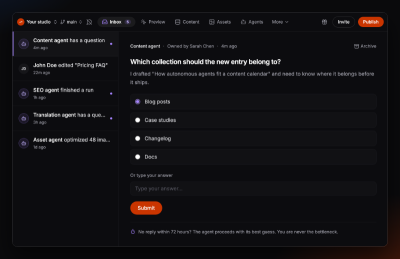
However, industry analysts warn that the implementation of such systems requires rigorous governance. If an agent is granted too much autonomy without a clear "human-in-the-loop" verification system, it could lead to widespread, automated errors that propagate across a site faster than a human could catch them. Consequently, the most successful implementations are those that start with narrow, well-defined agent scopes and expand only as the agent’s performance is validated over time.
Conclusion: The Future of Digital Permanence
The goal of autonomous website management is not to remove human oversight from the digital experience, but to remove the decay that currently renders most websites obsolete within months of their release. By distinguishing between rule-based maintenance and strategic creative judgment, teams can create a hybrid environment where machines handle the technical housekeeping while humans focus on the vision.
The "best day" of a website should not be the day it launches; it should be today. By leveraging agents to maintain the baseline quality and compliance of a site, organizations can ensure that their digital presence is always as current, accessible, and performant as it was on its first day—or better. In an increasingly competitive digital landscape, the ability to maintain this level of consistency without increasing head count may become a decisive advantage for companies looking to maintain a high-quality, long-term digital presence.