
As of August 2, 2026, the European Union has officially entered a new era of digital accountability with the enforcement of comprehensive transparency obligations under the EU AI Act. For companies operating within the European Economic Area (EEA)—and indeed, any global enterprise serving EU citizens—the era of the ambiguous "sparkle" icon is over. The new regulations mandate clear, distinguishable, and persistent labeling for AI-generated or manipulated content, marking a significant pivot from the "move fast and break things" ethos of the early generative AI boom toward a structured, regulated, and transparent framework.
The Legislative Landscape and Implementation Timeline
The foundation for these requirements is rooted in Article 50 of the EU AI Act, which seeks to mitigate the risks of disinformation, deepfakes, and the erosion of public trust in digital media. While the legislation has been under development for years, the August 2026 deadline represents the critical transition point where "best practices" have evolved into strict legal requirements.
The scope of this regulation is extraterritorial. Much like the General Data Protection Regulation (GDPR) and the European Accessibility Act (EAA), the AI Act applies to any entity that provides AI systems to users in the EU, regardless of where the company is headquartered. If a software-as-a-service (SaaS) provider based in California or a content platform based in Singapore serves users in Berlin, Paris, or Madrid, they are legally obligated to ensure their AI-generated outputs comply with these transparency mandates.

Defining the Threshold for Disclosure
The central question facing product managers and legal teams today is: what exactly triggers a labeling requirement? The EU commission has clarified that the primary objective is to allow individuals to distinguish between human-authored and machine-generated content.
However, the regulation is not a blanket mandate for every line of code or pixel produced by an algorithm. The law differentiates between "assistive" tools and "generative" outputs. Minor mechanical interventions—such as automated spellcheck, grammar correction, basic formatting, or color adjustments—do not require a disclosure label. Similarly, AI-powered translations are generally exempt from the labeling requirements under the current guidance.

Conversely, the requirement for disclosure is triggered when an AI system produces substantive content that could be mistaken for human work. This includes:
- AI-generated text: Any substantial narrative, summary, or report created by a Large Language Model (LLM) that is not subject to significant human editorial intervention.
- Synthetic imagery: Realistic photos, illustrations, or posters that depict real persons, objects, or events.
- Composite Media: Images or videos that have been significantly altered by AI, including the addition or removal of elements that change the nature of the original media.
A critical distinction is the "editorial responsibility" clause. The European Commission has specified that a human merely "skimming" an AI-generated draft before publication is insufficient. To bypass the labeling requirement, a named entity or individual must take explicit editorial responsibility for the content, indicating that the work has undergone rigorous human oversight and verification.

Beyond the Sparkle: Why Generic Icons Fail
For the past two years, the industry standard for identifying AI features has been the "sparkle" icon. While visually appealing, the European Commission has formally signaled that this icon is insufficient for legal compliance. Research from the Nielsen Norman Group and other UX design bodies has consistently shown that the sparkle icon is often misinterpreted by users as a generic "magic" or "upgrade" feature rather than a warning of machine generation.
In alignment with the new guidelines, the Commission has introduced an official set of icons designed to be clear and unambiguous. These icons are intended to be paired with plain-language labels, such as "AI-generated" or "AI-modified." The criteria for compliance are strict: the label must be persistent, meaning it must remain attached to the content even if it is downloaded or shared across different platforms. Hidden labels, footers that are easily overlooked, or brief pop-ups that vanish after a few seconds are explicitly deemed non-compliant.

Global Implications and Regulatory Harmonization
While the EU is currently the most aggressive regulator in this space, it is not acting in isolation. A broader trend of "transparency by design" is emerging globally. In the United States, several states have already moved to pass legislation governing synthetic performers and AI-enhanced political advertising.
This global shift suggests that the current EU mandate may soon become the de facto international standard. Companies that treat the EU AI Act as a "European problem" risk being caught flat-footed as other jurisdictions adopt similar frameworks. For global tech companies, the most efficient path forward is to adopt the highest standard of transparency—that of the EU—across their entire product portfolio to ensure operational consistency.

The Economic and Operational Impact
The financial implications of non-compliance are severe. Much like the GDPR, the EU AI Act provides for significant administrative fines, which can reach a substantial percentage of a company’s global annual turnover. However, the operational cost of compliance is arguably the more pressing concern for startups and mid-sized enterprises.
To maintain compliance, companies must integrate metadata tagging into their content pipelines. This involves:

- Provenance Tracking: Implementing technical solutions that keep a record of whether content was machine-generated at the point of creation.
- Design Integration: Updating UI/UX patterns to ensure that the AI label is always present in the context of the output, whether in a chat interface, a document editor, or a media player.
- Policy Auditing: Establishing internal review processes to define what constitutes "substantive" versus "assistive" use, ensuring that legal teams and product teams are in alignment.
Bridging the Gap: The Role of UX Design
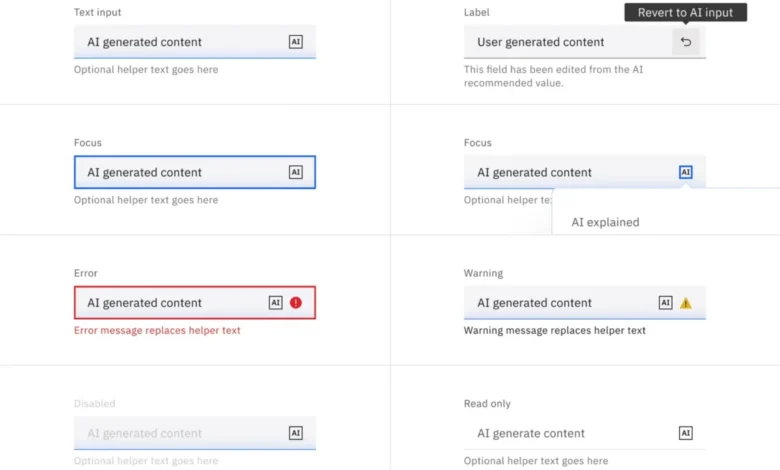
The challenge for designers is to integrate these labels without degrading the user experience. The Carbon Design System and other leading frameworks have already begun offering modular AI labeling components. These patterns demonstrate that transparency can be treated as a feature rather than a burden. By offering "explainability panels" alongside labels, companies can provide users with context—such as the model used or the degree of human intervention—which can actually increase user trust in the platform.
The transition to a transparent AI landscape is ultimately a market-correction mechanism. As the internet becomes flooded with synthetic content, the value of verified, human-created content is expected to rise. By forcing platforms to declare the origin of their content, the EU is attempting to preserve the integrity of the digital information ecosystem.

Conclusion
The new transparency obligations that took effect in August 2026 are not merely a regulatory hurdle; they are a maturation of the AI industry. The panic that initially surrounded the legislation has largely given way to a pragmatic understanding that clarity is a prerequisite for long-term sustainability.
As organizations adapt to these rules, the emphasis must shift from "hiding" the AI behind aesthetic icons to providing clear, accessible, and meaningful disclosures. For those who view transparency as a core component of their product design, the new EU mandates will likely serve as a competitive advantage. In an environment where the public is increasingly wary of "AI slop," the companies that proactively signal the provenance of their content will be the ones that retain the trust of their users. The mandate is clear: when content could be mistaken for human work, the distinction must be made explicitly, unequivocally, and consistently.