Automating Continuous Improvement: Bridging the Gap Between Hypothesis and Production with AWS DevOps Agent and LaunchDarkly

Continuous improvement is the engine of modern software engineering, yet the path from identifying a potential optimization to realizing a performance gain remains fraught with friction. For many development teams, the process is a slow, manual grind: proposing a change, architecting a feature flag, implementing the code, undergoing a series of human-led reviews, and finally monitoring metrics to see if the hypothesis holds water. This overhead often causes the "experimentation cycle" to stall, turning iterative development into a series of disconnected, sporadic efforts rather than a fluid, automated pipeline.
To solve this, a new reference architecture has emerged that integrates the AWS DevOps Agent with LaunchDarkly’s feature management platform and Kiro’s automated code generation. By creating a closed-loop system, this stack enables teams to state an improvement goal—such as increasing an add-to-cart conversion rate by 10%—and allow an autonomous agent to handle the heavy lifting of implementation, deployment, and validation within strict safety parameters.
The Mechanics of the Plan-Prove-Iterate Loop
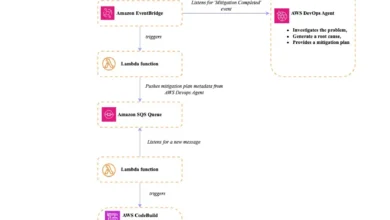
The architecture operates on a cyclical framework known as "Plan-Prove-Iterate," designed to strip away the administrative burden that typically slows down feature testing. The workflow begins with the AWS DevOps Agent, which acts as the orchestrator. When a team defines a business objective, the agent does not merely sit idle; it executes a multi-stage process that leverages the Model Context Protocol (MCP) to interact with external tools.
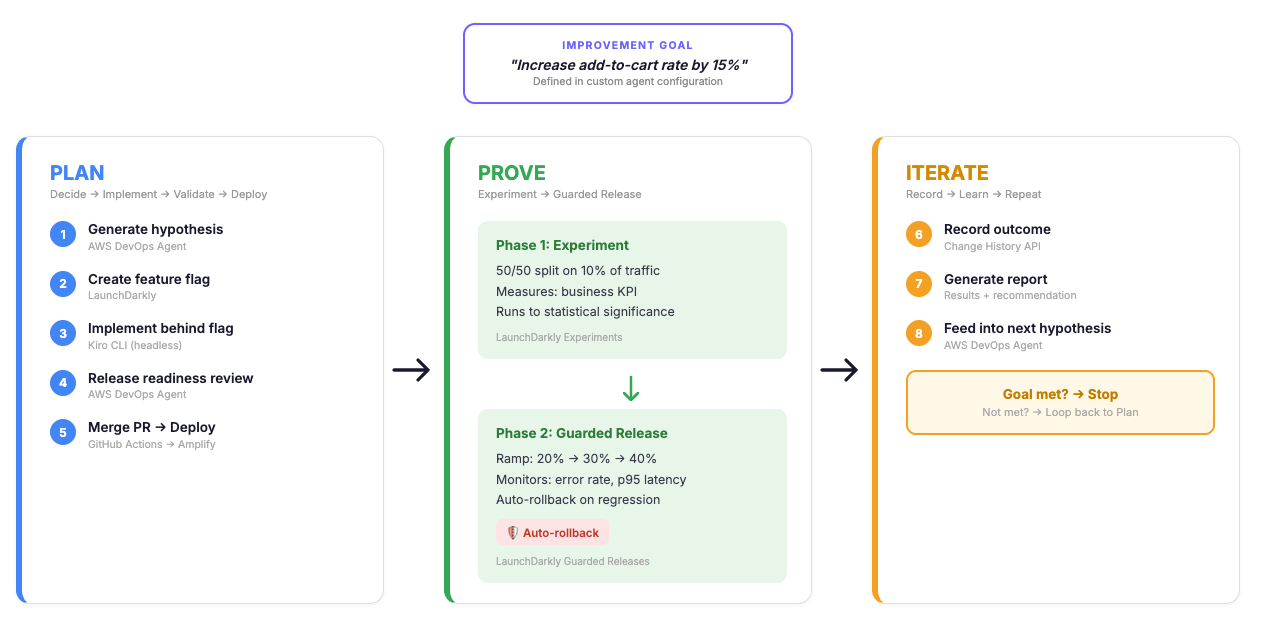
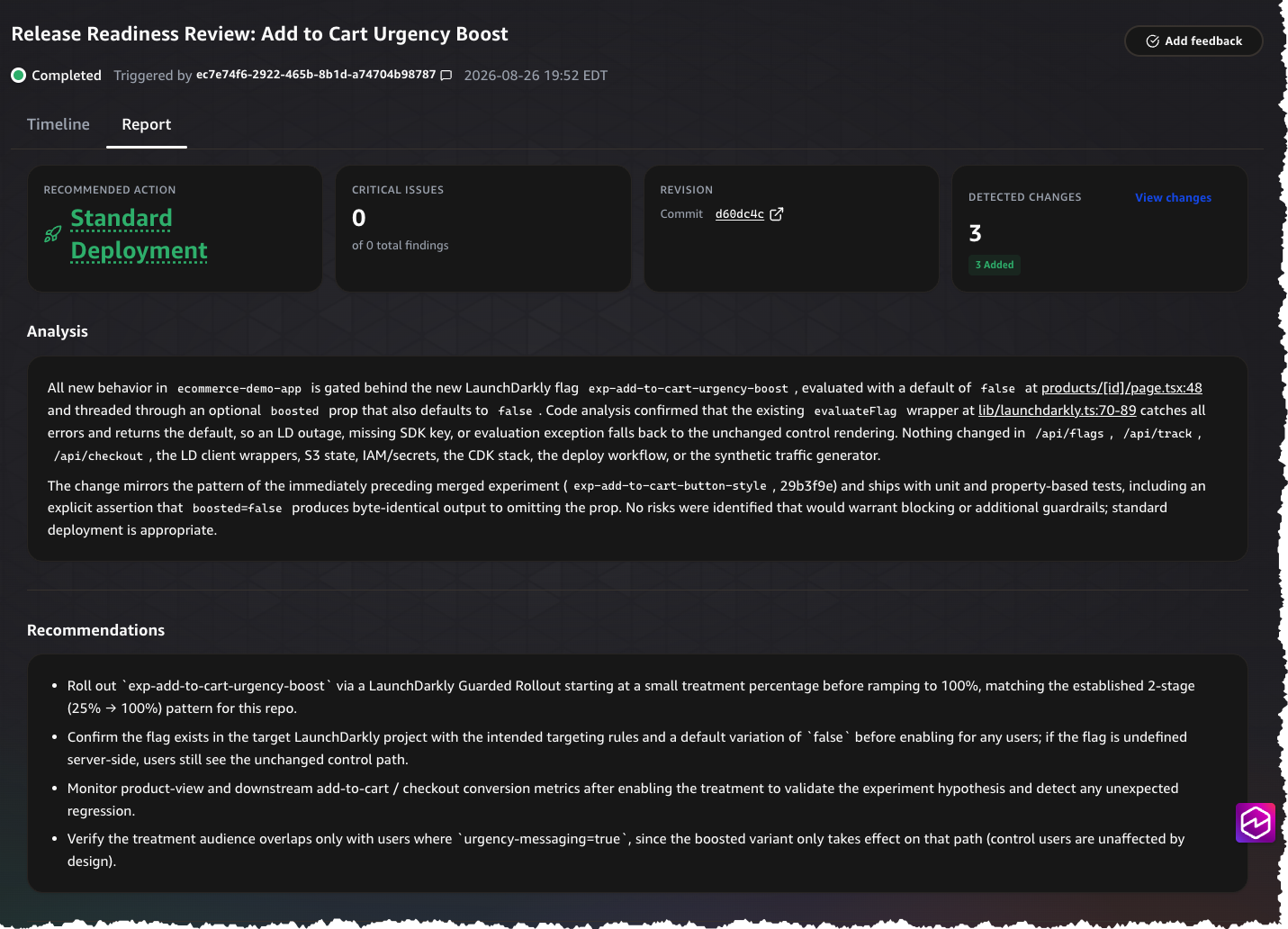
In the "Plan" phase, the agent uses the Kiro CLI to generate code changes directly within the repository, ensuring every modification is gated behind a LaunchDarkly feature flag from the outset. This "flag-first" approach is crucial, as it decouples deployment from release. The agent then shepherds this code through a release readiness review. Only once the automated review passes is the code merged and deployed via GitHub Actions and AWS Amplify.
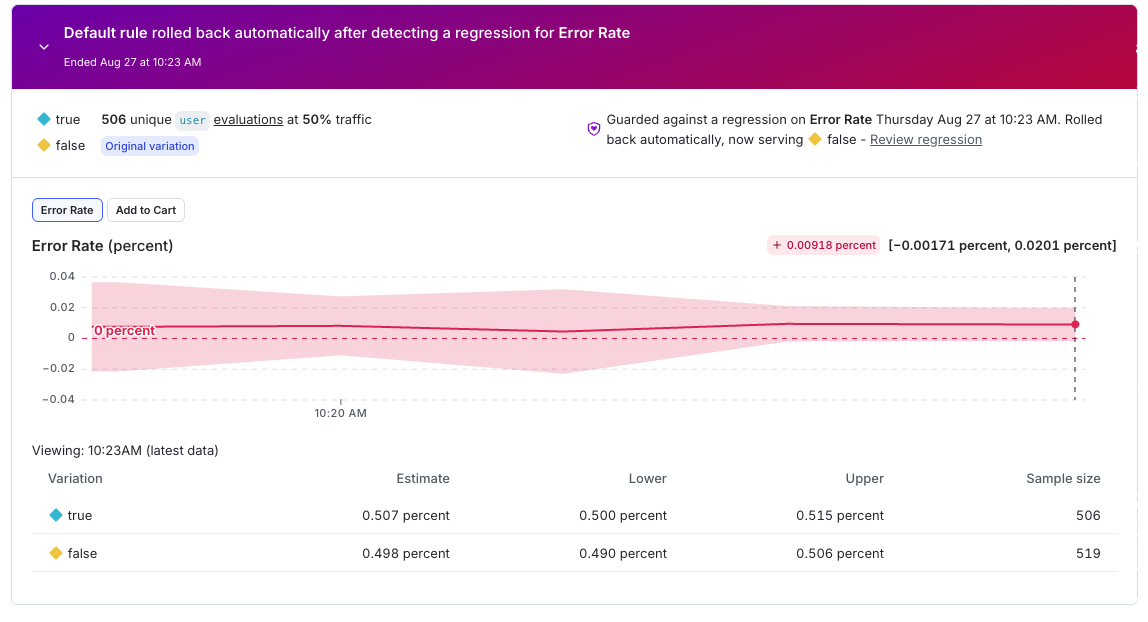
The "Prove" phase is where the system’s safety features truly shine. Once the code is live, the agent initiates a 50/50 A/B test on a small fraction of traffic. Unlike traditional testing, which often requires manual intervention to stop or roll back, this system utilizes LaunchDarkly’s Guarded Releases. If metrics such as error rates or p95 page-load times begin to regress, the system triggers an automatic rollback to the known-good state. This runtime safety net operates without requiring a redeployment, drastically reducing the "mean time to recovery" (MTTR) during an experiment.

Finally, the "Iterate" phase completes the cycle. After an experiment concludes, the agent queries the LaunchDarkly Change History API to correlate the specific code changes with the resulting business outcome. This data is fed back into the agent’s logic, allowing it to refine its next hypothesis. If an experiment fails, the agent learns from the failure, avoiding similar paths in future iterations.
Technical Integration and Tooling
The architecture relies on the seamless communication between three primary components: the AWS DevOps Agent, the LaunchDarkly hosted MCP server, and a custom-built Experiment MCP Server.
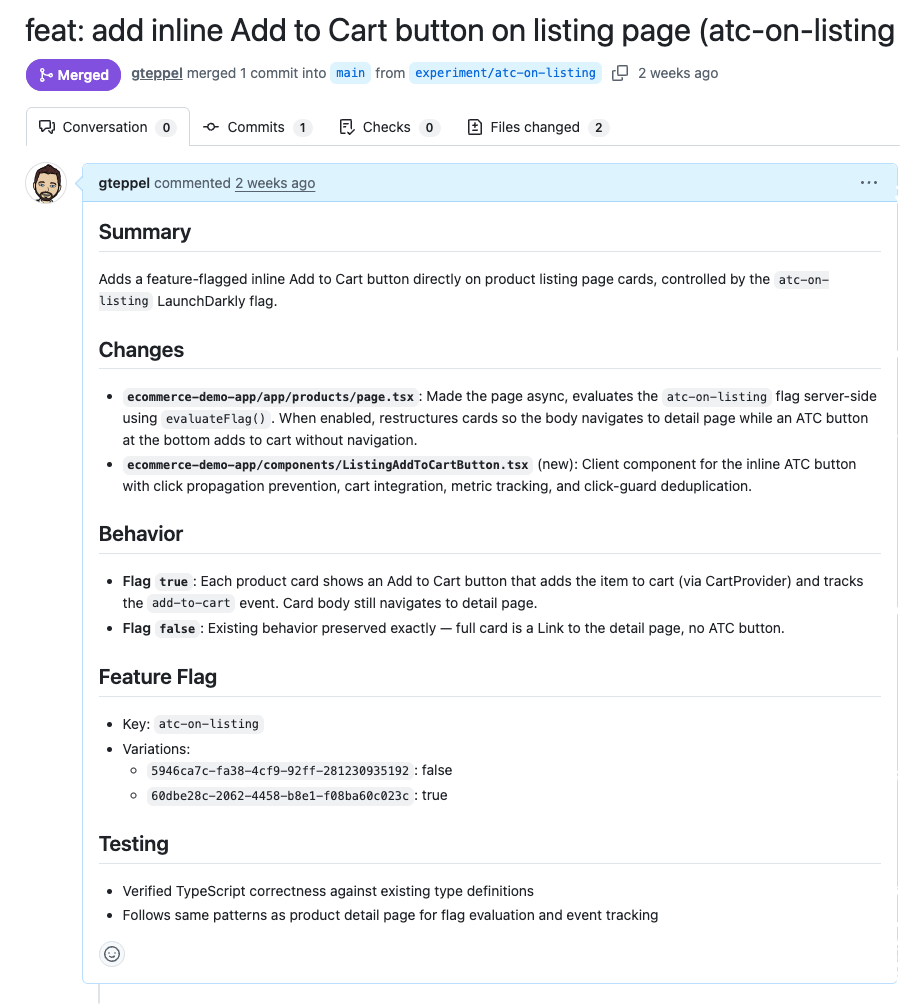
The LaunchDarkly MCP server provides the agent with deep visibility into flag states, targeting rules, and experiment health. Meanwhile, the custom Experiment MCP Server, which runs on Amazon Bedrock AgentCore, acts as the "hands" of the operation. It is responsible for the mutation operations that the agent cannot perform natively: cloning repositories, invoking the Kiro CLI for code generation, merging pull requests, and triggering deployments.
This separation of concerns is a deliberate design choice. The agent functions as the "brain," performing decision-making based on goals and telemetry, while the MCP servers function as the "limbs," performing the high-precision tasks of interacting with the codebase and infrastructure. By deploying these servers as stateless containers, the system ensures robustness; if a container is replaced or restarted, the state of the experiment remains persisted in external stores like Amazon S3 or GitHub, preventing data loss during the orchestration process.
Supporting Data and Industry Context
The necessity for this level of automation is backed by industry trends. According to recent developer productivity reports, engineers spend, on average, less than 40% of their time on actual feature development, with the remainder consumed by "toil"—coordination, debugging, and environment management. By automating the experimentation lifecycle, teams can potentially shift a significant portion of that 60% of lost time back into high-value product iteration.
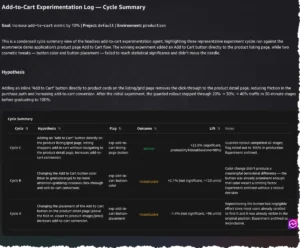
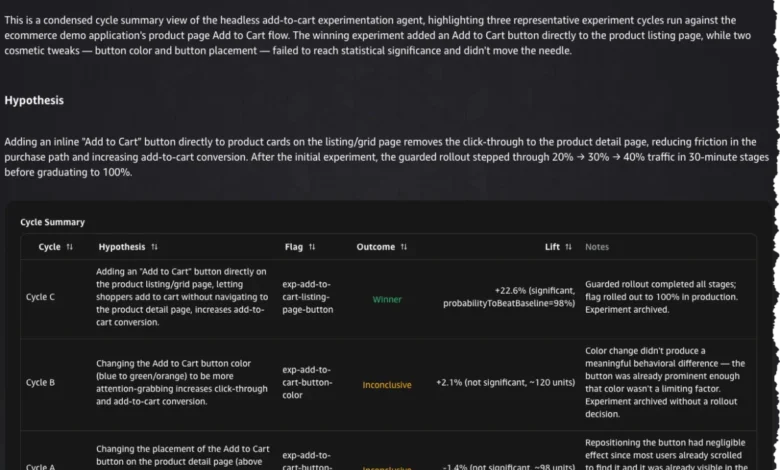
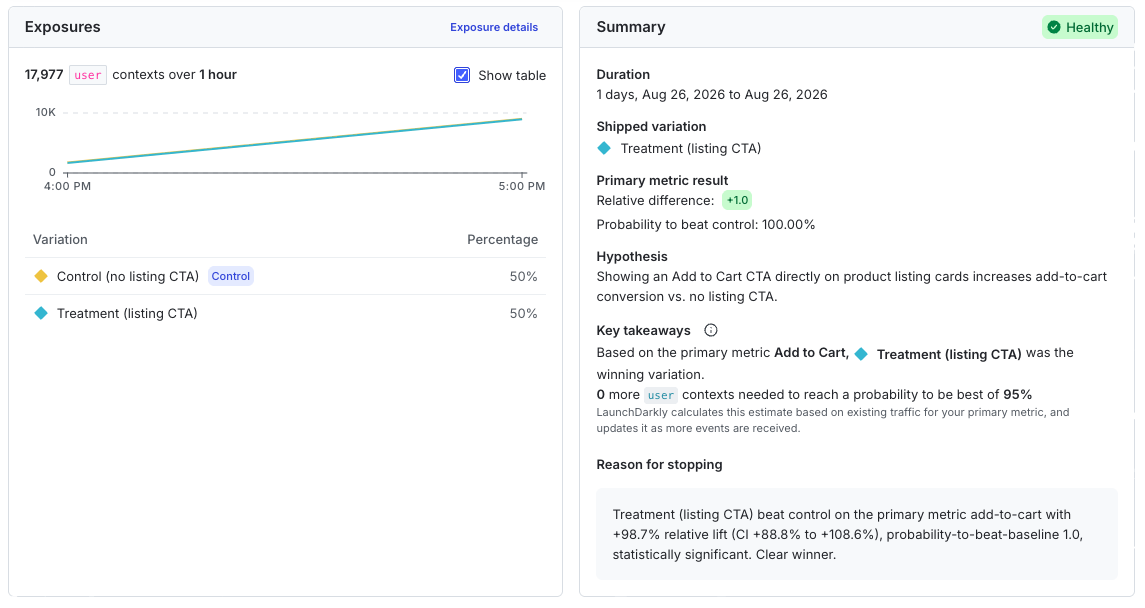
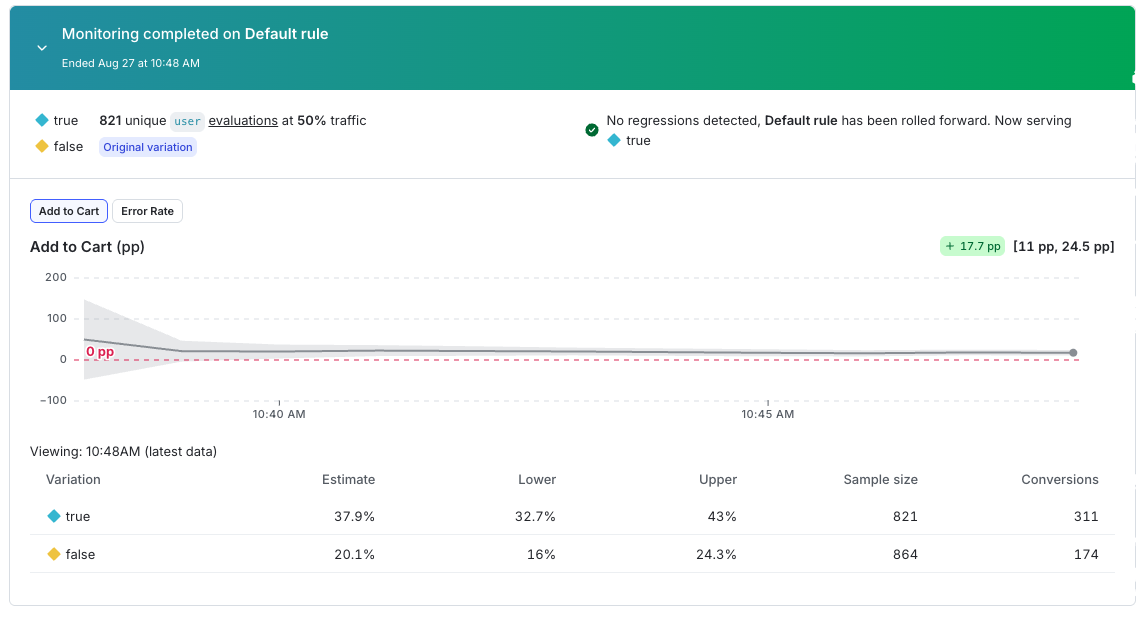
In the reference implementation, a demo e-commerce application was used to test the effectiveness of this loop. When the system was tasked with increasing add-to-cart rates, it autonomously identified that the product listing page lacked an "Add to Cart" call-to-action (CTA). The agent generated the code for a new button, deployed it, and began testing. The experiment resulted in a 98.7% probability that the new CTA would beat the control, yielding a 17.7 percentage point lift in conversions. Crucially, when an initial attempt at a different design triggered an error rate spike, the Guarded Release feature detected the regression and rolled back the change within seconds, demonstrating the efficacy of automated safety guardrails.
Implications for DevOps Culture
The implications of this autonomous loop are profound. Traditionally, DevOps has focused on "shifting left"—moving testing and security earlier into the development lifecycle. This new approach pushes the boundaries further by automating the "feedback loop" itself.
Industry analysts observe that this shift represents a transition from "Human-in-the-loop" to "Human-on-the-loop" management. In the former, developers must manually verify every step; in the latter, developers define the objective and the guardrails, while the agent manages the execution. This allows for a higher volume of experiments to run in parallel, which is statistically more likely to uncover non-obvious optimizations that human designers might overlook.
However, this increased autonomy requires a robust foundation of trust. The reliance on "Release Readiness Reviews" and operational guardrails (such as error-rate thresholds) is what allows organizations to adopt such a system. Without these non-negotiable safety constraints, the risk of an autonomous agent introducing systemic instability would be unacceptable in production environments.
The Path Forward: Turnkey Automation
While the reference implementation currently requires a manual configuration of MCP servers and agent skills, the industry trajectory points toward more turnkey, "off-the-shelf" experiences. Future iterations of tools like the AWS DevOps Agent are expected to provide native integrations with feature management platforms, eliminating the need for custom MCP servers and lowering the barrier to entry for smaller teams.
For organizations looking to adopt this model today, the process begins with defining clear business metrics. The system is most effective when success is measured against a singular, clear KPI—such as conversion rates or latency—while operational health is relegated to non-negotiable guardrails. By documenting these parameters and utilizing the orchestration skill defined in the reference, teams can begin to move away from the "guess-and-check" method of feature releases and toward a data-driven, automated experimentation culture.
As software systems grow in complexity, the ability to iterate safely and rapidly becomes the primary competitive advantage. By bridging the gap between a business goal and a production-ready feature, this closed-loop architecture serves as a blueprint for the next generation of DevOps, where the agent becomes a tireless partner in the quest for continuous improvement. The era of manual experimentation is not ending, but it is certainly being augmented by an intelligence capable of turning hypothesis into outcome at machine speed, all while ensuring that production remains stable, reliable, and user-focused.