AWS CloudFormation Introduces Express Mode to Dramatically Accelerate Infrastructure Deployment Cycles


Amazon Web Services (AWS) has announced the general availability of CloudFormation Express Mode, a significant enhancement designed to expedite the provisioning of cloud infrastructure as code. This new mode promises to dramatically reduce deployment times, particularly for development workflows, by allowing stack operations to complete as soon as resource configuration is applied, rather than waiting for full operational stabilization. This initiative builds upon earlier efforts by AWS to optimize CloudFormation performance, notably the "optimistic stabilization" strategy introduced in March 2024, which had already cut deployment times by up to 40%. Express Mode is positioned as the next logical step in this evolution, further solidifying AWS’s commitment to developer productivity and faster iteration.
CloudFormation, a cornerstone service for Infrastructure as Code (IaC) on AWS, enables users to model and provision AWS and third-party resources using JSON or YAML templates. Its integration with tools like the AWS Cloud Development Kit (CDK) and AWS Serverless Application Model (SAM) has made it indispensable for managing complex cloud environments. However, the speed of deployment cycles directly correlates with the pace of innovation. For developers and teams iterating frequently, the time spent waiting for infrastructure to provision and stabilize can be a significant bottleneck. Express Mode directly addresses this challenge, aiming to transform lengthy waits into near-instantaneous feedback loops.
The Evolution of CloudFormation Deployment Speed
The journey towards faster CloudFormation deployments has been a continuous one for AWS. Historically, a fundamental characteristic of CloudFormation’s default behavior has been its commitment to ensuring resources are not just "created" but fully "stabilized" before reporting a stack operation as complete. This stabilization process ensures that when CloudFormation reports CREATE_COMPLETE, the resources are fully ready to serve traffic, handle requests, or integrate with other services without immediate failure. While crucial for production environments where immediate operational readiness is paramount, this waiting period often extended deployment times, particularly for development and testing cycles.
In March 2024, AWS introduced "optimistic stabilization," a pivotal update that introduced the CONFIGURATION_COMPLETE event. This strategy allowed CloudFormation to intelligently assess resource readiness, significantly reducing deployment times by up to 40% for many common resource types. The core idea was to proactively determine when a resource was sufficiently configured, even if background processes were still finalizing. This improvement was a direct response to customer feedback highlighting the need for faster iteration. CloudFormation Express Mode now takes this concept even further, providing developers with explicit control over when they deem a deployment "complete" for their specific workflow.
Understanding Stabilization: The Default Behavior
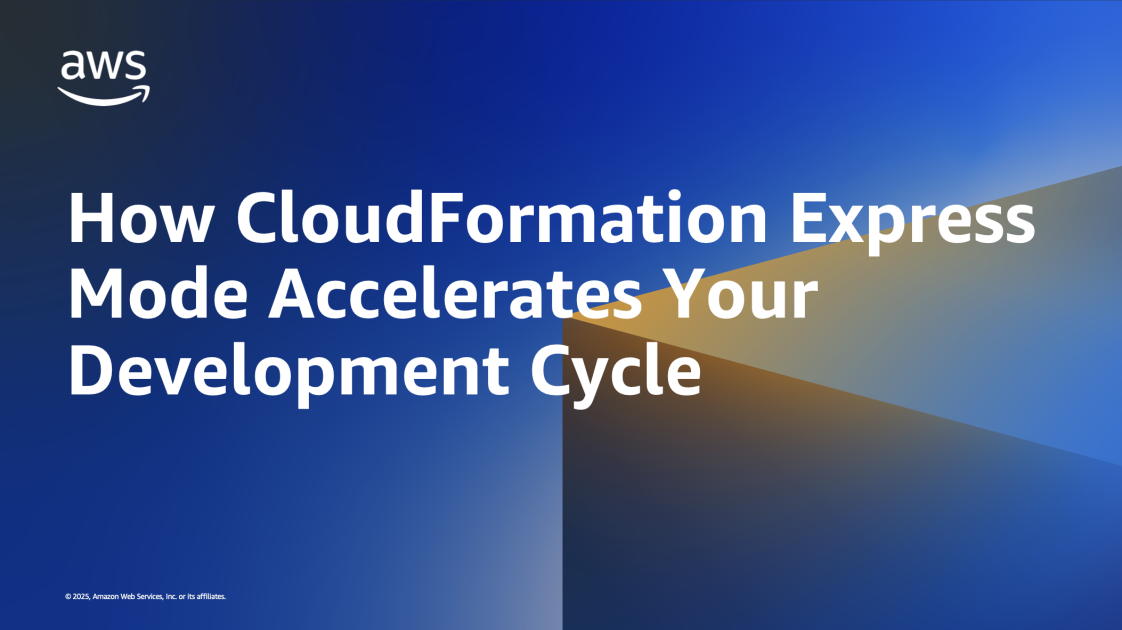
To appreciate the impact of Express Mode, it’s essential to understand CloudFormation’s traditional approach to resource provisioning and stabilization. When a resource like an AWS::SQS::Queue is added to a template and deployed, its creation involves several internal steps. The queue object is instantiated, but it may not immediately be ready to receive messages. Similarly, an Amazon EC2 instance might be "launched" but still undergoing boot processes and health checks before it can respond to HTTP requests. An Amazon CloudFront distribution, once "created," requires time to propagate its configuration to edge locations globally before it can effectively serve content. Even the deletion of a Lambda function isn’t truly complete until associated network interfaces are cleaned up.
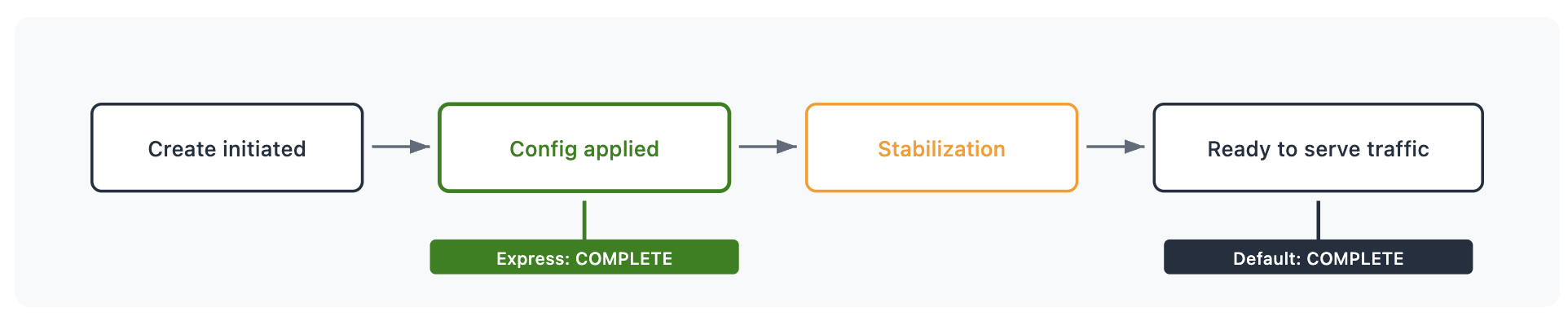
This period between a resource’s initial creation and its full operational readiness is what CloudFormation refers to as stabilization. For production pipelines, this default behavior is invaluable. It provides a strong guarantee that once a stack operation reports CREATE_COMPLETE, the underlying infrastructure is robust, functional, and ready for live traffic, minimizing the risk of deploying an application to an incomplete or non-responsive environment. The timeline for a default deployment illustrates this, showing the provisioning phase followed by a distinct stabilization phase, both contributing to the overall deployment time before the stack reaches a CREATE_COMPLETE status.
Express Mode: A Paradigm Shift for Development
Express Mode fundamentally alters this dynamic by empowering developers to choose when CloudFormation reports completion. With Express Mode enabled, CloudFormation concludes the stack operation as soon as the resource configuration is successfully applied. This means the system no longer waits for the resource to achieve full stabilization or become traffic-ready in the background. Instead, it provides immediate feedback, allowing developers to proceed with subsequent tasks or iterations.
Crucially, Express Mode does not alter the underlying resource behavior or its journey to becoming fully available. The resource still takes the same amount of time to reach traffic readiness. What changes is your iteration cycle. CloudFormation communicates this shift clearly, providing a status reason for each resource: "Resource operation completed using express mode. It may continue becoming available in the background." This transparency ensures that developers are always aware of which resources have completed configuration and which are still undergoing background stabilization.
Regardless of the deployment mode, CloudFormation continues to perform critical functions such as dependency resolution, change detection, and rollback management (though rollback is disabled by default in Express Mode for even faster iteration, it can be re-enabled). This ensures that while the feedback loop is accelerated, the integrity and reliability of the IaC process are maintained.
Key Use Cases and Quantified Benefits
The introduction of Express Mode offers tangible benefits across several critical development and operational scenarios:
-
Accelerated Development Iteration: Consider a scenario where a developer is building a complex network stack involving a Virtual Private Cloud (VPC), subnets, security groups, and an Application Load Balancer (ALB). The immediate need might be to obtain the ALB’s DNS name and the security group ID to configure the next layer of the application or a dependent service. Sending live traffic to the ALB isn’t the immediate priority. With Express Mode, these crucial attributes (ARN, DNS name, security group bindings) become available in seconds, drastically cutting down the waiting time and allowing developers to move swiftly to their next development task. This translates into hours saved over the course of a development sprint, fostering a more agile and responsive development environment.
-
Empowering AI Agent Workflows: The emergence of AI agents in infrastructure management necessitates tight feedback loops. An AI agent tasked with iterating on infrastructure definitions – deploying, observing results, adjusting, and redeploying – benefits immensely from Express Mode. The agent doesn’t need to wait for a CloudFront distribution to propagate globally to determine if the template syntax is correct or if the initial configuration was accepted. It requires immediate confirmation of configuration acceptance. Express Mode transforms what could be a 5-10 minute CloudFront deployment into a sub-minute confirmation. This allows AI agents to validate, refine, and redeploy infrastructure configurations multiple times within the window that a single default deployment would have occupied, unlocking new levels of automation and self-optimizing infrastructure.
-
Streamlined Dependent Stack Deployments: Many modern cloud architectures are built using modular, nested stacks or rely on cross-stack dependencies via import/export mechanisms. When deploying multiple stacks in sequence, the completion time of each individual stack directly impacts the overall deployment pipeline duration. Express Mode ensures that each stack operation completes faster, accelerating the entire chain. CloudFormation’s robust dependency management still applies; Express Mode moves faster without compromising the integrity of the dependency chain, handling retries and waits where necessary to ensure dependent resources can still be provisioned correctly. This can significantly reduce the cumulative time for complex multi-stack deployments, making large-scale infrastructure changes more manageable and faster to implement.
Implementation and Adoption
Enabling Express Mode is straightforward, requiring a single parameter to be added to CloudFormation operations. For command-line interface (CLI) users, the --deployment-config '"mode": "EXPRESS"' flag can be appended to create-stack or update-stack commands. By default, Express Mode disables rollback to further accelerate iteration. If a resource fails to configure, the stack remains in its current state, allowing for immediate fixes and retries without the overhead of a full rollback. Developers can re-enable rollback if desired using --deployment-config '"mode": "EXPRESS", "disableRollback": false'.
For users of the AWS Cloud Development Kit (CDK), the --express flag can be used with cdk deploy. Rollback can be re-enabled with cdk deploy --express --rollback. Similarly, for AWS Serverless Application Model (SAM) users, the --express flag works with sam deploy or sam sync. The --save-params flag can persist this setting in the samconfig.toml file, simplifying future deployments. Crucially, Express Mode requires no changes to existing CloudFormation templates or new resource types. The same templates deploy the same resources; the only difference is when the "done" signal is received.

Broader Implications and Future Outlook
The introduction of CloudFormation Express Mode represents more than just a performance tweak; it signifies a strategic move by AWS to address the evolving needs of cloud native development and operations. In an era where continuous integration and continuous delivery (CI/CD) pipelines are standard, and agile methodologies demand rapid feedback, deployment speed is no longer a luxury but a necessity. Express Mode directly contributes to reducing CI/CD pipeline execution times, allowing developers to detect and rectify issues earlier in the development lifecycle, thereby reducing the cost of bugs and accelerating time-to-market for new features.
From an economic perspective, faster deployments mean more efficient use of developer time, a critical and expensive resource. Less waiting translates into more building and innovating. For organizations adopting advanced practices like GitOps, where infrastructure changes are managed through Git repositories and automatically deployed, Express Mode enhances the responsiveness and efficiency of the entire system.
The potential impact on AI-driven infrastructure management is particularly noteworthy. As AI and machine learning increasingly augment human capabilities in managing complex systems, the ability to rapidly experiment with and deploy infrastructure configurations will be paramount. Express Mode provides the low-latency feedback loop necessary for AI agents to learn, adapt, and optimize cloud environments with unprecedented speed and autonomy. This could pave the way for self-healing, self-optimizing infrastructure that responds to changes in demand or anomalies in real-time, without human intervention.
While Express Mode is a powerful tool for accelerating development and testing, AWS reiterates that the default, stabilization-focused deployment behavior remains the optimal choice for production environments. In production, the guarantee that "stack complete" means "ready to serve traffic" is invaluable for maintaining system stability and reliability. The choice between modes provides flexibility, allowing teams to tailor their deployment strategy to the specific requirements and risk profiles of their different environments.
In conclusion, CloudFormation Express Mode is a significant enhancement that addresses a critical need for speed in modern cloud development. By separating the concern of "is my configuration correct?" from "are my resources serving traffic?", it empowers developers with immediate feedback, accelerates iteration cycles, and opens new possibilities for automated and AI-driven infrastructure management. This move underscores AWS’s ongoing commitment to refining its core services to meet the dynamic demands of its global user base, ultimately fostering a more efficient and innovative cloud ecosystem.
Related posts: