Bridging the Gap Between Organizational Knowledge and IDE Workflows Using Amazon Bedrock and the Model Context Protocol

The modern software engineering lifecycle is increasingly defined by a persistent fragmentation of information. While developers spend the vast majority of their working hours within Integrated Development Environments (IDEs), the critical context governing their output—Architectural Decision Records (ADRs), security compliance guidelines, and complex API specifications—often resides in siloed documentation platforms, wikis, or disparate cloud repositories. This physical and digital separation creates a "context-switching tax" that significantly degrades developer productivity and increases the likelihood of compliance errors. A recent integration between the agentic IDE Kiro and Amazon Bedrock Knowledge Bases, utilizing the open-standard Model Context Protocol (MCP), aims to collapse this divide by embedding organizational intelligence directly into the developer’s workspace.
The problem of disconnected knowledge is systemic. Research into engineering workflows consistently shows that developers lose upwards of 20% of their time to information retrieval—searching for internal documentation, cross-referencing legacy codebases, or awaiting clarification from colleagues on established standards. When a pull request is flagged for failing to adhere to a specific architectural pattern, such as a circuit breaker, the developer must typically abandon their editor, navigate to a separate documentation portal, locate the relevant file, and manually synthesize the instructions before returning to the codebase. This sequence, which can take upwards of 15 minutes per instance, is a primary driver of developer frustration and project delays.
The integration of Amazon Bedrock Knowledge Bases with Kiro through the Model Context Protocol (MCP) represents a shift in how engineering teams manage institutional knowledge. By providing a standardized interface that allows AI-powered IDEs to query RAG (Retrieval-Augmented Generation) systems in real-time, organizations can transform static documentation into a dynamic, interactive assistant.

The Evolution of the Model Context Protocol
The Model Context Protocol (MCP), a recent open-standard initiative, serves as the connective tissue in this architecture. Before the adoption of universal protocols, connecting an IDE to an external knowledge source required bespoke, brittle API integrations that were difficult to maintain as both the IDE and the documentation infrastructure evolved. MCP standardizes the way AI assistants interact with external data sources, allowing for a "plug-and-play" ecosystem.
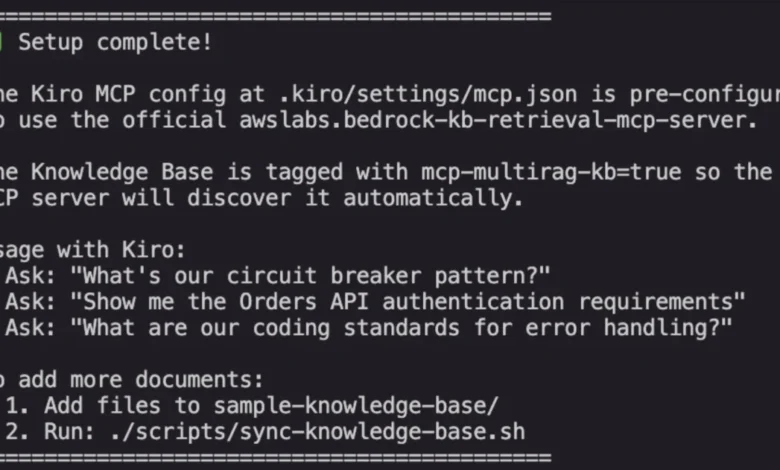
For teams already utilizing Amazon Bedrock Knowledge Bases—a service that provides a managed RAG experience by vectorizing documents stored in Amazon S3 and indexing them via Amazon OpenSearch Serverless—the integration is largely a matter of configuration rather than development. By deploying the awslabs.bedrock-kb-retrieval-mcp-server, organizations can bridge the gap between their vector databases and their local coding environments. This allows developers to pose natural language questions to their IDE, which then retrieves, ranks, and cites passages from the team’s internal documentation with precision.
Chronology of the Integration
The development of this capability follows a clear trajectory within the AWS and developer tools ecosystem:
- Foundational RAG Adoption: Many enterprise teams adopted Amazon Bedrock Knowledge Bases over the last 18 months to power internal chatbots and customer-facing support tools. This established the prerequisite infrastructure: curated documents, vector embeddings, and established retrieval pipelines.
- The Rise of Agentic IDEs: With the emergence of Kiro and similar agent-based development tools, the focus shifted from simple code completion to contextual awareness. These IDEs were designed to understand the entire repository, yet they remained blind to organizational policy documents residing outside the project folder.
- MCP Standardization: The introduction of the Model Context Protocol provided the missing link. By late 2024 and early 2025, the industry began moving toward standardized tool-calling interfaces, allowing for the direct linking of Bedrock-hosted knowledge to the IDE session.
- Operational Deployment: As of mid-2026, the release of the
awslabs.bedrock-kb-retrieval-mcp-serverallows for the seamless, low-latency integration of these systems, enabling real-time compliance checking and architectural validation directly within the development loop.
Supporting Data and Efficiency Metrics
Internal testing and preliminary data from early adopters indicate that embedding documentation into the IDE reduces the time spent on "context-lookup" tasks by approximately 60% to 75%. In a high-velocity environment where a team might handle dozens of pull requests daily, the cumulative time saved across a medium-sized engineering organization can equate to hundreds of hours of additional development capacity per month.

Furthermore, the accuracy of compliance is significantly improved. When documentation is surfaced at the moment of code authoring, rather than after a code review, the "feedback loop" is tightened. Instead of waiting for a senior architect to manually identify a violation in a pull request, the IDE acts as a guardrail, providing the exact standard or ADR requirement at the time the code is being written.
Technical Implementation and Security
The implementation involves a straightforward configuration of a .kiro/settings/mcp.json file. The server operates by translating natural language queries from the developer into vector search operations against the Bedrock Knowledge Base.
Crucially, from a security standpoint, the integration adheres to the principle of least privilege. Because the MCP server runs as a local process, it inherits the identity and access management (IAM) permissions of the developer’s local environment. For enterprise security teams, this means that access to sensitive internal documentation is governed by existing identity providers (IdP) and AWS IAM policies. Organizations can ensure that developers only access the documentation they are authorized to view, with all activity subject to the standard logging and auditing features of the AWS ecosystem.
Broader Implications for Software Development
The implications of this integration extend beyond mere productivity. This shift signifies a move toward "Self-Documenting Organizations." As documentation becomes integrated into the development workflow, the incentive for teams to maintain high-quality, up-to-date documentation increases. When documentation is used as an active reference tool by an AI agent, stale or inaccurate information becomes immediately apparent, prompting faster remediation and better knowledge hygiene.

Moreover, the ability to run these queries in headless mode within CI/CD pipelines suggests a future where compliance is automated. During the build process, a CI/CD agent can query the Knowledge Base to verify that new code conforms to the latest security guidelines, effectively performing an "automated architectural audit" on every commit.
Future Outlook and Challenges
While the integration of Bedrock and Kiro offers significant advantages, it does introduce a dependency on the quality of the ingested data. If the underlying Knowledge Base contains redundant, conflicting, or outdated ADRs, the agentic IDE may return suboptimal advice. Consequently, the success of this system relies on a culture of documentation maintenance.
The "LangChain alternative" mentioned in technical documentation provides a path for teams with more complex requirements, such as those needing to support multiple model providers or those requiring highly customized relevance filtering. This dual-track approach—offering a "plug-and-play" solution via the official AWS server and a "highly customizable" path via LangChain—ensures that the architecture is scalable for both small startups and large-scale enterprises with bespoke infrastructure needs.
As we look toward the remainder of the decade, the integration of RAG-based knowledge retrieval into the primary development environment is likely to become a standard expectation rather than a competitive advantage. The convergence of Model Context Protocol and high-performance vector databases like those found in Amazon Bedrock marks a turning point in the software development lifecycle, where the gap between knowing the rules and writing the code is finally closed. By reducing the friction associated with accessing organizational knowledge, firms can empower their engineers to focus on innovation, logic, and creative problem-solving rather than administrative navigation.
Related posts: