Accelerating Cloud Development: AWS CloudFormation Express Mode Redefines Infrastructure Deployment Cycles


AWS CloudFormation has long served as the cornerstone for Infrastructure as Code (IaC) within the Amazon Web Services ecosystem, enabling developers to provision complex cloud environments through declarative JSON or YAML templates. As organizations increasingly adopt rapid development cycles, CI/CD automation, and AI-driven infrastructure management, the time required to provision resources has become a critical bottleneck. To address this, AWS has introduced CloudFormation Express mode, a deployment strategy designed to decouple resource configuration from the stabilization phase, effectively slashing deployment wait times and providing immediate feedback for development workflows.
The Evolution of Cloud Deployment Efficiency
The introduction of Express mode represents the latest milestone in a sustained effort by AWS to optimize the developer experience. In March 2024, the company published detailed insights into the mechanics of "optimistic stabilization," a strategy that introduced the CONFIGURATION_COMPLETE event. By focusing on when a resource configuration is successfully applied rather than waiting for the resource to reach a fully operational state, AWS achieved deployment speed improvements of up to 40%. Express mode builds upon this foundation, offering a specialized configuration for environments where agility and rapid iteration are prioritized over immediate traffic-readiness.
Historically, CloudFormation has operated under a "stabilization-first" paradigm. When a developer triggers a stack update, the service does not report a successful completion until every resource within that stack is fully functional and capable of serving traffic. While this ensures a high degree of reliability for production environments, it imposes significant latency during the development phase. For instance, creating an Amazon EC2 instance or an Amazon CloudFront distribution involves several minutes of background propagation and health checking. Under the traditional deployment model, the developer remains blocked by this stabilization process, unable to proceed to the next iteration of their code or infrastructure schema.
Understanding the Stabilization Bottleneck
To grasp the impact of Express mode, one must analyze the lifecycle of cloud resources. The creation of a resource is rarely an instantaneous event. When a developer adds an AWS::SQS::Queue to a template, the API call to create the resource might succeed in seconds, but the underlying infrastructure may require additional time to initialize its internal state, establish network visibility, or register with load balancers.
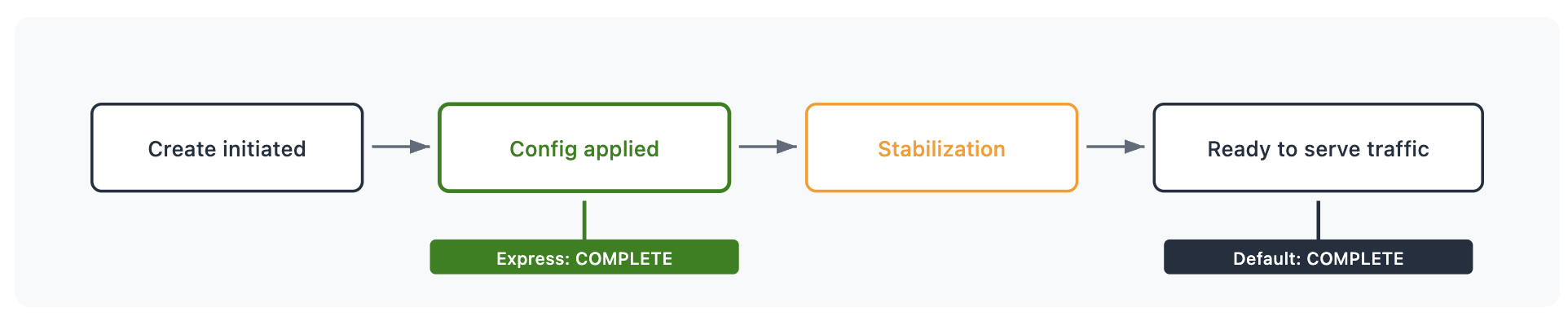
This window between "resource created" and "resource ready" is the stabilization phase. A CloudFront distribution, for example, must propagate its configuration to hundreds of edge locations globally; an Amazon ECS service must ensure its containers pass rigorous health checks before it can be considered active. In the default deployment mode, CloudFormation acts as a safeguard, ensuring that the CREATE_COMPLETE signal is only sent once the resource is fully operational. While this is the appropriate behavior for mission-critical production pipelines, it creates an unnecessary waiting period for developers who simply need to verify that their resource identifiers—such as ARNs, DNS names, or security group IDs—have been generated correctly.
The Mechanism of Express Mode
Express mode fundamentally changes the contract between the developer and the infrastructure service. By opting into this mode, the user instructs CloudFormation to report completion the moment the resource configuration has been successfully applied to the AWS provider. The resource continues to stabilize in the background, but the deployment engine does not wait for that process to conclude.
CloudFormation provides transparency during this transition by tagging individual resources with a status reason: "Resource operation completed using express mode. It may continue becoming available in the background." This allows developers to distinguish between successfully configured resources and those still undergoing internal initialization. Crucially, the fundamental security and dependency guarantees remain intact. CloudFormation continues to respect the order of operations defined in the template, ensuring that downstream dependencies are not broken even if upstream resources are still stabilizing.
Implications for AI and Rapid Iteration
The shift toward AI-assisted infrastructure management has heightened the demand for shorter feedback loops. AI agents, which are increasingly tasked with writing, testing, and deploying infrastructure, thrive on tight iteration cycles. In a typical workflow, an AI agent might deploy a template, observe the results, adjust the configuration, and redeploy.
When a standard deployment takes five to ten minutes due to stabilization, the agent’s ability to refine its infrastructure becomes severely constrained. Express mode reduces this wait time to a sub-minute confirmation, enabling an agent to perform multiple iterations within the time it would have taken to complete a single standard deployment. This accelerated feedback loop is also highly beneficial for developers building complex VPC architectures. By receiving immediate confirmation of security group IDs and ALB DNS names, developers can verify their network topology without waiting for the full suite of resources to become ready to handle production traffic.
Implementation and Operational Best Practices
Transitioning to Express mode requires minimal overhead, as it does not necessitate changes to existing infrastructure templates or the adoption of new resource types. Developers can trigger Express mode via the AWS Command Line Interface (CLI) by including the --deployment-config '"mode": "EXPRESS"' parameter during the create-stack operation.
AWS has also integrated support for Express mode across its primary developer tools. Users of the AWS Cloud Development Kit (CDK) can invoke the --express flag during deployment, while those using the AWS Serverless Application Model (SAM) can leverage sam deploy --express or sam sync --express. To further streamline workflows, SAM users can persist these settings in a samconfig.toml file, ensuring that subsequent deployments maintain the desired mode without additional command-line arguments.

A notable feature of Express mode is the default behavior regarding stack rollbacks. To further optimize for speed, Express mode disables automatic rollbacks by default. This allows developers to fix minor configuration errors and retry the deployment immediately without waiting for the stack to revert to its previous state. For teams that prefer a different safety profile, the feature remains configurable; users can toggle the disableRollback parameter to false to maintain the traditional rollback behavior if desired.
Future Perspectives and Industry Impact
The introduction of Express mode underscores a broader shift in cloud operations: the move toward "tiered" deployment strategies. As cloud environments grow in complexity, the "one-size-fits-all" approach to infrastructure deployment is increasingly viewed as an impediment to velocity. By allowing users to define the level of assurance required for each specific stage of the development lifecycle—from sandbox testing to production release—AWS is providing more granular control over the trade-off between speed and certainty.
Industry analysts suggest that this development will be particularly significant for large-scale enterprise organizations managing thousands of stacks. As dependencies grow, the ability to orchestrate multi-stack deployments without being hindered by the longest-running stabilization task in the chain could lead to significant reductions in total CI/CD runtime. Furthermore, the compatibility of Express mode with Change Sets ensures that this speed boost can be applied to complex updates and modifications, not just initial stack creations.
In conclusion, AWS CloudFormation Express mode offers a pragmatic solution to a persistent operational challenge. By separating the validation of configuration from the verification of service readiness, it empowers developers, DevOps engineers, and autonomous agents to move with greater agility. While production environments will likely continue to rely on the robust, default stabilization process, the introduction of Express mode provides a necessary performance lever for the rapid, iterative workflows that define modern software engineering. As the cloud infrastructure landscape continues to evolve, the capacity to choose the right balance of speed and stability will remain a critical advantage for high-performing technical teams.
Related posts: