Amazon Elastic Container Service (ECS) Gateway Simplifies Ingress Networking and Containerized Application Management at Scale

The management of containerized microservices at enterprise scale has long presented a major operational hurdle for platform engineering teams. While orchestrators like Amazon Elastic Container Service (ECS) have revolutionized how organizations deploy and scale compute resources, configuring, securing, and maintaining ingress networking for individual microservices has remained a notoriously tedious and complex workflow. Historically, for every new application or service rolled out to production, platform teams have had to manually provision, wire together, and continuously update a sprawling ecosystem of infrastructure components. This required configuring Application Load Balancers (ALBs), generating and validating AWS Certificate Manager (ACM) SSL/TLS certificates, setting up AWS WAF web access control lists (ACLs), and writing tightly scoped security groups. Furthermore, these resources needed to be perpetually audited and kept in sync as services scaled up or down, underwent rolling updates, or changed operational states.
This per-service infrastructure overhead has traditionally introduced severe bottlenecks into software delivery lifecycles, throttling deployment velocity, increasing cognitive load on engineers, and drastically elevating the risk of configuration drift across large cloud environments. In response to these persistent architectural challenges, Amazon Web Services (AWS) has announced the official launch of Amazon ECS Gateway. This new account-level resource aims to radically streamline ingress networking for containerized workloads by introducing automated, dynamic provisioning and lifecycle management of load balancing and security infrastructure directly within customer AWS accounts.
Core Architecture and Operational Mechanics
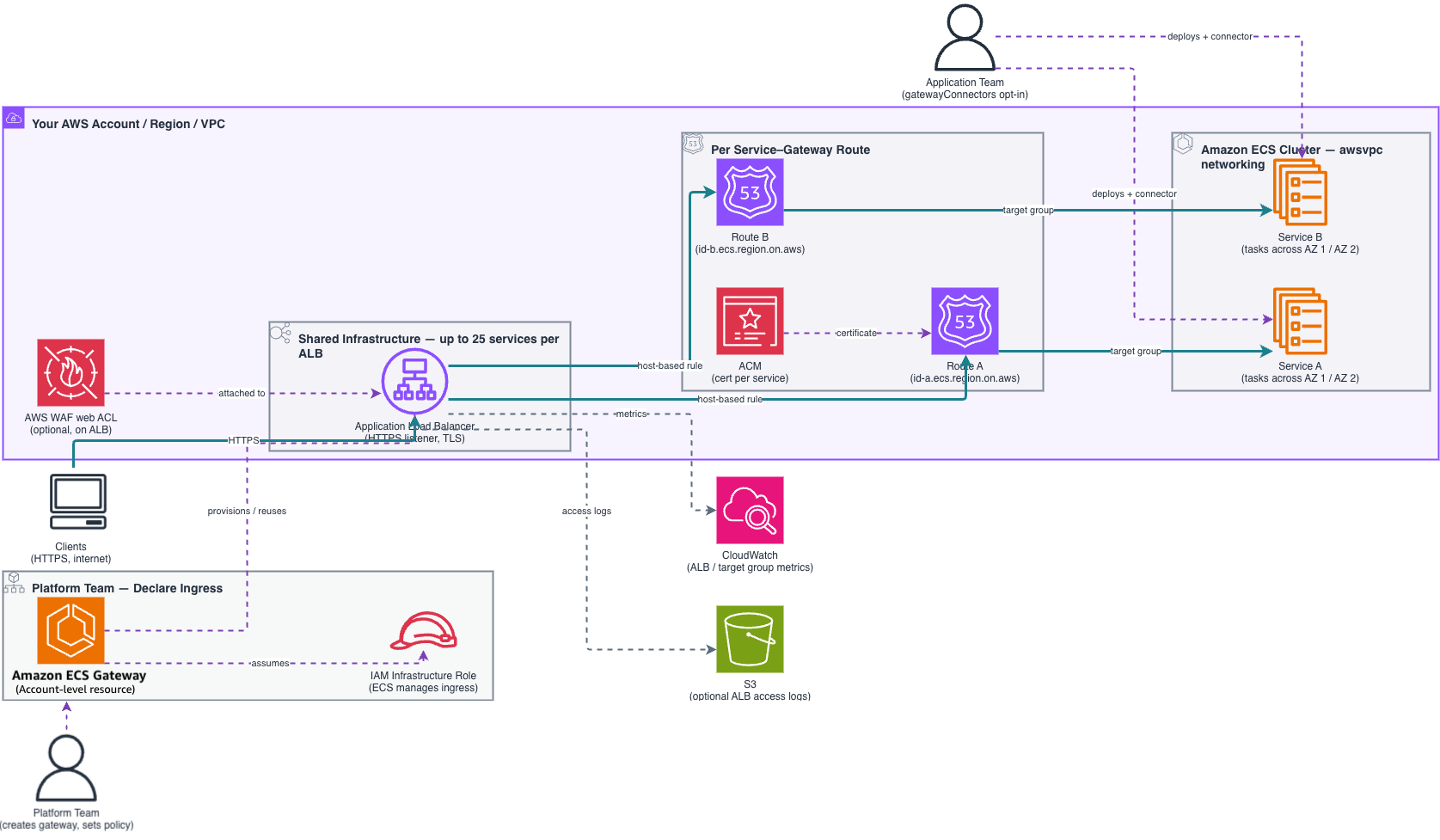
Amazon ECS Gateway introduces a clean, robust separation of responsibilities between centralized platform engineering teams and individual application development teams. Platform teams are empowered to establish standardized, secure networking pathways across the organization, while application developers can seamlessly attach their services to these pre-configured gateways with minimal friction.

At its core, the ECS Gateway utilizes host-based routing via Application Load Balancers, engineered for high density and cost optimization. A single ALB deployed through the gateway framework can be shared by up to 25 distinct microservices, drastically reducing idle load balancer costs and optimizing resource utilization across cloud footprints. Amazon ECS fully automates the lifecycle of this underlying infrastructure: the system automatically provisions the initial ALB the moment a service connects, dynamically scales out by provisioning additional ALBs as capacity thresholds are reached, and gracefully tears them down when services are decommissioned or traffic subsides.
Upon successful provisioning and connection, every individual service receives a unique, ready-to-use DNS hostname and an assigned ACM certificate, providing teams with an instantly accessible endpoint the moment deployment completes.
The architecture supports a flexible, many-to-many relationship mapping between gateways and ECS clusters. A single ECS Gateway can be associated with up to 10,000 distinct clusters, and conversely, a single cluster can support up to five separate gateway associations. This granular capability allows platform architects to design sophisticated routing topologies—such as separating public-facing internet traffic from internal, VPC-restricted traffic—and apply them selectively across multi-environment deployment strategies.
Getting Started: Implementation and Configuration
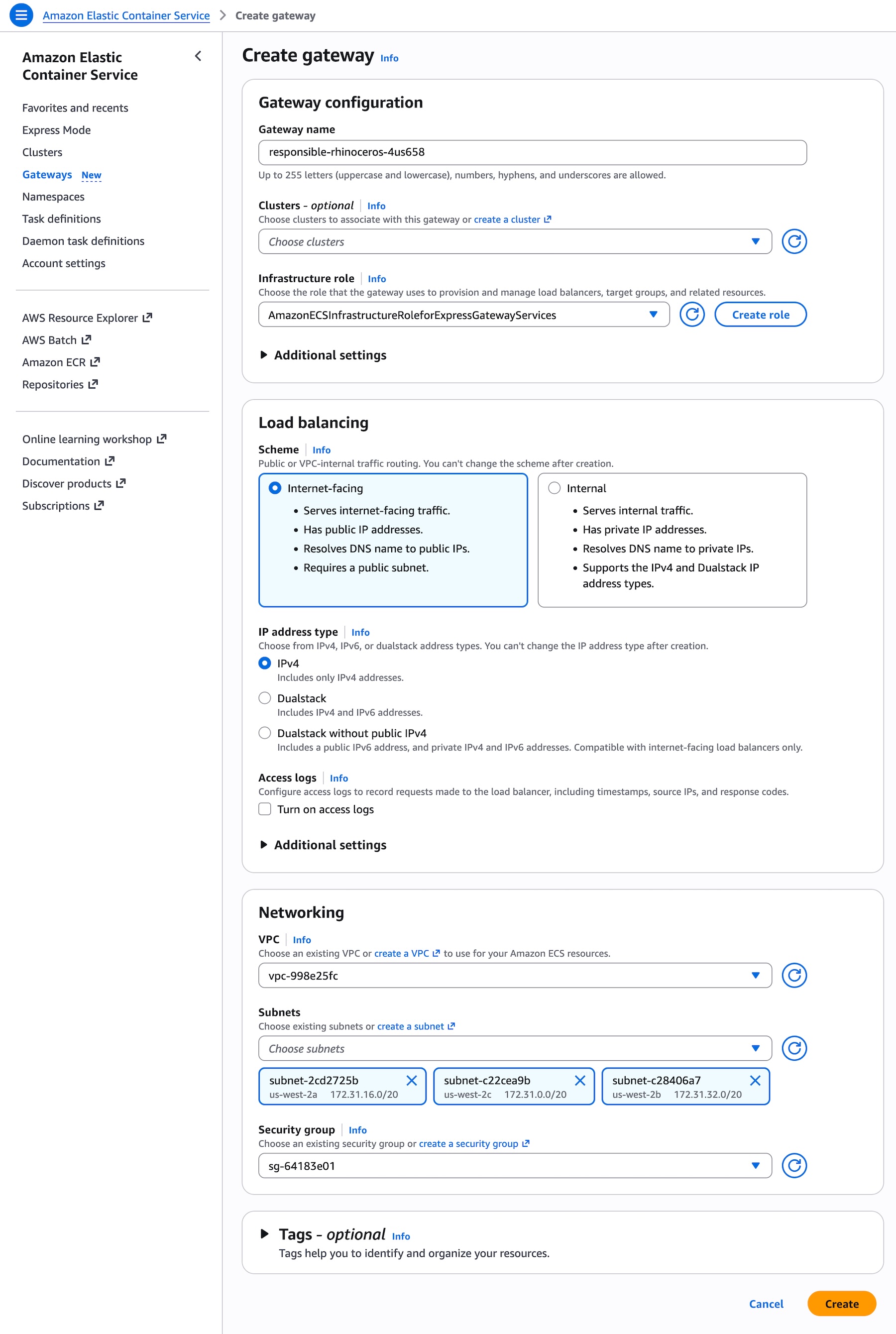
Platform teams can configure and provision Amazon ECS Gateways using either the AWS Management Console or infrastructure-as-code tooling via the AWS Command Line Interface (CLI).

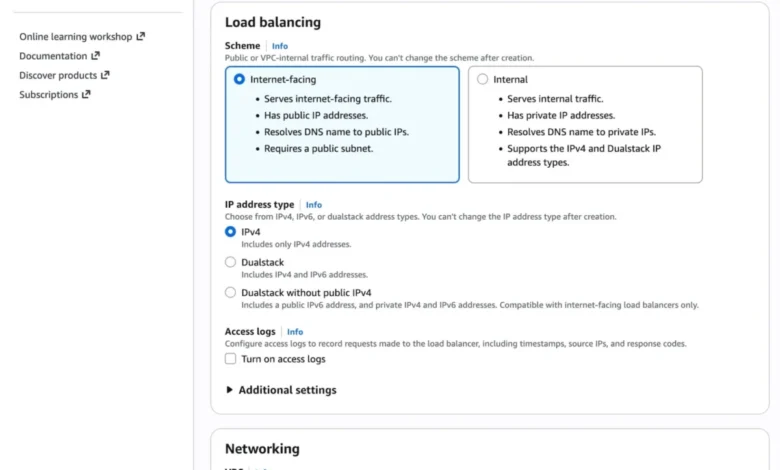
To instantiate a gateway through the console, platform administrators designate a unique gateway name and assign an infrastructure role—an IAM role that grants ECS the necessary permissions to provision and manage ALBs, security groups, and certificates within the target account. Administrators then select a load balancing scheme, designating the traffic routing as either public (internet-facing) or VPC-internal. Under advanced settings, operators can define listener ports, establish maximum ALB scaling limits to control infrastructure budgets, and attach AWS WAF web ACLs to protect workloads against common web vulnerabilities and distributed denial-of-service (DDoS) attacks.
Alternatively, automation-focused teams can execute the CreateGateway API call using the AWS CLI:
aws ecs create-gateway
  --name my-team-gateway
  --infrastructure-role-arn arn:aws:iam::123456789012:role/ECSGatewayRole
  --configuration '
    "HostSharedAlb":
      "networkConfiguration":
        "subnets": [
          "subnet-080779f9bd887757a",
          "subnet-03d5b2fead6bc6258",
          "subnet-0861210a397d31252",
          "subnet-06539e194023cb77a"
        ],
        "ipAddressType": "ipv4"
      ,
      "scheme": "internet-facing"

  '
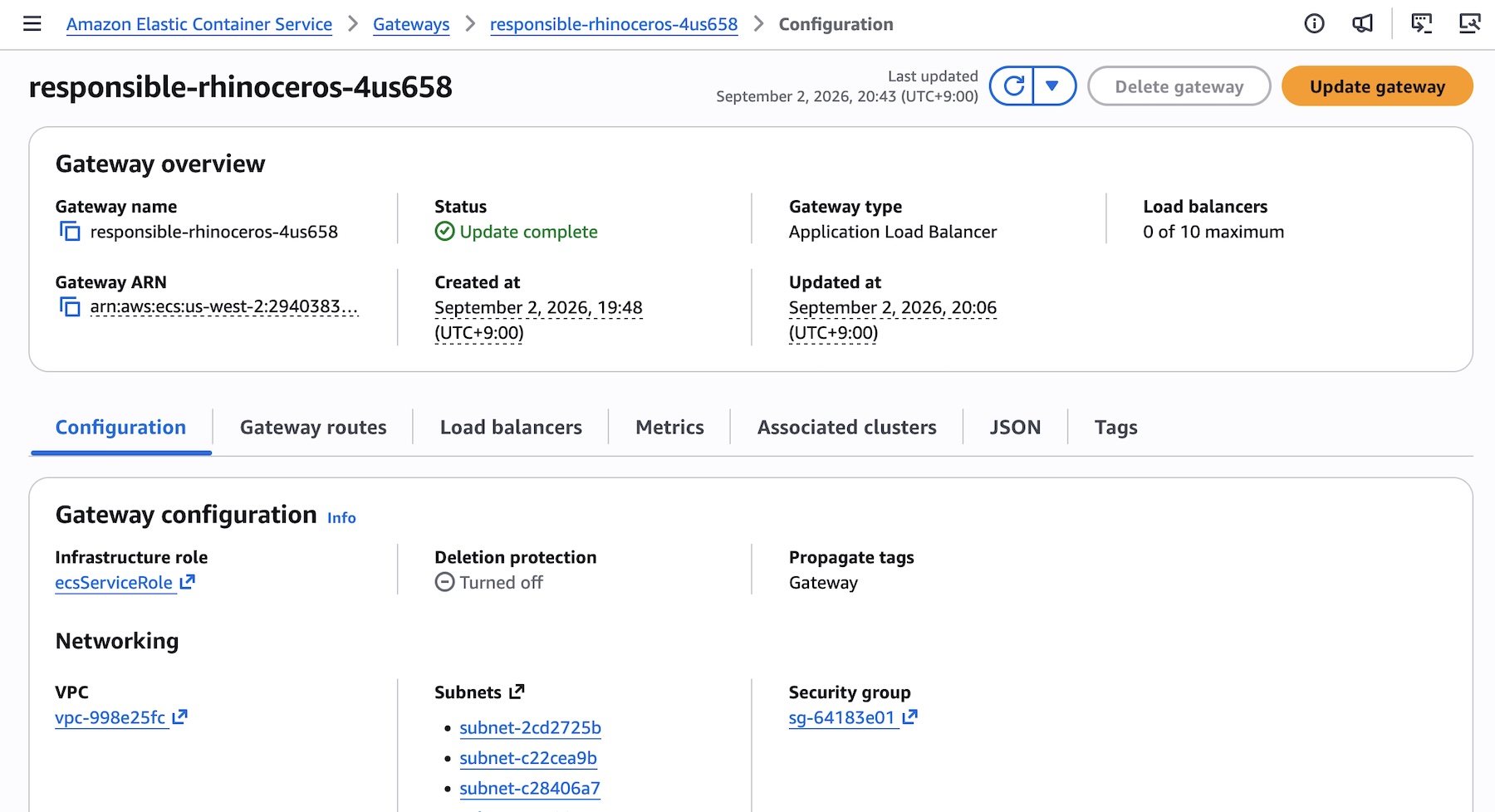
It is worth noting that foundational configuration parameters—such as the gateway name, routing scheme, designated VPC, subnets, IP address types, listener protocols, and ports—are immutable and cannot be altered after the initial gateway creation. Once the gateway resource is established, platform operators link it to desired ECS clusters using the AssociateGatewayWithCluster command, making the gateway’s ingress capabilities immediately available to any workloads residing on those clusters.
Furthermore, AWS has integrated support for the new capability into modern development workflows. Engineering teams can programmatically manage Amazon ECS Gateways, query documentation, and execute API calls using the AWS MCP Server and associated plugins within their preferred AI-assisted coding environments.
Incremental Adoption and Application Team Integration
A critical design consideration for enterprise platform upgrades is the ability to migrate existing workloads without experiencing downtime or risky "big bang" cutovers. Amazon ECS Gateway was engineered with incremental adoption in mind.
Application developers connect their services to a gateway by including a gateway connector block within their service definitions via the CreateService or UpdateService APIs:
aws ecs create-service
  --cluster my-cluster
  --service my-api-service
  --task-definition my-api-service:1
  --gateway-connectors '[ "portName": "api", "filters": "accessTypes": ["PUBLIC"], "healthCheck": ... ]'
For organizations managing mature legacy services that already utilize dedicated load balancers, ECS Gateway supports a seamless side-by-side transition. Teams can call UpdateService to attach a gateway connector to an existing running service while retaining its legacy load balancer configuration. This dual-path ingress setup allows systems administrators to thoroughly validate DNS routing, SSL handshake behavior, and target health checks through the new gateway before safely deprecating and removing the older load balancer infrastructure.
When a service deployment is initiated, Amazon ECS evaluates the available gateways linked to the target cluster, identifying compatible gateways where access types match connector filters, VPC boundaries align, and the gateway covers all Availability Zones utilized by the service subnets.
Behind the scenes, ECS instantly orchestrates the necessary underlying mechanics:
- Assigns the service to an available Application Load Balancer with remaining host capacity.
- Provisions a dedicated ACM SSL/TLS certificate for secure transport.
- Generates a predictable, unique DNS hostname.
- Automatically constructs listener rules that route incoming traffic for that specific hostname directly to the application target group.
- Configures isolated service security groups, strictly permitting inbound traffic solely from the associated ALB security group.
Once all underlying validation and provisioning checks successfully conclude, the gateway route transitions to an ACTIVE state, and the newly minted service endpoint is fully primed to accept production traffic loads.
Background Context and Industry Implications
The release of Amazon ECS Gateway arrives at a time of significant maturation within the cloud-native ecosystem. As organizations transition from monolithic architectures to sprawling microservices estates comprising hundreds or even thousands of containers, the operational burden placed on platform engineering teams has grown exponentially.
Historically, networking automation in AWS required complex, custom-built orchestration layers—often leveraging tools like AWS Lambda, custom CloudFormation templates, or third-party Kubernetes ingress controllers adapted for ECS. These bespoke solutions frequently introduced technical debt, required continuous maintenance, and lacked a unified, native governance model enforced directly by the container orchestrator.
Industry analysts note that by moving ingress orchestration directly into the core feature set of Amazon ECS, AWS is effectively narrowing the operational feature gap traditionally cited by teams comparing ECS to self-managed or managed Kubernetes distributions equipped with advanced gateway APIs. By delegating the heavy lifting of load balancer pooling, certificate management, and DNS provisioning to the platform layer, AWS enables enterprise organizations to enforce stringent security and compliance guardrails uniformly across all deployed microservices without slowing down developer velocity.
Cost Structure and Regional Availability
Amazon ECS Gateway is generally available starting today across all commercial AWS Regions where Amazon Elastic Container Service is currently supported.
AWS has structured the pricing model around transparency and predictability: the ECS Gateway feature itself is provided at no additional platform charge. Customers incur costs solely for the underlying AWS infrastructure resources dynamically provisioned within their accounts as services connect to gateways. This includes standard hourly charges for Application Load Balancers, CloudWatch logs and operational metrics, AWS Certificate Manager certificates, and standard data transfer fees. Detailed pricing breakdowns can be reviewed directly on the official Amazon ECS Pricing web portal.
Platform teams and cloud administrators looking to modernize their container networking strategies can begin deploying and configuring their first gateways immediately via the Amazon ECS console. Feedback, feature requests, and community discussions can be submitted directly through AWS re:Post for ECS or via standard enterprise AWS Support channels.