The Evolution of Retrieval-Augmented Generation
The history of RAG development is marked by a transition from keyword matching to dense vector embeddings. In the early stages of large language model (LLM) implementation, developers relied on text-splitting techniques that chopped documents into uniform segments. While effective for narrative prose, this approach frequently decimated the structural integrity of technical documentation. When a table was split in the middle, or an image was discarded entirely because it lacked text-based metadata, the retriever lost the semantic connection between visual data and its corresponding analysis.
Recent advancements in multimodal AI, such as the introduction of models like GPT-4o, have allowed for the native processing of visual inputs. This evolution has prompted a change in architecture: rather than attempting to convert everything into text, modern systems now store multi-vector representations. This allows for a document store to hold the original image while a parallel vector store holds a rich, machine-generated description of that image.
Technical Architecture and Implementation Framework
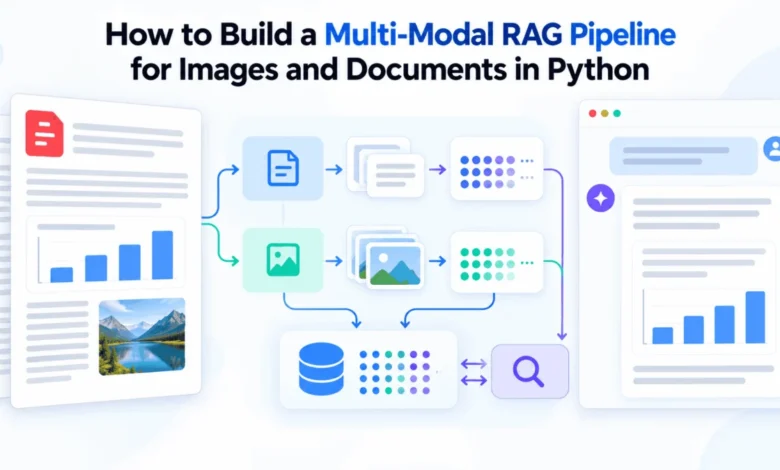
Building a production-ready, multi-modal RAG system requires a modular approach consisting of four primary phases: parsing, semantic enrichment, indexing, and multi-modal retrieval.
The first stage, parsing, utilizes specialized tools such as the unstructured library. Unlike simple text scrapers, this library performs document layout analysis. By utilizing the partition_pdf() function, the pipeline can distinguish between headers, paragraphs, and "CompositeElements" like tables and image blocks. This ensures that the layout of the document is preserved as metadata rather than being lost in a flat stream of data.
Following extraction, the second stage—semantic enrichment—addresses the "blind spot" of vector databases. Because standard vector stores cannot index raw image files, the system must generate a searchable textual proxy. This is achieved by passing the image file into a vision-capable model. The prompt, "Describe this image in detail for use in a search system," serves as the catalyst for creating high-quality, dense descriptions that capture data points, trends in charts, or the context of a diagram.
The third stage involves the construction of a Multi-Vector Retriever. This structure is essential for maintaining the link between the searchable summary and the raw asset. By employing a MultiVectorRetriever from the LangChain framework, developers can associate unique identifiers with both the generated summaries and the original document segments. When a user poses a question, the system searches the vector space for the summary that best matches the query, then pulls the corresponding raw image file from the document store.
The final stage is the synthesis phase, where the retrieved text and the visual context are fed into an LLM. By injecting both data types into the prompt, the model can synthesize a final response that reflects both the written text and the visual evidence, such as confirming a financial trend shown in a graph while explaining the accompanying written analysis.
Supporting Data and Industry Context
The demand for these pipelines is fueled by the sheer volume of unstructured data within the financial, legal, and engineering sectors. According to recent industry reports, approximately 80% of enterprise data exists in unstructured formats, with a significant portion contained within documents that rely heavily on visual cues to convey meaning.
In a typical scenario, a financial analyst might query a report for "Q3 revenue growth." In a traditional RAG system, the text might mention the growth, but the supporting chart—often the most reliable source of information—would be ignored. A multi-modal pipeline, however, retrieves the specific image of the Q3 chart, processes it, and provides a nuanced answer that verifies the text against the actual data visualization.
Implementation Requirements
To deploy this architecture, developers must prepare a robust environment. Beyond the basic Python dependencies, the system relies on system-level libraries such as poppler-utils, which are necessary for the rendering and extraction of image data from PDF files. The following packages are standard in this deployment:
langchainandlangchain-openai: For orchestrating the retrieval logic and managing the API connection to GPT-4o.unstructured[pdf]: For sophisticated document parsing.chromadb: To serve as the persistent vector storage engine.pillow: For image processing tasks.
Ethical and Operational Implications
The adoption of multi-modal RAG systems carries clear operational advantages but also necessitates a focus on cost management. Each image processed by an LLM incurs API costs based on token usage or image-processing pricing models. As such, best practices dictate that pipelines should implement a "filtering" step, where images smaller than a specific pixel threshold or file size—such as company logos or decorative icons—are excluded from the indexing process.
Furthermore, the shift toward these pipelines suggests a broader trend in AI development: the move away from "black box" systems toward verifiable, evidence-based AI. By grounding responses in the specific visual and textual data found within a provided document, these pipelines reduce the likelihood of hallucinations, as the LLM is constrained to the evidence retrieved from the source material.
Future Trajectory
Looking ahead, the field is expected to move toward even more streamlined models. Emerging architectures like ColPali are currently testing the limits of this process by bypassing the need for separate text/image parsing. These models treat entire pages of a document as images, embedding them directly into a visual-spatial vector space. While the current multi-modal RAG architecture provides a reliable, scalable solution for today’s business requirements, the rapid pace of research indicates that the gap between document structure and AI comprehension will continue to narrow.
For developers, the primary takeaway is clear: the ability to reason over visual evidence is no longer a luxury but a fundamental component of effective AI integration. By implementing a structured, multi-modal pipeline, organizations can transform their archives of complex, image-heavy documents into dynamic knowledge bases, capable of providing precise answers to the most complex inquiries.