Automating Operational Intelligence: Scaling SageMaker HyperPod Visibility with AWS DevOps Agent

Large-scale machine learning operations have entered a new era of complexity, where training, fine-tuning, and inference workloads are no longer confined to small, manageable server racks. Instead, these processes now span clusters of hundreds to thousands of GPU-accelerated instances, running continuously for days or even weeks. As organizations scale their AI infrastructure, maintaining operational visibility becomes a high-stakes challenge. Hardware health events, node lifecycle transitions, capacity fluctuations, and intricate workload-level issues emerge in event streams around the clock, often occurring during nights and weekends when human oversight is naturally limited.
Amazon SageMaker HyperPod was introduced as a purpose-built managed cluster service specifically designed to address these architectural hurdles. By providing a resilient environment for distributed training and inference, HyperPod inherently handles the heavy lifting of cluster management. Its built-in resiliency layer, powered by the Health Monitoring Agent (HMA), is engineered to automatically detect and replace faulty hardware. When a GPU failure occurs, the system triggers a sequence of automated actions—draining nodes, rebooting, or initiating replacements—allowing training jobs to continue with minimal disruption.
However, the sheer scale of modern AI infrastructure creates a fundamental operational tension. While self-healing systems are effective at mitigating routine hardware failures, they do not eliminate the need for human intelligence when complex, edge-case conditions arise. Engineering teams are often faced with the dilemma of either maintaining round-the-clock manual monitoring, which is both costly and prone to burnout, or accepting a degree of "blind" operation that could jeopardize the integrity of multi-million-dollar training runs.
The Evolution of Incident Response
To address this gap, developers are increasingly turning to autonomous incident-response platforms. The integration of the AWS DevOps Agent with SageMaker HyperPod represents a significant shift in how infrastructure teams manage cluster health. By deploying an autonomous agent, organizations can now create a 24/7 "digital companion" that operates alongside the existing HyperPod resiliency layer.
This integration does not seek to replace the HMA or the underlying SageMaker recovery mechanisms. Instead, it functions as an intelligent, read-only observation layer. It ingests cluster events and health signals to reconstruct incident timelines, perform root-cause analysis (RCA), and deliver clear, actionable verdicts to human operators. By maintaining a read-only boundary—meaning the agent cannot execute commands like SSH or node termination—the solution ensures a zero-blast-radius environment while providing the high-level cognitive analysis that was previously the sole domain of human SREs (Site Reliability Engineers).
Operational Conditions Requiring Human Oversight
Even the most robust self-healing systems encounter scenarios where a definitive human decision is required. These conditions often fall into categories that automated scripts struggle to interpret without high-level context:
- Persistent Configuration Errors: When a custom lifecycle script fails repeatedly during node bootstrap, simple retries may lead to a "crash loop" that wastes capacity.
- Capacity-Bound Recoveries: In regions where GPU availability is constrained, a node replacement might fail due to insufficient capacity, requiring an engineer to decide whether to pivot to a different instance type or wait for availability.
- Complex Hardware Fault Patterns: While a single GPU error is routine, a recurring pattern across a specific rack might indicate a power or cooling issue at the datacenter level—a situation that demands human investigation rather than simple node replacement.
- Workload-Level Anomalies: Situations where the infrastructure appears healthy, but the distributed training job has stalled or diverged, often require a cross-correlation between CloudWatch logs and Kubernetes pod states.
Without the intervention of an intelligent agent, these conditions force engineers into a manual triage process, requiring them to manually correlate data across the SageMaker control plane, Amazon EKS, and Amazon CloudWatch.
Architecture and Implementation
The deployment model for this solution is designed for simplicity and scalability, utilizing a single AWS CloudFormation stack per cluster. The architecture relies on two primary data paths: an incoming stream of telemetry and an outgoing stream of verdicts.
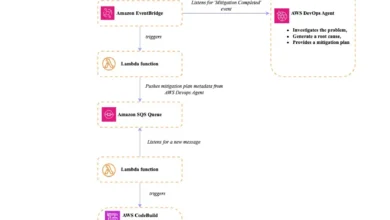
The event flow begins with the HyperPod Health Monitoring Agent, which captures infrastructure faults. These events are routed through Amazon EventBridge, where a webhook bridge filters and normalizes the data. Info-level status updates are discarded to prevent noise, while Warn and Error-level events are transformed into investigation payloads. These payloads are then transmitted to the AWS DevOps Agent, where custom-defined "skills" are applied to the data.
A secondary "periodic-audit" mechanism, implemented via a 15-minute Lambda function, monitors the Kubernetes state directly. This is critical for catching issues that fall outside the standard HyperPod event stream, such as specific pod-level stalls or namespace-specific resource exhaustion. By checking these states periodically and only triggering the agent when a real anomaly is detected, the solution remains cost-effective and prevents the "alert fatigue" associated with constant monitoring.
Teaching the Agent: The Power of Skills
The true innovation in this integration lies in the use of "skills"—plain-English instructions that define how the agent should reason about the operational domain. The solution typically employs two core skills:
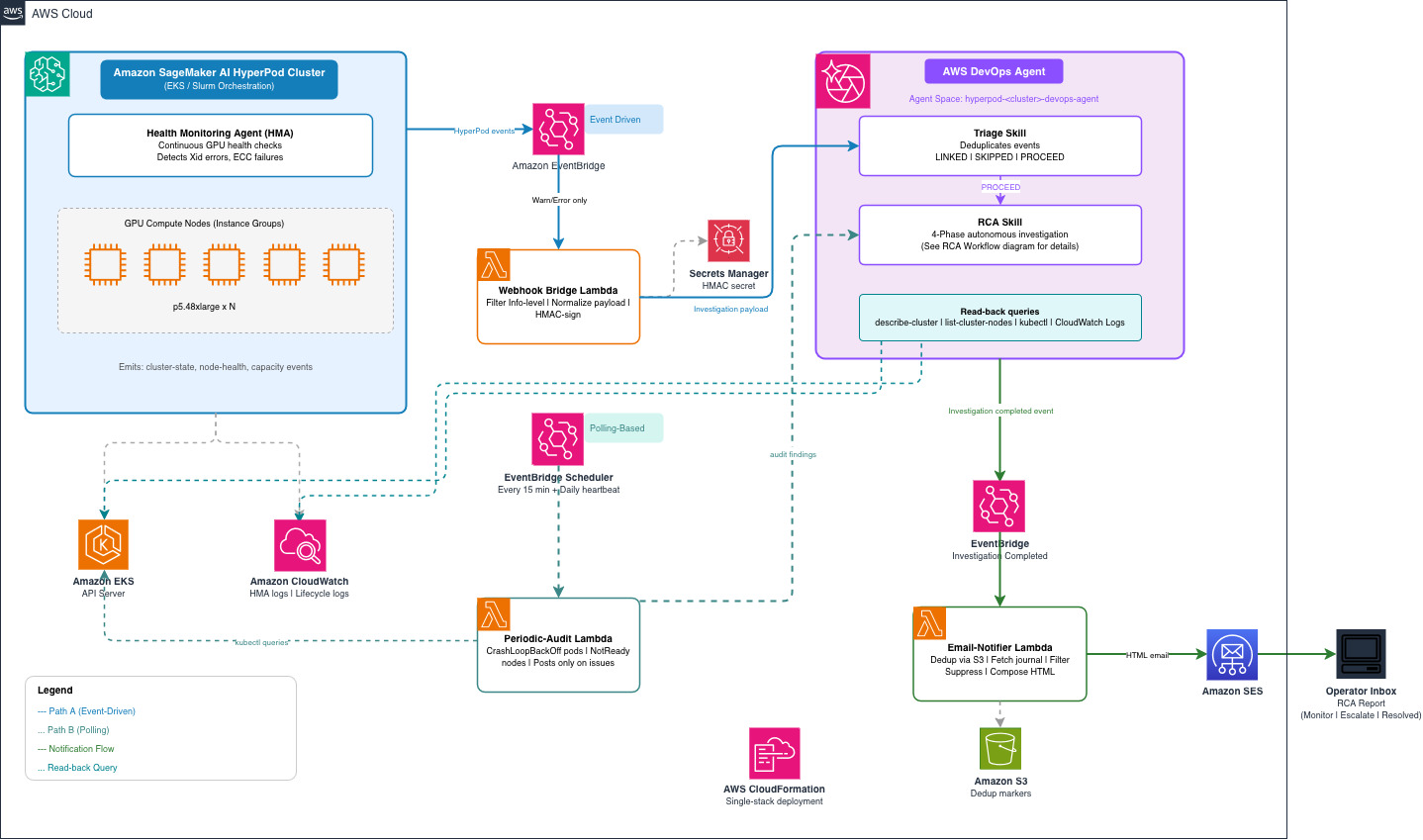
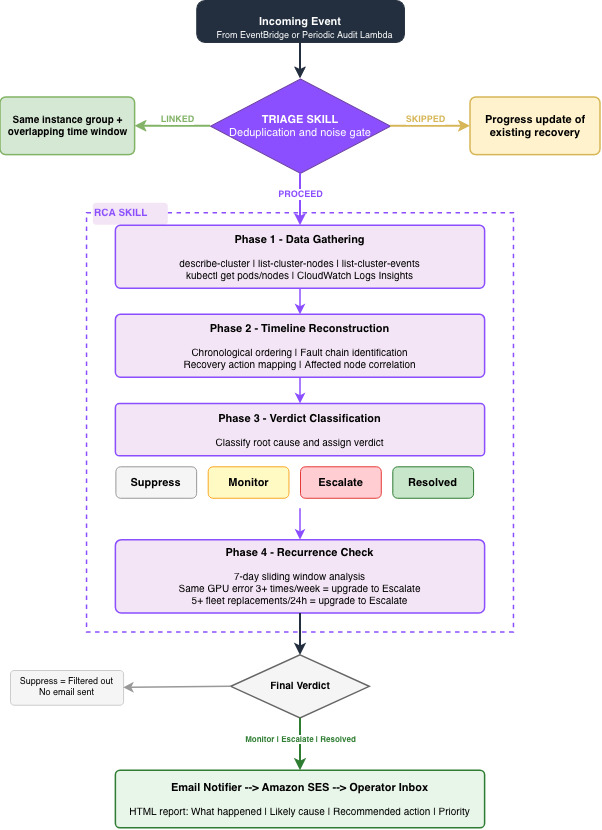
- Triage Skill: This skill acts as the first line of defense. It determines whether an incoming event should be linked to an existing, ongoing investigation, ignored as a transient glitch, or escalated to a full root-cause analysis. This deduplication process is essential for large-scale clusters, where a single physical fault can trigger a cascading series of network or service-level events.
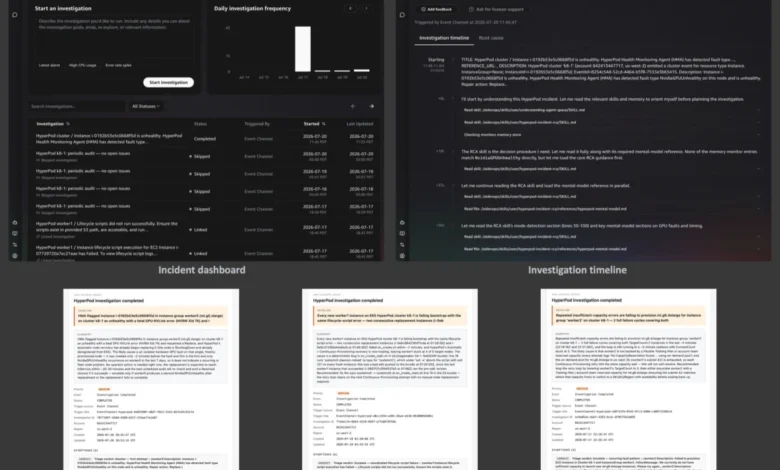
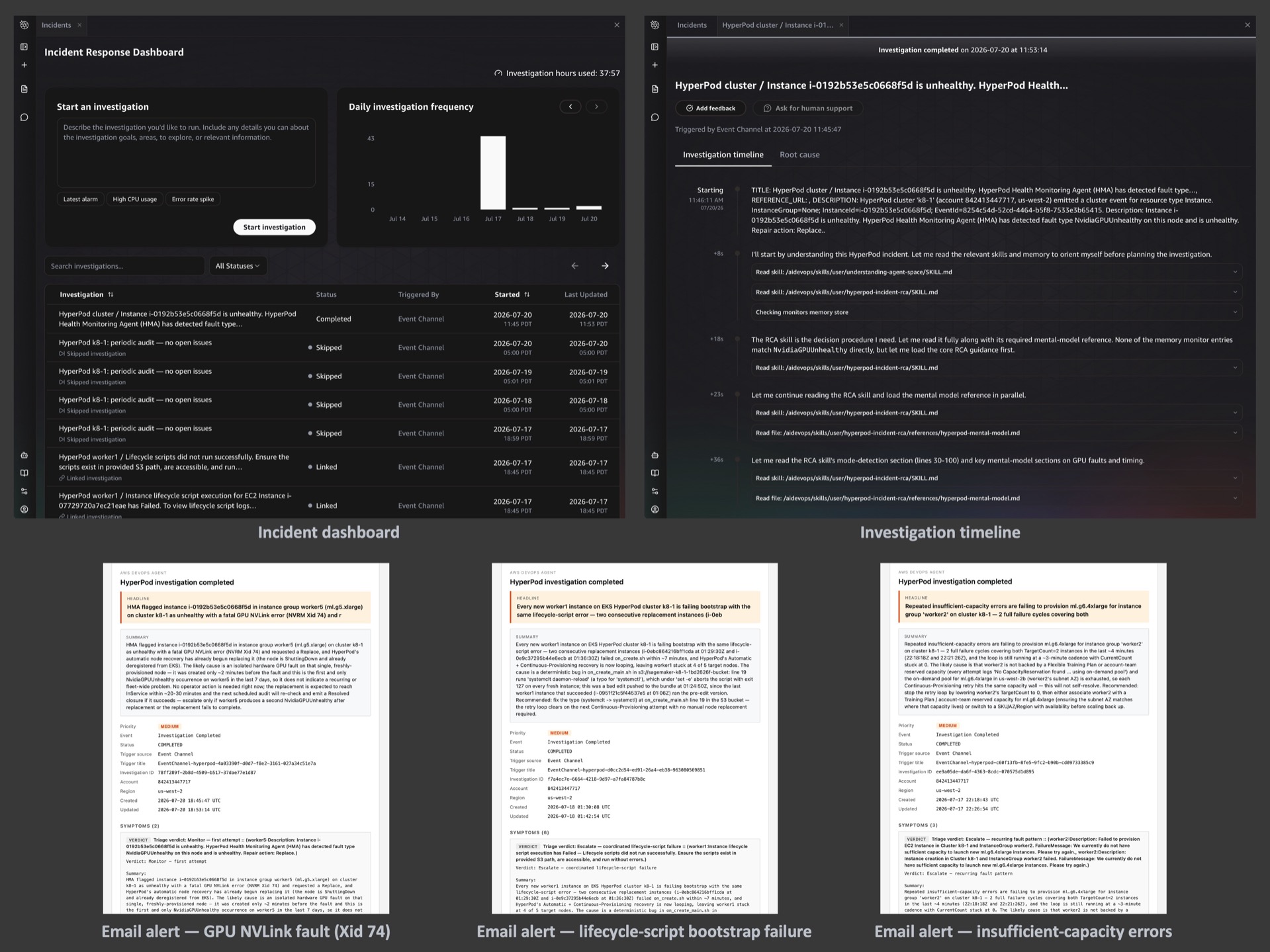
- RCA Skill: Once an incident is escalated, the RCA skill reconstructs the timeline of the failure. It cross-references logs, state changes, and event history to generate a "verdict." This report includes a plain-language summary of what happened, the likely root cause, and specific recommendations for the operator.
Economic and Operational Impact
From a financial perspective, the solution is designed to be near-zero cost on a healthy cluster. Expenses scale with the volume of incidents rather than the number of nodes. For a standard 500-node training cluster, where approximately 20 to 50 investigations might be generated per month after filtering, the cost of agent usage is remarkably low, especially when compared to the overhead of manual on-call shifts.
Industry data suggests that at the scale of 10,000 GPUs, hardware faults occur with a frequency that would overwhelm any manual team. By automating the triage and correlation process, this solution effectively replaces 10 to 15 hours of manual engineering time per month for a mid-sized cluster, allowing high-value personnel to focus on model development rather than infrastructure firefighting.
Broader Implications for AI Infrastructure
The integration of AWS DevOps Agent with SageMaker HyperPod serves as a blueprint for the future of "agentic" operations. As AI training workloads grow increasingly massive, the human-in-the-loop paradigm must evolve. We are moving toward a model where AI agents act as force multipliers, managing the complexity of massive-scale distributed systems by providing "verdicts" rather than just "alerts."
The ability to teach an agent the specific nuances of an operational environment—whether it is a specialized training cluster, a global database, or a serverless compute fleet—marks a departure from rigid, rule-based monitoring. It represents a move toward dynamic, context-aware management. For organizations operating at the frontier of AI development, this approach not only reduces the risk of long-running job failures but also fundamentally changes the economics of managing the world’s most sophisticated computing resources.
As the industry continues to refine these agentic workflows, the next frontier will likely involve auto-learning mechanisms, where the feedback provided by human operators on previous investigations is used to continuously refine the agent’s reasoning capabilities. By turning human expertise into reusable skills, teams can ensure that their operational knowledge is captured, scaled, and applied to every new challenge their infrastructure faces.