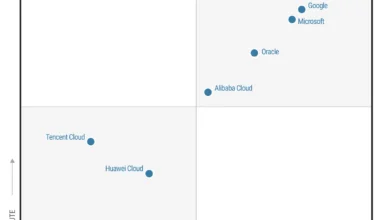
Microsoft named a Leader in the 2026 Gartner® Magic Quadrant™ for Server Virtualization Platforms


A New Paradigm for Virtualization
For over two decades, the enterprise virtualization market was defined by a singular, binary choice: which hypervisor to deploy. IT leaders evaluated performance metrics, licensing costs, and vendor lock-in risks associated with proprietary hypervisors. However, the 2026 Gartner Magic Quadrant reflects a fundamental shift in buyer requirements. Today, the "where" of infrastructure—the physical or virtual server—is secondary to the "how" of operations.
Modern enterprises operate in a fragmented landscape. Applications are no longer confined to a single private datacenter; they are increasingly distributed across global cloud regions, localized edge servers, and highly regulated sovereign clouds. This fragmentation has created a "management tax," where IT teams must maintain disparate toolsets, security protocols, and governance frameworks for each environment. Microsoft’s recognition as a Leader signals that the market is prioritizing platforms that can abstract this complexity, providing a single pane of glass for management, security, and lifecycle orchestration.
Chronology of the Shift: From Hypervisor to Operating Model
The virtualization industry has undergone three distinct phases of evolution:
- The Consolidation Era (2005–2015): Driven by the need to maximize physical hardware utilization, this period saw the dominance of x86 virtualization. The primary KPI was the virtual machine density per server.
- The Cloud Expansion Era (2016–2022): As businesses adopted public cloud services, IT departments became hybrid, managing a split between on-premises VMware/Hyper-V environments and cloud-native instances. This created the "silo effect," where operational teams were forced to manage two completely different technology stacks.
- The Unified Operations Era (2023–Present): With the rapid integration of AI and edge computing, the focus has shifted toward operational consistency. The industry now prioritizes the ability to apply policies, security patches, and governance at scale across all infrastructure, regardless of whether that infrastructure is hosted by Microsoft, a competitor, or a private server in a factory.
The Technical Foundation: Hyper-V and Azure Arc
Microsoft’s success in the 2026 Gartner report is largely attributed to its layered strategy. By decoupling the hypervisor from the management plane, the company has effectively addressed the two primary pain points of the modern CIO: infrastructure consistency and operational uniformity.
Hyper-V serves as the robust infrastructure foundation. By integrating deeply with Windows Server and providing a lightweight, high-performance hypervisor, Microsoft ensures that the underlying virtualization layer remains consistent for traditional enterprise workloads. This stability is critical for legacy applications that require specific hardware interactions or local data residency.
Conversely, Azure Arc acts as the connective tissue. By extending Azure’s control plane to any environment, Azure Arc allows administrators to manage servers, Kubernetes clusters, and SQL databases across any location—on-premises, multi-cloud, or edge—using the same Azure Resource Manager (ARM) templates and policies. This effectively treats a server in a remote warehouse the same way as an instance in an Azure region, reducing the need for specialized knowledge across multiple platforms.
Market Data and Industry Implications
The 2026 Gartner Magic Quadrant report notes that the total addressable market for virtualization software is undergoing a period of intense transformation. Data from the report suggests that by 2028, over 70% of enterprises will adopt a hybrid, multi-cloud management platform to mitigate the risks of operational sprawl.
Industry analysts observe that the move toward unified management is not merely an efficiency play but a security imperative. In an era where cybersecurity threats move at machine speed, fragmented management is a vulnerability. If an IT team cannot apply a security patch across every environment simultaneously, they create "shadow infrastructure" that acts as a target for malicious actors. Microsoft’s focus on governance-at-scale is a direct response to this threat landscape.
Furthermore, the rise of sovereign cloud requirements—where governments demand that data remain within specific geographic or regulatory borders—has forced vendors to prove that their virtualization platforms can remain compliant while offering modern, cloud-like features. Microsoft’s ability to offer "Azure-consistent" operations within sovereign environments has been a key differentiator for public sector and highly regulated financial services clients.
The AI Imperative: Infrastructure at Scale
The emergence of Generative AI (GenAI) and automated agents is set to further complicate the enterprise infrastructure landscape. As AI models require massive amounts of data and compute power, organizations are increasingly deploying AI-enabled applications at the edge.
"AI will not simplify the infrastructure stack; it will make it more demanding," says an independent industry analyst who follows the virtualization market. "When you have AI agents running at the edge, in the datacenter, and in the cloud, the underlying infrastructure must be able to support those agents with the same performance, security, and governance. If your virtualization platform is not capable of bridging those gaps, your AI strategy will fail at the implementation stage."
Microsoft’s leadership position reflects its proactive approach to this AI-heavy future. By standardizing the management layer, Microsoft enables enterprises to deploy AI models across distributed environments without having to rewrite their infrastructure code or retrain their IT staff on new, isolated virtualization platforms.
Official Response and Strategic Direction
In response to the Gartner recognition, leadership at Microsoft has emphasized that the goal is not to force customers into a single cloud, but to provide the tools that make any cloud—or no cloud—easier to manage.
"Our strategy has always been to meet customers where they are," a company spokesperson noted. "By providing operational consistency through Azure Arc and infrastructure consistency through Hyper-V, we enable our customers to preserve their existing investments while gaining the agility of a modern, cloud-first operating model. This recognition from Gartner underscores that the future of enterprise IT is not about picking a single hypervisor; it is about choosing a platform that provides the flexibility to evolve as business requirements change."
Broader Impact and Future Outlook
The implications of this shift are profound for the IT industry. Vendors that cannot provide a bridge between on-premises and cloud-native management are increasingly finding themselves relegated to legacy status. The market is consolidating around providers that can deliver a "Cloud-in-a-Box" experience—essentially bringing the power of hyperscale management to the local datacenter.
For the CIO, the 2026 Gartner report serves as a roadmap. The focus for the next three years will be on consolidating toolsets and reducing the "complexity debt" that accumulated during the rapid digital transformation of the early 2020s. As companies look to optimize their IT spend, platforms that provide broad compatibility—supporting various Linux distributions, container runtimes, and legacy Windows workloads—will continue to gain market share.
In summary, Microsoft’s recognition as a Leader in the 2026 Gartner Magic Quadrant is a validation of its long-term investment in hybrid cloud management. As the industry moves toward an era of ubiquitous AI and distributed computing, the ability to manage infrastructure as a singular, cohesive environment will be the primary determinant of enterprise success. The battle for the hypervisor is over; the battle for the operational model has just begun.
Gartner, Magic Quadrant for Server Virtualization Platforms, Tony Harvey, Daniel Bowers, Paul Delory, Tony Iams, Owen Marino, 14 September 2026.
Gartner does not endorse any company, vendor, product, or service depicted in its publications, and does not advise technology users to select only those vendors with the highest ratings or other designation. Gartner publications consist of the opinions of Gartner’s business and technology insights organization and should not be construed as statements of fact. Gartner disclaims all warranties, expressed or implied, with respect to this publication, including any warranties of merchantability or fitness for a particular purpose.
Gartner and Magic Quadrant are trademarks of Gartner, Inc., and/or its affiliates. This graphic was published by Gartner, Inc. as part of a larger research document and should be evaluated in the context of the entire document. The Gartner document is available upon request from Microsoft.