Microsoft Azure Databricks Delivers Unprecedented Return on Investment, Fueled by Strategic Partnership and Deep Integration

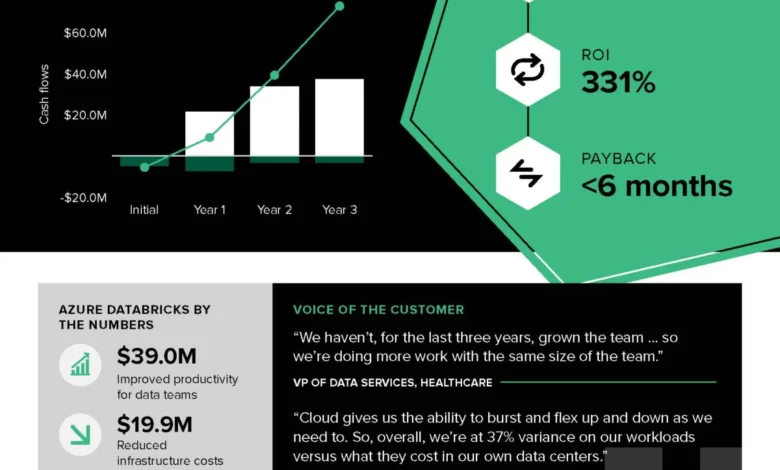
Microsoft Azure Databricks, the native integration of the Databricks Lakehouse Platform within the Microsoft Azure cloud ecosystem, is demonstrating significant, quantifiable business value for organizations, according to a recent Total Economic Impact™ (TEI) study commissioned by Microsoft and conducted by Forrester Consulting. The report reveals a compelling three-year return on investment (ROI) of 331%, a net present value (NPV) of $58.1 million, and a remarkably short payback period of less than six months for a composite organization. This underscores the tangible benefits derived from the deep, co-engineered partnership between Microsoft and Databricks, which translates into enhanced performance, reduced costs, and accelerated time-to-value for data and AI initiatives.
The advantage of Azure Databricks lies in its "built-in, not bolted-on" nature. This strategic alignment means that Databricks is not merely an add-on service but a first-party Azure offering. This co-engineering effort ensures a unified integration roadmap across Microsoft’s extensive data and AI stack, leading to a streamlined go-to-market strategy characterized by a single motion, one bill, and one unified support path. For technical teams, this translates to deeper native integration and demonstrably stronger performance. For the business, the implications are profound: lower operational costs, mitigated risk, and a significantly faster realization of business objectives.
Forrester TEI Study Highlights Transformative Business Value
The Forrester Total Economic Impact™ study, released in June 2026, delved into the financial and operational impacts experienced by organizations leveraging Azure Databricks. The research methodology involved in-depth interviews with existing Azure Databricks customers, from which a composite organization was constructed to model the platform’s benefits. This composite entity represented a $6 billion company operating within a regulated industry, managing approximately 10 petabytes of data.
Prior to adopting Azure Databricks, this representative organization grappled with a fragmented and costly data estate that was unreliable at scale and presented significant governance challenges. The implementation of Azure Databricks fundamentally transformed this landscape, yielding a remarkable $75.6 million in quantified benefits against $17.5 million in costs over a three-year period. This substantial financial uplift resulted in the aforementioned $58.1 million in net present value and an investment recovery period of under six months, a testament to the platform’s immediate and sustained impact.
The study identified four primary areas where these significant financial benefits were realized:
- Increased Productivity: This encompasses improvements in developer productivity, data scientist efficiency, and business analyst output due to streamlined workflows and enhanced tooling.
- Reduced Infrastructure Costs: The native integration and optimized performance of Azure Databricks lead to more efficient resource utilization, thereby lowering overall infrastructure expenditure.
- Enhanced Operational Efficiency: Streamlined data management, improved data quality, and faster processing times contribute to greater operational efficiency across the organization.
- Accelerated Time to Insight and Action: By reducing data silos and simplifying access to data, Azure Databricks empowers organizations to derive insights and take decisive actions much more rapidly.
Beyond these quantifiable benefits, Forrester also highlighted several qualitative advantages that contribute to Azure Databricks’ overall value proposition. These include seamless native integration with other Azure services, enabling faster generation of insights, broader and more democratized access to data across the organization, and robust governance facilitated by features like Unity Catalog. These non-monetized benefits are crucial drivers of productivity and cost efficiencies that underpin the quantified returns.
The infographic summarizing the Forrester TEI study starkly illustrates these key findings: a 331% return on investment, $58.1 million in net present value, and a payback period of less than six months. These figures, while representing a composite organization and subject to variation based on individual customer implementations, provide a powerful benchmark for the potential economic impact of adopting Azure Databricks.
The Genesis of Value: Deep Integration and Co-Engineering
The significant value derived from Azure Databricks can be attributed to its fundamental nature as a true first-party Azure service. The close collaboration and co-engineering between Microsoft and Databricks ensure that the platform is intrinsically woven into the fabric of the Azure ecosystem. This deep integration eliminates the need for cumbersome data duplication, the adoption of disparate tooling, and the extensive integration work that often inflates costs and complicates management in other cloud environments.
A prime example of this synergistic integration is the Azure Databricks Genie feature, which offers seamless connectivity with Microsoft Copilot Cowork. This allows organizations to contextualize their business data and infuse that intelligence directly into the tools their teams already use daily. Genie empowers users to query their lakehouse using natural language, now accessible within familiar interfaces such as Microsoft Teams and Microsoft 365 Copilot. Most recently, through Copilot Cowork, it grounds tasks in trusted data via Genie Ontology. Crucially, every response is meticulously scoped by Unity Catalog, ensuring that users only access information they are authorized to see, thereby maintaining stringent governance while facilitating intelligence flow into daily workflows.
This level of deep integration extends across the entire Azure Databricks platform, impacting various facets of data and AI operations:
- Unified Data Governance with Unity Catalog: This feature provides a centralized metadata layer for data discovery, access control, and lineage tracking, ensuring compliance and security across all data assets.
- Enhanced Data Engineering Capabilities: Azure Databricks offers a comprehensive suite of tools for ETL/ELT, data warehousing, and real-time data processing, enabling efficient management of large and complex datasets.
- Accelerated Machine Learning Development: Integrated MLflow capabilities and optimized compute resources allow data scientists to build, train, and deploy machine learning models faster and more efficiently.
- Seamless Integration with Azure Services: Azure Databricks integrates effortlessly with other Azure services such as Azure Synapse Analytics, Azure Machine Learning, Power BI, and Azure Active Directory, creating a cohesive data and AI ecosystem.
- Optimized Performance and Scalability: The platform leverages Azure’s robust infrastructure and Databricks’ advanced optimizations to deliver high performance and seamless scalability for demanding workloads.
These integrations, while not always explicitly priced in the Forrester study, are critical enablers of the quantified productivity and cost benefits. They represent the underlying technological advantages that translate into tangible business outcomes.
Independent Benchmarks Validate Performance Prowess
Beyond the economic impact, the performance and speed of Azure Databricks have also been rigorously tested by independent third parties. Principled Technologies, a respected independent research firm, conducted an industry-standard decision-support benchmark, similar to TPC-DS, on a 10-terabyte dataset. The results of this benchmark clearly demonstrated the superior performance of Azure Databricks.
In a single query stream scenario, Azure Databricks completed queries up to 21.1% faster than Databricks on AWS (when autoscale was disabled). Furthermore, when running four concurrent query streams, Azure Databricks achieved a more than nine-minute advantage. These performance metrics are crucial, as speed directly impacts the ability to derive timely insights, respond to market changes, and maintain a competitive edge. Such performance gains translate into reduced wait times for critical data analysis, enabling faster decision-making and a more agile operational posture.
Implications for Organizations: A Foundation for Data-Driven Success
The choice of a data and AI platform is a strategic, long-term decision for any organization. With Azure Databricks, the various components of the platform work in synergy to reinforce each other. The deep integration drives the significant cost savings identified by Forrester, while the optimized performance ensures that these gains are sustained and scaled as data volumes and usage grow. This is all built upon the solid foundation of a first-party partnership, where both Microsoft and Databricks engineering, product roadmaps, and support are collectively dedicated to the success of an organization’s data estate.
The value proposition of Azure Databricks is not merely a marketing claim; it is a rigorously measured reality. The reported three-year 331% ROI, with an investment payback in under six months, provides compelling evidence of its transformative potential. This combination of deep integration, robust performance, unified governance, and a strong strategic partnership makes Azure Databricks the platform of choice for countless teams aiming to build and operate their lakehouse environments effectively.
For businesses looking to harness the full power of their data and AI initiatives, Azure Databricks offers a compelling pathway. It simplifies complex data challenges, accelerates innovation, and delivers measurable business value, all within the familiar and secure environment of Microsoft Azure.
Exploring Further: Resources and Next Steps
Organizations interested in understanding the full scope of Azure Databricks’ capabilities and the findings of the Forrester TEI study are encouraged to explore the following resources:
- The Forrester Total Economic Impact™ Study: Access the full report to delve deeper into the methodology, findings, and detailed financial projections.
- Azure Databricks Product Page: Learn more about the features, benefits, and technical specifications of Azure Databricks.
- Microsoft Azure Data and AI Solutions: Discover the broader ecosystem of data and AI services available on Azure and how they complement Azure Databricks.
- Databricks Lakehouse Platform: Understand the foundational principles and innovations that power both Databricks and Azure Databricks.
By leveraging the insights from independent research and the comprehensive capabilities of Azure Databricks, organizations can confidently embark on their data and AI journeys, driving innovation and achieving unprecedented business success.
Related posts: