Solving Cross-Stack Infrastructure Failures with AWS DevOps Agent and Automated Remediation

Modern cloud architecture relies heavily on modularity, with organizations frequently segmenting their infrastructure into independent Terraform stacks. While this approach offers distinct advantages—such as clear ownership boundaries, reduced blast radiuses for individual changes, and streamlined team autonomy—it introduces a significant, often overlooked challenge: the visibility gap. When infrastructure is fragmented, a failure occurring across these boundaries can become notoriously difficult to diagnose, particularly when the team observing the symptoms is disconnected from the team that implemented the change. AWS DevOps Agent has emerged as a critical tool for bridging this gap, providing automated root-cause analysis that spans disparate Terraform state files.
The Anatomy of a Cross-Stack Visibility Gap
The complexity of contemporary cloud environments often leads to "siloed" infrastructure management. In a standard enterprise scenario, an infrastructure team might manage networking and VPC security, while an application team oversees compute resources and data persistence layers. Each team maintains its own Terraform state file, operating independently to maintain agility.
However, operational health is rarely as isolated as the code repositories that define it. A minor configuration update in the networking layer—such as a routine security audit adjustment—can have cascading, silent effects on an application stack. Because the application team lacks visibility into the infrastructure team’s recent commits, their incident response efforts are frequently misdirected. They may spend hours investigating Lambda execution logs, IAM permission sets, or database performance metrics, unaware that the true failure lies in a restrictive egress rule governing the network path between their compute function and the data layer.
Chronology of a Managed Failure
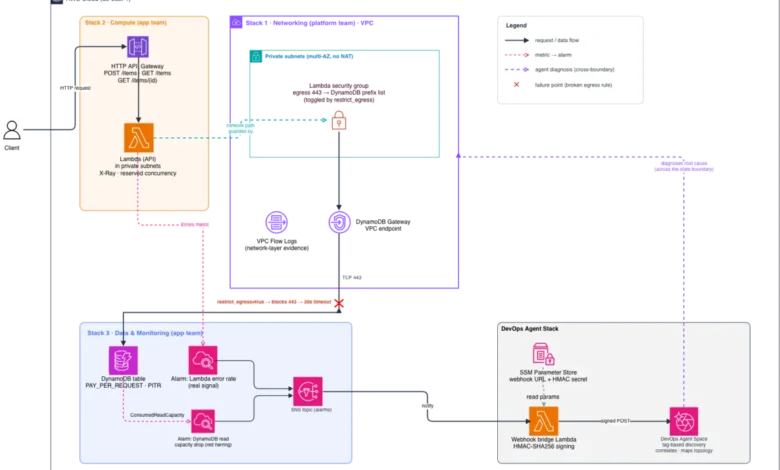
To illustrate this systemic risk, consider a scenario involving an application stack dependent on a networking stack. In this environment, an AWS Lambda function residing within a private VPC communicates with an Amazon DynamoDB table via a Gateway VPC endpoint.
- Deployment Phase: Initially, the architecture is fully functional. The infrastructure team provides the networking foundation, while the application team deploys their compute and data resources. The two stacks are linked through logical dependencies, with the compute stack referencing the networking outputs via
terraform_remote_state. - The Security Audit: During a routine security audit, the infrastructure team updates a security group egress rule. The goal is to enforce stricter compliance by scoping egress traffic to the VPC CIDR rather than the broader DynamoDB prefix list. This change is technically correct from a security perspective but operationally catastrophic, as it inadvertently severs the path to the VPC endpoint.
- The Incident Onset: Almost immediately, the application team’s monitoring systems alert them to timeouts. The symptoms appear as connection failures within the Lambda function.
- The Investigation Loop: Under traditional conditions, the application team initiates a "war room." They examine their own stack, finding no changes in their Terraform files. They proceed to audit IAM roles and database health. Meanwhile, the infrastructure team remains unaware that their "tightening" of a security rule caused the outage.
The Role of AWS DevOps Agent in Incident Resolution
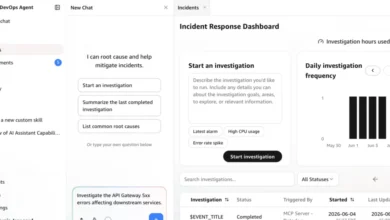
AWS DevOps Agent transforms this linear, time-consuming investigation into a parallelized diagnostic process. By correlating alarms and mapping the dependency chain across state boundaries, the agent identifies the root cause with surgical precision.
When the alarms fire, the AWS DevOps Agent utilizes a webhook bridge to ingest events. It does not merely look at the failing Lambda; it fans out, analyzing VPC Flow Logs, CloudTrail logs, and resource topology. The agent effectively reconstructs the "blast radius" of the security group modification. By comparing the state of the network before and after the audit, it identifies the egress rule change as the definitive source of the timeout.
Data-Driven Insights and Automated Mitigation
The effectiveness of this approach is supported by the rapid synthesis of evidence. In large-scale cloud environments, manual log analysis can take hours or even days, during which time service availability suffers. Automated agents, by contrast, can ingest and cross-reference thousands of events in seconds.
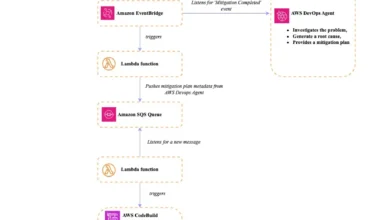
Once the agent identifies the root cause, it generates a "mitigation specification." This is a structured document that provides the necessary context for remediation. The integration with Kiro—a tool designed to bridge the gap between AI-driven diagnosis and infrastructure code—allows engineers to translate this specification into actionable Terraform diffs. By keeping the human in the loop, organizations ensure that the fix is verified against their own security standards before it is deployed.
Broader Implications for DevOps Culture
The rise of tools like AWS DevOps Agent reflects a broader shift in how organizations perceive "ownership" in the cloud. As infrastructures grow in complexity, the traditional model of isolated stacks is proving insufficient for maintaining system-wide reliability.
Industry analysts suggest that the future of DevOps lies in "topology-aware" observability. When an organization can map resources across state files, they move beyond simple health checks to a state of total system awareness. This does not mean abandoning the benefits of modular Terraform stacks; rather, it means augmenting those stacks with an orchestration layer that understands the hidden dependencies between them.
Official Guidance and Operational Constraints
While AWS DevOps Agent offers a robust solution for cross-stack visibility, it is important for engineering teams to understand its operational parameters. The agent requires precise IAM trust policies—specifically using aidevops.amazonaws.com as the service principal—to function correctly. Furthermore, the initial "discovery" phase, where the agent maps the environment’s topology, is a prerequisite for accurate analysis. Teams must allow sufficient time for this phase to complete before relying on the agent for critical incident response.
Limitations also exist; the agent is most effective when the infrastructure is well-defined in code. If critical components are managed manually through the AWS Management Console without corresponding updates in Terraform, the agent’s visibility into the dependency chain may be incomplete.
Conclusion
The integration of AWS DevOps Agent into the modern deployment pipeline represents a significant leap forward in resolving the "visibility gap" inherent in modular infrastructure. By acknowledging that failures do not respect the boundaries of Terraform state files, teams can implement proactive strategies to ensure that their systems remain resilient.
As the industry continues to emphasize secure, compliant, and highly available cloud services, the transition from manual, reactive troubleshooting to automated, topology-aware diagnosis will become the standard. The combination of AWS DevOps Agent and automated remediation tools like Kiro ensures that while infrastructure may remain decentralized, operational intelligence remains unified, allowing teams to move faster with the confidence that they have a clear view of their entire digital footprint.