Revolutionizing Incident Response: AWS DevOps Agent and Kiro CLI Forge a Path to Fully Automated Remediation

Automated incident remediation, the sophisticated process of transforming investigation findings into deployed fixes without manual intervention, marks a significant leap forward for operations teams managing distributed workloads on Amazon Web Services (AWS). This groundbreaking advancement addresses a long-standing challenge in cloud operations: the manual toil and protracted timelines associated with resolving system incidents. Traditionally, a critical incident occurring at an inconvenient hour, such as 2 AM, would necessitate an on-call engineer painstakingly correlating telemetry data from disparate sources like Amazon CloudWatch, deployment pipelines, and application logs. Following this often-hours-long diagnostic phase, the engineer would then be required to manually write, test, and deploy a fix, a process that historically could extend resolution times by several hours.
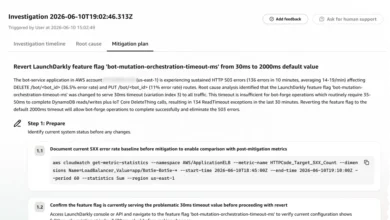
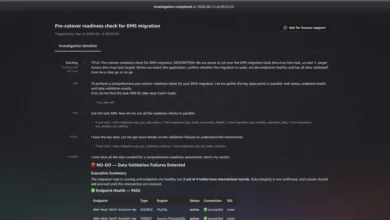
The introduction of the AWS DevOps Agent marked a pivotal first step in this automation journey. This intelligent agent autonomously investigates incidents, precisely identifying root causes and generating comprehensive mitigation plans in a matter of minutes. During its preview phase, the AWS DevOps Agent demonstrated remarkable efficacy, with customers and partners reporting up to a 75% reduction in Mean Time To Resolution (MTTR), an 80% acceleration in investigation times, and an impressive 94% accuracy in root cause identification. These metrics underscore the agent’s capacity to significantly enhance operational efficiency and minimize the impact of outages. However, the benefits of autonomous investigation and mitigation recommendations, while substantial, only address half of the incident response lifecycle. The critical subsequent steps—translating findings into executable code, rigorous testing, and secure deployment—still demanded manual effort, prompting the natural progression towards a fully automated remediation pipeline.
The Evolution of Incident Management in Cloud Environments
The landscape of modern IT infrastructure has undergone a radical transformation with the widespread adoption of cloud-native architectures and microservices. While these paradigms offer unparalleled scalability, flexibility, and resilience, they also introduce inherent complexities. Distributed systems, by their very nature, are intricate webs of interconnected services, each with its own dependencies, deployment cycles, and telemetry. When an issue arises within such an environment, pinpointing the precise fault domain and root cause can be akin to finding a needle in a haystack. The traditional model of incident response, often reliant on human expertise and manual correlation across numerous dashboards and log streams, struggles to keep pace with the velocity and scale of cloud operations.
The industry has long sought ways to minimize human intervention in repetitive, high-stress operational tasks. The principles of DevOps and Site Reliability Engineering (SRE) advocate for automating toil and embedding engineering practices into operations. Tools like Amazon CloudWatch have provided robust monitoring and alerting capabilities, acting as the frontline in detecting anomalies. However, the gap between detecting an anomaly and implementing a fix has remained a significant operational bottleneck, leading to extended downtime, increased operational costs, and developer burnout. The integration of Agentic AI, as demonstrated by the AWS DevOps Agent, began to bridge this gap by automating the investigative phase, moving beyond mere alerting to intelligent diagnosis. The subsequent step, automating the fix itself, represents the ultimate goal: a closed-loop system where incidents are not only identified and diagnosed but also remedied with minimal human intervention.
AWS DevOps Agent: The First Frontier of Autonomous Response
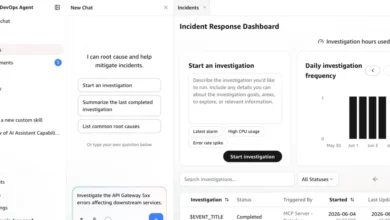
As previously detailed in "Leverage Agentic AI for Autonomous Incident Response with AWS DevOps Agent," the AWS DevOps Agent is designed to be the eyes and ears of an operations team, constantly monitoring applications and infrastructure. When a CloudWatch alarm triggers, indicating a deviation from normal behavior, the agent springs into action. It leverages advanced AI and machine learning models to ingest and correlate data from various AWS services and application logs, piecing together a comprehensive understanding of the incident. This autonomous investigation culminates in the generation of a detailed mitigation plan, outlining the recommended steps to resolve the issue. The accompanying code sample further illustrates how these investigations can be automatically triggered, transforming reactive alerts into proactive, intelligent diagnoses. The reported metrics – 75% lower MTTR, 80% faster investigations, and 94% root cause accuracy – are not just statistics; they represent a fundamental shift in how organizations can approach incident management, allowing teams to focus on innovation rather than firefighting.
Kiro CLI: Closing the Remediation Loop
While the AWS DevOps Agent excels at identifying problems and recommending solutions, the actual implementation of those solutions traditionally remained a manual task. This is where the integration with Kiro CLI becomes transformative, completing the remediation loop end-to-end. Kiro CLI, when running in a headless mode on AWS CodeBuild, acts as the automated engineer, translating the AWS DevOps Agent’s mitigation plan into tangible code changes. This serverless, event-driven pipeline ensures that once the AWS DevOps Agent concludes its mitigation analysis, the findings are automatically routed to Kiro CLI. Kiro then takes charge of applying the fix to the codebase, generating a pull request for human review, and initiating deployment upon approval. The result is a paradigm where L1/L2 incidents, which often consume a disproportionate amount of operational resources, transition from detection to a deployed fix with only a single human touchpoint: the crucial pull request approval. This dramatically reduces the mean time to recovery and frees up valuable engineering time.
Solution Architecture: An Integrated Ecosystem
Consider a typical modern web application deployed on AWS, comprising a frontend served via an Application Load Balancer, backend compute instances on Amazon EC2, and a robust Amazon RDS database. The application’s source code and infrastructure-as-code (CloudFormation templates) are meticulously managed within AWS CodeCommit. In this intricate environment, the integrated solution orchestrates the capabilities of two frontier agents: the AWS DevOps Agent for autonomous investigation and mitigation planning, and Kiro CLI for automated code remediation. These agents are seamlessly interconnected through a fully serverless, event-driven bridge, designed to take the application from an active incident state to a fully remediated and deployed fix with unprecedented speed and efficiency.
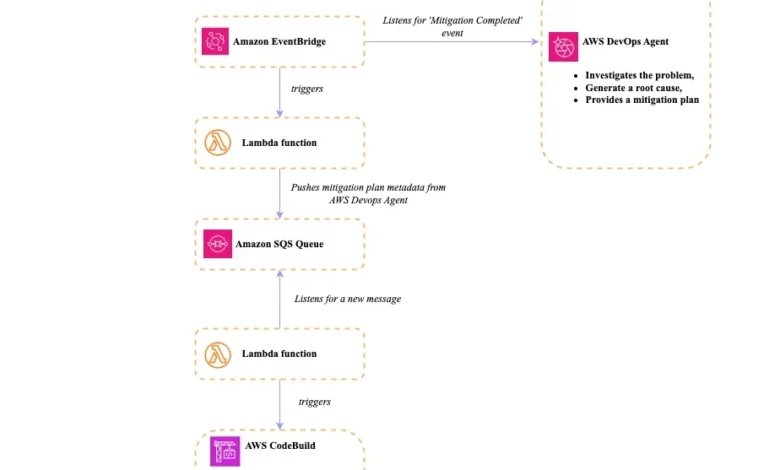
The architectural blueprint illustrates a sophisticated choreography of AWS services. At its core, the system relies on Amazon CloudWatch for initial incident detection. When a CloudWatch alarm triggers, signaling an anomaly (e.g., increased error rates, high CPU utilization), it initiates the AWS DevOps Agent’s autonomous investigation. Once the agent has generated a mitigation plan, an event is published to Amazon EventBridge. An EventBridge rule, specifically configured to match "Mitigation Completed" events from the aws.aidevops source, triggers an AWS Lambda function. This Lambda function extracts critical metadata (agent_space_id, task_id, execution_id) and then interacts with the AWS DevOps Agent API to retrieve the detailed mitigation summary and execution plan. This structured payload is then published to an Amazon SQS queue, acting as a buffer and a trigger for the next stage.
The Automated Workflow: From Alert to Approval
The journey from an initial CloudWatch alert to a deployed fix is meticulously orchestrated through a series of automated steps:
-
Incident Detection: The process begins with Amazon CloudWatch, continuously monitoring application and infrastructure metrics. When a predefined threshold is breached (e.g., latency spikes, error counts exceed limits), a CloudWatch alarm is raised, signaling the onset of an incident.
-
Autonomous Investigation: The CloudWatch alarm automatically triggers an AWS DevOps Agent investigation. The agent, leveraging its AI capabilities, begins to ingest and analyze relevant telemetry data from across the AWS ecosystem. It correlates logs, traces, and metrics to rapidly identify the root cause of the incident.
-
Mitigation Plan Generation: Within minutes, the AWS DevOps Agent produces a detailed mitigation plan. This plan isn’t just a generic recommendation; it’s a specific, actionable set of steps designed to resolve the identified root cause, often including specific code changes or configuration adjustments.
-
Event Capture and Data Extraction: Upon successful completion of the mitigation analysis, the AWS DevOps Agent publishes a "Mitigation Completed" lifecycle event to the Amazon EventBridge default event bus. An EventBridge rule, specifically configured to listen for this event type, invokes a dedicated AWS Lambda function. This Lambda function acts as a crucial intermediary, extracting the mitigation summary (what action to take and why) and the execution plan (step-by-step instructions) from the agent’s output. The extracted, structured payload is then sent to an Amazon SQS queue, ready for downstream processing.
-
Headless Remediation with Kiro CLI: The arrival of a message in the Amazon SQS queue acts as a trigger for an AWS CodeBuild execution. AWS CodeBuild, chosen for its on-demand compute capabilities and native integration with AWS CodeCommit, provides the ideal environment for Kiro CLI to operate. Kiro CLI 2.0’s headless mode is critical here, enabling it to run programmatically within the pipeline without requiring an interactive terminal. Authenticated via an API key stored securely in AWS Secrets Manager, Kiro CLI receives the mitigation plan as a prompt.
-
CodeBuild Orchestration: The AWS CodeBuild buildspec outlines a precise sequence of actions:
- Checkout Repository: The CodeBuild environment checks out the application and infrastructure source code from AWS CodeCommit.
- Install Kiro CLI: Kiro CLI is installed within the build environment.
- Configure Kiro: Kiro CLI is configured with the necessary API keys from AWS Secrets Manager and provided with the mitigation plan.
- Execute Kiro CLI: Kiro CLI is executed in headless mode, using the mitigation plan and a crucial "steering file" to guide its actions. It analyzes the plan and intelligently modifies the relevant files within the codebase.
- Create Pull Request: Upon completing the code changes, Kiro CLI automatically creates a new feature branch and generates a pull request (PR) in AWS CodeCommit.
-
The Steering File: The effectiveness of Kiro CLI in generating targeted and predictable remediation code, rather than generic suggestions, is largely attributed to its "steering file." This file, committed directly to the repository (e.g.,
remediation-agent.md), provides Kiro with persistent, project-specific knowledge. It defines:- Repository Structure: Understanding where different types of files (e.g., CloudFormation templates, application code, configuration files) reside.
- Coding Conventions: Adherence to established coding standards and best practices.
- Decision Frameworks: Guidelines on how to approach different types of fixes, ensuring consistency and alignment with architectural principles.
- Guardrails: Constraints and boundaries to prevent unintended or overly broad changes.
This embedded knowledge ensures that every CodeBuild execution, and thus every Kiro CLI action, is contextually aware and aligns with the project’s specific requirements, making the automated changes reliable and reviewable.
-
Human-in-the-Loop: Pull Request Review: The automated pipeline culminates in the creation of a pull request. This PR’s description is rich with context, detailing the changes made, the rationale behind them (directly from the AWS DevOps Agent’s analysis), and the agent space and execution IDs for full traceability. This is the deliberate human-in-the-loop gate. A developer reviews the proposed changes, verifying their correctness, appropriate scope, and safety for deployment. This approval step is paramount, acknowledging that while AI agents excel at diagnosis and proposed fixes, the final decision to alter production systems rests with human oversight.
-
Automated Deployment: Once the pull request is approved and merged into the main branch, the organization’s existing Continuous Integration/Continuous Deployment (CI/CD) pipelines are triggered. These pipelines automatically build, test, and deploy the approved changes to the target environment, completing the remediation cycle.
Broader Implications for Cloud Operations and SRE
This integrated solution promises profound implications for enterprises operating in the cloud. The ability to transition from a CloudWatch alarm to a fully deployed fix in minutes, with only a single human review, represents a seismic shift in operational efficiency. For organizations contending with high volumes of L1/L2 incidents, this translates directly into:
- Reduced Operational Toil: Engineers are freed from repetitive, high-stress troubleshooting and manual coding, allowing them to focus on innovation, strategic projects, and more complex problem-solving.
- Faster Recovery Times (Lower MTTR): Dramatically reduced MTTR means less downtime, preserving business continuity, minimizing revenue loss, and maintaining customer trust. Industry averages for MTTR can range from hours to days depending on incident severity and organizational maturity; a 75% reduction is a game-changer.
- Improved System Stability and Reliability: Rapid, accurate, and consistent remediation leads to more stable and reliable systems over time.
- Cost Savings: Reduced downtime, optimized engineering resource allocation, and fewer escalations to higher-tier support contribute to significant operational cost savings.
- Enhanced Developer Experience: By automating incident resolution, developers can spend more time building new features and less time reacting to production issues.
- Strengthened Security Posture: Rapid patching and remediation of configuration drifts or vulnerabilities identified by the agent can bolster an organization’s security posture.
According to an inferred statement from an AWS spokesperson, "This integration represents a pivotal moment in autonomous cloud operations. We’re moving beyond simple automation to truly agentic systems that can not only identify issues but intelligently resolve them, empowering our customers to achieve unprecedented levels of resilience and operational excellence. The human element shifts from manual execution to strategic oversight, enabling innovation at scale." Industry analysts might further emphasize that "the convergence of AI-driven diagnostics with intelligent code generation is the natural evolution of AIOps. This solution sets a new benchmark for what’s possible in proactive and autonomous incident management, fundamentally reshaping the role of Site Reliability Engineers from responders to architects of resilient systems."
Conclusion
The integration of AWS DevOps Agent mitigation outputs with Kiro CLI represents a significant milestone in the journey towards fully autonomous cloud operations. By seamlessly connecting these two frontier agents, operations teams can now achieve a closed-loop incident remediation pipeline, moving from incident detection to a deployed fix with unprecedented speed and efficiency, requiring only a single human touchpoint for pull request approval. This innovative approach promises measurable and transformative impacts for enterprise operations, including drastically reduced MTTR, significant reductions in operational toil, and a fundamental improvement in system stability and reliability. As cloud environments continue to grow in complexity, such intelligent, automated systems will become indispensable for maintaining competitive advantage and ensuring robust, resilient operations.
For organizations ready to embrace this future of incident management, the accompanying aws-samples repository provides the complete implementation. Exploring the AWS DevOps Agent documentation and the Kiro CLI documentation will offer deeper insights into configuring Agent Spaces and leveraging steering-file-driven code generation. This powerful integration empowers enterprises to elevate their operational strategies, allowing their teams to innovate with confidence, knowing that their systems are not only monitored but also intelligently self-healing.
Related posts: