JetBrains, the prominent software development company, has announced a significant milestone for its acclaimed programming language, Kotlin, as it celebrates its 15th anniversary. The occasion, dubbed "The Kotlin Effect," marks a decade and a half since the inception of the multiplatform language, which has since grown into a formidable force in the software development landscape, particularly within the Android ecosystem and increasingly across various other platforms. The celebration is framed as a tribute to the global community of developers, educators, and contributors who have been instrumental in shaping Kotlin into the robust, concise, and versatile language it is today.
The journey of Kotlin began in 2009 at JetBrains, driven by the company’s desire for a more modern and pragmatic alternative to Java for its internal projects. Dissatisfaction with the verbosity and certain limitations of existing languages spurred the creation of a new, statically typed language that could run on the Java Virtual Machine (JVM). The project was officially unveiled to the public in July 2011, garnering immediate attention for its promise of improved developer productivity and safety features like null-safety. In February 2012, JetBrains open-sourced Kotlin under the Apache 2.0 license, a pivotal decision that accelerated its adoption and fostered a vibrant community around its development.
A Decade and a Half of Evolution: Key Milestones
The path to Kotlin’s current prominence is punctuated by several critical developments. Its initial appeal stemmed from seamless interoperability with Java, allowing developers to gradually integrate Kotlin into existing Java codebases without friction. This compatibility, combined with its concise syntax and robust type system, made it an attractive option for developers seeking to modernize their projects.
The release of Kotlin 1.0 in February 2016 was a landmark event, signifying the language’s stability and readiness for production environments. This release solidified Kotlin’s core features and laid the groundwork for its future expansion. However, the truly transformative moment arrived in May 2017 when Google announced official support for Kotlin on Android at Google I/O. This endorsement from one of the largest mobile platforms served as a monumental catalyst, propelling Kotlin into the mainstream and leading to a surge in adoption among Android developers worldwide. Google further cemented its commitment in 2019 by declaring Kotlin as its preferred language for Android app development, a move that firmly established Kotlin’s dominance in the mobile space.
Beyond Android, Kotlin’s capabilities have expanded significantly. Early on, it found a niche in server-side development, offering a more modern alternative to Java for building scalable and performant backend services. Frameworks like Ktor and Spring Boot (with Kotlin support) have facilitated this adoption. More recently, Kotlin Multiplatform (KMP), particularly Kotlin Multiplatform Mobile (KMM), has emerged as a game-changer, enabling developers to share business logic, and even UI, across different platforms such as Android and iOS, using a single codebase. This addresses a long-standing challenge in cross-platform development, promising increased efficiency and consistency. The continued evolution of Kotlin has also seen its application extend to web development (with Kotlin/JS and Kotlin/Wasm for frontend), desktop applications (with Compose Multiplatform), and even data science, showcasing its versatility and JetBrains’ vision for a truly multiplatform future.
The "Kotlin Effect": Impact on the Developer Ecosystem
The "Kotlin Effect" is more than just a marketing slogan; it encapsulates the profound influence the language has had on the developer community and the broader software industry. Its design philosophy, prioritizing conciseness, safety, and developer experience, has resonated deeply. Features like null-safety, which virtually eliminates the dreaded NullPointerException, and coroutines for asynchronous programming, have dramatically improved code reliability and readability.
Statistical data consistently highlights Kotlin’s rising popularity. According to the JetBrains Developer Ecosystem Survey 2023, Kotlin ranks among the most loved languages by developers who use it, with a significant percentage planning to increase their usage. Furthermore, the Stack Overflow Developer Survey has shown a steady increase in Kotlin’s ranking among popular technologies. In terms of market share, Kotlin is now the primary language for a substantial portion of new Android projects, and its footprint in backend and multiplatform development continues to grow. Major companies like Netflix, Pinterest, Airbnb, and Expedia have publicly shared their positive experiences adopting Kotlin, citing benefits such as reduced code size, fewer bugs, and improved developer productivity.
The ecosystem surrounding Kotlin has also flourished. JetBrains’ own IntelliJ IDEA provides unparalleled support for Kotlin, offering intelligent code completion, refactoring tools, and robust debugging capabilities. A plethora of third-party libraries and frameworks have emerged, catering to various development needs, from database access to networking and UI components. The community-driven efforts, including open-source contributions, educational initiatives, and local meetups, have been crucial in sustaining this growth and ensuring a supportive environment for new and experienced developers alike.
A Call for Community Engagement: Celebrating 15 Years
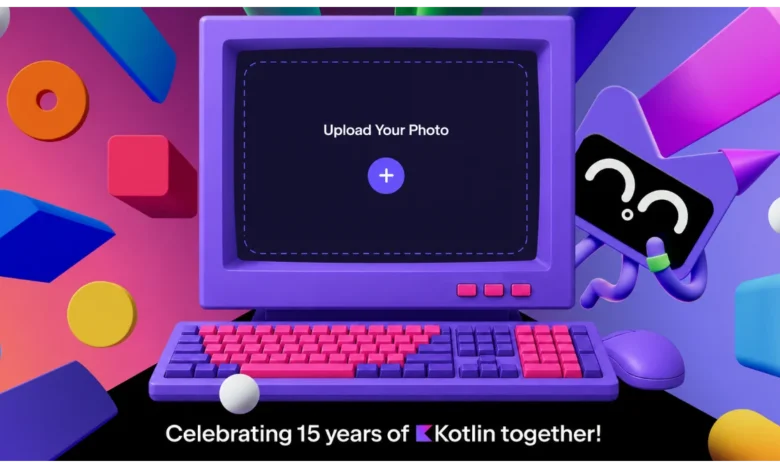
To commemorate this significant anniversary, JetBrains has launched several initiatives designed to engage the global Kotlin community. A central component of the celebration is the invitation for developers to create a "digital birthday postcard." This interactive feature on the Kotlin website allows individuals to craft personalized messages, wishes, or predictions for Kotlin’s future, with the option to upload personal photos to further customize their postcards. These digital mementos can then be shared across social media platforms, contributing to a collective tapestry of appreciation and anticipation for the language’s next chapter. This direct appeal to community participation underscores JetBrains’ recognition of the pivotal role developers have played in Kotlin’s success.
Beyond the digital postcards, JetBrains hinted at "More ways to celebrate," suggesting a broader spectrum of activities and content designed to highlight the "Kotlin Effect." While specific details beyond the postcard initiative were not explicitly enumerated in the initial announcement, such celebrations typically include special blog posts detailing the language’s history and future vision, webinars or online events featuring prominent Kotlin developers and JetBrains engineers, and potentially community-driven contests or hackathons. These activities serve not only as a thank you to the community but also as an opportunity to reinforce Kotlin’s strengths and foster continued engagement. The recurring appearance of "Kodee," the Kotlin mascot, in celebratory imagery, further personalizes the anniversary, making it relatable to the community members who have come to associate the character with the language.
Official Responses and Forward-Looking Statements
While the initial announcement did not feature direct quotes from specific JetBrains executives or Kotlin project leads, the underlying message is clear: immense gratitude to the community. The tone of the celebratory communication consistently emphasizes that Kotlin’s remarkable journey and current standing are direct results of the collective efforts of its users, contributors, and evangelists. It implicitly conveys a strong sense of pride from the JetBrains team in what has been achieved collaboratively over 15 years.
Looking ahead, the commitment from JetBrains remains unwavering. The company’s vision for Kotlin extends far beyond its current successes in Android and server-side development. The continued investment in Kotlin Multiplatform, with its ambitious goal of enabling truly cross-platform development across mobile, desktop, web, and even embedded systems, signals a bold future. Innovations like Kotlin/Wasm (WebAssembly) demonstrate a forward-thinking approach, aiming to position Kotlin as a viable language for new and emerging computing paradigms. The ongoing development of the language itself, with regular updates introducing new features, performance enhancements, and improved tooling, reflects a dedication to continuous improvement and responsiveness to developer feedback.
The "Kotlin Effect" also implies a responsibility: to continue removing friction for developers, to explore new ideas, and to build even more powerful tools and applications. This commitment extends to fostering a welcoming and inclusive community, ensuring that Kotlin remains accessible and appealing to a diverse range of developers, from seasoned professionals to those just starting their programming journey.
Broader Impact and Implications
Kotlin’s 15-year journey has had far-reaching implications across the software industry. It has demonstrably influenced other language designs, prompting discussions and even feature adoptions in languages striving for similar levels of conciseness and safety. Its success on Android has set a new standard for mobile development, pushing the boundaries of what developers can achieve with modern language features.
The rise of Kotlin Multiplatform also represents a significant shift in the cross-platform development paradigm. Unlike frameworks that rely on web technologies or compile to native code with limited platform access, KMP leverages Kotlin’s native compilation capabilities to generate platform-specific code while sharing core business logic. This approach offers a compelling balance between code reuse and native performance, a critical consideration for many businesses. As KMP matures, it is poised to democratize multiplatform development further, allowing smaller teams to target multiple platforms more efficiently and consistently.
Furthermore, Kotlin’s strong ties to the JVM ensure its continued relevance in enterprise environments, where Java remains a dominant force. Its ability to seamlessly integrate with existing Java codebases provides a smooth migration path for organizations looking to modernize their applications without a complete rewrite. This pragmatism has been a key factor in its enterprise adoption, complementing its agility and modern feature set.
In conclusion, Kotlin’s 15th anniversary is not merely a celebration of a programming language; it is a recognition of a vibrant community, a testament to innovative language design, and a look towards a future where multiplatform development is more streamlined and accessible than ever before. From its humble beginnings as an internal project at JetBrains to its current status as a preferred language for millions of developers globally, Kotlin has profoundly impacted the software development landscape. The ongoing celebrations underscore JetBrains’ gratitude and commitment, inviting the community to reflect on past achievements and collectively shape the exciting chapters yet to unfold for "The Kotlin Effect."