AWS DevOps Agent and LaunchDarkly Forge a Unified Front for Intelligent Feature Flag Orchestration

The integration of feature flag management with incident response tooling has historically been a fragmented and often manual process, demanding engineers to painstakingly identify relevant flags, assess their impact, and coordinate changes during critical outages. This inherently manual workflow introduces significant latency at precisely the moment swift action is paramount, exacerbating customer impact and extending resolution times. A groundbreaking collaboration between Amazon Web Services (AWS) and LaunchDarkly is poised to transform this landscape, introducing a unified solution that automates feature flag recommendations across both proactive deployment review and reactive incident response workflows.
At the heart of this innovation is the AWS DevOps Agent, leveraging its Model Context Protocol (MCP) server feature to seamlessly connect with LaunchDarkly’s hosted MCP server. This connection empowers DevOps Agent to intelligently query flag states, interpret targeting rules, and surface actionable recommendations directly within engineers’ existing decision-making workflows. This strategic integration promises to significantly enhance operational efficiency, reduce the Mean Time To Resolution (MTTR) for incidents, and bolster the overall resilience of software delivery pipelines.
The Evolving Landscape of Software Delivery and Its Challenges
Feature flags, also known as feature toggles, have become an indispensable component of modern continuous integration and continuous delivery (CI/CD) practices. They enable progressive delivery, A/B testing, personalized user experiences, and provide crucial "kill switches" to rapidly disable problematic features without requiring a full code rollback. However, the proliferation of feature flags across complex microservices architectures can introduce its own set of management challenges. Organizations often grapple with tracking flag dependencies, understanding their current state, and ensuring they are correctly applied throughout the software development lifecycle.
When an incident strikes in production, the pressure to identify the root cause and implement a fix is immense. Estimates frequently place the cost of IT downtime for enterprises anywhere from thousands to millions of dollars per hour, underscoring the urgency of efficient incident response. Traditional approaches often involve sifting through logs, correlating deployments with performance metrics, and manually engaging with various teams to understand potential flag-related impacts. This multi-tool, multi-team coordination adds significant cognitive load and precious minutes to resolution times. The new integration directly addresses this critical pain point by bringing intelligent, automated flag insights directly into the operational workflow.
A Dual Strategy: Proactive Defense and Reactive Offense
This partnership focuses on two primary use cases, creating a comprehensive strategy for managing feature flags throughout the application lifecycle:
- Proactive Defense: Release Management and Pre-Deployment Flag Validation: Preventing issues before they impact production by recommending appropriate feature flag coverage for high-risk code changes.
- Reactive Offense: Incident Response and Flag-Based Containment: Rapidly identifying and mitigating issues during an incident by suggesting flag manipulations as a containment strategy.
Beyond these core applications, the solution also details the underlying connection architecture, introduces a reusable DevOps Agent Skill for pre-deployment flag validation, and provides pathways for immediate adoption.
Proactive Defense: Strengthening Release Management with Intelligent Recommendations
The release management capabilities, now in public preview within AWS DevOps Agent, are designed to scrutinize code changes meticulously before they are deployed to production environments. This comprehensive review process encompasses a range of crucial checks:
- Functional Testing: Automated execution in an AWS-managed verification environment to confirm expected behavior.
- Dependency Assessment: Evaluation of risks associated with cross-codebase dependencies.
- Standards Adherence: Verification against an organization’s internal best practices and coding standards.
- Security & Compliance: Mathematical validation of CloudFormation access control configurations to ensure alignment with AWS Well-Architected Framework best practices, reducing security vulnerabilities and compliance risks.
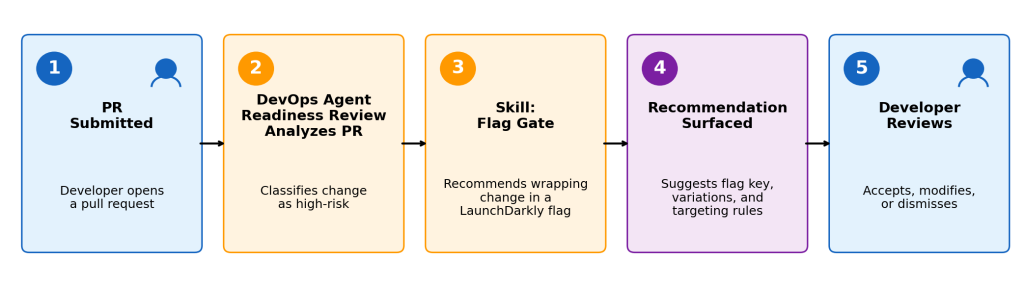
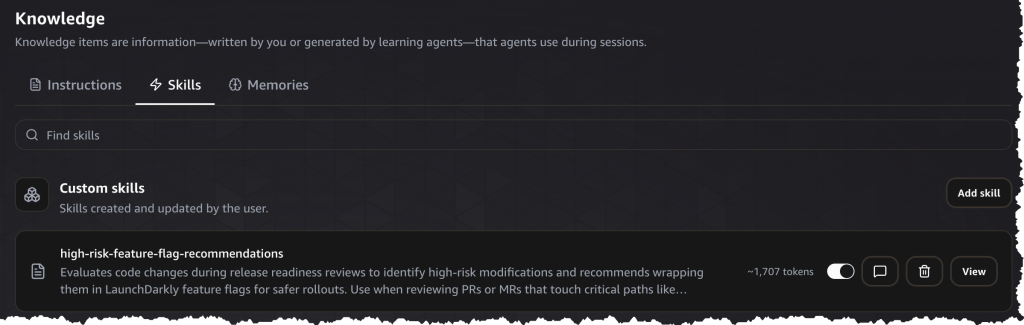
A cornerstone of AWS DevOps Agent’s extensibility is its "Skills" framework, allowing organizations to tailor and augment its capabilities to fit their unique tooling and operational requirements. In the context of feature flag management, a custom Skill can be deployed to assess whether identified high-risk changes possess adequate feature flag coverage. This Skill operates by analyzing deployment metadata and code, identifying potential gaps, and surfacing concrete recommendations directly to the developer, advocating for LaunchDarkly feature flags where necessary.
How the Skill Evaluates and Recommends
The release readiness flag Skill classifies code changes into distinct risk tiers—Critical, High, and Moderate—based on the nature of the modifications. Categories triggering these classifications include:
- Critical Risk: Changes impacting payment/billing logic, authentication/authorization mechanisms, database schema modifications (especially on high-traffic tables), data deletion or mutation operations, and new or altered third-party API integrations or core business logic (e.g., order processing, inventory management).
- High Risk: Introduction of new API endpoints, modifications to performance-sensitive code paths (e.g., caching logic, query optimizations), significant feature rewrites, concurrency changes, and critical configuration updates.
- Moderate Risk: UI changes to critical user flows, modifications to logging/monitoring, and adjustments to error handling or retry logic.
For identified gaps, the Skill generates a detailed recommendation, which includes:
- Flag Name: A descriptive, lower-cased, hyphenated name (e.g.,
enable-new-payment-processor). - Flag Type: Suggestion for the most appropriate LaunchDarkly flag type (Boolean for simple on/off, Multivariate for A/B testing or gradual migrations, Number/String for configuration values).
- Targeting Strategy: A recommended rollout strategy (e.g., percentage rollout starting at 1-5%, user segment targeting for internal users first, or environment-specific targeting).
- Kill Switch Guidance: A clear explanation of the flag’s behavior when disabled, including any cleanup, rollback considerations, or data consistency implications.
Example Scenario: Safeguarding Tax Calculation Updates
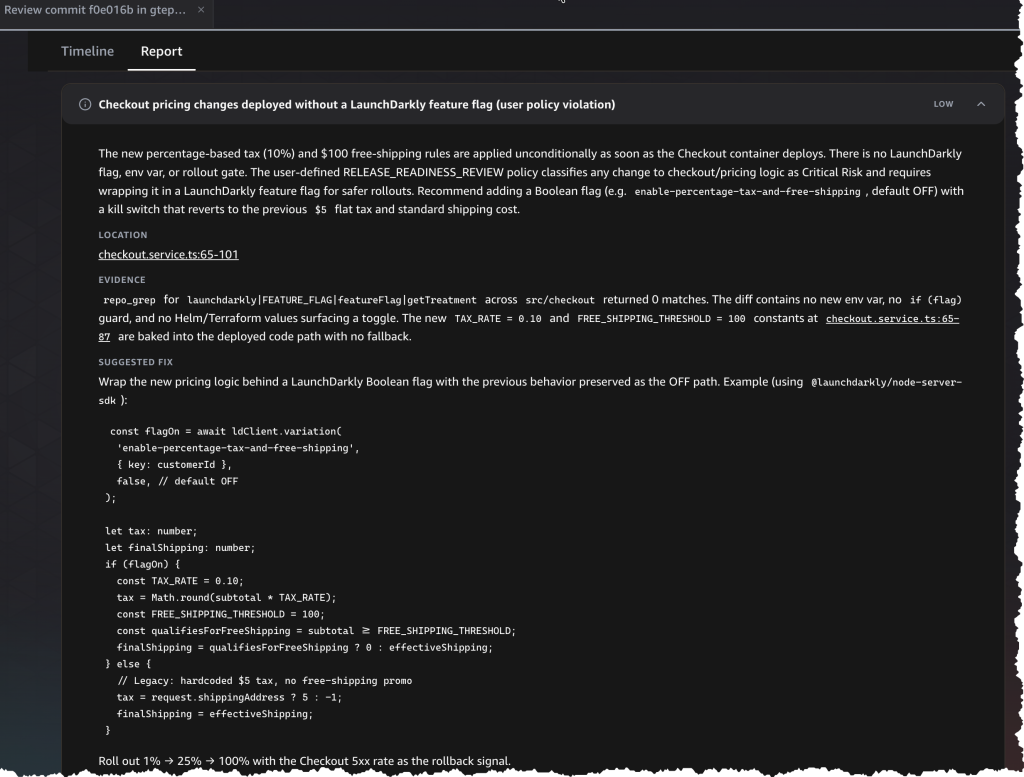
Consider a development team tasked with deploying an update to a tax calculation service. The change modifies the core logic for computing tax rates, a critical function affecting all order totals across multiple geographical regions. Upon submission, AWS DevOps Agent initiates its readiness review and classifies the deployment as high-risk due to its impact on core financial logic. The pre-deployment flag gate Skill then intelligently identifies that:
- The code change directly impacts a critical business function (tax calculation).
- There is no existing LaunchDarkly feature flag currently protecting this specific modification.
- The nature of the change warrants a controlled rollout strategy.
Consequently, the Skill surfaces a precise recommendation: "This deployment modifies tax calculation logic with no existing feature flag coverage. Recommend wrapping the new tax computation in a LaunchDarkly flag (tax-calculation-v2) with a phased rollout targeting internal test accounts first, followed by 5% of production traffic."
This actionable advice empowers the developer to implement the recommendation by creating the flag in LaunchDarkly, adjusting the suggested configuration as needed, or formally documenting a justification for proceeding without a flag. This process not only instills greater confidence in deployments but also creates an auditable record, improving compliance and accountability.
Closing the Loop with Kiro IDE
The efficacy of DevOps Agent’s release management capabilities is further amplified when paired with Kiro IDE. Kiro IDE integrates directly with LaunchDarkly via its MCP server, enabling flag integration capabilities seamlessly within the development environment. As a developer constructs a new feature in Kiro, the IDE can query LaunchDarkly to determine if a relevant flag already exists or generate code with the necessary flag evaluation built in from the outset.
This creates a continuous, "shift-left" workflow: DevOps Agent identifies risk and recommends flag coverage; the developer, working within Kiro, generates the flag and wraps the code in a single, fluid action; the deployment then ships with comprehensive flag coverage already in place. This eliminates context-switching between disparate tools and manual flag creation, streamlining the development process. Furthermore, Kiro’s independent flag integration offers a layered defense: if a developer utilizes Kiro during development, DevOps Agent validates the targeting rules at deployment. If Kiro is bypassed, DevOps Agent still identifies the critical gap, ensuring robust coverage.
Reactive Offense: Accelerating Incident Response with Flag Recommendations
During an active incident, the speed of containment is directly proportional to the potential customer impact. DevOps Agent plays a pivotal role in incident response workflows by querying LaunchDarkly for real-time flag state, then recommending targeted containment actions based on its findings. This capability is crucial, as studies have shown that faster incident resolution directly translates to reduced financial losses and improved customer satisfaction.
When an incident is detected, DevOps Agent automatically correlates the affected service with recent deployments and flag changes. It queries LaunchDarkly to identify feature flags associated with those deployments and retrieves their current state, including whether they are enabled, their targeting rules, and current rollout percentages. If a relevant flag is active, the agent intelligently recommends disabling it as a primary containment option, often preceding a full deployment rollback. This flag-based containment strategy offers a highly precise and often faster alternative to traditional rollbacks, which can be time-consuming and disruptive. Disabling a single flag can revert behavior to a stable state within minutes, minimizing service disruption.
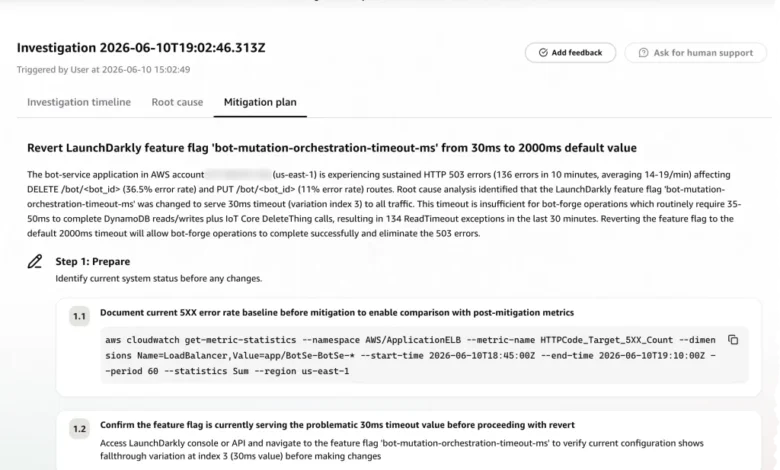
Example Scenario: Mitigating Bot-Service 5XX Errors
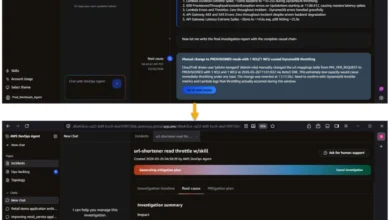
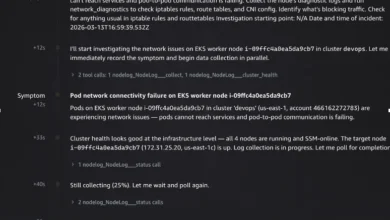
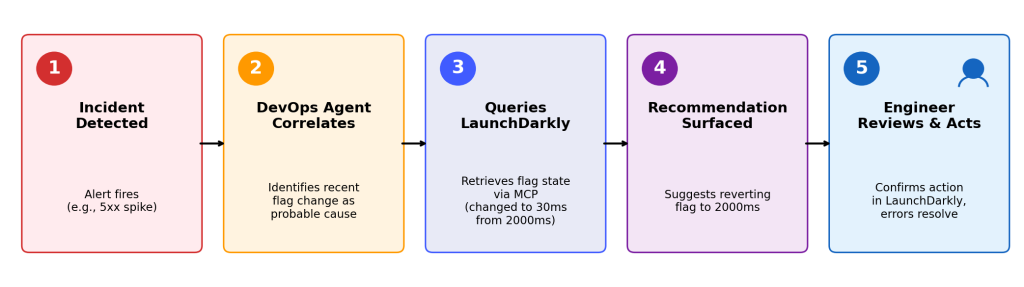
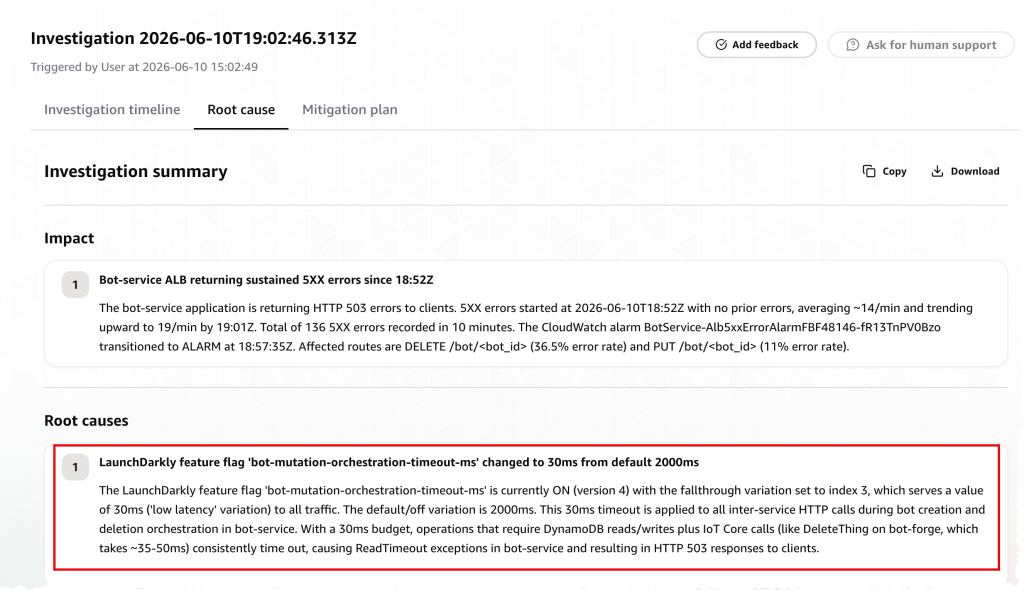
Imagine an alert indicating sustained 5XX errors on a critical bot-service. The on-call engineer engages DevOps Agent, which initiates an automated investigation:
- Correlation: DevOps Agent correlates the spike in errors with a recent change to the
bot-mutation-orchestration-timeout-msfeature flag. - Flag State Query: It queries LaunchDarkly via the MCP server and discovers that the flag’s value was recently changed from a default of 2000ms to a much shorter 30ms.
- Impact Analysis: The agent identifies that this aggressive timeout setting is causing
ReadTimeoutexceptions, leading to the 5XX errors. - Recommendation: DevOps Agent recommends reverting the
bot-mutation-orchestration-timeout-msflag to its previous 2000ms default value.
The engineer, presented with this clear diagnosis and actionable recommendation, updates the flag variation in LaunchDarkly. Within minutes, the error rate on the bot-service returns to baseline, demonstrating the power of intelligent, flag-aware incident response. This targeted approach avoids the need for a full service rollback, which could have been more disruptive and time-consuming.
Structured Mitigation Plans for Clarity and Efficiency
Beyond simple recommendations, when DevOps Agent pinpoints a root cause, it generates a comprehensive, structured mitigation plan. This isn’t a vague suggestion but a concrete, executable runbook designed to guide the on-call engineer through resolution. Each plan includes:
- Problem Statement: A clear articulation of the identified issue.
- Root Cause: A concise explanation of why the problem occurred, including evidence.
- Executable Steps: A series of precise sub-steps with specific commands, API paths, and clear success criteria.
This level of detail transforms a high-pressure incident into a manageable sequence of actions, reducing cognitive load for engineers and ensuring consistent, auditable resolution processes. For instance, a mitigation plan might include an AWS CLI command to document the current error baseline, followed by steps to modify the LaunchDarkly flag via its API or console, and then subsequent commands to verify the resolution.
The Technical Backbone: Connecting to LaunchDarkly via MCP
The seamless integration between AWS DevOps Agent and LaunchDarkly is facilitated by the Model Context Protocol (MCP) server feature. MCP is a standardized protocol designed to allow agents to interact with domain-specific tools, exposing their management operations in a consistent, programmatic way. LaunchDarkly’s hosted MCP server makes flag management operations accessible to DevOps Agent as agent-callable tools.
Architecture and Flow:
- Request Initiation: A developer or an automated workflow initiates an action (e.g., a pull request review or an incident investigation) that triggers DevOps Agent.
- Skill Activation: DevOps Agent loads and executes a relevant Skill (e.g., "high-risk-feature-flag-recommendations" or an incident response Skill).
- MCP Query: The Skill, recognizing the need for feature flag data, directs DevOps Agent to query LaunchDarkly’s hosted MCP server. This query leverages the agent’s pre-configured credentials and permissions.
- Data Retrieval & Action: LaunchDarkly’s MCP server processes the request, retrieves flag state, targeting rules, or other relevant data, and returns it to DevOps Agent. Based on this information, the Skill formulates and surfaces its recommendation.
Registration and Configuration:
Setting up this powerful connection involves a few straightforward steps:
- LaunchDarkly Account: Ensure an active LaunchDarkly account with appropriate projects and environments.
- API Key Generation: Generate a dedicated LaunchDarkly API key with the necessary read/write permissions for flag management.
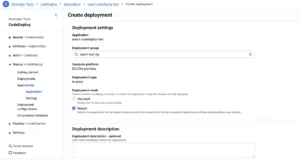
- DevOps Agent Configuration: Configure AWS DevOps Agent to connect to LaunchDarkly’s hosted MCP server, providing the generated API key and specifying the relevant LaunchDarkly project and environment details.
This same LaunchDarkly MCP server connection is also leveraged by Kiro IDE, providing a consistent and robust interface for flag-aware code generation throughout the development cycle.
Example Skill: High-Risk Feature Flag Recommendations
AWS DevOps Agent Skills are modular instruction sets that embed specialized domain knowledge and investigation methodologies. The "High-Risk Feature Flag Recommendations" Skill exemplifies this by providing a structured framework for evaluating code changes and generating specific flag recommendations. Its flexible format typically includes:
- Skill Description: A high-level overview of the Skill’s purpose.
- Risk Classification Criteria: Detailed definitions of Critical, High, and Moderate risk changes.
- Feature Flag Recommendation Format: Guidelines for structuring flag name, type, targeting strategy, and kill switch guidance.
- Example Recommendations: Concrete scenarios demonstrating how the Skill applies its logic.
- Integration Notes: Instructions on how the Skill’s output should be presented in workflows.
- What NOT to Flag: Guidance to avoid unnecessary flag recommendations.
Activating this Skill for consistent application during release readiness reviews is straightforward. A directive added to the Agent.md file (DevOps Agent’s instructions) ensures the Skill is always loaded and applied, guaranteeing that every release readiness review benefits from intelligent feature flag evaluation.
Broader Implications and Industry Impact
This integration marks a significant step forward in the evolution of DevOps practices. By automating the intelligence around feature flag management, AWS and LaunchDarkly are empowering organizations to achieve:
- Enhanced Operational Resilience: The ability to proactively prevent issues and reactively contain them with precision dramatically reduces the risk of costly outages.
- Accelerated Innovation: Developers can ship features faster and with greater confidence, knowing that robust flag coverage and automated safety nets are in place.
- Improved Developer Experience: Reduced manual overhead, context-switching, and uncertainty lead to a more efficient and less stressful development and operations workflow.
- Strategic Shift-Left: Integrating flag awareness from the IDE through pre-deployment reviews ensures quality and safety are built in from the earliest stages.
- Democratization of Advanced Practices: The automated recommendations and structured plans make sophisticated feature flag management accessible even to teams without deep expertise, raising the bar for DevOps maturity across the board.
- AI-Driven Automation: This collaboration is indicative of a broader trend towards leveraging intelligent automation to streamline complex IT operations, moving beyond simple scripting to contextual, data-driven recommendations.
This joint solution underscores AWS’s commitment to providing comprehensive tools for modern software development and LaunchDarkly’s dedication to making feature flag management more intelligent and integrated. It represents a strategic move to address some of the most pressing challenges in balancing speed, reliability, and innovation in today’s fast-paced digital landscape.
Getting Started
Organizations eager to harness the power of this integration can begin by:
- Setting up LaunchDarkly: Ensure a LaunchDarkly account is active and configured.
- Configuring AWS DevOps Agent: Deploy and configure AWS DevOps Agent within their AWS environment.
- Connecting via MCP: Establish the connection between DevOps Agent and LaunchDarkly’s hosted MCP server using the provided documentation.
- Activating Skills: Import and activate the "High-Risk Feature Flag Recommendations" Skill and explore other custom Skills to tailor the agent’s behavior.
Conclusion
The integration of feature flag orchestration with AWS DevOps Agent and LaunchDarkly fundamentally redefines how organizations manage software deployments and respond to incidents. By automating flag recommendations before high-risk changes are shipped and enabling intelligent, flag-based containment during active incidents, this collaboration promises faster resolution times and significantly reduced disruption compared to traditional methods.
For developers leveraging Kiro IDE, the seamless connection to LaunchDarkly’s MCP server facilitates flag-aware code generation, effectively shifting flag coverage left to the point of authorship. This layered approach ensures comprehensive protection: individual developers build with flags, DevOps Agent’s release management capabilities validate coverage at deployment, and DevOps Agent utilizes real-time flag state for swift incident response. This unified strategy is set to empower development and operations teams with unprecedented control, efficiency, and resilience in the ever-evolving world of software delivery.
Authors
Related posts: