The Public’s True Demand for AI: Augmentation Over Autonomy, Integration Over Intrusion

Many companies operate under the silent assumption that the public universally craves more Artificial Intelligence in their lives, envisioning a future where new AI features, products, and workflows magically replace outdated practices. However, a growing body of evidence and user sentiment suggests a starkly different reality: most people don’t want more AI, at least not in the disruptive, all-encompassing way many AI leaders envision it. Instead, there is a clear preference for AI that is seamlessly integrated, reliable, and serves to augment human capabilities by automating mundane tasks, thereby freeing up time for more meaningful pursuits.
This prevailing corporate mindset, often fueled by competitive pressures and the allure of technological advancement, often translates into the development of "bolt-on" AI features. These additions, rather than enhancing existing workflows, frequently pull users out of their familiar operational patterns, forcing them to adapt to new, often fragmented, systems. Consequently, numerous AI features suffer from low adoption and retention rates, despite the significant investment in their development and the inherent risks of reputational damage should they fail to deliver. This phenomenon highlights a critical disconnect between the industry’s supply-driven approach to AI and the actual demand from end-users.
The Misguided Push for "More AI"
The notion that "AI is a value proposition" is a pervasive but ultimately flawed belief within many organizations. Experts like David Bland have illustrated this succinctly, noting that AI belongs in the "Key Activities" and "Key Resources" sections of a Business Model Canvas, not in the "Value Propositions." Simply labeling a product or feature as "AI-powered" does not automatically translate into happy or excited customers. When AI features are introduced as separate tools, they often complicate rather than simplify, requiring employees to navigate yet another disconnected system in an already fragmented digital landscape. This often leads to increased workload and diminished job satisfaction, as users spend more time managing these new tools than benefiting from them.
Moreover, AI, far from being a panacea, often amplifies existing organizational shortcuts and shortcomings. Issues ranging from poor data quality to inconsistent decision-making processes become more glaringly apparent when AI is applied. It cannot magically resolve years of accumulated technical debt, quick patches, broken organizational culture, or internal politics. Instead, these inconsistencies are often exposed and even exacerbated, presenting users with a complex "mess" they are left to decipher and manage. This unintended consequence undermines the very promise of efficiency and improvement that AI is often touted to deliver.
The Hidden Costs and User Resistance
The widespread adoption of generative AI has also brought to light the significant "cost of finding and fixing AI hallucinations." While asking an AI to generate a response might initially feel easier than crafting one from scratch, it introduces a new layer of verification and correction. Users are acutely aware that AI outputs can be inaccurate, biased, or nonsensical, requiring substantial human oversight to ensure quality and factual integrity. This additional cognitive load and time investment negate much of the perceived efficiency gains, turning AI interaction into a task of vigilant error-checking rather than effortless productivity.

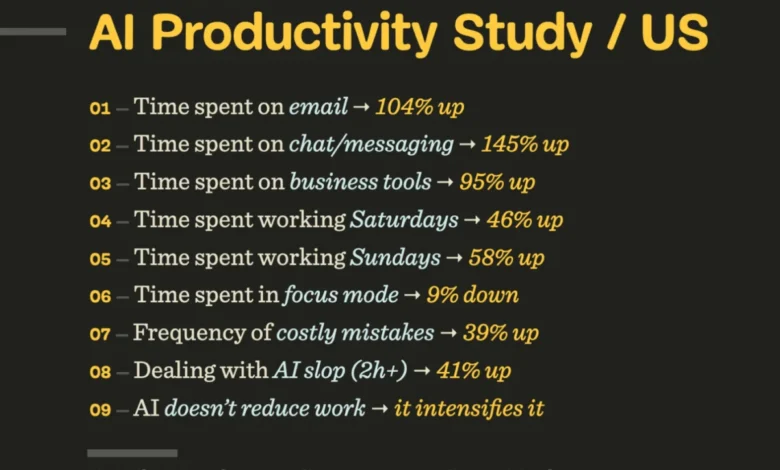
Beyond the practical challenges, there’s a profound psychological dimension to user resistance. For many, AI arrives uninvited, dictated by corporate timelines rather than individual needs or desires. This lack of agency, combined with pervasive media narratives about AI replacing jobs, fuels fears and anxieties rather than excitement. Reports from sources like the Washington Post highlight how various professions are exposed to AI automation, contributing to a broader societal apprehension. This resistance to change is not merely technological but deeply rooted in concerns about job security and one’s place in a rapidly evolving world. A study compiled by Mike Rosenberg (NBC News, HBR, WSJ, Activtrak) revealed that rather than reducing work, AI often intensifies it: email time up 104%, chat/messaging up 145%, business tools up 95%, working Saturdays up 46%, working Sundays up 58%, focus mode down 9%, costly mistakes up 39%, and dealing with "AI slop" up 41%. These findings starkly contradict the narrative of AI as a universal productivity booster.
Consequently, user perception of AI ranges from silent acceptance to outright skepticism and concern. Unlike other software features that offer predictable and reliable outcomes, AI is often viewed as inherently unpredictable and potentially unreliable. This perception positions AI not as an asset but as a potential liability, further eroding trust and hindering adoption. The public does not yearn for AI art museums, AI-powered fridges, AI hotel receptionists, or AI-narrated children’s books. They are not seeking romantic AI partners, nor do they wish to actively manage a "swarm of AI agents" acting on their behalf in their bank accounts. The notion of constantly conversing with a "magical box" for every task is equally unappealing. These examples underscore a fundamental misunderstanding by developers of what problems AI should genuinely solve for people.
The AI People Actually Need: An "AI-Second" Approach
The true measure of AI’s value lies not in its technological sophistication or the speed of its delivery, but in its ability to consistently and reliably serve human needs. Users compare features with features, not software with human fallibility. If an AI-powered feature is unreliable, while a non-AI alternative works flawlessly, the latter will always be preferred. The emphasis should therefore be on functionality and consistency, irrespective of the underlying technology.

Most people prioritize doing things well, with ample time for thoughtful decision-making, and deriving enjoyment from their work. The relentless pursuit of faster delivery, often at the expense of quality and human satisfaction, strips away the intrinsic reward and achievement associated with meaningful work. What users truly need are features that are fast, accessible, reliable, predictable, and useful—every single time. Crucially, these should be tools that augment existing workflows, taking over the most mundane, annoying, and boring tasks, rather than replacing entire processes or forcing radical behavioral shifts.
Many jobs, despite being exposed to AI automation, contain a rewarding, unique, and creative core that demands human taste, perspective, and intuition. When AI is deployed to automate the tedious and mentally exhausting aspects of these roles, its value becomes immediately apparent. This approach not only enhances productivity but also infuses daily work with greater joy and purpose. Such AI should not feel like a separate add-on but be deeply integrated into people’s established workflows and mental models. The technology should adapt to how humans think and make decisions, not the other way around.
This human-centric approach leads to what is often termed "AI-second" tools. These are not "AI-first" products that center the technology, but rather solutions where AI plays a subtle, humble, calm, and ambient supportive role in the background. It quietly handles dull and unnecessary tasks, allowing humans to focus on what truly matters. As Bo Young Lee eloquently stated, "I don’t want to read books written by AI. I don’t want to gaze upon paintings by AI. I don’t want AI to teach my children. I don’t want to have an AI therapist. I don’t want AI making my medical decisions. I want AI to do all the physical and mental labor that taxes me so I can read books written by humans and go to art galleries to engage with art made by humans. I want AI that makes my life easier rather than forces me to change myself." This sentiment perfectly encapsulates the desired role of AI: a powerful assistant, not a replacement for human experience or creativity.
Broader Implications and Industry Pivot

The implications of this user-centric perspective are profound for the entire AI industry. Product developers and UX designers must shift their focus from showcasing AI capabilities to identifying genuine user pain points that AI can reliably alleviate. Business leaders need to re-evaluate investment strategies, prioritizing solutions that demonstrate clear, measurable value in augmenting human work over speculative, disruptive applications. This pivot necessitates a deeper understanding of user research, ethnographic studies, and human-centered design principles.
Companies that embrace this "AI-second" philosophy are likely to see higher adoption rates, greater user satisfaction, and ultimately, more sustainable business models. It suggests a future where AI’s success is not measured by its presence, but by its seamless, often invisible, utility. This shift also opens opportunities for specialized training in designing effective AI interfaces, such as the "Design Patterns For AI Interfaces" course, which focuses on practical examples and UX principles to build AI that truly serves people.
The current trajectory of AI development, if it continues to disregard user needs and anxieties, risks alienating a significant portion of the population. The industry must move beyond the initial hype cycle and cultivate a more thoughtful, ethical, and human-aligned approach to AI innovation. This involves robust testing, transparent communication about AI’s limitations, and a commitment to building tools that genuinely enhance human well-being and productivity.
In conclusion, the widespread corporate assumption that people crave more AI is a fundamental misreading of human desire. People don’t need more AI in their lives; they need AI to automate the mundane, time-consuming tasks that detract from their ability to engage in activities they truly love and enjoy. The ultimate goal of AI should be to liberate human potential, not to create new burdens or anxieties. This means fostering more time spent with other humans, engaging in creative pursuits, and enjoying life, rather than spending more time interacting with algorithms. The future of AI success lies in its humility, its reliability, and its unwavering commitment to serving humanity in the background, quietly making life easier and more fulfilling.