AWS DevOps Agent and LaunchDarkly Integration Revolutionizes Feature Flag Management for Enhanced Release Safety and Accelerated Incident Response

Organizations navigating the complexities of modern software delivery often grapple with the manual overhead of integrating feature flag management with their incident response and deployment workflows. This disconnect forces engineers to manually identify relevant flags during outages, make critical disabling decisions, and coordinate changes across diverse teams, introducing significant latency at moments when rapid action is paramount. However, a new integration leveraging the AWS DevOps Agent and LaunchDarkly’s hosted Model Context Protocol (MCP) server is poised to transform this landscape, offering automated feature flag recommendations during both proactive deployment reviews and reactive incident response workflows. This synergistic solution empowers engineering teams to query flag states, interpret targeting rules, and receive actionable recommendations directly within their operational environments, drastically reducing manual effort and improving decision-making speed.
The Evolving Challenge of Feature Flag Orchestration
Feature flags, also known as feature toggles, have become an indispensable tool in modern software development, enabling teams to decouple code deployment from feature release. They facilitate continuous delivery, A/B testing, gradual rollouts, and kill switches for problematic features. Despite their benefits, the operational management of feature flags, particularly in large-scale environments, presents its own set of challenges. Engineers often find themselves juggling multiple tools – a version control system for code, a CI/CD pipeline for deployment, an incident management system for outages, and a separate platform for feature flags. The manual correlation of these disparate systems introduces friction, increases the risk of human error, and extends the Mean Time To Resolution (MTTR) during incidents. A recent industry report indicated that the average MTTR for critical incidents can still span several hours, with much of that time spent on diagnostics and coordination, areas where intelligent automation can make a substantial difference. The ability to automatically identify, assess, and recommend actions related to feature flags across the software lifecycle is not merely a convenience but a strategic imperative for maintaining high availability and accelerating innovation.
Bridging the Gap: AWS DevOps Agent and LaunchDarkly via MCP
The core of this transformative integration lies in the AWS DevOps Agent’s ability to connect with LaunchDarkly’s hosted MCP server. The Model Context Protocol (MCP) is an open specification designed to enable interoperability between developer tools and platforms, allowing agents to understand and interact with the operational context of various systems. By leveraging MCP, AWS DevOps Agent establishes a direct, programmatic link to LaunchDarkly, a leading feature management platform known for its robust capabilities in feature flagging, experimentation, and progressive delivery. This connection grants the DevOps Agent real-time access to critical feature flag data – including their current state, associated targeting rules, and historical changes – without requiring complex, custom API integrations. This foundational link is crucial for enabling the two primary use cases that redefine how organizations manage releases and respond to incidents: proactive deployment review and reactive incident response. The integration not only streamlines operations but also embeds intelligence directly into the DevOps workflow, ensuring that feature flags are utilized optimally throughout the software development lifecycle.
Proactive Defense: Reinforcing Release Management with Intelligent Flag Recommendations
One of the most significant advancements offered by this integration is its capability to enhance release management through proactive feature flag recommendations. AWS DevOps Agent, with its publicly previewed release management capabilities, is designed to evaluate code changes rigorously before they ever reach production. This involves a multi-faceted assessment that includes functional testing in AWS-managed verification environments, risk analysis of cross-codebase dependencies, validation against organizational standards and best practices, and even mathematical verification of CloudFormation access control configurations to ensure adherence to Well-Architected principles.
The true power of AWS DevOps Agent, however, lies in its extensibility. Organizations can customize and extend its capabilities by adding specialized "Skills." For instance, a custom Skill can be developed to specifically evaluate whether a high-risk code change possesses adequate feature flag coverage. This "Flag Gate Skill" operates by analyzing deployment metadata and code changes, identifying potential gaps, and then surfacing precise, actionable recommendations directly to the developer. This shift-left approach means that potential issues are identified and addressed at the earliest possible stage, significantly reducing the likelihood of production incidents.
Understanding the High-Risk Feature Flag Recommendation Skill
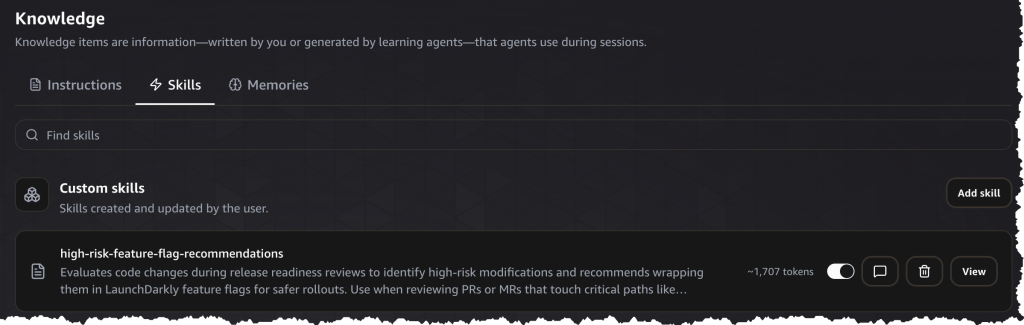
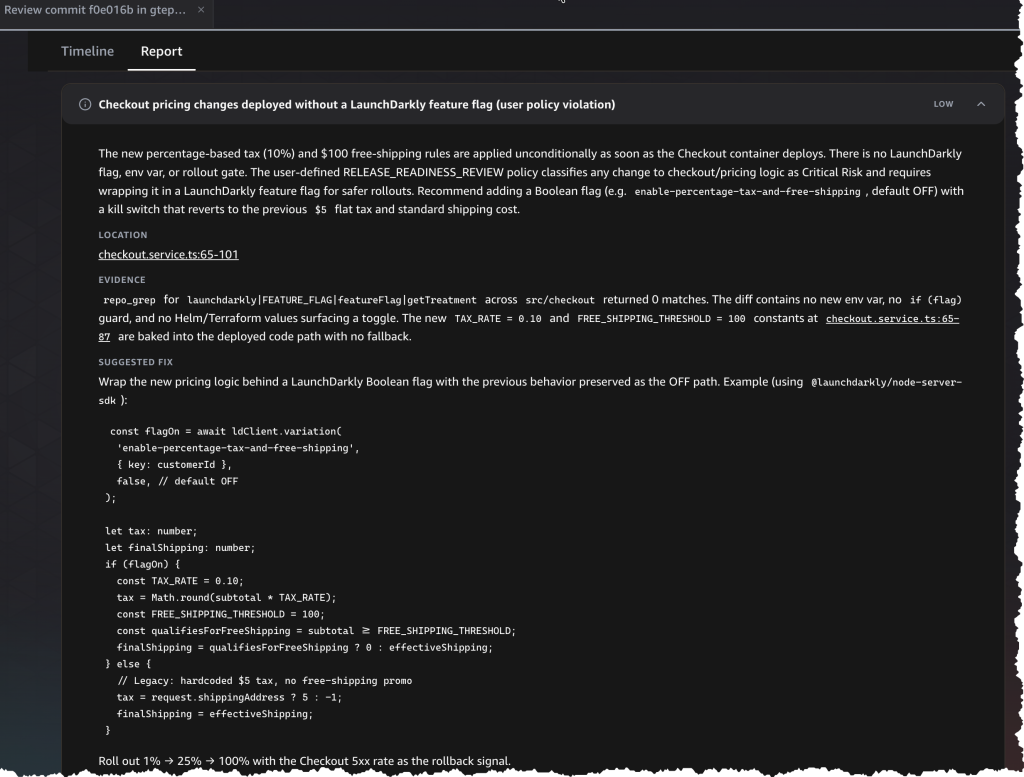
The specialized "High-Risk Feature Flag Recommendations" Skill is central to this proactive defense strategy. It classifies incoming code changes into distinct risk tiers – Critical, High, and Moderate – based on the nature and potential impact of the modifications. Changes affecting sensitive areas like payment processing, authentication, database schemas, third-party integrations, new API endpoints, or performance-sensitive paths are immediately flagged for their inherent risk. The Skill then recommends feature flag coverage proportional to this identified risk level, ensuring that appropriate guardrails are in place.
When a gap in feature flag coverage is detected, the Skill doesn’t just raise an alert; it provides a comprehensive recommendation. This includes a suggested flag name (e.g., enable-new-payment-processor), an appropriate flag type (Boolean, Multivariate, Number/String), a tailored targeting strategy (e.g., percentage rollout, user segment targeting, environment targeting), and crucial kill switch guidance detailing the behavior when the flag is disabled, along with any necessary cleanup or rollback considerations. This level of detail empowers developers to implement the recommended flag quickly and correctly, minimizing the cognitive load during the development and deployment process.
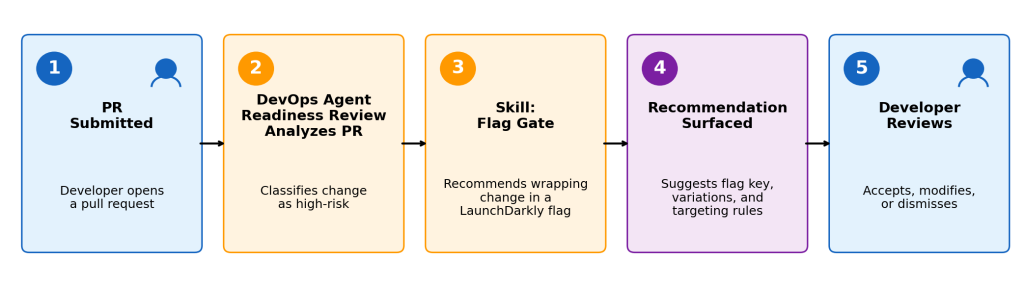
Consider a practical scenario: a development team is deploying an update to a critical tax calculation service. The change involves modifying the core logic for tax rate computation, impacting all order totals across multiple geographical regions. AWS DevOps Agent evaluates this deployment and classifies it as "high-risk." The pre-deployment Flag Gate Skill then meticulously identifies that this critical modification lacks any existing feature flag coverage. It proceeds to surface a clear, actionable recommendation: "This deployment modifies tax calculation logic with no existing feature flag coverage. Recommend wrapping the new tax computation in a LaunchDarkly flag (tax-calculation-v2) with a phased rollout targeting internal test accounts first, followed by 5% of production traffic." The developer can then immediately act on this recommendation, creating the flag in LaunchDarkly, adjusting the rollout plan as needed, or documenting the justification for proceeding without a flag as part of an auditable deployment record. This structured approach not only enhances deployment safety but also contributes to a culture of accountability and informed decision-making.
Closing the Loop: Kiro IDE and the Shift-Left Paradigm
The synergy extends further with the integration of Kiro IDE. While AWS DevOps Agent’s release management capabilities are adept at identifying the need for feature flag coverage, Kiro IDE makes the implementation of these recommendations seamless within the development workflow itself. Kiro connects directly to LaunchDarkly’s MCP server, offering integrated flag capabilities during feature development. When a developer is building a new feature in Kiro, the IDE can query LaunchDarkly via MCP to check for existing flags or even generate code with the necessary flag evaluations built in from the outset. This "shift-left" approach ensures that feature flags are considered and implemented as an integral part of the development process, rather than an afterthought.
Together, this creates a continuous, highly efficient flow: AWS DevOps Agent identifies the risk and recommends flag coverage; the developer, working within Kiro, generates the flag and wraps the code in a single, integrated action; and the deployment proceeds with robust feature flag coverage already in place. This eliminates the need for context-switching between different tools and manual flag creation, significantly boosting developer productivity and ensuring consistent adherence to best practices. Even if a developer bypasses Kiro or uses a different toolchain, the layered coverage ensures that AWS DevOps Agent will still identify any missing flag coverage during the crucial release readiness review.
Reactive Offense: Accelerating Incident Response with Flag-Based Containment
During an active incident, every second counts. The speed of containment directly correlates with the reduction of customer impact and financial losses. The integration of AWS DevOps Agent with LaunchDarkly fundamentally transforms incident response by enabling the agent to participate actively in containment strategies. When an incident is detected, DevOps Agent correlates the affected service with recent deployments and queries LaunchDarkly to identify feature flags associated with those deployments, including their current state (enabled, targeting rules, rollout percentage). If a relevant flag is enabled and potentially contributing to the incident, the agent can recommend disabling it as a primary containment option, often as a faster alternative to a full deployment rollback.
Flag-based containment offers a distinct advantage: it can return system behavior to a known good state much faster than rolling back an entire deployment, which often involves redeploying previous code versions and can introduce its own set of risks and delays. A quick flag toggle can isolate the problematic feature, restoring service stability within minutes, thereby dramatically reducing the Mean Time To Recovery (MTTR). Studies have shown that organizations with mature feature flagging practices can resolve critical incidents up to 50% faster than those relying solely on traditional rollback methods.
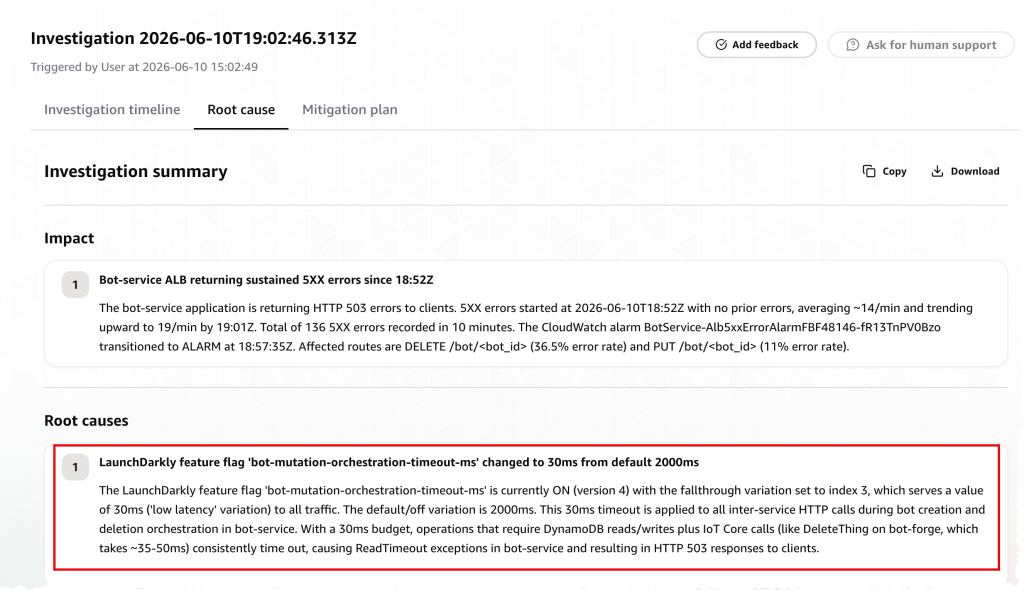
Incident Scenario: Bot-Service 5XX Errors
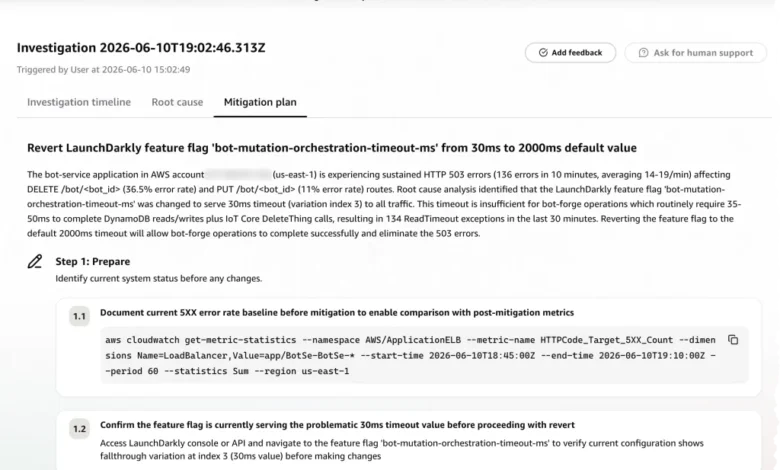
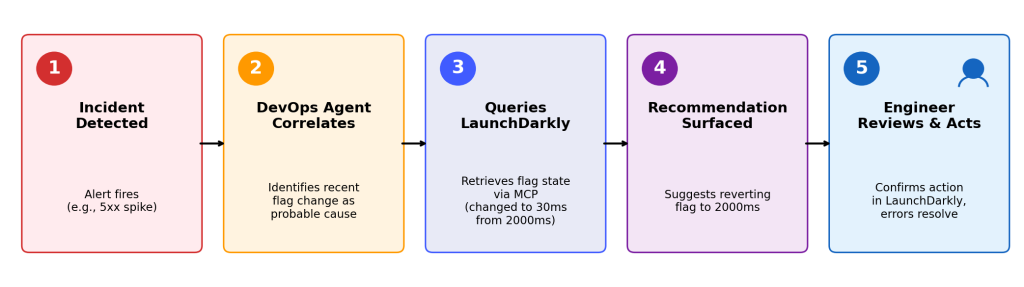
Consider a scenario where an alert fires, indicating sustained 5XX errors on a critical bot-service. An on-call engineer engages AWS DevOps Agent for assistance. The agent rapidly performs the following actions:
- Correlates the incident: It identifies recent changes related to the
bot-service. - Queries LaunchDarkly: It discovers a recent modification to the
bot-mutation-orchestration-timeout-msfeature flag, which was changed from a default of 2000ms to an aggressive 30ms. - Identifies Root Cause: It correlates this flag change with the observed ReadTimeout exceptions, pinpointing the flag as the probable cause of the 5XX errors.
- Recommends Containment: It immediately recommends reverting the
bot-mutation-orchestration-timeout-msflag value from 30ms back to its default of 2000ms.
Upon reviewing the recommendation, the engineer updates the flag variation in LaunchDarkly. Within minutes, the error rate returns to baseline, and the incident is resolved with minimal disruption, demonstrating the power of intelligent, flag-aware incident response.
Structured Mitigation Plans for Clarity and Speed
Beyond just identifying the root cause and suggesting a containment action, AWS DevOps Agent elevates incident response by generating structured mitigation plans. These plans are not vague recommendations but concrete, executable steps designed to guide the on-call engineer through the resolution process. Each plan typically includes:
- A concise summary of the mitigation goal: Clearly stating what needs to be achieved.
- A step-by-step procedure: Outlining the exact actions to take.
- Specific commands, API paths, and success criteria: Providing the granular detail required for execution and verification.
This level of detail transforms a potentially stressful and ambiguous situation into a clear, auditable runbook, significantly reducing cognitive load and the potential for error during high-pressure incidents. For instance, a mitigation plan might include sub-steps to document the current 5XX error baseline using an AWS CLI command, confirm the problematic flag value via the LaunchDarkly API, execute the flag change, and then verify the resolution by monitoring error rates, all within a single, coherent plan. This structured approach not only accelerates resolution but also contributes to better post-incident analysis and knowledge sharing.
Technical Deep Dive: Connecting to LaunchDarkly via MCP
The seamless integration relies on AWS DevOps Agent’s ability to connect to LaunchDarkly’s hosted MCP server. This connection architecture is designed for security, efficiency, and scalability.
Architecture Flow:
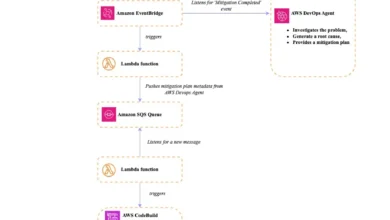
- DevOps Agent Initiates Query: When a release readiness review or an incident investigation requires feature flag data, AWS DevOps Agent sends a query.
- Query Routes to LaunchDarkly MCP Server: This query is securely routed to LaunchDarkly’s hosted MCP server.
- MCP Server Processes Request: The MCP server translates the agent’s query into LaunchDarkly-specific operations.
- LaunchDarkly API Interaction: The MCP server interacts with the LaunchDarkly API to retrieve real-time flag state, targeting rules, and other relevant data.
- Response to DevOps Agent: The data is then securely transmitted back to the DevOps Agent, which uses it to formulate recommendations or contribute to its analysis.
Registration and Configuration:
Setting up this connection involves a straightforward process:
- LaunchDarkly Configuration: Configure a dedicated API key in LaunchDarkly with the necessary permissions for the AWS DevOps Agent to read flag data and potentially modify flag states (for incident response actions).
- AWS DevOps Agent Registration: Register the LaunchDarkly MCP server endpoint within AWS DevOps Agent’s configuration, providing the API key for authentication.
- Skill Development/Activation: Develop or activate the relevant DevOps Agent Skills (like the "High-Risk Feature Flag Recommendations" Skill) that leverage this MCP connection to perform their analysis and generate recommendations.
This robust connection ensures that the DevOps Agent always has access to the most current and accurate feature flag information, enabling its intelligent capabilities across the development and operations lifecycle. The same LaunchDarkly MCP server connection is also utilized by Kiro IDE, further unifying the feature flag experience from development to deployment and incident response.
Broader Implications for DevOps and Engineering Excellence
The integration of AWS DevOps Agent and LaunchDarkly represents a significant leap forward for DevOps practices, offering profound implications for engineering excellence:
- Enhanced Software Delivery Velocity and Quality: By automating the assessment of feature flag coverage and providing actionable recommendations, teams can deploy new features faster and with greater confidence, knowing that robust guardrails are in place. This reduces friction in the CI/CD pipeline and improves the overall quality of releases.
- Improved System Reliability and Resilience: Proactive flag recommendations prevent potentially risky changes from reaching production without proper containment strategies. During incidents, rapid, flag-based containment options drastically reduce downtime and improve MTTR, directly translating to higher system availability and customer satisfaction.
- Reduced Operational Burden and Cognitive Load: Engineers are freed from manual correlation and decision-making under pressure. The automated recommendations and structured mitigation plans reduce stress during incidents and streamline pre-deployment reviews, allowing teams to focus on innovation rather than operational firefighting.
- Empowered Developer Experience: Integrating flag management into the IDE (via Kiro) and the deployment pipeline makes feature flagging an intuitive part of the development process, fostering a culture of safe and controlled experimentation.
- Data-Driven Decision Making: By providing real-time access to flag states and targeting rules, the integration facilitates more informed decisions, not only during incidents but also for A/B testing and progressive delivery strategies.
- Improved Compliance and Auditability: Every recommendation, action, and justification is logged within the DevOps Agent’s reports, providing a clear, auditable trail of decisions made during both proactive reviews and reactive incident responses, which is crucial for regulated industries.
This integration is not just about connecting two tools; it’s about creating an intelligent, self-optimizing DevOps ecosystem that proactively mitigates risks and reactively accelerates recovery, setting a new standard for operational excellence.
Activating the Skill: Embedding Intelligence in Workflows
To ensure the "High-Risk Feature Flag Recommendations" Skill is consistently applied during release readiness reviews, it’s crucial to activate it within AWS DevOps Agent’s instructions. DevOps Agent loads Skill metadata at the beginning of each workflow and retrieves the full Skill content when it determines relevance. For critical Skills like this, explicit activation is key. Adding a directive to your Agent.md file (which is loaded at the start of every session) guarantees consistent application:
“When performing release readiness reviews, always load and apply the high-risk-feature-flag-recommendations skill to evaluate code changes for risk and recommend LaunchDarkly feature flags where appropriate.”
This simple directive ensures that the agent consistently loads and applies the Skill for every release readiness review, eliminating reliance on dynamic relevance detection and guaranteeing comprehensive coverage.
Getting Started and Conclusion
The integration of AWS DevOps Agent and LaunchDarkly through the Model Context Protocol marks a significant milestone in optimizing software delivery and operational resilience. This powerful combination reduces the manual coordination and latency typically associated with feature flag management during both proactive deployment reviews and reactive incident response. By leveraging a specialized DevOps Agent Skill, organizations can ensure that intelligent flag recommendations are surfaced before high-risk changes ship, preventing potential outages. During active incidents, the agent’s ability to query LaunchDarkly for real-time flag states enables it to recommend precise, flag-based containment actions, leading to faster resolution with significantly less disruption than traditional full rollbacks.
For developers, the complementary integration with Kiro IDE further enhances this ecosystem by enabling flag-aware code generation directly within the development environment, shifting flag coverage left to the point of authorship. This layered approach ensures comprehensive protection: individual developers build with flags, AWS DevOps Agent’s release management capabilities validate coverage at deployment time, and the agent then utilizes flag state for rapid incident response. Organizations looking to enhance their DevOps maturity, reduce incident MTTR, and build more resilient software delivery pipelines are encouraged to explore this integration.
To begin harnessing the power of feature flag orchestration with AWS DevOps Agent and LaunchDarkly, interested parties can start by configuring the MCP server connection in AWS DevOps Agent, then activating the "High-Risk Feature Flag Recommendations" Skill, and finally integrating Kiro IDE into their development workflows for a truly end-to-end, intelligent feature flag management solution.
Authors
Related posts: