AWS CloudFormation Introduces Express Mode to Accelerate Development Workflows


Amazon Web Services (AWS) has unveiled CloudFormation Express Mode, a significant enhancement designed to drastically cut down deployment times for cloud infrastructure, particularly in development and iterative testing environments. This new feature allows developers to receive immediate confirmation that their infrastructure configuration has been applied, rather than waiting for resources to fully stabilize and become ready to serve live traffic, which can often be a time-consuming process. The move underscores AWS’s continuous commitment to optimizing developer experience and accelerating the pace of innovation for its vast user base.
Contextual Background: The Evolution of Infrastructure as Code and the Need for Speed
The practice of Infrastructure as Code (IaC) has become fundamental to modern cloud operations, enabling organizations to manage and provision computing resources through machine-readable definition files rather than manual configuration. AWS CloudFormation stands as a cornerstone of this paradigm within the AWS ecosystem, empowering users to model and provision their cloud infrastructure using declarative templates written in JSON or YAML. Beyond direct template usage, CloudFormation serves as the provisioning engine for higher-level abstraction tools like the AWS Cloud Development Kit (CDK) and the AWS Serverless Application Model (SAM), further democratizing access to robust, scalable infrastructure.
The benefits of IaC are numerous: consistency, version control, reusability, and reduced human error. However, as development cycles have become increasingly agile and continuous integration/continuous deployment (CI/CD) pipelines have matured, the speed of infrastructure provisioning has emerged as a critical bottleneck. Every minute spent waiting for a deployment to complete translates into reduced developer productivity, delayed feedback loops, and a slower pace of iteration. This challenge is amplified in environments where developers are constantly experimenting, testing new configurations, and refining application architectures.
The Intricacies of Resource Stabilization: A Historical Bottleneck
Traditionally, when CloudFormation reports a stack operation as CREATE_COMPLETE, it signifies that all resources within that stack are not just created but also fully stabilized and ready to serve traffic. This "stabilization" phase accounts for the time it takes for a resource to transition from a configured state to an operational state. For instance, an AWS::SQS::Queue might be created, but it takes additional time before it can reliably receive messages. Similarly, an Amazon EC2 instance is launched, but it requires a period to initialize and respond to HTTP requests. A CloudFront distribution, once created, needs time to propagate its configuration to edge locations worldwide before it can effectively cache and serve content. An Amazon ECS service might be ACTIVE, but its containers must pass health checks and reach desired capacity before the service is fully operational. Even resource deletions, such as a Lambda function, aren’t truly complete until associated network interfaces are cleaned up.
This comprehensive stabilization process, while crucial for ensuring production readiness, introduced inherent delays. While essential for production deployments where a "stack complete" signal must unequivocally mean "ready to shift traffic," it often proved excessive for development and testing scenarios where immediate feedback on configuration validity was prioritized over full operational readiness. These delays, sometimes extending to several minutes or even longer for complex resources like CloudFront, directly impacted the agility of development teams.
Paving the Way: Optimistic Stabilization and Its Impact
Recognizing the growing demand for faster deployment cycles, AWS had previously introduced "optimistic stabilization" in March 2024. As detailed in a prior blog post, "How we sped up AWS CloudFormation deployments with optimistic stabilization," this strategy marked an initial step towards accelerating deployments. By introducing the CONFIGURATION_COMPLETE event, CloudFormation began to optimistically report resource completion earlier in the lifecycle, reducing overall deployment times by up to 40% for many common operations. This initial optimization laid the groundwork, demonstrating the potential for significant time savings by re-evaluating the definition of "completion" for different use cases. Optimistic stabilization provided a substantial improvement, but Express Mode takes this concept further, offering explicit control to the user.
Introducing CloudFormation Express Mode: A Paradigm Shift for Development Workflows
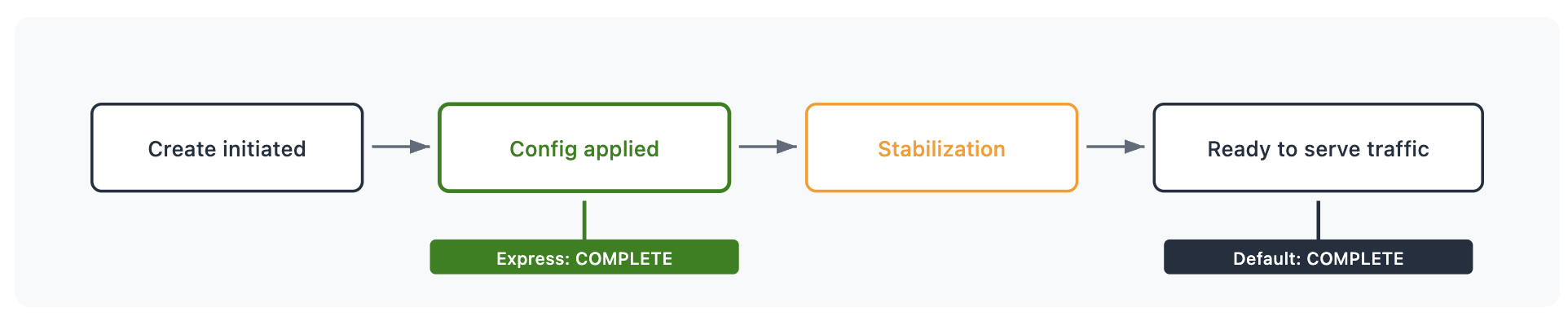
Building on the foundation of optimistic stabilization, CloudFormation Express Mode now offers developers explicit control over when CloudFormation reports a stack operation as complete. With Express Mode activated, CloudFormation concludes the stack operation as soon as the resource configuration is successfully applied. The process of resources becoming fully ready to serve traffic then continues in the background, decoupled from the immediate feedback loop.
This distinction is crucial: Express Mode separates the act of configuring infrastructure from the act of stabilizing it for production traffic. For each resource, CloudFormation provides a clear status reason: "Resource operation completed using express mode. It may continue becoming available in the background." This ensures transparency, allowing developers to understand which resources have completed their configuration phase and which are still undergoing background stabilization. Regardless of the deployment mode, CloudFormation continues to manage resource dependencies, handle retries, and ensure the eventual consistency of the infrastructure. The key difference lies in when the developer receives the "done" signal, thereby unlocking faster iteration.
Key Use Cases and Transformative Benefits
Express Mode is specifically tailored for development and testing workflows where rapid iteration is paramount. Its introduction is expected to have a profound impact across several critical scenarios:
-
Accelerated Development Iteration: Consider a scenario where a developer is constructing a complex network infrastructure, including a Virtual Private Cloud (VPC), subnets, security groups, and an Application Load Balancer (ALB). To configure subsequent layers of the application, the developer primarily needs the ALB’s DNS name and the security group ID. They don’t necessarily need the ALB to be ready to process live traffic at that exact moment. With Express Mode, the ARN, DNS name, and security group bindings are available in seconds, allowing the developer to immediately proceed to the next iteration of their application development without waiting for the ALB to fully stabilize and propagate across availability zones. This drastically reduces context switching and boosts overall productivity.
-
Empowering AI Agent Workflows: The rise of AI agents for infrastructure management and generation demands extremely tight feedback loops. An AI agent iterating on infrastructure templates needs to deploy, observe the immediate result, adjust the template, and redeploy rapidly. Waiting for a CloudFront distribution to propagate globally, which can take 5-10 minutes in default mode, is counterproductive for an AI agent’s learning cycle. Express Mode transforms such deployments into sub-minute confirmations that the configuration was accepted. This enables AI agents to validate, refine, and redeploy multiple iterations within the time frame a single default deployment would have consumed, significantly accelerating the development and optimization of AI-driven infrastructure solutions.
-
Streamlined Dependent Stack Deployments: Many complex applications are built using a modular approach with multiple CloudFormation stacks, often with dependencies between them. Whether these dependencies are managed within a single stack or across stacks via export/import mechanisms, Express Mode accelerates each individual stack operation. This means that a sequence of dependent stack deployments completes much faster overall. Express Mode intelligently handles implicit and explicit dependencies, ensuring that even with faster completion signals, the underlying resource provisioning respects the dependency chain, moving quickly without compromising the integrity of the infrastructure. For large enterprises managing hundreds or thousands of stacks, this cumulative time saving can translate into thousands of developer hours annually.
Technical Implementation and Ease of Adoption
A significant advantage of CloudFormation Express Mode is its ease of adoption. It requires no changes to existing CloudFormation templates or resource types. The same template used for default deployments can be deployed with Express Mode, as it is a deployment configuration option rather than a template-level setting.
Users can enable Express Mode per operation using a single parameter:
aws cloudformation create-stack
  --stack-name my-app
  --template-body file://template.yaml
  --deployment-config '"mode": "EXPRESS"'
By default, Express Mode disables rollback for faster iteration. This means if a resource fails to configure, the stack remains in its current state, allowing developers to fix the issue and retry immediately without the added time of a rollback. For scenarios where rollback is desired, it can be re-enabled:
aws cloudformation create-stack
  --stack-name my-app
  --template-body file://template.yaml
  --deployment-config '"mode": "EXPRESS", "disableRollback": false'
For users leveraging the AWS Cloud Development Kit (CDK), Express Mode integration is equally straightforward:
cdk deploy --express
# To enable rollback:
cdk deploy --express --rollback
Similarly, for applications built with the AWS Serverless Application Model (SAM), the --express flag can be used with sam deploy or sam sync:
sam deploy --express
sam sync --express
To persist the Express Mode setting for future SAM deployments, the --save-params flag can be used, which stores the configuration in the samconfig.toml file. The --disable-rollback flag also functions seamlessly alongside --express within SAM commands. This widespread integration across AWS’s core IaC tools ensures that a broad spectrum of developers can immediately benefit from Express Mode.
Broader Implications for DevOps and Cloud Agility
The introduction of CloudFormation Express Mode represents more than just a performance tweak; it signifies a strategic alignment with modern DevOps principles and the relentless pursuit of cloud agility. By dramatically shortening the feedback loop for infrastructure changes, Express Mode directly contributes to:

- Enhanced Developer Experience: Less waiting means developers can focus more on coding and less on managing deployment pipelines, leading to higher job satisfaction and reduced burnout.
- Faster Innovation Cycles: The ability to iterate on infrastructure in seconds rather than minutes or tens of minutes directly translates to quicker experimentation, faster feature delivery, and a more responsive development process.
- Improved CI/CD Efficiency: While production pipelines will still benefit from full stabilization, development and testing stages within CI/CD can leverage Express Mode to run faster, providing earlier validation of infrastructure changes before they reach critical environments.
- Potential Cost Savings: For compute-intensive CI/CD environments or AI agents, faster deployments mean less time resources are provisioned and active for testing, potentially leading to optimized cloud spending.
- Reduced Cognitive Load: Developers can confidently make changes, knowing they will get near-instant feedback on configuration validity, reducing the fear of lengthy, failed deployments.
Considerations and Best Practices
While Express Mode offers compelling advantages for development, it is crucial to understand its intended use cases. AWS explicitly recommends the default behavior for production deployments where resources must be fully stabilized and ready to serve traffic before proceeding. For production, the "stack complete" signal needs to be an unequivocal assurance of operational readiness.
Express Mode is fully supported with CloudFormation change sets, allowing users to specify the --deployment-config at create-change-set time, ensuring the configuration is applied upon execution. Furthermore, enabling Express Mode on a parent stack automatically propagates the setting to all nested stacks within the hierarchy, streamlining deployments for complex, modular architectures.
AWS is committed to providing comprehensive documentation, and users are encouraged to consult the CloudFormation Express Mode documentation for a complete list of supported features, any specific limitations, and advanced usage patterns.
AWS’s Commitment to Developer Experience
This release is part of a larger trend within AWS to continuously enhance the developer experience. From new SDK features to improved tooling and performance optimizations, AWS consistently invests in making its services more accessible, efficient, and enjoyable for developers. Express Mode, coupled with previous enhancements like pre-deployment validation (which catches template errors before provisioning even begins), completes a robust picture for rapid infrastructure iteration: validate in seconds, deploy in seconds. This holistic approach ensures that developers can move from concept to deployment with unprecedented speed and confidence.
Conclusion
CloudFormation Express Mode marks a significant advancement in the realm of Infrastructure as Code, providing developers with unprecedented control over their deployment cycles. By separating the confirmation of configuration application from the often-lengthy process of resource stabilization, AWS empowers development teams, AI agents, and complex dependent stack deployments to iterate at speeds previously unattainable. While the default stabilization behavior remains the gold standard for production environments, Express Mode offers a powerful new option for development workflows where immediate feedback and rapid iteration are paramount. This strategic enhancement reinforces AWS’s position at the forefront of cloud innovation, enabling its customers to build, deploy, and evolve their applications with greater agility and efficiency.
Related posts: