Automating AWS Managed Service Upgrades Using AWS DevOps Agent and Kiro to Eliminate Operational Debt

Maintaining modern cloud infrastructure requires a constant, rhythmic cycle of updates to keep services secure, performant, and compliant. For organizations running large-scale deployments on Amazon Web Services (AWS), this lifecycle management is frequently governed by Planned Lifecycle Events (PLEs). These notifications alert administrators when managed services—such as Amazon Elastic Kubernetes Service (EKS), Amazon Relational Database Service (RDS), Amazon OpenSearch Service, and Amazon ElastiCache—approach the end of their standard support window. While these events are critical for security, they impose a significant and recurring operational burden on engineering teams who must manually identify, validate, and deploy infrastructure updates across complex, multi-region architectures.
The industry is now witnessing a shift toward intelligent, event-driven automation to solve this challenge. By integrating the AWS DevOps Agent with Kiro—an agentic development environment—organizations can transition from reactive, manual "firefighting" to a proactive, governed workflow. This approach not only streamlines the upgrade process but also embeds safety constraints directly into the automation pipeline, significantly reducing the risk of human error in critical production environments.
The Anatomy of Operational Burden
The traditional workflow for managing a service upgrade is labor-intensive. When an AWS Health PLE is triggered, engineers must first perform a comprehensive audit to identify all affected resources across every AWS account and region. Once the scope is defined, the team must determine the correct target version, assess compatibility with existing dependencies, and ensure that consumers of those services will not be disrupted by the upgrade.
This process is compounded when multiple services reach their end-of-support deadlines simultaneously. For a Site Reliability Engineering (SRE) team, this creates a sustained operational bottleneck. Engineers are often forced to choose between performing manual, repetitive tasks that consume valuable development hours or delaying updates, which introduces compliance and security risks. As cloud ecosystems grow, the manual approach becomes unsustainable, necessitating a transition toward systems that can "reason" about infrastructure state.
The Emergence of Agentic DevOps
The AWS DevOps Agent represents a frontier in autonomous systems, designed to function as an experienced DevOps engineer capable of resolving incidents and proactively identifying performance improvements. By acting as a central intelligence layer, the agent can continuously monitor infrastructure, analyze software changes for production risks, and investigate incidents.
When paired with Kiro, the AWS DevOps Agent transforms version upgrades into a governed, event-driven loop. The agentic workflow functions in four distinct stages: discovery, analysis, code generation, and validation. First, the agent discovers impacted resources and evaluates potential upgrade paths. Second, it produces a structured change specification—a technical blueprint for the upgrade. Third, Kiro applies these changes to infrastructure-as-code (IaC) definitions, such as AWS Cloud Development Kit (CDK) scripts, while validating safety constraints. Finally, the system opens a pull request (PR) for human review. This shift effectively changes the engineer’s role from an executor of mundane tasks to a high-level reviewer who validates a pre-analyzed, pre-coded, and pre-validated plan.
End-to-End Architecture: A Case Study in EKS Upgrades
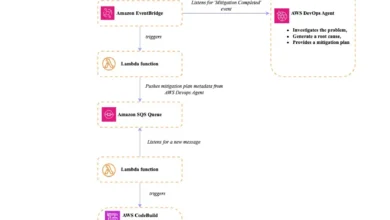
The effectiveness of this approach is best illustrated by its application to Amazon EKS, a service that requires strict adherence to versioning constraints. The pipeline begins when AWS Health publishes an AWS_EKS_PLANNED_LIFECYCLE_EVENT to Amazon EventBridge. This event triggers a Lambda function that alerts the AWS DevOps Agent to initiate an investigation using the eks-upgrade-planning skill.
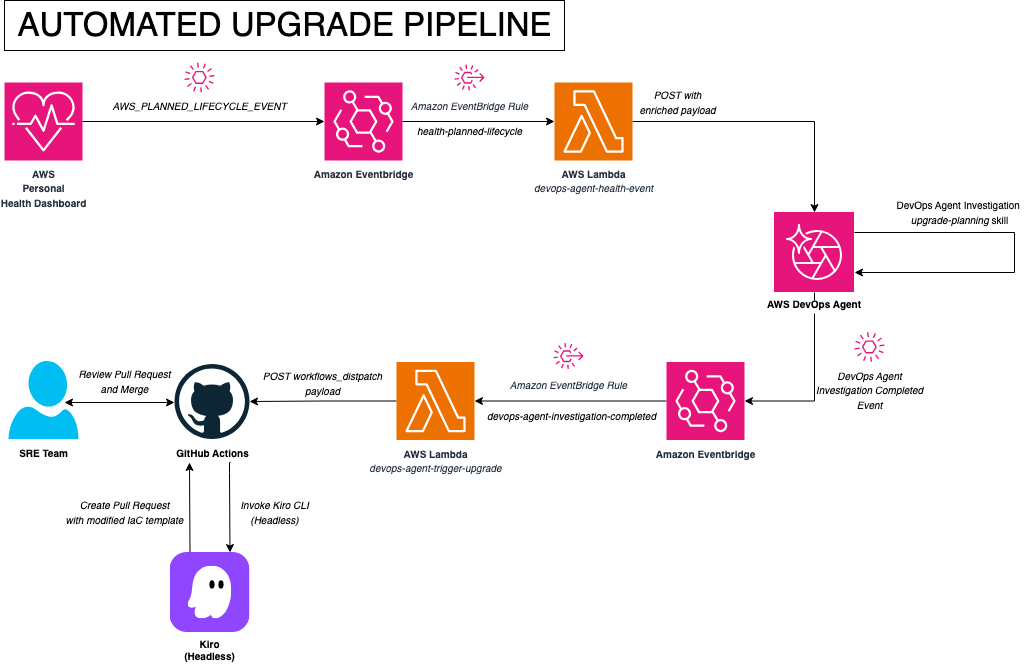
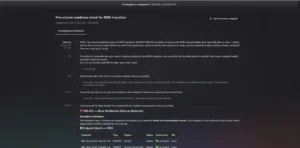
The investigation is not merely a data-fetching exercise; it is an analytical process. The agent scans the cluster topology, validates version increments, checks add-on compatibility, and assesses whether the cluster is within the mandatory 7-day rollback window. If the agent determines the cluster is ready, it generates a CDK Change Spec. This spec acts as the "source of truth" for the upgrade.
A secondary EventBridge rule triggers a deployment pipeline that fetches the agent’s findings and dispatches a GitHub Actions workflow. Crucially, the system enforces a "failure closed" policy. If the agent cannot find an actionable path, or if the findings conflict with established safety rules, the pipeline stops. It does not attempt to "guess" the correct configuration, thereby eliminating the risk of an automated system applying an incorrect or destructive change.
Safety Constraints and the Closed-Loop Failure Path
One of the most significant risks in infrastructure automation is the "blind" execution of changes. To mitigate this, the pipeline enforces strict safety gates. For example, EKS upgrades must occur one minor version at a time; the agent automatically rejects attempts to skip versions. Furthermore, the pipeline utilizes the CloudFormation DependsOn attribute to ensure that the Amazon VPC CNI add-on is updated before node groups, preventing network loss during the upgrade process.
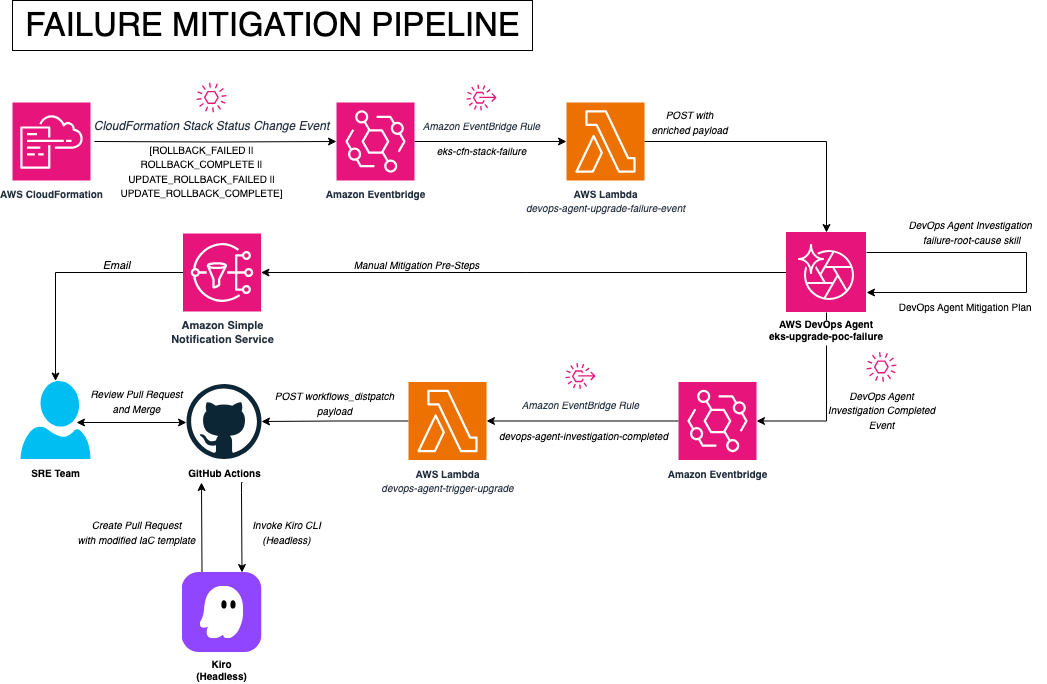
Perhaps most innovative is the closed-loop failure path. Real-world upgrades occasionally fail due to unforeseen environment-specific conditions. If a deployment fails, the system does not wait for a human to notice. Instead, the pipeline automatically invokes a failure-analysis skill. The AWS DevOps Agent investigates the root cause and, if the 7-day rollback window is active, determines if reverting the cluster version is a more efficient recovery path than applying a code fix. By documenting the decision-making process in the PR body, the system provides engineers with full transparency, ensuring that automated actions are always attributable and reversible.
Self-Maintenance: The Daily Skill Review
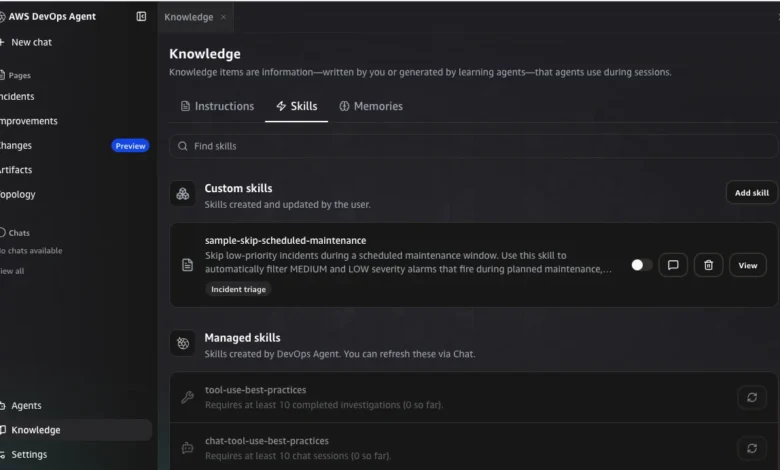
Infrastructure environments are dynamic, and static automation scripts quickly become obsolete. To counter this, the pipeline includes a "Daily Skill Review." Every 24 hours, an Amazon EventBridge rule triggers a check that compares the agent’s current skill files—such as the upgrade logic—against the latest authoritative information from AWS. If the agent detects that its knowledge is outdated, it initiates a self-updating workflow, opening a PR to update its own logic. This continuous self-maintenance loop ensures that the automation remains aligned with the latest AWS features, such as new version rollbacks or changes to default settings for managed add-ons.
Strategic Implications for the Enterprise
The shift toward agent-driven infrastructure management has profound implications for organizational efficiency. By offloading the investigative and repetitive aspects of lifecycle management to an automated agent, organizations can significantly reduce their Mean Time to Remediation (MTTR). In a manual environment, an EKS upgrade might take days of planning, testing, and execution. With an agentic pipeline, this time can be compressed to minutes of review.
Furthermore, this model promotes "governance by design." Because every change is generated by an agent and validated against a predefined spec before reaching a human reviewer, the risk of configuration drift is minimized. It also allows engineering teams to focus on higher-value activities, such as improving application architecture and user-facing features, rather than managing the low-level mechanics of cloud service versions.
Future Horizons: Proactive Incident Prevention
Looking ahead, the integration of Release Management and Proactive Incident Prevention promises to further refine this pipeline. Release Management allows the agent to evaluate code changes against an organization’s internal policies before they are even committed to the repository, identifying cross-service dependency risks that traditional testing might miss.
Meanwhile, Proactive Incident Prevention uses machine learning to analyze patterns across hundreds of investigations, allowing the system to flag potential systemic issues before they result in a failure. For example, if the agent notices that clusters with a specific configuration of admission webhooks consistently experience issues during upgrades, it can flag this risk for engineers proactively, offering a remediation plan before the upgrade is ever triggered.
Conclusion
The automation of Planned Lifecycle Events represents a fundamental maturation of cloud operations. By moving from manual, reactive processes to an event-driven, agentic workflow, organizations can achieve a level of consistency and safety that is difficult to maintain at scale. The integration of the AWS DevOps Agent and Kiro provides a robust framework that respects the complexity of AWS managed services while providing the necessary guardrails for production-grade environments.
For enterprises aiming to optimize their cloud operations, the path forward is clear: identify repetitive lifecycle processes, define the constraints and safety requirements, and encapsulate this logic into agentic skills. This approach does not replace the engineer; rather, it empowers them to act as architects and auditors of an automated system, ensuring that their infrastructure remains resilient, compliant, and ready for the next wave of innovation. As cloud services continue to evolve, those who embrace agent-driven governance will find themselves better equipped to handle the complexities of modern, distributed systems.
Related posts: