Beyond Prediction: Integrating Traditional Machine Learning with Agentic Reasoning for Advanced AI Systems

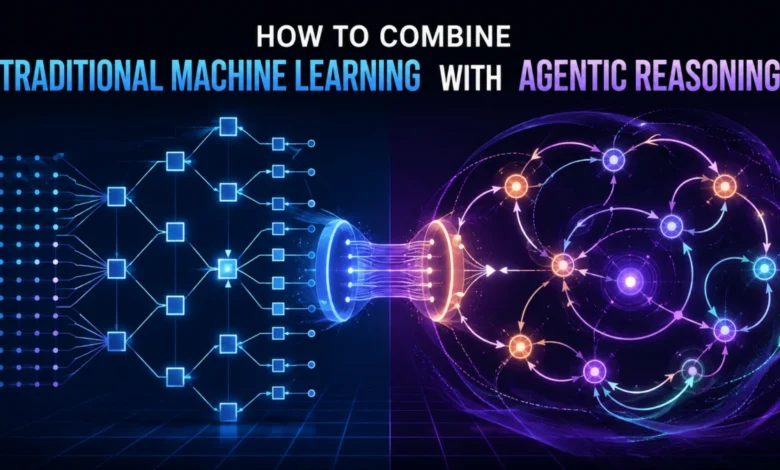
For over a decade, the field of artificial intelligence has been dominated by supervised learning, a paradigm that treats intelligence as a high-speed mapping exercise. In this model, algorithms are fed structured inputs to generate specific outputs—a process that has revolutionized everything from credit scoring to medical imaging. However, as organizations attempt to move beyond simple automation toward autonomous systems capable of executing complex business processes, the limitations of static models have become increasingly apparent. The industry is currently witnessing a paradigm shift as developers move away from relying on standalone models toward hybrid architectures that integrate traditional machine learning with agentic reasoning.
The Evolution of Predictive Intelligence
The trajectory of modern AI began with the refinement of statistical learning, which gained massive momentum around 2012 with the rise of deep learning. These systems, such as convolutional neural networks for image recognition or gradient-boosted decision trees for tabular data, are designed for precision. According to recent industry benchmarks, models like XGBoost and specialized Transformer-based classifiers consistently outperform human analysts in speed and consistency when performing isolated tasks, such as identifying a fraudulent transaction in under 50 milliseconds.
However, these systems are essentially "black boxes" that operate in a vacuum. A model trained to forecast supply chain disruptions is effective only if the input data—historical shipping times, port congestion levels, and weather—is pre-formatted and complete. In practice, data is rarely clean, and the environment is dynamic. When a disruption occurs, the model might accurately predict a delay, but it cannot navigate the downstream consequences: it cannot contact a logistics provider, negotiate a new shipping route, or notify a customer of a change in delivery time. This structural rigidity has created a significant "action gap" in corporate AI deployments.
The Rise of Agentic Reasoning: Moving Toward Autonomy
The emergence of Large Language Models (LLMs) has provided the missing link for these systems. Unlike traditional models that merely classify or predict, agentic systems use LLMs as a "reasoning engine." These systems operate in loops—perceiving, thinking, acting, and observing.
The transition from passive models to agents can be viewed as a shift from "calculation" to "orchestration." In early 2023, the release of frameworks like LangChain and Microsoft’s AutoGen signaled a broader move toward allowing AI to use external tools. These agents can interface with SQL databases, execute Python scripts, or query web APIs to retrieve real-time information that was not present during their initial training phase. This capability effectively solves the "static model" problem; if an agent discovers that a data point is missing, it can pause, execute a search query to fill the knowledge gap, and then resume its reasoning process.
Comparative Analysis: Traditional vs. Agentic
A professional assessment of these technologies reveals that they occupy distinct, non-overlapping roles within the AI stack:
- Traditional Machine Learning (The Specialist): excels at high-throughput pattern recognition. It is the engine that provides the probability score for a specific feature set. It is highly cost-effective and auditable.
- Agentic Reasoning (The Generalist): excels at task decomposition and environmental interaction. It manages the flow of a process, determines which tools to pull from a "toolbox," and translates raw predictive data into actionable business outcomes.
Data from recent enterprise AI adoption surveys suggest that projects failing to move past the proof-of-concept stage often do so because they rely too heavily on the "specialist" model to perform "generalist" tasks. For instance, attempting to force a classification model to handle complex, multi-step customer service inquiries often results in high error rates. By contrast, a system where an agent orchestrates the conversation and delegates specific sentiment or classification tasks to a fine-tuned model has shown a 30-40% increase in resolution success in early pilot studies.
Chronology of the Hybrid Shift
The move toward these hybrid systems has occurred in three distinct phases:
- The Predictive Era (2012–2020): Focus on maximizing model accuracy and performance metrics on static datasets.
- The Generative Era (2020–2023): The explosion of LLMs brought natural language interfaces to the forefront, though these early models often suffered from "hallucinations" and a lack of tool-use capabilities.
- The Agentic Era (2024–Present): Integration of LLMs with deterministic software tools, enabling systems to handle end-to-end workflows. This is the era of "AI Agents" that can function as employees rather than just assistants.
Real-World Implications: Insurance and Finance
The most practical application of this hybrid architecture is visible in high-stakes industries like insurance. In a standard setup, a model evaluates the risk of a claim. In an agentic system, that same model acts as one component of a larger "Claims Agent."
When a claim is submitted, the agent verifies the policy details by querying the internal database. It then triggers the traditional ML model to assess fraud risk. If the fraud score is low but the documentation is incomplete, the agent does not simply reject the claim or wait for human intervention; it automatically generates an email to the claimant requesting the missing documentation. Once the user responds, the agent parses the attachment, re-runs the assessment, and prepares a summary for the human adjuster. This reduces the time-to-decision from days to minutes.
Fact-Based Analysis of Strategic Implementation
The integration of agentic reasoning does not signal the obsolescence of traditional machine learning; rather, it elevates the value of existing ML assets. Companies that have invested millions in proprietary fraud detection or predictive maintenance models can now "wrap" those models in agentic wrappers. This allows the models to be accessed via natural language, linked to internal workflows, and updated in real-time.
However, this shift brings new challenges. Security and governance become significantly more complex when a system is permitted to "act" on the world rather than just "predict." Enterprise-grade agentic systems now require guardrails—deterministic layers that monitor agent outputs to ensure they remain within organizational policy and safety constraints.
Conclusion: The Future of AI Orchestration
The promise of AI lies not in creating a single, omniscient model, but in building robust ecosystems where different types of intelligence are assigned to their most appropriate tasks. As organizations move toward this hybrid future, the focus is shifting from "how accurate is my model?" to "how effective is my system at achieving an objective?" By utilizing agentic reasoning as the connective tissue for traditional predictive models, companies can finally bridge the gap between AI-driven insights and tangible business results. The era of the autonomous agent, supported by the precision of traditional machine learning, is no longer a theoretical construct—it is the emerging standard for enterprise technology.