Data processing architectures have reached a critical inflection point as the volume of log-based telemetry and raw event streaming continues to expand exponentially. For many software engineering teams, the traditional approach of loading entire datasets into random-access memory (RAM) has become a primary cause of system instability. When a standard script designed to process moderate traffic encounters a sudden surge in data—such as a 9 GB log file generated during a high-traffic window—the typical result is a fatal MemoryError. This failure occurs because the underlying logic, often relying on list comprehensions or readlines() calls, attempts to store the entire dataset as an object in memory before performing any filtering or transformation.
The Anatomy of a Memory Failure
The history of this technical challenge can be traced back to the convenience of high-level abstractions in modern programming languages. For years, Python developers have utilized list comprehensions and eager loading to perform rapid data analysis. In a controlled environment, these tools are highly effective. However, when the size of the input file exceeds the physical memory capacity of the host environment, the application reaches a threshold where it can no longer buffer the incoming information.
The progression of such failures often follows a predictable chronology. Initially, developers build scripts that read entire files into memory because the datasets are small. As the business grows, logs rotate and expand, causing the script to ingest increasingly larger volumes of data. Eventually, the script hits the ceiling of the system’s memory allocation. In many enterprise scenarios, this leads to immediate process termination, triggering downtime in critical reporting pipelines. The irony of this situation is that the parsing logic itself is rarely the source of the error; the culprit is the storage of intermediary states within list structures that are never intended to be fully materialized.
The Mechanics of Lazy Evaluation
To solve this issue, engineers have turned to the iterator protocol, a design pattern that has been a cornerstone of Python for over two decades. Unlike an eager list, which holds all elements in memory simultaneously, an iterator operates as a cursor that moves through a dataset. By leveraging iter() and next() methods, a program can process individual records one at a time, discarding them as soon as the relevant data is extracted or filtered.
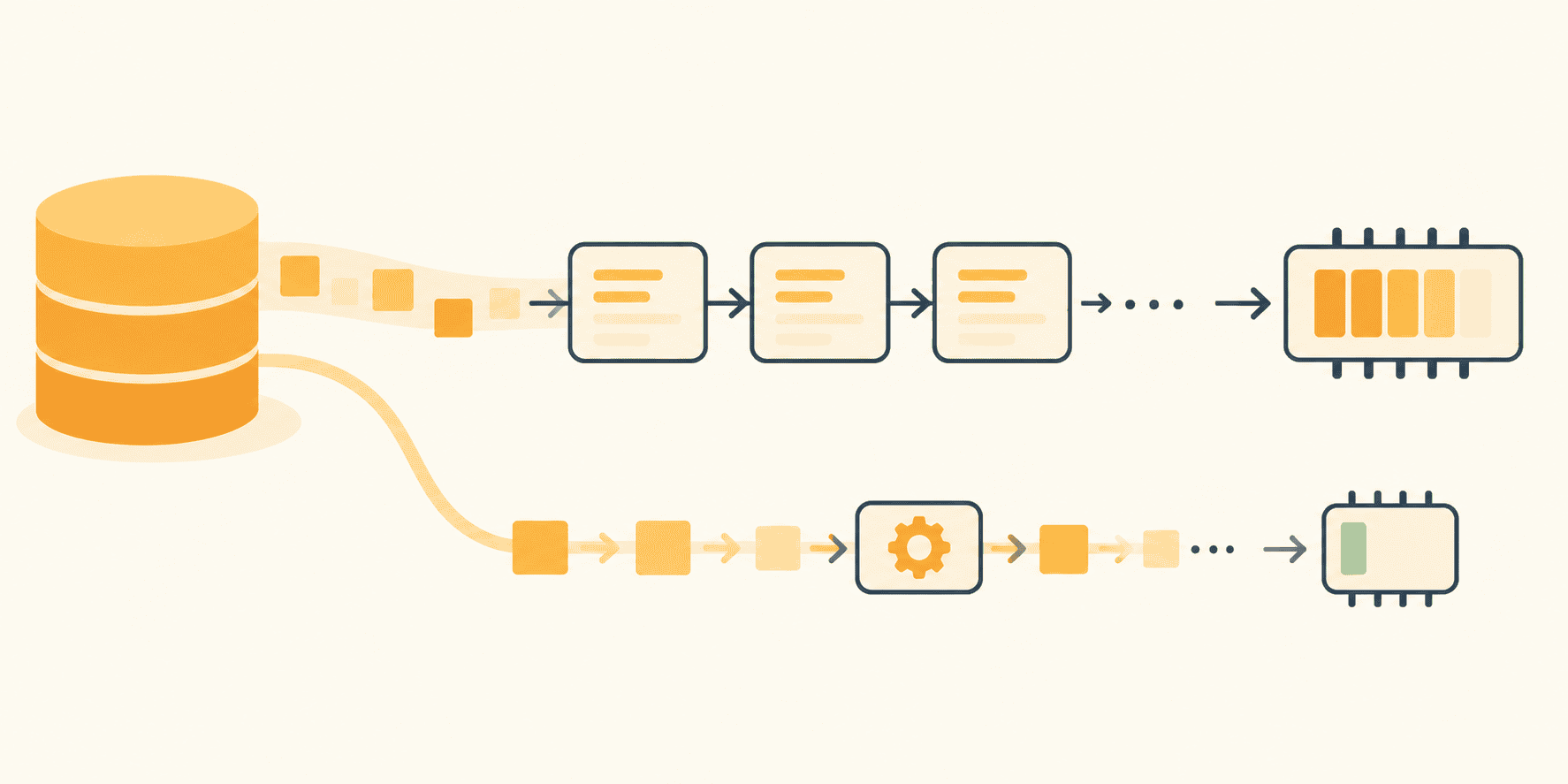
The efficiency of this approach is supported by the concept of "lazy evaluation." When a function uses the yield keyword, it becomes a generator. Instead of returning a complete list, the function returns a generator object that produces items on demand. This ensures that only the current record occupies memory, rather than the entire file. When applied to a 9 GB log file, the difference is stark: the peak memory usage shifts from several gigabytes to a few kilobytes, effectively decoupling the memory footprint from the size of the dataset.
Implementing a Streaming Pipeline
A robust data processing pipeline consists of four distinct stages: the source (file), the parser (transformation), the filter (logic), and the sink (output). By treating each of these as an independent generator, engineers can build a chain of operations that remains "lazy" from start to finish.
- Source: Using a file object directly as an iterator, which reads the file in buffered chunks.
- Transformation: Utilizing generator functions to parse raw strings into structured dictionaries or objects without holding multiple records.
- Filter: Employing generator expressions to discard unwanted data points before they reach the sink.
- Sink: Implementing a batching strategy at the final step, such as using
itertools.batched()(available in Python 3.12+), to write results to disk in controlled, manageable chunks.
This architectural shift is not merely a matter of code style; it is a fundamental shift in resource management. By strictly defining where data is "materialized" (turned into a permanent list or structure), developers can prevent the silent creep of memory usage that often plagues long-running analytical jobs.
Data-Driven Performance Analysis
The empirical benefits of adopting these patterns are measurable. Using tracemalloc, a standard library tool for tracking memory allocations, engineers have observed significant disparities between eager and lazy processing. In a controlled simulation involving a 200,000-line log file (approximately 17 MB), an eager script peaked at roughly 198 MB of memory usage. In contrast, a streaming pipeline using the same logic peaked at a mere 0.4 MB.
Crucially, the peak memory usage of the streaming version remained relatively stable even as the simulated file size was increased, whereas the eager version’s memory usage scaled linearly with the input file. This scalability is essential for cloud-native environments where container memory limits are strictly enforced. Exceeding these limits typically leads to an Out-of-Memory (OOM) kill signal, which can result in data loss or corrupted state if the job is not properly checkpointed.

Industry Implications and Best Practices
The transition toward streaming pipelines has broader implications for data engineering and machine learning. As datasets for model training—such as large-scale JSONL files—continue to grow, the ability to stream data directly into training loops or preprocessing stages has become a competitive necessity. Organizations that rely on streaming can process massive datasets on modest hardware, reducing operational costs and improving the reliability of automated reporting.
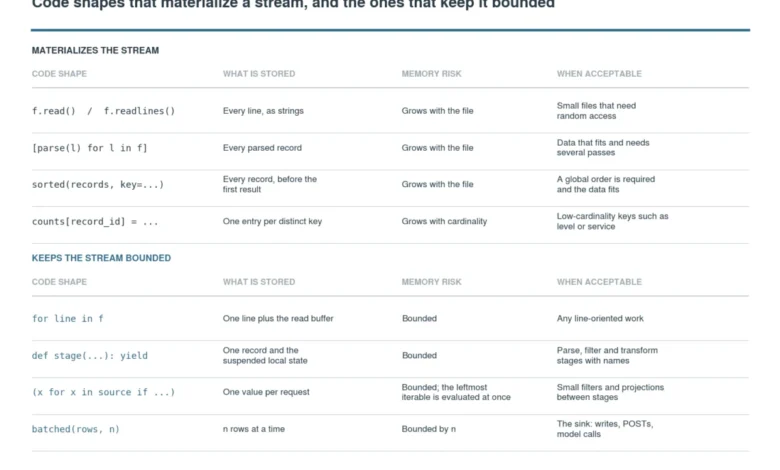
However, developers must remain vigilant against "eager traps." A common pitfall is the introduction of intermediate calls that force materialization, such as calling list() on an iterator, or using functions like sorted() which, by definition, require the entire dataset to be present in memory to calculate the final ordering. Furthermore, developers should exercise caution with library calls that might implicitly load data into memory, such as certain database connectors or data frame constructors that default to eager loading.
To maintain the integrity of a streaming architecture, the industry recommends the following standards:
- Audit for Materialization: Regularly check for methods that force the entire iterator into memory.
- Use Explicit Batching: Always perform materialization at the final "sink" step, and ensure the batch size is configurable.
- Test with Small Samples: Utilize
itertools.islice()to inspect the first few items of a pipeline without consuming the entire stream. - Monitor Peak Memory: Use tools like
tracemallocor OS-level telemetry to verify that the peak memory footprint stays within expected bounds during production runs.
Conclusion: The Future of Data Handling
As data volumes continue to climb, the reliance on memory-bound processing will become increasingly untenable. The adoption of iterators and generators represents a return to foundational principles of computing: minimizing the distance between the data source and the final output while maximizing the efficiency of the available resources. By treating data as a continuous stream rather than a static collection, organizations can build more resilient, scalable, and maintainable systems.
The move toward lazy evaluation is not just a performance optimization; it is a design philosophy that prioritizes system stability in an era of "big data." By clearly defining where the stream ends and the storage begins, developers can ensure their applications are prepared for the scale of tomorrow’s challenges, turning potential memory errors into routine, predictable, and highly efficient data processing tasks. The goal is to create a pipeline that is as readable as it is efficient, where each component has a single responsibility and the memory budget remains constant, regardless of the size of the input.