The Genesis of Amutable
The formation of Amutable earlier this year sent ripples through the Linux ecosystem, given the pedigree of its founders. Lennart Poettering, widely recognized as the creator of systemd and a key figure in modern Linux infrastructure, teamed up with Christian Brauner and Chris Kühl to address what they identified as a fundamental disconnect between modern application deployment and the underlying operating system. The startup’s mission is to move away from the traditional, mutable Linux paradigm—where systems are modified in-place over time—toward a model characterized by immutability, auditability, and absolute state control.
Before the debut of Foundations, the company established its technical foundation through two open-source projects: tine and Quarry. Tine, licensed under MPL-2.0, is a build system based on Buck2 designed for the composition of comprehensive OS images. Quarry, licensed under Apache-2.0, utilizes The Update Framework (TUF) to ensure the secure and authenticated distribution of these images across a fleet of machines. These tools serve as the engine for the newly announced Foundations service, which layers a professional management control plane over these open-source building blocks.
Core Architecture: The Immutable Paradigm
Amutable Foundations is built on the premise that a machine’s state should be predictable and verifiable. In a traditional Linux environment, package managers like DNF, APT, or YUM facilitate ongoing changes to the filesystem, which can lead to "configuration drift"—a state where two theoretically identical servers diverge over time due to varying update histories, manual patches, or ephemeral changes.
Foundations eliminates this variability by removing the package manager, the SSH daemon, and the interactive shell entirely. Under this model, the operating system is a read-only volume protected by dm-verity, a kernel feature that provides transparent integrity checking of block devices. When data is read from the disk, the kernel verifies its hash against a trusted root; if the data has been tampered with, the system will trigger an I/O error, effectively neutralizing persistent rootkits or unauthorized modifications.
The boot process is equally stringent. By utilizing signed Unified Kernel Images (UKIs) and measured boot, the system ensures that the bootloader, kernel, and initial RAM disk have not been altered. Every component of the system is verified from the moment the power button is pressed. When updates are required, administrators do not "patch" the system; instead, they deploy an entirely new, cryptographically signed image. This ensures that every node in a fleet is running an identical, validated state.
Attestation and The Control Plane
The standout feature of the Foundations platform is its focus on continuous verification. Each machine is equipped to generate a signed report—a cryptographic "proof" of its current state—which encompasses everything from the firmware and bootloader to the specific kernel version and OS configuration. These reports are transmitted to the Amutable control plane at regular intervals and during every boot sequence.
This process is underpinned by hardware-rooted trust. Ideally, these signatures are generated by a Trusted Platform Module (TPM) or a CPU with confidential computing capabilities (such as AMD SEV or Intel TDX). For hardware lacking these features, the system allows for a software-key fallback, though the security profile is significantly higher when hardware attestation is utilized.
The control plane, which utilizes systemd-report (an experimental component integrated into systemd 260), acts as the arbiter of the fleet’s health. It compares the machine’s reported state against the desired state defined by the administrator. If a machine deviates—perhaps due to a failed update or unauthorized intervention—the control plane flags the anomaly. Because this system is integrated into the infrastructure’s core, it can programmatically gate access to resources. For example, if a machine cannot prove it is running the latest security-hardened image, the system can automatically withhold sensitive credentials, such as database access tokens or API keys, preventing potentially compromised nodes from interacting with the wider network.
The Role of SBOMs and Reproducibility
In the modern cybersecurity landscape, the Software Bill of Materials (SBOM) has become a regulatory and operational necessity. Foundations integrates SBOM generation directly into its build pipeline. Because every image is built from pinned inputs—meaning the exact version of every library, kernel module, and utility is locked—the resulting images are fully reproducible.

Tine, the company’s build system, is capable of importing packages from established distributions like Fedora or CentOS Stream, allowing organizations to maintain their preferred upstream ecosystems while benefiting from the immutable, verified wrapper that Foundations provides. This approach allows enterprises to maintain a familiar package ecosystem while eliminating the operational overhead of managing stateful, mutable systems.
Industry Impact and Strategic Direction
The introduction of Amutable Foundations signals a broader industry shift toward "infrastructure as code" reaching its logical conclusion: the operating system itself as a static, immutable artifact. This approach is particularly relevant in high-security environments, such as finance, healthcare, and critical infrastructure, where the ability to prove that a machine is in a known-good state is a regulatory requirement.
While the core tools tine and Quarry are open source, the Foundations management service is a proprietary offering from Amutable. The company has not yet clarified the full extent of the open-source components within the control plane, leaving some in the open-source community to watch closely for how much of this infrastructure will be accessible for self-hosting versus SaaS-only consumption.
Looking forward, the company has signaled that its next major expansion will target Kubernetes. By applying the same principles of immutable image deployment and cryptographic attestation to container orchestrators, Amutable aims to solve the "black box" problem of modern cluster management, where identifying exactly what is running inside a container at a specific micro-second is notoriously difficult.
Getting Started: The Design Partner Program
Amutable is currently transitioning from its initial internal development phase to a "design partner" model. The company is actively recruiting teams that manage large Linux fleets and face significant challenges in state management, security auditing, and compliance.
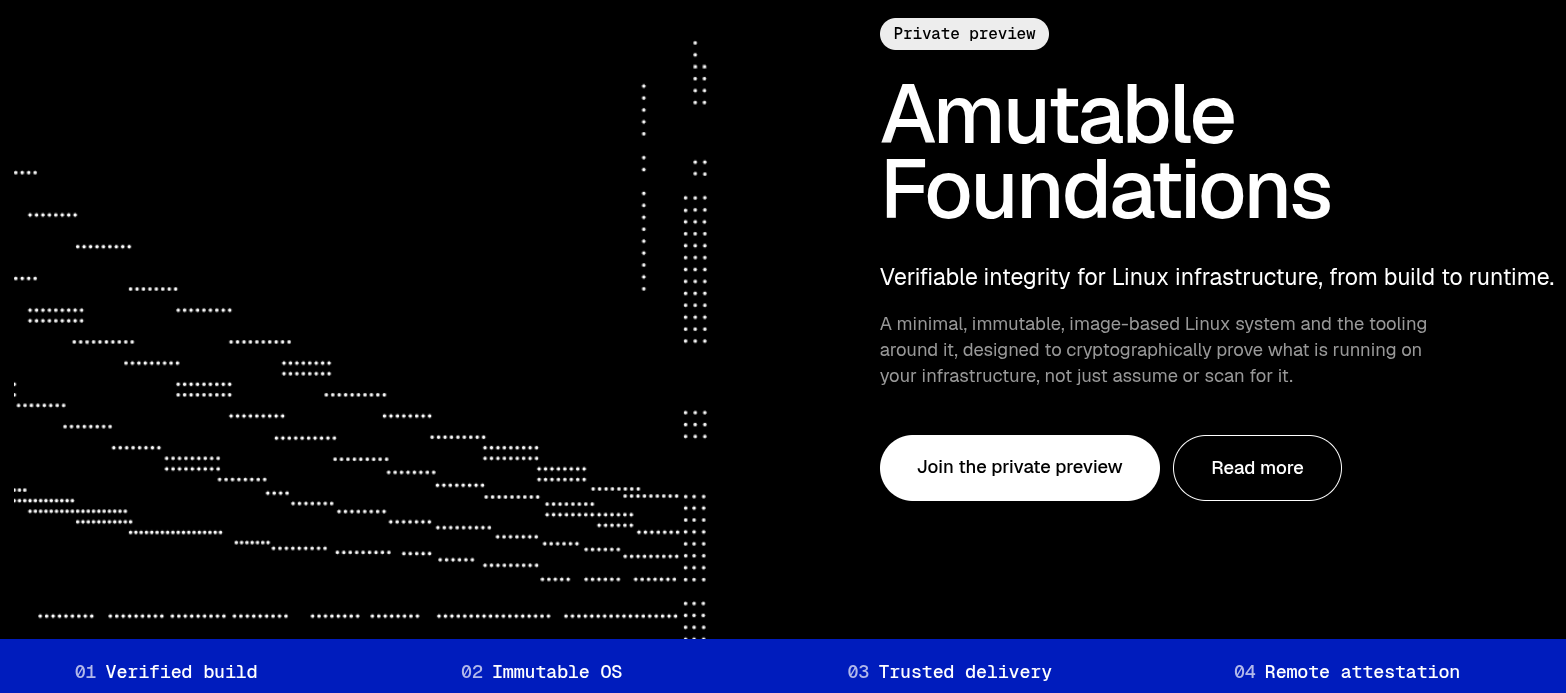
For these partners, the benefit is twofold: they receive early access to the platform and, more importantly, they gain a direct channel to provide feedback to the developers. The company has invited interested parties to sign up via its official portal, requesting detailed information on industry, company scale, and operational requirements.
The team behind Amutable will be showcasing these technologies at KubeCon North America in Salt Lake City at Booth 347. This presence underscores their intention to integrate deeply with the cloud-native ecosystem. As the industry moves toward increasingly automated and hardened infrastructure, the work being done at Amutable represents a significant pivot point, potentially moving the Linux server market away from the "patch-and-pray" cycle of the past three decades and toward a future defined by verifiable, immutable, and cryptographically sound system state management. The upcoming months will be critical in determining whether these technologies can achieve the necessary scale and adoption to become the new standard for enterprise Linux.
Related posts: