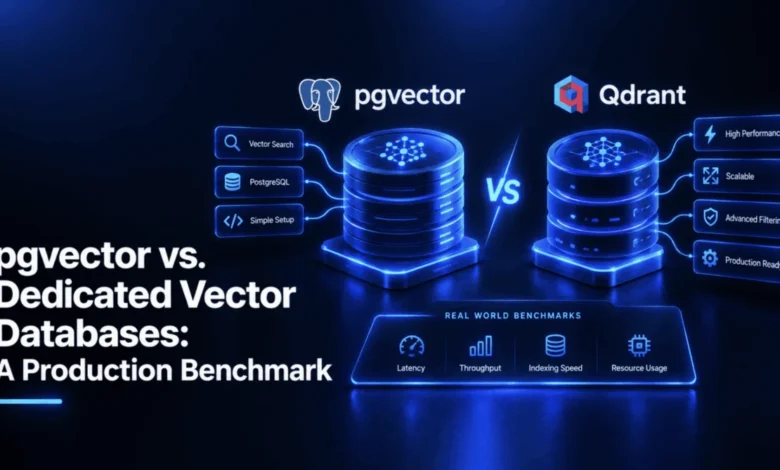
The rapid ascent of Large Language Models (LLMs) and Retrieval-Augmented Generation (RAG) architectures has forced a fundamental question upon engineering teams: where should the vector data reside? For years, the default choice for relational storage has been PostgreSQL. With the emergence of the pgvector extension, many developers found they could store vector embeddings directly alongside their structured data. However, as the vector database market has matured, vendors have increasingly pushed for migration to specialized, purpose-built systems. This pivot has created a divide between those advocating for the simplicity of a unified stack and those arguing for the performance advantages of dedicated vector engines.
To resolve this debate, engineers must move beyond marketing claims and examine objective, reproducible performance data. By evaluating the architectural differences, operational overhead, and measured latency profiles, it becomes clear that the choice between pgvector and a dedicated solution is not a matter of "better" technology, but a strategic decision based on workload, scale, and operational maturity.
The Architectural Shift: pgvector vs. Dedicated Engines
pgvector, an open-source extension for PostgreSQL, functions by adding a native vector column type and specialized indexing methods—such as HNSW (Hierarchical Navigable Small World) and IVFFlat—directly into the database. By operating within the Postgres ecosystem, pgvector allows developers to maintain ACID compliance for both relational data and vector embeddings in a single transaction. This integration eliminates the need for cross-service synchronization, reduces network latency, and leverages the robust tooling already familiar to most database administrators.
Conversely, dedicated vector databases—such as Qdrant, Pinecone, Weaviate, and Milvus—are designed from the ground up as specialized search engines. These systems utilize custom storage engines optimized for high-dimensional vector math. Their architectural separation means they are typically deployed as independent services, which introduces a new set of operational requirements: data must be synced from the primary database to the vector store, consistency models must be managed, and additional infrastructure must be monitored and backed up.
Chronology of the Vector Search Ecosystem
The discourse surrounding vector storage has evolved significantly over the last three years. In the early stages of the generative AI boom, the industry relied heavily on specialized, standalone vector databases, as the capability to perform efficient nearest-neighbor searches within general-purpose databases was not yet production-ready.
By late 2023, the release of advanced indexing in pgvector 0.5.0 and beyond signaled a turning point. Suddenly, the performance gap between PostgreSQL and specialized systems began to narrow significantly. In early 2024, the industry saw an influx of benchmarks from various vendors, often highlighting the strengths of dedicated systems in massive-scale scenarios. However, these benchmarks were frequently criticized for being opaque or using non-comparable configurations. The recent focus, led by independent testing firms and open-source contributors, has shifted toward "like-for-like" comparisons, where both systems are tuned using the same indexing parameters and hardware specifications.
Benchmarking Performance at Scale
To understand the trade-offs, one must look at how these systems perform when managing tens of millions of vectors. A recent, highly-regarded study conducted by Tiger Data provides a critical baseline. The study compared PostgreSQL with pgvector (augmented with the pgvectorscale extension) against Qdrant, using 50 million Cohere embeddings (768 dimensions) on identical AWS r6id.4xlarge instances.
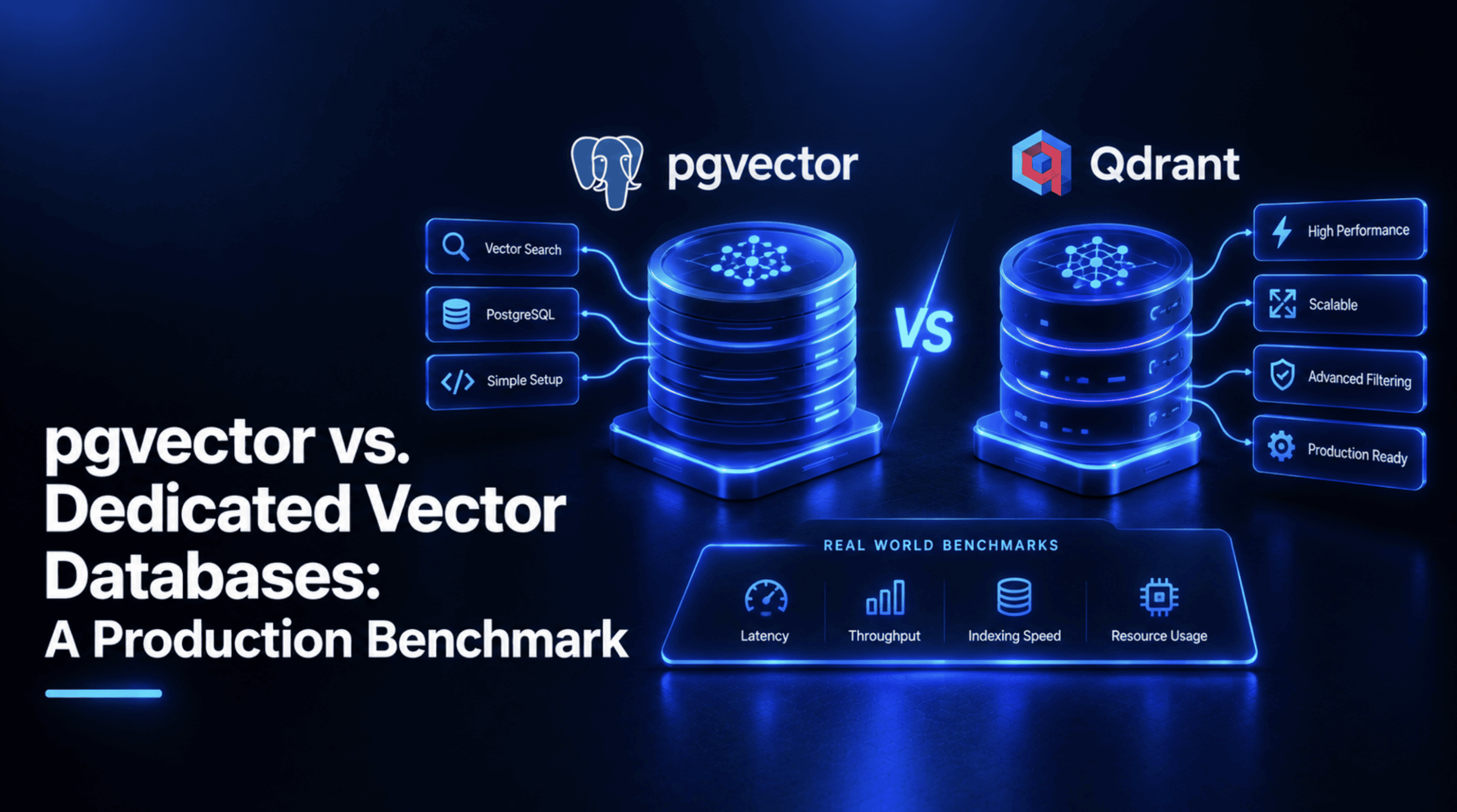
The results reveal a nuanced performance landscape. At 99% recall—the gold standard for accuracy in production search—pgvector demonstrated a superior ability to handle high throughput, achieving 471.57 Queries Per Second (QPS) compared to Qdrant’s 41.47 QPS. This suggests that for workloads where horizontal scalability and raw query volume are the primary constraints, PostgreSQL with optimized extensions is a formidable competitor.
However, the analysis of tail latency tells a different story. Qdrant maintained a significant advantage in query consistency, with a p99 latency of 38.71ms, nearly 48% faster than the 74.60ms measured for the Postgres-based setup. For applications that require strict, sub-50ms latency guarantees regardless of load, these results indicate that specialized databases offer a level of predictability that is difficult to replicate in a general-purpose environment.
Operational and Organizational Implications
Beyond raw latency and throughput, the decision to migrate involves significant organizational overhead. Maintaining a "single-database" architecture via pgvector provides several distinct advantages:
- Transactional Integrity: Updates to user profiles and their corresponding vector embeddings can occur within a single transaction, preventing "stale" or "orphan" vectors that often plague distributed, two-system architectures.
- Operational Simplicity: Engineering teams do not need to manage a separate cluster, configure replication across two systems, or write complex reconciliation logic to handle data drift.
- Cost Efficiency: For smaller to mid-sized workloads, the cost of adding an extension to an existing, well-managed PostgreSQL instance is negligible compared to provisioning and securing a secondary, dedicated vector database cluster.
However, dedicated systems excel in specific "extreme" use cases. Organizations operating at the billion-vector scale, or those requiring heavy GPU-accelerated indexing, will find the distributed, purpose-built architectures of systems like Milvus or Pinecone to be more robust. Furthermore, for companies that lack deep PostgreSQL expertise, a managed, zero-ops vector database service can significantly accelerate time-to-market by offloading the burden of database tuning, partitioning, and maintenance.
The Role of Hybrid Search
A significant factor often missing from the "vector-only" debate is the importance of hybrid search. Many real-world applications require a combination of vector-based similarity and traditional BM25 keyword matching. Specialized systems like Weaviate offer built-in hybrid search capabilities that are highly optimized. While pgvector can perform hybrid searches using Postgres’s native text-search features, the implementation often requires more manual tuning. Consequently, the choice of database often hinges on the complexity of the query pipeline. If the application requires deep integration between keyword filtering and vector similarity, the "all-in-one" nature of advanced vector databases becomes a compelling feature rather than an architectural preference.
Future Outlook and Conclusion
The distinction between general-purpose databases and specialized vector stores is likely to continue blurring. PostgreSQL developers are actively working on further performance optimizations, such as improved support for disk-based indexing and hardware-accelerated vector calculations. Meanwhile, dedicated vector database vendors are increasingly adding relational-like features to their platforms to satisfy the demand for better metadata management and data consistency.
For most production workloads—specifically those involving fewer than 10 million vectors—pgvector provides a sufficiently high-performance, low-complexity solution that satisfies the majority of use cases. It allows teams to iterate faster by minimizing the "moving parts" in their stack.
Conversely, for high-concurrency, latency-sensitive applications at the massive scale of 100 million vectors or more, or for organizations that require a managed, hands-off infrastructure, dedicated vector databases remain the optimal choice. The benchmark data confirms that there is no universal winner. Instead, the decision should be dictated by the specific requirements of the application: if the bottleneck is operational complexity, stick with PostgreSQL; if the bottleneck is consistent, sub-millisecond tail latency under massive concurrency, a dedicated vector engine is the appropriate investment. Engineering leaders are advised to prioritize architectural transparency and test against their own specific data distributions, rather than relying on generalized marketing claims that ignore the nuances of their unique technical environment.