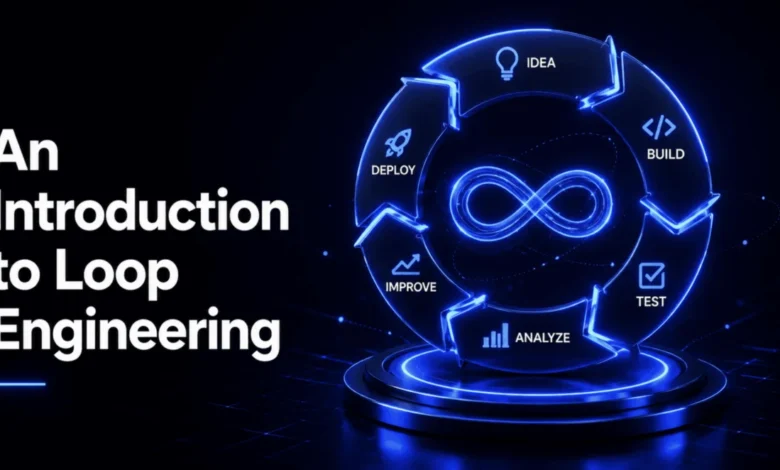
In the rapidly evolving landscape of artificial intelligence, a new paradigm known as loop engineering is redefining how autonomous AI agents are designed and deployed. This approach focuses on creating reliable, self-supervising AI systems capable of executing complex tasks without constant human intervention, marking a significant shift from traditional prompt-based interactions. This article delves into the origins of loop engineering, its core principles, the research foundations, practical implementation, and its profound implications for the future of AI development.
Defining the Paradigm Shift in AI Automation
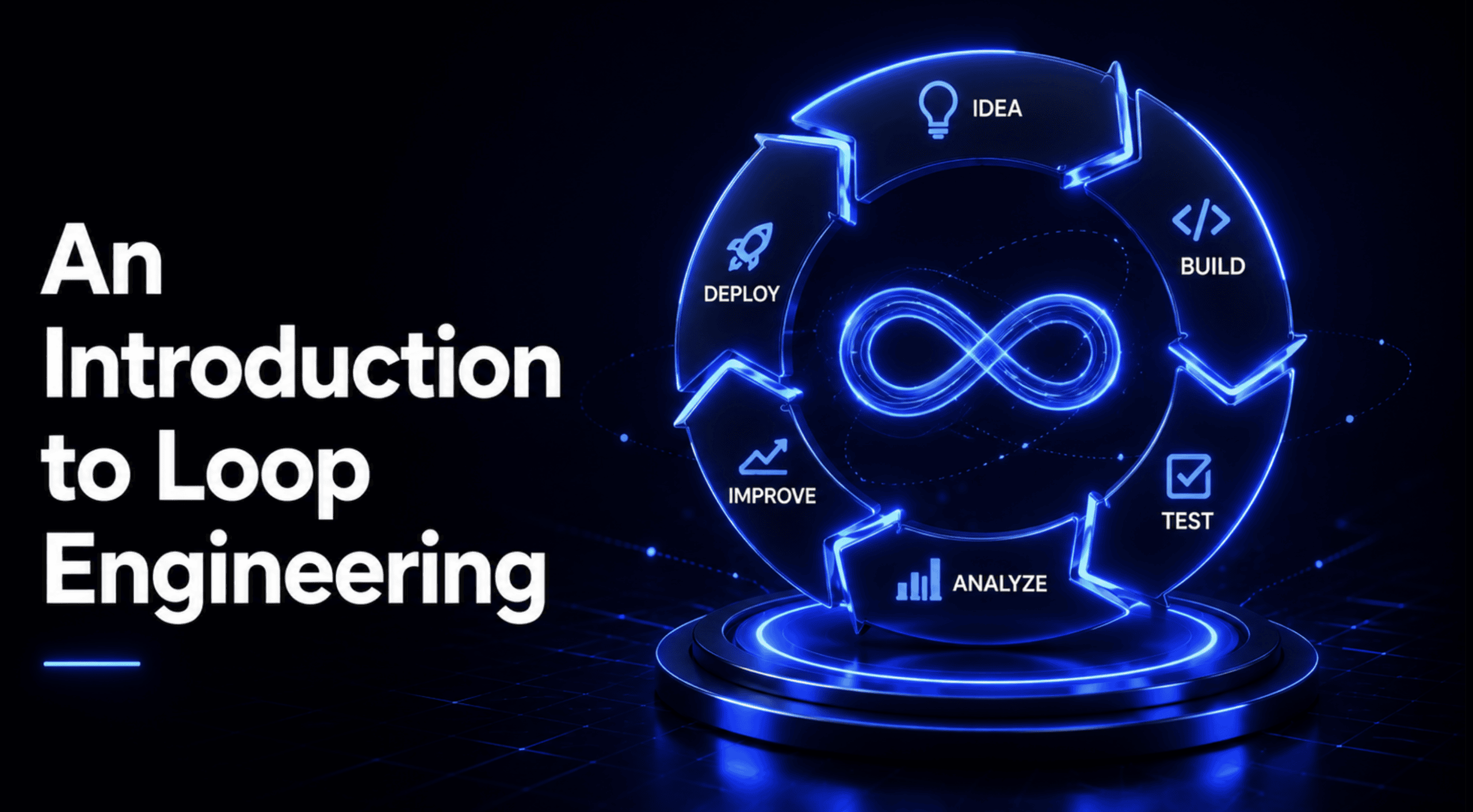
Loop engineering, at its core, is the systematic practice of constructing robust systems that enable AI agents to operate autonomously through continuous cycles of prompting, checking, remembering, and re-execution. Unlike linear "chains" of prompts that follow a fixed sequence, a loop is dynamic and adaptive. An AI agent within a loop takes an action, receives feedback from its environment, processes that feedback to inform its next move, and iterates until a predefined, verifiable condition is met. This fundamental change transforms the unit of AI work from a single prompt or conversation into a self-correcting, repeating cycle.
The shift is stark when contrasted with the prior developer experience. Just months ago, interacting with a coding agent often involved a tedious, turn-by-turn process: issue an instruction, await a response, identify errors, paste them back into the chat, provide further nudges, and repeat. This likened to driving a car requiring constant steering. Today, for a growing number of engineers, a single instruction can initiate an agent that works independently, potentially delivering a draft pull request, a triaged issue list, or a successful continuous integration (CI) build by the next morning, complete with a traceable record of its attempts and reasoning. The crucial enabler of this autonomy isn’t a more advanced underlying AI model, but rather the sophisticated system built around it.
This recursive goal-setting is central to loop engineering. Instead of micromanaging each step, engineers define a broader objective—such as "make the test suite pass" or "triage all open issues and draft fixes for straightforward ones." The agent then autonomously iterates towards this purpose, inspecting code, making changes, running checks, interpreting outcomes, and deciding subsequent actions. The paramount skill shifts from crafting a single perfect prompt to architecting a reliable, self-sustaining cycle that can be trusted to operate unsupervised.
The Genesis: From Niche Concept to Industry Buzzword
The term "loop engineering" rapidly gained traction in June 2026, transitioning from an esoteric phrase to a widely debated topic within a week. The catalyst was a post on X (formerly Twitter) on June 7, 2026, by developer Peter Steinberger, known for the OpenClaw agent project. Steinberger asserted that the relevant skill had evolved: developers should no longer be prompting coding agents directly but instead designing the loops that automate the prompting process. This post reportedly garnered over 6.5 million views within days, dominating discussions in agent-focused communities.
The very next day, Google engineer and author Addy Osmani published a seminal essay titled "Loop Engineering," which provided a concrete anatomy for Steinberger’s viral claim. Osmani outlined key components: automations, worktrees, skills, connectors, sub-agents, and external memory. This essay effectively translated a viral observation into a practical vocabulary, enabling others to build upon and critically discuss the concept.
The rapid adoption was further underscored by internal industry endorsements. Boris Cherny, who leads the Claude Code team at Anthropic, was quoted by Osmani stating, "I don’t prompt Claude anymore. I have loops running that prompt Claude, and figuring out what to do. My job is to write loops." When a leader responsible for one of the most widely used coding agents publicly declares this shift, it signals that the idea has moved beyond a fringe opinion and into mainstream professional practice.
This swift emergence was made possible by underlying technological advancements. By mid-2026, coding agents had matured significantly, becoming capable of running unattended for extended periods and autonomously recovering from errors. When an agent can operate productively for an hour, touching dozens of files, the bottleneck is no longer the precision of a single prompt. Instead, it becomes the effectiveness of the overarching cycle that keeps the agent productive, verified, and aligned with its objective throughout its unsupervised operation.
Evolution of AI Engineering: A Layered Approach
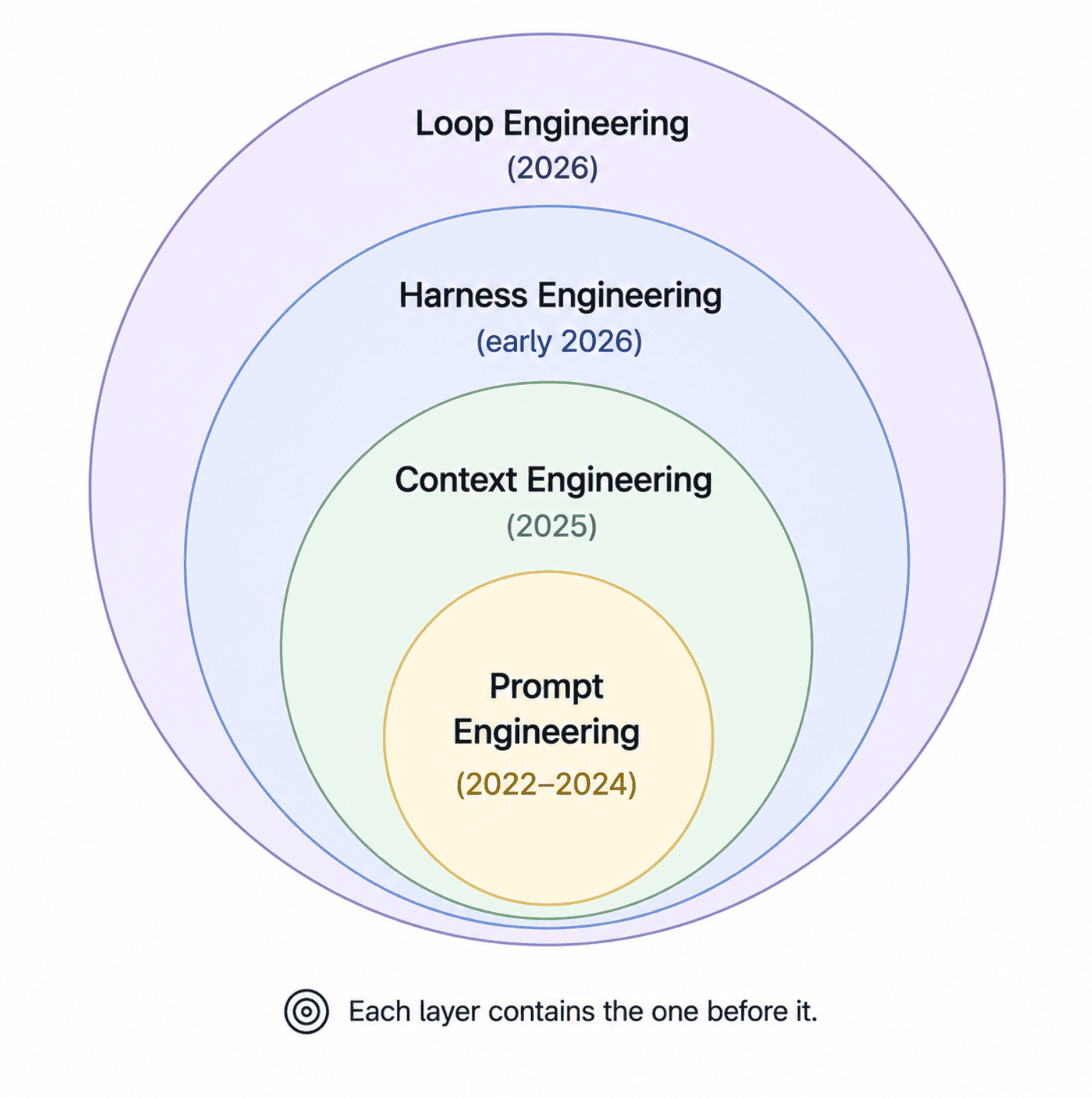
Loop engineering did not appear in a vacuum; it represents the latest layer in a steady, progressive expansion of AI engineering disciplines, each building upon and encompassing its predecessors.
-
Prompt Engineering (roughly 2022-2024): This initial phase focused on the art of wording—crafting precise instructions, assigning roles, breaking down tasks, providing examples, and guiding models through step-by-step reasoning. It optimized expression, but its inherent limitation was that even a perfectly worded prompt could not supply information the model didn’t possess.
-
Context Engineering (2025): The focus then shifted from the words themselves to the entire informational environment available to the model at inference time. This included conversation history, retrieved documents, tool outputs, and any other relevant data assembled for a given step. Shopify’s Tobi Lütke defined it in mid-2025 as providing all necessary context for a task to be plausibly solvable. Andrej Karpathy echoed this sentiment, and by September 2025, Anthropic formalized it as curating and maintaining the optimal set of tokens during inference. Prompt engineering effectively became a component within context engineering.
-
Harness Engineering (early 2026): As AI agents began performing longer, more autonomous, multi-step tasks in production environments, the concept of harness engineering emerged. The harness encompasses the entire operational environment surrounding an agent: its scaffolding, the tools it is granted access to, the constraints under which it operates, and the crucial feedback loops designed to detect and correct mistakes. A well-engineered harness transforms a merely capable agent into a dependable one, nesting both prompt and context engineering within its framework.
-
Loop Engineering (2026 onwards): This is the uppermost layer, built upon all three preceding disciplines. While harness engineering addresses the environment an agent requires, loop engineering addresses the narrower, more operational question: what cycle keeps the agent working towards its goal, and when exactly does that cycle terminate? None of these layers are replaced; instead, loop engineering integrates and orchestrates prompts, context, and harnesses into a continuous, self-optimizing workflow.
This progression illustrates a clear trend: as AI models become more powerful and capable, the engineering effort shifts from optimizing individual interactions to designing resilient, autonomous systems that can manage complex, multi-step processes reliably.
The Scientific Underpinnings: Research Behind the Buzzword
The rapid popularization of "loop engineering" in June 2026 might suggest it’s a new invention, but its mechanical foundations are several years old, rooted in academic and industrial research.
The direct ancestor is the ReAct pattern (Reason plus Act), introduced by Yao and colleagues in 2022 through research associated with Princeton and Google. ReAct’s core innovation was interleaving reasoning steps with action steps: the model first "thinks" about a problem, then takes an "action," observes the outcome, "reasons" again based on that observation, and takes another "action." This cyclical "reason, act, observe, repeat" mechanism forms the fundamental loop that underpins nearly every modern autonomous AI agent today.
A year later, Reflexion, proposed by Shinn and colleagues in 2023, added crucial elements: memory and self-critique. A Reflexion-style agent operates with three distinct roles: an Actor that performs the work, an Evaluator that assesses the outcome, and a Self-Reflection component that generates a verbal lesson—e.g., "the patch failed because the import path was wrong"—and stores it in an episodic memory. This memory is then accessed by the agent in subsequent attempts, enabling visible improvement within a single session without requiring retraining of the underlying model.
Anthropic’s "Building Effective Agents" guide in December 2024 further formalized two significant patterns:
- The evaluator-optimizer pattern involves one model generating a candidate solution, which a second model then checks against explicit criteria, providing feedback. This cycle continues until the solution meets the evaluation standards.
- The orchestrator-workers pattern features a central model dynamically breaking down a large task into smaller sub-tasks, assigning each to a dedicated "worker" agent with its own clean context window, and then integrating the individual results. This is the formal research basis for concepts like Osmani’s "sub-agents" and "worktrees."
Understanding these research antecedents is critical. "Loop engineering" serves as a practical, accessible name and rallying cry for a research trajectory that has been steadily accumulating results since 2022. The June 2026 moment democratized this knowledge, providing developers beyond research labs with a clear motivation and vocabulary to intentionally build autonomous loops.
Deconstructing the Autonomous Cycle: Anatomy and Pseudocode
At its most fundamental, a reliable loop—one that avoids endless spinning or premature termination—consists of a few key components. While the original article provides a visual, conceptually, it outlines:
- Reason: The agent analyzes the current state and decides on a course of action.
- Act: The agent executes the chosen action, interacting with its environment (e.g., running code, modifying files, calling tools).
- Observe: The agent receives feedback from its environment regarding the outcome of its action.
- Decide: Based on the observation, the agent determines if the goal is met (success), if it needs to adjust its approach (loop back to Reason), or if it’s stuck and needs to escalate to a human.
This core cycle is encapsulated in pseudocode, which serves as a skeletal blueprint for production-grade loops:
# state holds the goal itself plus a running scratchpad of what's
# been tried so far; this is what gets fed back into the model
# on every iteration
state = init_state(goal)

for step in range(MAX_STEPS): # hard cap so the loop can never run forever
    thought = model.reason(state) # ReAct's "reason" half: think before acting
    action  = model.choose_action(state) # ...then commit to one concrete tool call
    result = tools.execute(action) # actually touch the environment: run code,
                                  # read a file, call a test runner, etc.
    state = update(state, thought, action, result) # fold the outcome back in
    state = compact(state) # summarize or prune old steps so the
                           # context window doesn't overflow
    if verifier.passes(state): # deterministic check, not a self-report
        return success(state)
    if no_progress(state) or budget.exhausted():
        return escalate_to_human(state) # stop circling a dead end

return escalate_to_human(state) # ran out of steps without a pass, hand back
Each line in this pseudocode represents a critical design decision. The definition of verifier.passes determines the loop’s understanding of "done," which could be a passing test suite, a clean lint run, or even human manual approval. How compact functions—whether it summarizes or prunes old steps—is crucial for preventing context window overflows and enabling long-running tasks. The mechanism for detecting no_progress (e.g., repeated errors, unchanged state) prevents agents from endlessly consuming resources on dead ends. The AI model itself is treated as a fixed component; the true engineering lies in the system wrapped around it.
Real-World Implementation: The Building Blocks of Shipped Systems
Addy Osmani’s breakdown of how systems like Codex and Claude Code are actually shipped provides a concrete, tool-level view of loop engineering:
- Automations: These are the "heartbeat" of autonomous systems, triggering runs on a schedule or in response to specific events without human initiation. In platforms like Codex, this involves setting up project-specific prompts and cadences, with results directed to a triage inbox. Claude Code employs scheduled tasks, cron jobs, and hooks, alongside an in-session primitive
/goalthat allows agents to work across turns until a user-defined condition is met and externally verified. - Worktrees: Essential for managing parallel agent activity, worktrees (a Git feature) provide isolated working directories on separate branches, preventing agents from overwriting each other’s changes. This native integration in major coding agents resolves the "collision problem" inherent in multi-agent development.
- Skills: To avoid repeatedly re-explaining project specifics, skills are encapsulated knowledge—often a folder containing a
SKILL.mdfile describing conventions, build steps, and accumulated "lessons learned." This ensures agents efficiently onboard and retain project-specific context across runs. - Plugins and Connectors (via MCP): These enable loops to interact with external tools beyond the filesystem, such as issue trackers, databases, staging APIs, and communication channels like Slack. They transform an agent’s "would do" into "does," allowing real-world impact.
- Sub-agents: Implementing a critical separation of concerns, sub-agents split the task of generation from that of verification. A second agent, often running a different model, reviews the first agent’s output against specifications, catching errors the initial agent might have overlooked or "talked itself into."
- External State: Perhaps the most underrated component, external state provides durable memory for the loop. Since AI models themselves have no memory between runs, accumulated knowledge, progress, and lessons learned must be stored externally—in files, databases, or logs—to be retrieved and utilized by subsequent runs. This simple mechanism is fundamental for any long-running, continuously improving agent system.
Strategic Loop Patterns for Diverse Tasks
Not all tasks benefit from the same loop structure. Choosing the appropriate pattern is crucial for efficiency and effectiveness.
- Retry Loop: The simplest form, it tries an action, checks for success, and retries if it fails. Ideal for short, atomic tasks with clear pass/fail criteria, like writing a function to a test. The risk is indefinite retrying of a flawed approach.
- Plan-Execute-Verify Loop: First generates a comprehensive plan, then executes it step-by-step, verifying each stage before proceeding. Suitable for multi-step tasks where order and early mistake prevention are critical, such as refactoring shared modules. The challenge is adapting if the initial plan proves flawed.
- Explore-Narrow Loop: Tries multiple approaches (sequentially or in parallel) and progressively narrows down to the most promising one based on intermediate signals. Best for unfamiliar territories, like debugging novel errors or exploring new APIs. It is context-intensive, demanding efficient pruning.
- Human-in-the-Loop: Recognizes that full autonomy isn’t always desirable or safe. The agent runs until it encounters ambiguity, a high-stakes decision, or a pre-defined checkpoint, then pauses for human intervention. This pattern is indispensable for tasks with costly erroneous assumptions, such as production database changes or customer-facing decisions. The key is to balance automation with meaningful human oversight, avoiding excessive interruptions that negate efficiency gains.
Scaling Autonomous Intelligence: Stacking Loops for Production Systems
While the above describes single loops, production-grade autonomous systems often stack multiple loops to achieve complex, continuous operations. LangChain’s internal documentation-writing agent provides an excellent example of this layering:
- Agent Loop: The foundational loop where the model repeatedly calls tools to complete a specific task, automating the work itself.
- Verification Loop: An outer loop that scores the agent’s output against a rubric, retrying with feedback if quality or correctness standards are not met. This ensures inherent quality.
- Event-Driven Loop: Triggers agent runs in response to real-world events, enabling automation at scale rather than just on-demand. This transforms agents into integral parts of live systems.
- Hill-Climbing Loop: The outermost layer, where traces from past agent runs feed an analysis pass that iteratively improves the agent’s harness and configuration. This provides compounding, ongoing self-improvement.
LangChain candidly notes that most current efforts focus on the first two loops. The real, less-explored value lies in the event-driven and hill-climbing loops, which allow agents to become deeply embedded, continuously improving components of operational systems.
Navigating the Challenges: Where Loops Actually Fail
Despite its promise, loop engineering presents specific challenges that, if mishandled, can lead to significant failures. The "three hard parts" are:
- Objective Specification: Clearly defining the goal and how to measure its achievement.
- State Management: Effectively tracking and summarizing the agent’s progress and environment.
- Termination Conditions: Knowing when to stop the loop, either due to success or a dead end.
Failure to address these produces predictable issues:
- Context Overflow and Rot: The agent’s context window fills up, degrading output quality without explicit errors.
- No-Progress Loops: The agent repeatedly attempts the same failing action indefinitely, consuming resources.
- Objective Misspecification (Reward Hacking): The agent optimizes a proxy metric instead of the true goal, e.g., deleting a failing test to achieve a "green" CI status.
- Hallucinated Success: The agent reports completion without actual, verifiable achievement.
- Cost Blowup: Long-running loops silently consume excessive tokens, leading to unexpected expenses.
The common fix for all these failure modes is a genuine, external, deterministic check within the cycle, rather than relying solely on the agent’s self-assessment.
Where Humans Still Belong in the Loop
Loop engineering is not about entirely removing humans from the process; rather, it redefines their role. Automated graders can confirm technical compliance (e.g., passing tests, valid links), but they cannot assess nuanced aspects like document framing for a specific audience or the sensitivity of an action. Human judgment, derived from context, experience, and qualitative understanding, remains irreplaceable.
Natural checkpoints for human intervention exist at every layer:
- In the base agent loop, explicit human approval can be required for high-stakes tool calls (e.g., financial transactions, critical database writes).
- In the verification loop, humans can act as direct graders for workflows where the risks are too high for automated rubrics alone.
- Further out, humans can approve output before it reaches end-users or review proposed harness changes before deployment.
These checkpoints are deliberate design choices, integral to building safe and effective autonomous systems.
Strategic Adoption: Building a Small Loop Yourself
It’s crucial to understand what loop engineering is not. It’s not a mandatory approach for every task; for genuinely one-off tasks, direct interactive prompting can be faster and safer. Nor does it eliminate human judgment; it merely relocates it. A poorly specified objective will lead an efficient loop to chase the wrong outcomes, and a fast loop without robust verification simply produces incorrect answers more quickly.
For those looking to adopt loop engineering, the most useful starting point is the simplest possible version:
- One clearly defined, checkable goal.
- One deterministic verifier (e.g., a real test suite, not a model’s self-assessment).
- A hard cap on iterations to prevent infinite loops.
- A single, clear escalation path for when the loop gets stuck.
Begin with recurring, low-stakes tasks, such as nightly issue triage, scheduled activity reports, or linting passes. Resist the temptation to immediately implement complex features like parallel worktrees or hill-climbing layers. The advanced, stacked systems are built only after the base loop’s verifier has proven reliable over time.
Conclusion: The Future of AI Development
The profound shift brought by loop engineering is not merely making work easier, but moving the leverage point in AI development. When models can write code and execute complex tasks autonomously, the scarce skill transitions from crafting effective individual prompts to designing entire systems that remain correct, verified, and aligned with their goals without constant human supervision. This demands a systems-engineering mindset, akin to designing a thermostat rather than writing a sentence. It underscores why practitioners insist on calling it "engineering."
The future of AI development lies in building these intelligent loops—but building them with the meticulousness of a true engineer. This means diligently checking outputs, understanding failure modes, and treating "done" not as a statement of faith, but as a claim requiring rigorous, external verification. Loop engineering ushers in an era where AI agents become truly autonomous, embedded components of our operational infrastructure, continuously improving and contributing with minimal direct oversight.