Unveiling OpenVLA: A New Era in Robot Control
OpenVLA, short for Open Vision-Language-Action, was introduced to the robotics community through a paper published in June 2024 (arXiv:2406.09246). It represents a significant open-source initiative aimed at democratizing access to powerful robot control models. At its core, OpenVLA is a 7-billion-parameter model trained on an extensive dataset of 970,000 real-world robot demonstrations. This massive scale underscores its potential for generalizability across a wide array of robotic tasks but also highlights the practical difficulties associated with its deployment and adaptation.

As a VLA model, OpenVLA operates by integrating two primary inputs: a camera image capturing the robot’s workspace and a natural-language instruction, such as "put the cup on the plate." From these inputs, the model is designed to predict the precise sequence of actions the robot should undertake to fulfill the given command. This capability is crucial for developing robots that can understand and respond to human directives in dynamic, unstructured environments.
The Reproducibility Imperative: Why a Small Test Matters
The challenge of working with large-scale models like OpenVLA lies not just in their size but in the complexity of their training and adaptation. Full fine-tuning, which involves updating every parameter of a pre-trained model, demands substantial computational resources, including high-end GPUs and extended training times. For many researchers and practitioners, particularly those without access to vast computing clusters, embarking on such an endeavor can be daunting and cost-prohibitive. There’s a critical need for a preliminary, low-cost method to validate the training pipeline itself—to ensure that datasets load correctly, GPUs are actively engaged in training, and that the process leaves behind inspectable evidence of real work being performed.

This Colab-based experiment serves precisely this purpose: it acts as an integration validation, offering a small, reproducible pathway to confirm the integrity of the OpenVLA fine-tuning process. It aims to demystify what changes during OpenVLA fine-tuning, the advantages of employing a Low-Rank Adaptation (LoRA) adapter, how to execute the official training path in an accessible environment like Colab, and, crucially, how to verify that the outcome is more than just a notebook that completed without crashing. This foundational step is vital before allocating significant time and resources to larger-scale robot experiments or performance benchmarks.
LoRA: Bridging Efficiency and Performance in Fine-Tuning
One of the most critical innovations enabling the practical application of large models is Parameter-Efficient Fine-Tuning (PEFT), and Low-Rank Adaptation (LoRA) is a prime example within this paradigm. Developed by Microsoft Research in 2021, LoRA allows for the adaptation of large pre-trained models to specific tasks without the need to fine-tune all their parameters. Instead, LoRA introduces small, trainable "adapter" weights into the model’s architecture, while the vast majority of the original model’s weights remain frozen.

This approach offers several significant advantages, particularly for models of OpenVLA’s scale. Firstly, it drastically reduces the memory footprint required for training, making it feasible to fine-tune models on less powerful hardware, such as a Colab A100 High-RAM GPU, which would otherwise struggle with full fine-tuning. Secondly, it accelerates the training process, as fewer parameters need to be updated. Thirdly, it results in much smaller checkpoints for the adapted model, as only the LoRA adapter weights need to be saved, not the entire base model. The OpenVLA project itself has reported that LoRA can match the performance of full fine-tuning while updating only about 1.4 percent of the total parameters, making it an incredibly efficient and effective method for adaptation. For this initial validation run, LoRA’s efficiency is paramount, allowing a legitimate training process to be demonstrated within the constraints of a single Colab session.
The LIBERO Dataset: Fueling Robot Learning
The specific dataset employed in this reproducible run is the libero_spatial_no_noops split from the modified LIBERO RLDS (Robot Learning Dataset Standard) data. LIBERO (Liu et al., 2023) is a recognized benchmark for language-conditioned robot manipulation, designed to test a robot’s ability to execute instructions involving spatial relationships between objects. The "spatial" split specifically focuses on tasks requiring the robot to understand and act upon positional relationships, for instance, "place object A on object B." The "no_noops" suffix indicates that "no-operation" actions—periods where the robot is idle—have been removed, ensuring that the training data is concentrated on meaningful state-changing actions.

RLDS provides a standardized format for storing robot demonstrations as episodes, each comprising a chronological sequence of observations (e.g., camera images), language instructions, robot actions (e.g., 7-DoF end effector commands), and associated step metadata. This standardization is crucial for ensuring consistency and reproducibility across different research efforts. In this experiment, OpenVLA learns from these episodes by comparing its predicted action tokens with the ground-truth action tokens provided in the dataset, aiming to minimize the discrepancy and improve its action prediction accuracy for the specific task family. The dataset, distributed by the OpenVLA project on Hugging Face, operates under the Creative Commons Attribution 4.0 International (CC BY 4.0) license, permitting commercial use with attribution, while the OpenVLA codebase itself is under the MIT License.
A Detailed Look at the Colab Experiment
The Colab notebook (accessible at https://colab.research.google.com/drive/1AiiJuFvNUTyQ-eksm9Mj7wAGtvH_V4zQ) is meticulously crafted for a single, self-contained run. It mandates a specific runtime configuration: Python 3, an A100 GPU, and the High-RAM option, underscoring the computational demands even for a "small" fine-tuning task. To ensure proper tracking and authentication, users are required to input their Weights & Biases (W&B) API key into Colab Secrets, which then facilitates the logging and syncing of experiment data to their respective W&B accounts.

A distinctive feature of this setup is the utilization of two separate Python environments: /content/openvla_venv for the OpenVLA training script and /content/wandb_sync_venv for syncing the offline W&B run. This architectural choice addresses potential dependency conflicts, as OpenVLA pins older machine learning library versions, while W&B benefits from a more current client. The training proceeds offline within the OpenVLA environment, and upon completion, a fresh sync environment is created to upload the comprehensive run data, ensuring stability and compatibility throughout the process.
Dissecting the Training Command and Hyperparameters
The core of the fine-tuning process is driven by the vla-scripts/finetune.py entry point from the official OpenVLA codebase. The command line arguments are carefully chosen to facilitate a verifiable yet resource-conscious run. Key parameters include:

--vla_path openvla/openvla-7b: Specifies the pre-trained OpenVLA model checkpoint.--data_root_dir /content/data/rlds/modified_libero_rldsand--dataset_name libero_spatial_no_noops: Link to the downloaded LIBERO dataset.--lora_rank 32: Defines the rank of the LoRA adapter matrices, influencing the number of trainable parameters and thus the adapter’s capacity. A rank of 32 is a common starting point for LoRA experiments, balancing expressiveness with efficiency.--batch_size 2and--grad_accumulation_steps 8: These parameters are critical for managing GPU memory. A small physical batch size of 2 keeps memory usage low, while gradient accumulation over 8 steps effectively results in a larger logical batch size of 16 (2 physical batches 8 accumulation steps 1 training process). This strategy allows for stable gradient updates without requiring excessive GPU memory for individual batches.--learning_rate 0.0005: A conservative learning rate, typical for fine-tuning large models, to prevent rapid divergence.--image_aug True: Enables image augmentation, a standard practice in vision tasks to improve model robustness to visual variations, mirroring the official OpenVLA LoRA recipe.--max_steps 100: Limits the training to just 100 steps. This short duration is sufficient to observe initial learning signals and validate the pipeline without being a full performance benchmark.
Verifiable Outcomes: Interpreting the Metrics
Despite its brevity, the 100-step run generated clear evidence of a learning signal, which is the primary goal of this validation. Three key metrics were logged and tracked in Weights & Biases:
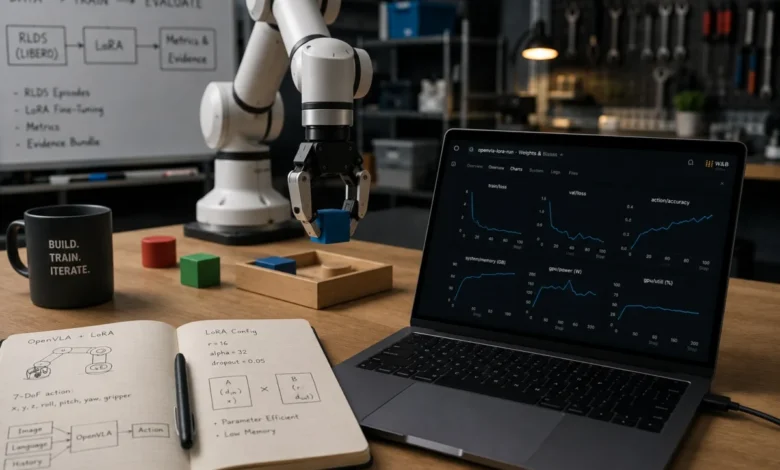
train_loss: Measures the supervised training error. A decrease in this value indicates that the model is learning to predict actions more accurately based on the demonstrations. The run showed a sharp initial drop from approximately 11 to 3.6 within the first 10 steps, stabilizing around 3.2-3.6, and ending at 3.42928.l1_loss: Represents the absolute error between the predicted continuous action values and the demonstrated action values. Lower L1 loss signifies that the model’s predicted robot movements are closer to the ground truth. This metric decreased from about 0.46 at the start, fluctuating between 0.18 and 0.29, and concluding at 0.2222.action_accuracy: Quantifies how often the predicted discrete action tokens precisely match the demonstrated action tokens. An increase in this metric confirms the model’s improving ability to select the correct actions from its vocabulary. The accuracy rose from approximately 0.09 to a peak near 0.35, settling at 0.28571 by the end of the run.
Collectively, the downward trend in both train_loss and l1_loss, coupled with the upward trajectory of action_accuracy, unequivocally demonstrates that the LoRA training loop was actively updating the model’s parameters and that the model was indeed learning from the LIBERO dataset. Crucially, system telemetry—including host memory usage, process GPU power consumption (ranging from 165 to 195 watts), and GPU utilization (around 40-48%)—provided concrete proof that the Colab A100 GPU was engaged in sustained computational work throughout the training period. This detailed logging, made possible by W&B, transforms the experiment from a simple "finished without crashing" outcome into a thoroughly inspectable and verifiable training process.

The Audit Trail: Evidence and Reproducibility
The power of this reproducible experiment lies not just in its execution but in the comprehensive audit trail it generates. Upon completion, the notebook creates an evidence folder and a zip file containing critical artifacts:
colab_environment.json: Details of the Colab runtime environment.openvla_lora_colab_command.sh: The exact training command used.openvla_lora_train_stdout.txt: The full console output of the training script.wandb_run_url.txt: The URL to the synced Weights & Biases run, serving as the central hub for all metrics, charts, and system telemetry.wandb_verified_run.json: Metadata confirming the successful W&B sync.
This collection of evidence provides an unparalleled level of transparency. Any interested party can review the precise configuration, the training logs, and the resulting performance metrics and system activity via the W&B run page (https://wandb.ai/wb-authors/openvla-lora-finetune/runs/zwo162re). This robust approach to reproducibility aligns with best practices in machine learning research, where verifiable results are paramount for building trust and accelerating progress. It exemplifies how experiment trackers are not merely logging tools but essential components of the scientific process, providing a stable, inspectable record for every claim.

Broader Implications and the Road Ahead
This reproducible OpenVLA fine-tuning experiment, while small in scope, carries significant implications for the broader robotics AI community. It demonstrates a practical pathway for researchers to engage with cutting-edge large VLA models without requiring prohibitive computational resources. By validating the training pipeline in an accessible environment like Colab, it lowers the barrier to entry for experimentation, fostering greater participation and innovation. This move towards democratizing access to powerful models and efficient fine-tuning techniques is critical for accelerating the development of more capable and versatile robotic systems.
However, it is crucial to reiterate that this experiment is an integration validation, not a performance benchmark. While it confirms the model’s ability to learn, it does not measure real-world robot task success or generalization capabilities, which would require extensive held-out simulation rollouts or real-robot evaluations. The ongoing challenges in robotics AI, such as the "sim-to-real" gap (transferring policies from simulation to physical robots), ensuring robustness in diverse real-world conditions, and addressing ethical considerations in autonomous systems, remain significant areas of active research.

Ultimately, the core lesson from this reproducible run extends beyond OpenVLA: for any large-model fine-tuning tutorial, the true value lies in the inspectable evidence it leaves behind. Before researchers can confidently ask whether a fine-tuned robot model is "good" or "ready for deployment," they must first establish that the underlying training run is real, reproducible, and thoroughly measurable. This methodical approach ensures that subsequent, larger-scale experiments are built upon a solid, verifiable foundation, propelling the field of robotics AI forward with confidence and transparency.
Sources:
- Colab notebook: https://colab.research.google.com/drive/1AiiJuFvNUTyQ-eksm9Mj7wAGtvH_V4zQ
- W&B run: https://wandb.ai/wb-authors/openvla-lora-finetune/runs/zwo162re
- OpenVLA paper: https://arxiv.org/abs/2406.09246
- Modified LIBERO RLDS dataset: https://huggingface.co/datasets/openvla/modified_libero_rlds
- LIBERO (Liu et al., 2023): https://github.com/Lifelong-Robot-Learning/LIBERO