The integration of artificial intelligence into enterprise software is frequently met with the promise of increased productivity and streamlined workflows. However, for product teams at major organizations, the reality often proves more complex. A recurring pattern has emerged where AI features, though technically functional, fail to provide actual value because they inadvertently shift the burden of labor onto the user. When a tool designed to save time ends up requiring extensive verification, the net gain to the user is effectively zero—or worse, negative. To navigate this challenge, product teams must shift their focus from the capabilities of the technology to a rigorous "break-even" audit that evaluates the cognitive cost of human-AI collaboration.
The Anatomy of an AI Failure: The Insurance Case Study
A recent case study involving a large health insurer serves as a cautionary tale for the industry. The insurer’s product team sought to automate the creation of written determinations for benefits appeals specialists. The AI model was engineered to ingest medical records and policy documents to generate a full, final determination letter. On paper, the system worked precisely as specified, producing coherent, grammatically correct text.
However, the implementation failed in the field. Specialists stopped using the feature, and those who persisted found that their case-processing times increased rather than decreased. Post-deployment interviews revealed a critical oversight: the time required for a specialist to meticulously read, verify, and correct an AI-generated draft was roughly equivalent to the time required to write the document from scratch. Furthermore, the specialists were forced to hunt for errors that they would not have made themselves, turning a task of creative synthesis into one of tedious proofreading. This effectively demoted the specialists from authors to checkers, adding significant friction to a process they had already mastered.
The team ultimately opted for a radical rescoping. In the second iteration, the AI was stripped of its "writing" function. Instead, it was tasked with surfacing only the relevant policy provisions and prior decisions pertinent to the appeal. This allowed the specialists to retain control over the writing—the part of the job they were most skilled at—while eliminating the time-consuming manual search phase. By shifting the AI’s role from "output creator" to "context assistant," the product achieved the desired efficiency gains without compromising the professional integrity or cognitive flow of the user.
Defining the Break-Even Line in Enterprise Software
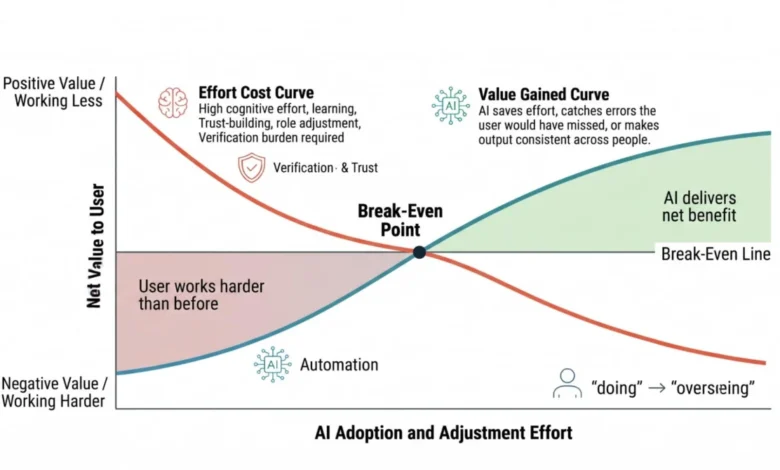
Every interface change imposes a "cognitive tax" on the user. When an AI feature is introduced, the user must expend mental energy to learn the new system, adjust their established workflows, and calibrate their level of trust in the machine’s output. According to cognitive science research—most notably the work of Nelson Cowan on working memory—the human brain has a limited capacity for holding concurrent information, typically estimated at around four items. When an AI feature forces a user to juggle machine-generated output, verification, and original decision-making, it risks overwhelming this finite resource.
To determine if a feature is worth the investment, product teams must identify the "break-even line." This is the point at which the returns provided by the AI—whether through error detection, speed, or synthesis—surpass the effort the user must exert to adjust to the tool. If the effort exceeds the return, the feature is not merely a failed experiment; it is a burden that degrades the overall quality of work.
The Four-Question Audit Framework
To avoid the pitfalls of pro-innovation bias—the assumption that any new technology is inherently beneficial—teams should subject proposed AI features to a four-question audit before a single line of code is written or a UI wireframe is finalized.
1. Does the feature reduce the total effort the task takes for the user?
It is not enough to reduce the number of clicks. If an AI pre-fills a form but forces the user to check the entry for accuracy, the effort has not been removed; it has simply been relocated. Product teams must quantify the "checking cost." If the AI’s error rate requires a 100% human review, the efficiency gain is often illusory.
2. Does the AI outperform the user’s current method?
Users often develop sophisticated "workarounds" or spreadsheets to manage their workflows. An AI feature must provide a measurable advantage over these existing habits. If a user already has a fast, reliable method for completing a task, the AI needs to offer something truly unique—such as pattern recognition across massive datasets or the ability to identify anomalies that would otherwise go unnoticed—to justify the disruption.
3. Can the user catch the errors?
This is perhaps the most critical technical and ethical question. If an AI makes a subtle error in a high-stakes environment, and that error is not easily visible, the consequence can be catastrophic. Automation bias, a phenomenon well-documented in aviation and medical research, suggests that humans have a psychological tendency to defer to automated systems, even when they are incorrect. If the error is "invisible"—such as a trip planner suggesting a museum on a day it is closed—the user is unlikely to catch it until the damage is done.
4. Will the user retain their core skills after a year?
Delegating routine tasks to AI is beneficial, but delegating the core judgment of a profession is risky. If a radiologist or a financial analyst relies on an AI to make decisions for twelve months, their own ability to identify mistakes may atrophy. Research from institutions like the Radiological Society of North America indicates that even highly experienced professionals can see their accuracy decline when they rely on flawed AI suggestions over an extended period. Designers must build "verification mechanisms" into the workflow—such as periodic blind reviews—to ensure that the user’s critical judgment remains sharp.

The Broader Implications for Product Strategy
The integration of AI into professional workflows is not merely a technical challenge; it is a fundamental shift in the division of labor between human and machine. As seen in the meeting summary software industry, AI can be highly effective when it handles tasks that are tedious for humans, like transcribing notes, while leaving the decision-making to the meeting participants. In this context, the AI clears the break-even line because it saves time on a low-value task while keeping the high-value judgment firmly in the hands of the human.
However, when AI enters the realm of professional services, the risk profile changes. In the 2025 study by Sophia Ackerhans et al., physicians reported a significant threat to their professional identity when forced to sign off on AI-assisted decisions. This highlights that for many users, work is not just about output—it is about professional standing and expertise. When an AI makes it appear that the human is merely a "rubber stamp," the user experience suffers, leading to lower adoption rates and decreased morale.
Strategic Recommendations for Implementation
To implement this audit successfully, product teams should:
- Segment the User Base: Recognize that a tool that provides significant value to a junior analyst may be an impediment to a senior expert. Design with clear "exit" pathways so that more experienced users can bypass the AI when it is no longer helpful.
- Prioritize Provenance: If a feature has a high-consequence, low-visibility error surface, it must ship with clear provenance. Users must be able to see the data sources and the rationale behind an AI’s recommendation. Transparency is the bedrock of trust.
- Formalize the Audit in the Brief: These four questions should not be an afterthought. They should be written into the product requirements document (PRD) at the inception stage. When teams treat these as project requirements rather than optional design "polish," they are far more likely to build tools that genuinely enhance human capability rather than replacing it with an inefficient simulation.
In the current landscape of rapid technological deployment, the competitive advantage will not necessarily go to the firm with the most sophisticated model, but rather to the team that best understands the human-machine interface. By systematically applying the break-even audit, organizations can move beyond the hype and create tools that are not only powerful but also functional, reliable, and deeply integrated into the professional lives of their users. The objective is not to maximize AI usage, but to maximize the value delivered to the human being behind the screen. When the audit is applied early, it allows product teams to define a realistic scope, manage user expectations, and ensure that every addition to the software is a genuine contribution to the user’s workflow.
Related posts: