STRG Emerges as a Cost-Effective, S3-Compatible Cloud Object Storage Alternative for Modern Web Applications

The exponential growth of modern web applications has fundamentally transformed how digital assets are managed, stored, and scaled across the internet. As web platforms evolve to incorporate high-resolution media, extensive user-generated content, and complex data architectures, the volume of digital assets and their corresponding file sizes increase in tandem. This continuous upward trajectory introduces significant operational challenges for engineering teams, most notably escalating cloud infrastructure expenditures and compounding vendor complexity. For years, the enterprise cloud storage market has been dominated by legacy hyperscalers such as Amazon Web Services (AWS), Google Cloud Platform (GCP), and Microsoft Azure. While these platforms offer robust ecosystems, their intricate pricing tiers, data egress fees, and complex configurations have prompted developers and organizations to seek streamlined, cost-effective alternatives. Enter STRG, a modern cloud object storage platform engineered to provide a fully S3-compatible alternative designed specifically to mitigate these financial and technical friction points.
The Genesis of Cloud Object Storage and Market Pressures
To understand the current landscape of web asset management, it is necessary to examine the evolution of cloud storage models over the past two decades. In the early days of web development, static assets were typically housed on the same physical servers or simple Virtual Private Servers (VPS) running the application code. As traffic scaled, this centralized architecture created critical bottlenecks, leading to the adoption of Content Delivery Networks (CDNs) and dedicated object storage buckets.
AWS S3, launched in 2006, revolutionized the industry by providing infinitely scalable, highly durable object storage via a standardized Application Programming Interface (API). However, as the digital economy matured, organizations began to realize that hyperscale cloud providers often imposed heavy financial penalties for data transfer, retrieval operations, and cross-region replication. These hidden costs frequently caught growing startups and mid-sized enterprises off guard, transforming routine asset management into a volatile line item on corporate balance sheets. Furthermore, the sheer breadth of ancillary services offered by major cloud providers often resulted in vendor lock-in, making it difficult and expensive to migrate data to competing platforms.
Industry analysts note that modern development teams are increasingly prioritizing architectural simplicity, predictable billing structures, and native interoperability. STRG enters this competitive ecosystem by offering a streamlined infrastructure layer that replicates the familiar S3 API standard while stripping away the bureaucratic overhead and complex pricing matrices associated with legacy cloud giants. By positioning itself as a drop-in replacement for existing S3 workflows, STRG aims to capture market share from organizations looking to optimize their cloud spend without undertaking expensive code rewrites or infrastructure overhauls.
Technical Architecture and Integration Capabilities
A primary barrier to adoption for any new cloud storage provider is compatibility. Engineering teams cannot afford to rewrite legacy codebases or retrain personnel on proprietary command-line interfaces and SDKs just to switch storage vendors. STRG has addressed this challenge by adopting the widely used S3 API specification as its operational foundation. This strategic decision ensures that any application currently communicating with AWS S3 can be redirected to STRG with minimal configuration changes.
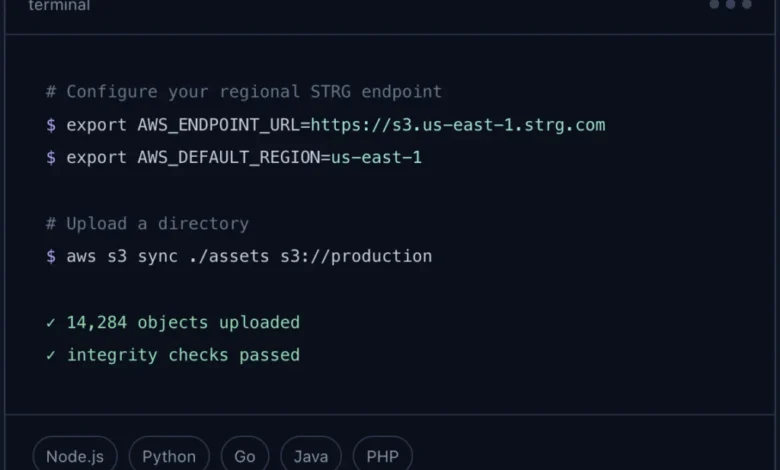
Upon establishing a STRG account, administrators can generate dedicated API keys and provision storage buckets through a streamlined control panel. Once configured, developers can immediately interact with the platform using familiar tools such as the AWS Command Line Interface (CLI). For instance, setting up an upload profile and managing assets can be executed via standard terminal commands:
Configure your STRG upload settings
aws configure –profile strg
Manage some assets!
aws s3 ls –profile strg –endpoint-url https://s3.eu-central-1.strg.com
aws s3 cp ./hello.txt s3://my-first-bucket/hello.txt –profile strg –endpoint-url https://s3.eu-central-1.strg.com
aws s3 ls s3://my-first-bucket/ –profile strg –endpoint-url https://s3.eu-central-1.strg.com
aws s3 cp s3://my-first-bucket/hello.txt ./hello-copy.txt –profile strg –endpoint-url https://s3.eu-central-1.strg.com
Beyond command-line utilities, modern web applications rely heavily on robust software development kits to handle programmatic file uploads, retrievals, and bucket management. STRG integrates seamlessly with standard development runtimes, including Node.js and modern JavaScript environments, utilizing established libraries like the AWS SDK for JavaScript. Developers can instantiate standard S3 clients pointing to STRG regional endpoints, maintaining full parity with their existing codebase logic:
import
S3Client,
PutObjectCommand,
ListObjectsV2Command,
GetObjectCommand,
from "@aws-sdk/client-s3";
const s3 = new S3Client(
endpoint: "https://s3.eu-central-1.strg.com",
region: "eu-central-1",
);
await s3.send(
new PutObjectCommand( Bucket: "my-first-bucket", Key: "hello.txt", Body: "Hello, STRG!" ),
);
const listing = await s3.send(new ListObjectsV2Command( Bucket: "my-first-bucket" ));
for (const object of listing.Contents ?? []) console.log(object.Key, object.Size);
const object = await s3.send(new GetObjectCommand( Bucket: "my-first-bucket", Key: "hello.txt" ));
console.log(await object.Body.transformToString());
Advanced Data Governance and Security Frameworks
While cost reduction is a primary driver for cloud migration, enterprise-grade security, data governance, and regulatory compliance remain non-negotiable requirements for web infrastructure. STRG incorporates a comprehensive suite of advanced storage management features designed to match the operational standards expected by modern engineering organizations.
Among these capabilities are customizable lifecycle policies, which enable automated tiering, archiving, and deletion of assets based on predefined chronological rules or metadata tags. This automation prevents storage bloat and ensures compliance with corporate data retention policies. Additionally, STRG provides granular access controls, Cross-Origin Resource Sharing (CORS) rule configurations, and object-locking mechanisms. Object locks are particularly vital for financial, legal, and healthcare applications, as they enforce Write-Once-Read-Many (WORM) models to protect critical records against accidental deletion, ransomware attacks, or unauthorized modification.
Security within the platform is enforced through strict principle-of-least-privilege access management. By scoping API keys and credentials to specific actions and buckets, organizations can compartmentalize their storage infrastructure, minimizing the blast radius in the event of compromised credentials.
Integration with Artificial Intelligence and Model Context Protocols
As artificial intelligence and autonomous software agents become integral components of modern software engineering pipelines, infrastructure platforms must adapt to support machine-driven workflows. STRG has anticipated this paradigm shift by introducing native support for Model Context Protocols (MCP), enabling AI agents to directly interact with cloud storage repositories.
This integration allows developers to empower AI assistants—such as Claude and other compatible language model interfaces—to manage, query, and manipulate digital assets stored within a STRG account. Integration is achieved through simple command-line provisioning:
claude mcp add –transport http strg https://mcp.strg.com/mcp
Crucially, the operational scope of these AI agents is strictly bound by the permissions assigned to the underlying access keys. If an access key is provisioned with read-only permissions for a specific bucket, an autonomous agent utilizing that key is mathematically restricted from executing write, update, or delete operations. This security architecture bridges the gap between automated artificial intelligence workflows and enterprise-grade data governance, ensuring that autonomous agents cannot execute unauthorized tasks or breach compliance boundaries.
Industry Implications and Broader Economic Impact
The introduction of specialized, S3-compatible alternatives like STRG reflects a broader maturation within the cloud computing industry. For over a decade, the prevailing narrative favored hyperscale consolidation, where organizations moved all workloads into massive, centralized cloud ecosystems. However, as cloud expenditures consume increasingly large portions of corporate budgets, CTOs and engineering leaders are adopting multi-cloud and specialized cloud strategies to optimize performance and cost.
Asset storage is a foundational layer of virtually every digital product, ranging from consumer-facing media streaming portals to enterprise software-as-a-service (SaaS) platforms. Selecting the appropriate storage infrastructure from the outset of a project’s lifecycle is paramount to long-term economic viability. Services that combine low-cost, multi-region delivery with familiar tooling and modern integrations—such as native AI agent support—lower the barrier to entry for innovative startups while offering enterprise-level reliability.
As competition within the cloud object storage market intensifies, platforms that prioritize developer experience, transparent pricing, and API compatibility are well-positioned to disrupt traditional market dynamics. By eliminating vendor lock-in and reducing the financial burdens associated with asset scaling, STRG and similar alternatives provide engineering teams with the flexibility required to build resilient, cost-effective web applications for the digital economy of the future.