Kiro CLI and the MAESTRO Framework Redefine the Landscape of Automated Mathematical Theorem Proving

The quest to automate high-level mathematical reasoning has reached a significant inflection point with the introduction of MAESTRO, a sophisticated prover harness integrated into the Kiro CLI environment. While large language models (LLMs) have demonstrated an increasing capacity for generating code and performing standard tasks, they have historically struggled with the rigorous, non-linear demands of formal mathematics. Specifically, LLMs often falter when tasked with proving complex theorems in Lean, a language used for interactive theorem proving. When these models encounter a dead end in a proof path, they frequently succumb to repetitive token generation or catastrophic failure, losing the thread of the logical argument. The MAESTRO framework, however, shifts the paradigm from simple model inference to a structured, iterative process of planning, diagnosis, and systematic revision.
The Evolution of Formal Reasoning
The integration of artificial intelligence into formal proof development is not merely a software upgrade; it represents a fundamental change in how mathematical research may be conducted in the future. Historically, the primary obstacle for automated provers has been the "exploration problem." In mathematics, a proof is not always a straight line; it is a branching tree of logical obligations. If an AI agent attempts a path that leads to a contradiction or an unprovable lemma, it must be able to backtrack, evaluate why the path failed, and synthesize a new approach.
Previous attempts at automated proving, such as Codex or standard implementations of Claude Code, functioned largely as independent agents. They were highly capable of executing known patterns but struggled when faced with novel problems that required architectural creativity. The MAESTRO framework addresses this by introducing a persistent, centralized coordinator. This coordinator acts as an overseer, maintaining a shared "proof skeleton" and distributing tasks across specialized agents. This allows for concurrent exploration of proof obligations, with the coordinator continuously vetting the results against the broader, evolving proof architecture.
Benchmark Performance and Chronology
The efficacy of the MAESTRO framework was put to the test against several rigorous benchmarks, including the PutnamBench, the NTP4VC dataset, and the highly specialized ArxivLean and FormalQualBench. The results indicate that the coordination mechanism provides a distinct competitive advantage over standalone agentic harnesses.
In June 2026, evaluations on the ArxivLean dataset demonstrated that while baseline models struggled to maintain coherence in research-level proofs, Kiro CLI consistently outperformed its peers. For instance, using GPT 5.6, Kiro CLI achieved 33 successful proofs compared to 24 for standard Codex configurations. The improvement was even more striking with Claude Opus 5, where the success rate jumped from 17 to 37, a massive leap in efficiency and capability.
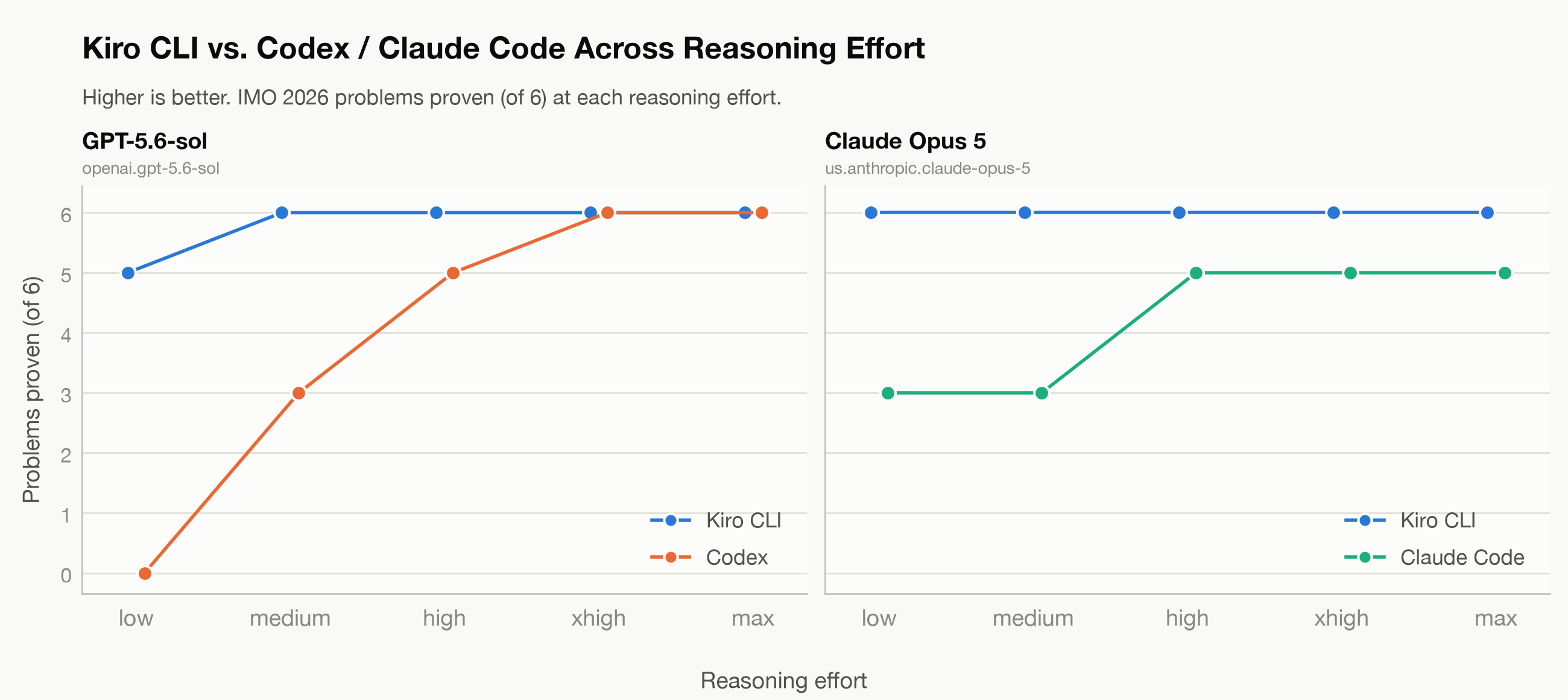
The most notable stress test occurred on July 15–16, 2026, during the International Mathematical Olympiad (IMO). The IMO serves as the gold standard for high-level mathematical problem solving. In this instance, Kiro CLI solved all six problems in a total time of 1 hour and 46 minutes. To put this in perspective, previous benchmarks for similar systems like Humanfia required over eight hours, while the AxiomProver system took nearly 25 hours to reach the same result. The data suggests that Kiro CLI is not just more accurate; it is an order of magnitude faster than its predecessors.
The Mechanism of Coordination
The secret to Kiro CLI’s performance lies in its ability to treat a proof as a living project rather than a static query. When a worker agent returns a piece of logic, the coordinator does not simply accept it; it evaluates it against the current state of the Lean development. If an agent proposes a lemma that proves to be false or, more subtly, creates an interface that is incompatible with other parts of the proof, the coordinator takes corrective action.
One illustrative example of this is the handling of the Quillen-Suslin theorem. In this scenario, a worker agent proposed an algebraic simplification that seemed plausible at a local level. However, a secondary agent—acting as a critic—identified a counterexample showing that this simplification discarded critical information. Rather than forcing the system into an endless loop of failed attempts, the coordinator identified the error, rejected the flawed logic, and re-architected the interface between the proof’s components. This capacity for "architectural repair" is what separates MAESTRO from earlier, less flexible systems.
Discovery and Novelty in Mathematical Proofs
Perhaps the most intriguing outcome of the Kiro CLI trials is its potential for discovering novel mathematical insights. In the proof of the theorem Real Matrices as Linear Combinations of Three Orthogonal Matrices, the system bypassed standard academic approaches. While the original research paper relied on a method of perturbation and compactness to handle singular values, Kiro CLI developed an original, direct construction. By grouping singular values into two-dimensional blocks and telescope-fitting them together, the agent arrived at a proof that was fundamentally different from the human-authored version.
This capability suggests that AI is moving beyond the "imitator" phase. By identifying structural shortcuts and novel constructions, tools like Kiro CLI may eventually assist human mathematicians in identifying new proofs that might otherwise remain buried in the complexity of traditional approaches.
Comparative Data and Efficiency Metrics
The following table summarizes the performance gains across key benchmarks, highlighting the consistent improvement provided by the MAESTRO-driven Kiro CLI:
| Benchmark | Tasks | GPT 5.6 (Kiro) | GPT 5.6 (Codex) | Claude Opus 5 (Kiro) | Claude Opus 5 (Code) |
|---|---|---|---|---|---|
| PutnamBench | 672 | 690 | 656 | 671 | 645 |
| NTP4VC | 600 | 599 | 588 | 600 | 589 |
| ArxivLean | 48 | 33 | 24 | 37 | 17 |
| FormalQualBench | 23 | 14 | 11 | 16 | 9 |
Note: Data reflects comparative success rates. Improvements are noted in the absolute count of successfully completed proofs.
Implications for the Future of Mathematics and Technology
The rapid advancement of Kiro CLI and the MAESTRO framework has profound implications for both software development and academic mathematics. First, it demonstrates that the limitations of current LLMs are often due to a lack of structure rather than a lack of intelligence. By providing these models with a "managerial" layer—a persistent coordinator—the effective intelligence of the system is significantly magnified.
Second, for the field of formal verification, this represents a major step toward the widespread adoption of machine-assisted proofs. As mathematical papers become increasingly complex, the ability to verify every step of an argument through automated means will be essential for maintaining the integrity of the discipline. If AI can not only verify these proofs but also assist in their construction, the speed of scientific discovery could accelerate significantly.
However, researchers involved in the development of Kiro CLI caution that these tools are currently best suited for high-effort, high-reasoning tasks. The computational cost of the coordination framework is significant, meaning it is not intended for trivial tasks but rather for the "frontier" problems that currently demand months of human labor.
Conclusion and Future Directions
The success of Kiro CLI in solving the 2026 IMO problems in under two hours serves as a benchmark for the next generation of AI reasoning tools. By moving away from a single-model approach toward a multi-agent, coordination-heavy architecture, the developers have created a system that is resilient to the errors that typically plague automated provers. As the research continues, the focus will likely shift toward further optimizing the coordinator’s decision-making process and exploring how these techniques can be applied to fields beyond pure mathematics, such as formal code verification, legal reasoning, and complex systems architecture.
The project, as detailed in the technical paper Maestro: Agentic Formal Proof Development by Coordination, underscores a key lesson in the current era of artificial intelligence: the architecture of the system—how it organizes its thoughts and manages its resources—is just as important as the raw capability of the model itself. The era of the lone, struggling AI prover appears to be coming to an end, replaced by the rise of the coordinated, deliberative agent.