AWS CloudFormation Enhances Infrastructure as Code Development with Automatic Pre-Deployment Validation Across All Stack Operations


Amazon Web Services (AWS) has announced a significant enhancement to its CloudFormation service, extending automatic pre-deployment validation to all CreateStack and UpdateStack operations. This critical update, previously available only during change set creation, aims to accelerate infrastructure as code (IaC) development by providing developers with immediate feedback on template errors, thereby minimizing costly and time-consuming deployment failures. The expansion of validation capabilities is complemented by the introduction of three new validation checks, a DisableValidation parameter for granular control, and deep integration with the AWS Cloud Development Kit (CDK) via the cdk validate command.
Background: The Imperative of Infrastructure as Code and the Challenge of Feedback Loops
AWS CloudFormation stands as a cornerstone for managing cloud resources, allowing users to model and provision an entire AWS infrastructure stack using declarative JSON or YAML templates. This "infrastructure as code" paradigm offers immense benefits in terms of consistency, repeatability, version control, and automation. However, a persistent challenge in IaC development has been the time taken to identify and rectify errors within templates. Traditionally, syntax errors, resource misconfigurations, or naming conflicts would only become apparent during the actual provisioning process. A failed deployment could trigger a lengthy rollback, wasting valuable development time and incurring unnecessary compute costs.
Recognizing this critical pain point, CloudFormation previously introduced pre-deployment validation during change set creation. This initial step allowed developers to preview proposed infrastructure changes and catch common errors such as property syntax issues, resource name conflicts, and S3 bucket emptiness constraints before actual execution. While a significant improvement, this validation was not universally applied across all deployment paths, leaving gaps for direct stack creation and updates. The latest announcement addresses this by embedding these vital checks directly into the core CreateStack and UpdateStack operations, making early error detection a ubiquitous feature of the CloudFormation experience.
Key Enhancements to CloudFormation Validation
The new capabilities represent a comprehensive upgrade to CloudFormation’s validation framework, designed to "shift left" error detection in the development lifecycle.
1. Automatic Validation on All Stack Operations:
The most impactful change is the automatic execution of pre-deployment validation on every CreateStack and UpdateStack operation. This means that regardless of whether a developer is creating a new stack, updating an existing one, or utilizing change sets for a preview, fundamental checks are performed without any explicit configuration. This seamless integration ensures that all deployment workflows, including those driven by CI/CD pipelines and emerging AI agents, benefit from immediate error feedback.
2. Introduction of New Validation Checks:
To further bolster resilience and adherence to best practices, three new types of validation checks have been integrated:
- Service Quotas Limit Exceeded: This check proactively identifies if a proposed deployment would exceed existing AWS service quotas for specific resources. For example, attempting to create more EC2 instances or VPCs than allowed by the account’s quota will trigger a warning, allowing developers to request a quota increase before deployment, preventing an otherwise guaranteed failure.
- AWS Config Recorder Conflicts: AWS Config provides a detailed inventory of AWS resources and their configurations. Deploying a new Config Recorder could conflict with an existing one or violate service rules. This validation prevents such conflicts, ensuring proper configuration governance.
- ECR Repository Delete Readiness: When updating or deleting ECR repositories, certain conditions (like containing images) must be met to ensure a smooth operation. This check verifies delete readiness, preventing failures related to non-empty repositories.
These new checks primarily operate in "WARN" mode, meaning they will flag potential issues without immediately halting the deployment, providing developers with critical information to make informed decisions.
3. Operation-Level Control with DisableValidation:
While pre-deployment validation is now the default, AWS recognizes scenarios where bypassing these checks might be necessary. The new DisableValidation parameter offers operation-level control, allowing developers to explicitly skip validation for a specific CreateStack or UpdateStack command. This parameter should be used judiciously, as it trades early error detection for potentially faster deployment initiation, with the understanding that errors might only surface later during the resource provisioning phase.
4. Enhanced CDK Integration with cdk validate:
For developers leveraging the AWS Cloud Development Kit (CDK), the cdk validate command has been significantly enhanced. This command now acts as a unified validation experience, combining multiple validation sources into a single report. Crucially, it leverages the server-side CloudFormation pre-deployment validation and maps any identified errors directly back to the specific construct and source file location in the CDK code. This construct-level tracing is a game-changer, providing highly precise feedback that points developers to the exact line of code requiring modification, dramatically accelerating the debugging process.
How Pre-Deployment Validation Works in Practice
CloudFormation pre-deployment validation operates in two distinct modes, influencing how deployment failures are handled:
- FAIL Mode: When validation fails in this mode, the stack operation is immediately halted, and no resources are provisioned or modified. This prevents the initiation of potentially costly and time-consuming rollbacks. Property syntax errors and resource name conflicts typically trigger a FAIL mode validation.
- WARN Mode: In this mode, validation failures generate warnings, but the stack operation is allowed to proceed. This is particularly useful for issues like service quota limits, where a developer might choose to proceed with the deployment while simultaneously initiating a quota increase request. The new Service Quota, Config Recorder, and ECR Repository delete readiness checks operate in WARN mode.
Illustrative Scenarios:
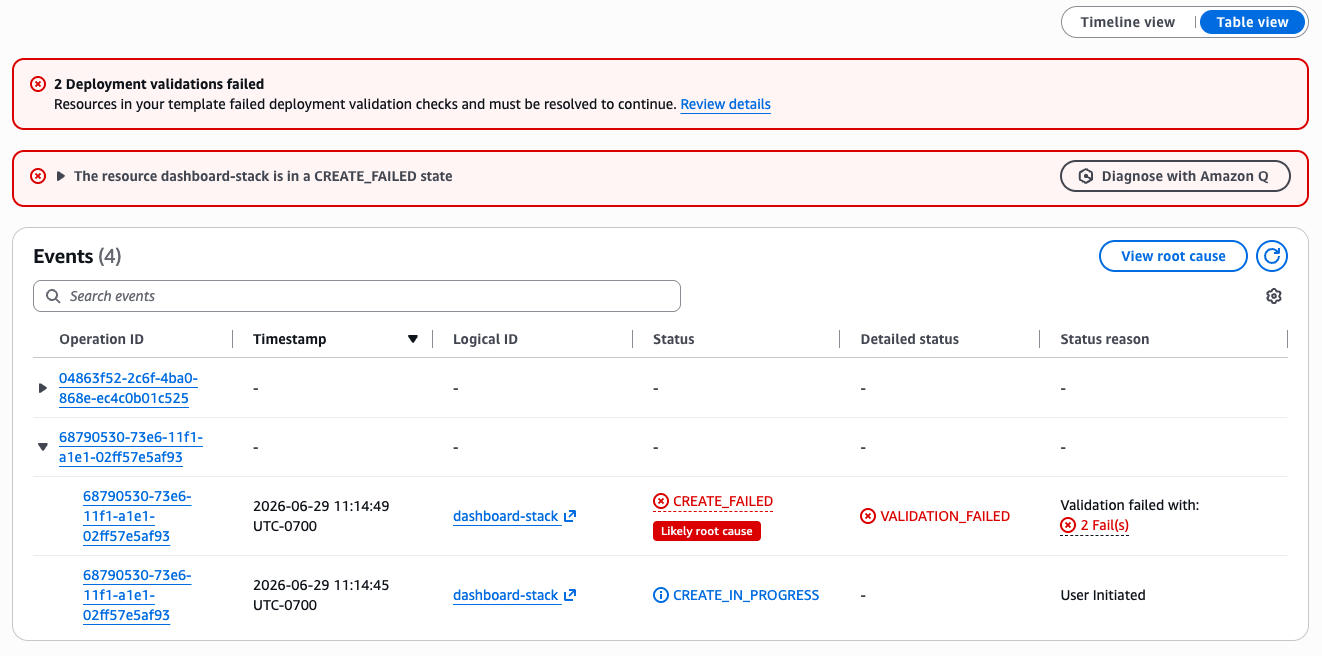
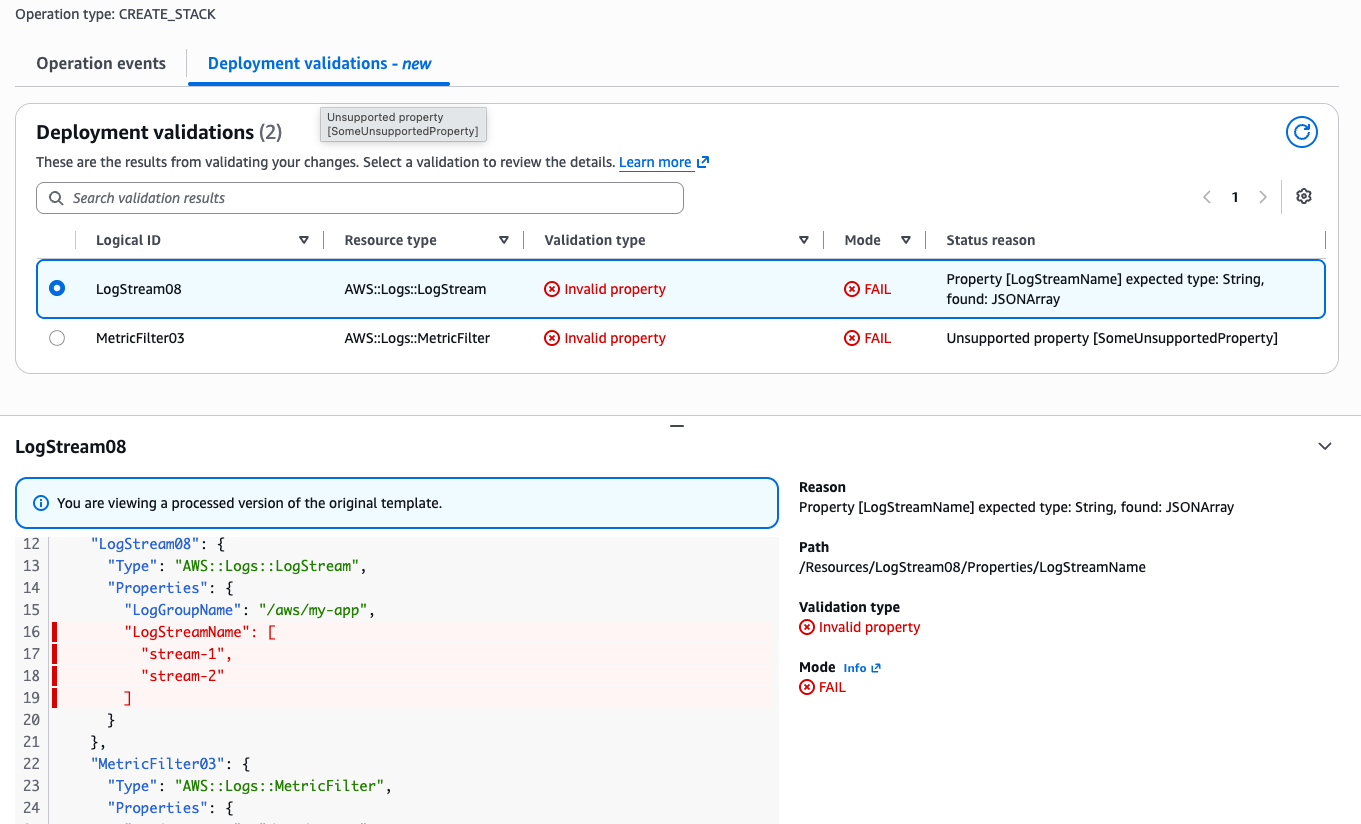
Consider a developer attempting to create a new dashboard stack with a template containing common property errors, such as an unsupported property or an incorrect data type for a LogStreamName.
AWSTemplateFormatVersion: "2010-09-09"
Description: Dashboard stack with property validation errors

Resources:
  Dashboard04:
    Type: "AWS::CloudWatch::Dashboard"
    Properties:
      DashboardName: "MyDashboard"

  LogStream08:
    Type: "AWS::Logs::LogStream"
    Properties:
      LogGroupName: "/aws/my-app"
      LogStreamName:                        # Expected string, found JSONArray
        - "stream-1"
        - "stream-2"

  MetricFilter03:
    Type: "AWS::Logs::MetricFilter"
    Properties:
      LogGroupName: "/aws/my-app"
      SomeUnsupportedProperty: "value"      # Unsupported property
      MetricTransformations:
        - MetricName: "ErrorCount"
          MetricNamespace: "MyApp"
          MetricValue: "1"
Upon executing aws cloudformation create-stack --stack-name "dashboard-stack" --template-body file://dashboard-stack.yaml, the pre-deployment validation engine will immediately scan the template. Instead of initiating a partial provisioning and subsequent rollback, the operation will stop, and the describe-events API or the CloudFormation console will display detailed VALIDATION_ERROR events. These events will pinpoint the LogicalResourceId (e.g., MetricFilter03, LogStream08), ResourceType, ValidationName (PROPERTY_VALIDATION), and a precise ValidationStatusReason (e.g., "Unsupported property [SomeUnsupportedProperty]", "Property [LogStreamName] expected type: String, found: JSONArray"). This immediate, structured feedback allows the developer to correct the template in seconds, rather than waiting minutes for a failed stack creation.
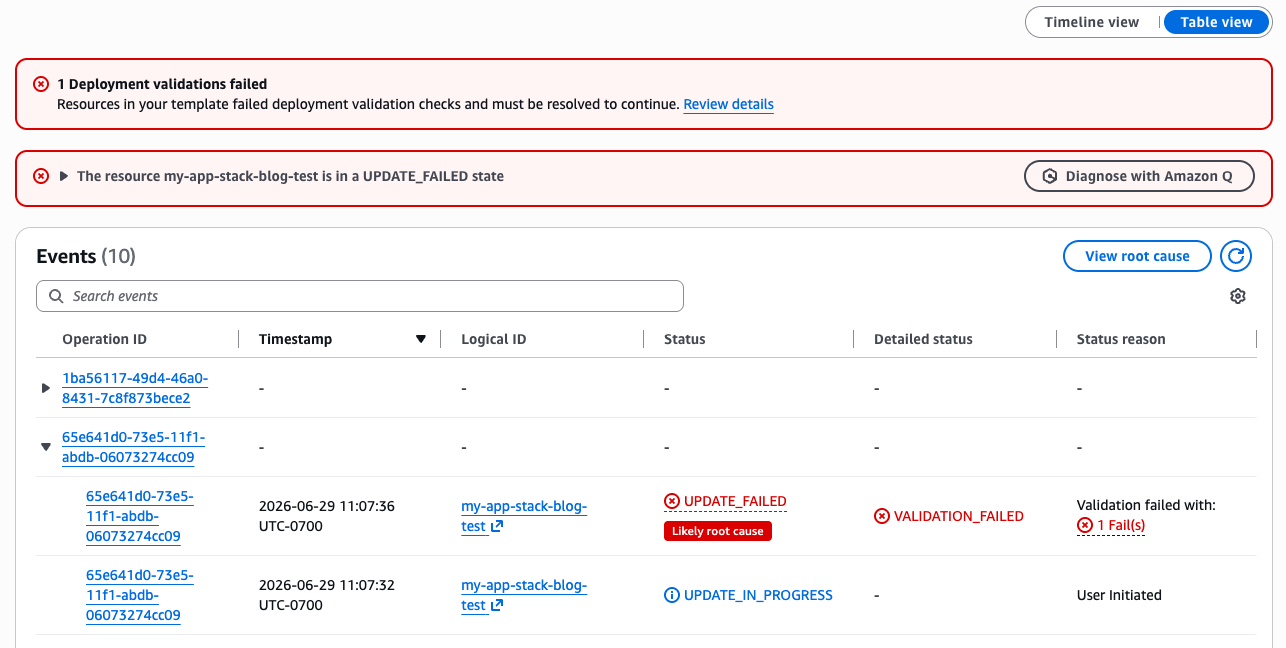
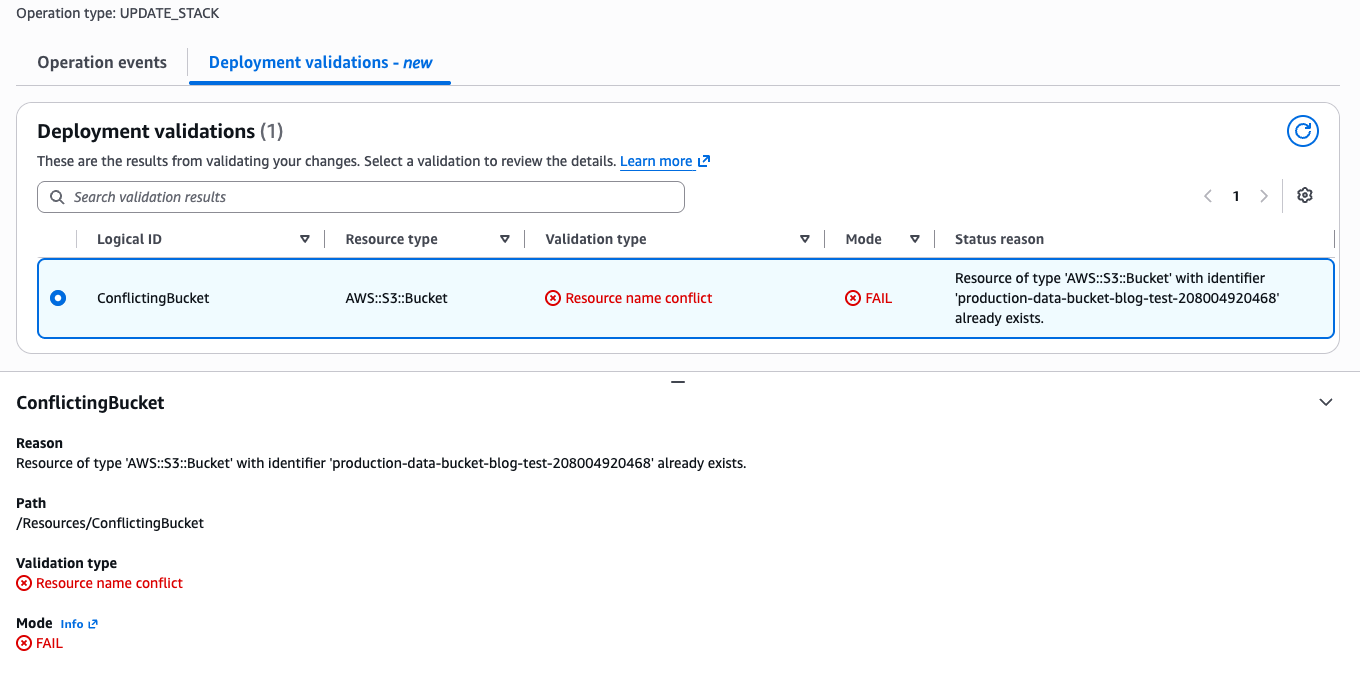
Similarly, an UpdateStack operation attempting to add an S3 bucket with a name already existing in the account would previously fail during resource creation. With the enhanced validation, this NAME_CONFLICT_VALIDATION will now occur pre-deployment, halting the update before any modifications are attempted and providing clear guidance on the conflicting resource.
For the new WARN mode validations, such as a Service Quota exceeding scenario, a CreateChangeSet operation might show a VALIDATION_ERROR with ValidationFailureMode: "WARN" and ValidationStatusReason: "Service quota will be exceeded: AWS::EC2::VPC current usage 1/5, creating 6 would exceed limit". The change set would still be created, allowing the developer to review the warning, decide whether to proceed, or initiate a quota increase request before executing the change set.
Impact on Automated Workflows and AI Agents
The implications of automatic pre-deployment validation extend significantly beyond individual developer workflows. In modern DevOps practices, CI/CD pipelines automate the deployment of infrastructure changes. Previously, a faulty template in such a pipeline could lead to a multi-minute deployment attempt, followed by a failure and rollback, consuming pipeline execution time and delaying subsequent stages. With immediate validation, CI/CD pipelines can detect errors in seconds, fail fast, and provide instant feedback to developers or even trigger automated remediation steps.
Furthermore, the rise of AI agents capable of provisioning and managing cloud infrastructure necessitates fast and precise feedback loops. When an AI agent generates or modifies a CloudFormation template, pre-deployment validation offers a crucial self-correction mechanism. A structured error message, returned in seconds, allows the agent to parse the issue, adjust the template, and retry almost immediately, transforming what could be a lengthy, iterative debugging process into a rapid, automated fix-and-retry loop. For CDK users, the construct-level tracing provided by cdk validate offers an even finer-grained feedback mechanism, enabling AI agents to pinpoint and correct errors at the source code level. AWS has already released a CloudFormation agent skill for its Agent Toolkit, allowing AI agents to leverage these validation capabilities directly.
Getting Started and IAM Permissions
Developers can immediately benefit from these enhancements as pre-deployment validation is now automatically enabled on all CreateStack, UpdateStack, and CreateChangeSet operations in all AWS Regions where CloudFormation is supported. No configuration or opt-in is required.
While basic property syntax validation and resource name conflict detection require no additional IAM permissions beyond those needed for the stack operation itself, the new WARN mode validation checks necessitate specific permissions for the IAM role executing the change set:
- Service Quota Check:
servicequotas:GetServiceQuotaservicequotas:ListServiceQuotasservicequotas:ListAWSDefaultServiceQuotasservicequotas:ListRequestedServiceQuotaChangeHistoryByQuotaservicequotas:ListRequestedServiceQuotaChangeHistory
- Config Recorder Check:
config:DescribeConfigurationRecorders
- ECR Repository Delete Readiness Check:
ecr:GetRepositoryPolicyecr:DescribeImagesecr:ListTagsForResource
It is important to note that if these permissions are not granted, the corresponding validation checks will simply be skipped without blocking the operation, ensuring backward compatibility and flexibility. For CDK users, executing cdk validate before deploying will provide a comprehensive validation report, mapping errors back to their source code.
Best Practices for Leveraging Enhanced Validation
To maximize the benefits of these new CloudFormation capabilities, AWS recommends several best practices:
- Integrate
cdk validatein CI/CD: For CDK users, incorporatecdk validateas an early stage in CI/CD pipelines to catch errors before deployment attempts. - Monitor Validation Events: Regularly review CloudFormation events, especially
VALIDATION_ERRORevents, to understand common issues and continuously improve template quality. - Educate Teams on New Checks: Ensure development teams are aware of the new Service Quota, AWS Config Recorder, and ECR Repository delete readiness checks to proactively address potential issues.
- Use
DisableValidationJudiciously: Reserve theDisableValidationparameter for highly specific, well-understood scenarios where the trade-off between early error detection and deployment speed is acceptable. - Automate Quota Requests: For recurring service quota warnings, consider automating quota increase requests or designing infrastructure to stay within default limits where possible.
- Leverage AI Agent Skills: For organizations experimenting with AI-driven infrastructure, integrate the CloudFormation agent skill from the AWS Agent Toolkit to enable automated template correction.
Broader Implications and Industry Context
This enhancement by AWS CloudFormation is a clear demonstration of the ongoing "shift-left" movement in software development and operations. By moving error detection to the earliest possible stage, AWS is empowering developers to build cloud infrastructure with greater confidence, speed, and efficiency. The reduction in failed deployments translates directly into significant cost savings, not only from avoiding wasted compute cycles but also from optimizing developer productivity.
An AWS spokesperson commented on the release, stating, "Our commitment to enhancing the developer experience is unwavering. This automatic pre-deployment validation for CloudFormation is a direct response to customer feedback, addressing a critical need for faster feedback loops in infrastructure as code. By catching errors in seconds rather than minutes, we are enabling our customers to innovate more rapidly and build more resilient cloud environments."
The comprehensive nature of these validations, particularly the integration with CDK and the focus on AI-driven workflows, positions CloudFormation as an even more robust and developer-friendly IaC tool. It reinforces AWS’s leadership in providing foundational services that streamline complex cloud operations, making advanced cloud management accessible and efficient for a broad spectrum of users, from individual developers to large enterprises. This move will undoubtedly contribute to higher quality infrastructure deployments, reduced operational overhead, and a more agile development ecosystem across the AWS platform.
In conclusion, the rollout of automatic pre-deployment validation across all CloudFormation stack operations marks a significant milestone in infrastructure as code development. By catching common deployment errors in seconds, before any resources are provisioned, this capability eliminates unnecessary rollback cycles and accelerates development workflows. Combined with the cdk validate command offering construct-level tracing and the DisableValidation parameter for nuanced control, development teams now possess a comprehensive toolkit to optimize their IaC pipelines. This forward-thinking approach empowers both human developers and AI agents with the immediate, structured feedback necessary for rapid iteration and self-correction, fundamentally transforming the efficiency of cloud infrastructure provisioning.
Related posts: