Wildfires Force Evacuation of NASA Madrid Deep Space Station as Network Resilience Faces Unprecedented Challenges

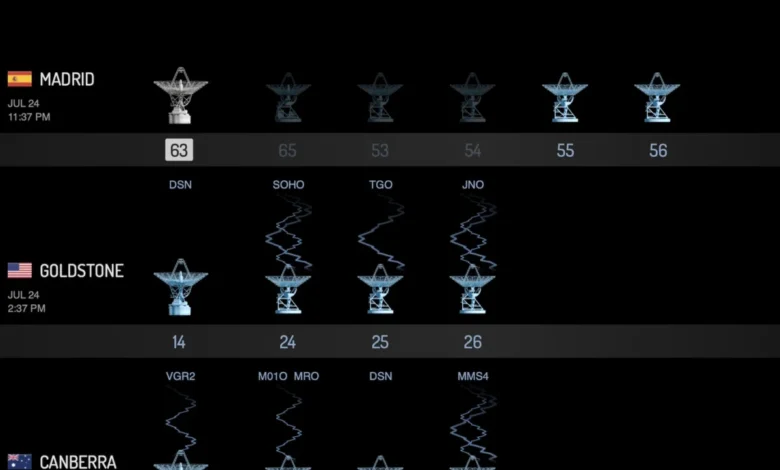
The global infrastructure supporting humanity’s exploration of the solar system faced a significant setback this week as raging wildfires in central Spain forced the emergency evacuation of the Madrid Deep Space Communications Complex. The facility, a critical node in NASA’s Deep Space Network (DSN), was shuttered on Friday afternoon as local authorities struggled to contain blazes that have already displaced thousands of residents. This closure leaves the space agency with a dangerously thin communication link to its most distant missions, including the Voyager probes and the Juno spacecraft currently orbiting Jupiter.
As of Friday, NASA’s "DSN Now" status portal showed a total lack of activity at the Madrid site, located in Robledo de Chavela. While the agency’s sister complexes in Goldstone, California, and Canberra, Australia, remained operational, the loss of the Madrid site creates a geographical blind spot in the network. The DSN is designed with three stations spaced approximately 120 degrees apart in longitude, ensuring that as the Earth rotates, at least one station can maintain a constant line of sight with any given spacecraft. With the Madrid station offline, the network’s ability to provide continuous coverage is severely compromised, particularly for missions requiring high-bandwidth data transfers.
The Escalating Crisis in the Madrid Region
The wildfires, fueled by a punishing summer heatwave and years of chronic drought, have devastated the mountainous terrain west of Madrid. Spanish emergency services reported that more than 19,000 people were ordered to evacuate from various towns in the Sierra de Guadarrama region. The scale of the emergency has necessitated a massive mobilization, with more than 2,000 firefighters and emergency personnel deployed to the front lines. These ground crews are supported by 10 specialized firefighting aircraft, though thick smoke and turbulent winds have occasionally grounded aerial operations.
NASA officials issued a statement emphasizing that the safety of the workforce is the paramount concern. "The safety and well-being of our personnel is our highest priority, and our thoughts are with the families and neighbors who are also experiencing the impact of the wildfires in the surrounding communities," the agency stated. The facility is currently being maintained by a skeleton crew of security and fire-safety personnel where possible, but all scientific and communication operations have been suspended indefinitely until the fire threat is neutralized.
The crisis is not limited to NASA’s assets. A separate deep space tracking station at Cebreros, owned and operated by the Spanish government and the European Space Agency (ESA), was also evacuated. The Cebreros station is a vital component of ESA’s Estrack network, providing support for missions such as the Juice (Jupiter Icy Moons Explorer) and the BepiColombo mission to Mercury. The proximity of these two major space hubs—located only a few miles apart—highlights the vulnerability of ground-based space infrastructure to regional environmental disasters.
A Network Under Pressure: The California Outage
The timing of the Madrid evacuation could not be worse for NASA’s Jet Propulsion Laboratory (JPL), which manages the DSN. The network is already operating at a reduced capacity due to a catastrophic hardware failure at the Goldstone Deep Space Communications Complex in California’s Mojave Desert.
In mid-2026, the 70-meter (230-foot) antenna at Goldstone, known as Deep Space Station 14 (DSS 14), was taken offline following a severe mechanical accident. During a routine repositioning maneuver, the massive structure "over-rotated," bypassing its safety stops. The resulting mechanical stress caused extensive damage to the antenna’s structural cables and severed critical fluid lines. The incident resulted in the release of 200,000 gallons of water mixed with glycol—a cooling agent—into the base of the antenna structure.
The cleanup of the glycol spill, which is classified as an environmental hazard, has been both costly and time-consuming. Current estimates place the repair and remediation costs between $4.1 million and $4.6 million. NASA has opted to synchronize these emergency repairs with previously scheduled upgrades to the antenna’s electronic systems, but the complexity of the work means the Goldstone 70-meter dish will likely remain out of commission until at least 2028.
With the Madrid 70-meter antenna (DSS 63) now threatened by fire and the Goldstone 70-meter antenna (DSS 14) undergoing multi-year repairs, the Deep Space Network is currently reliant on a single 70-meter antenna: DSS 43 in Canberra, Australia. While smaller 34-meter antennas at all three sites can be "arrayed" together to mimic the sensitivity of a larger dish, this process is technically demanding and often insufficient for the extremely weak signals transmitted by older spacecraft like Voyager 1 and Voyager 2, which are currently billions of miles away in interstellar space.
Technical Implications for Active Missions
The DSN is the only gateway for data coming from beyond Earth’s orbit. It handles everything from the high-resolution imagery of the James Webb Space Telescope to the vital telemetry that keeps Mars rovers like Perseverance and Curiosity operational.
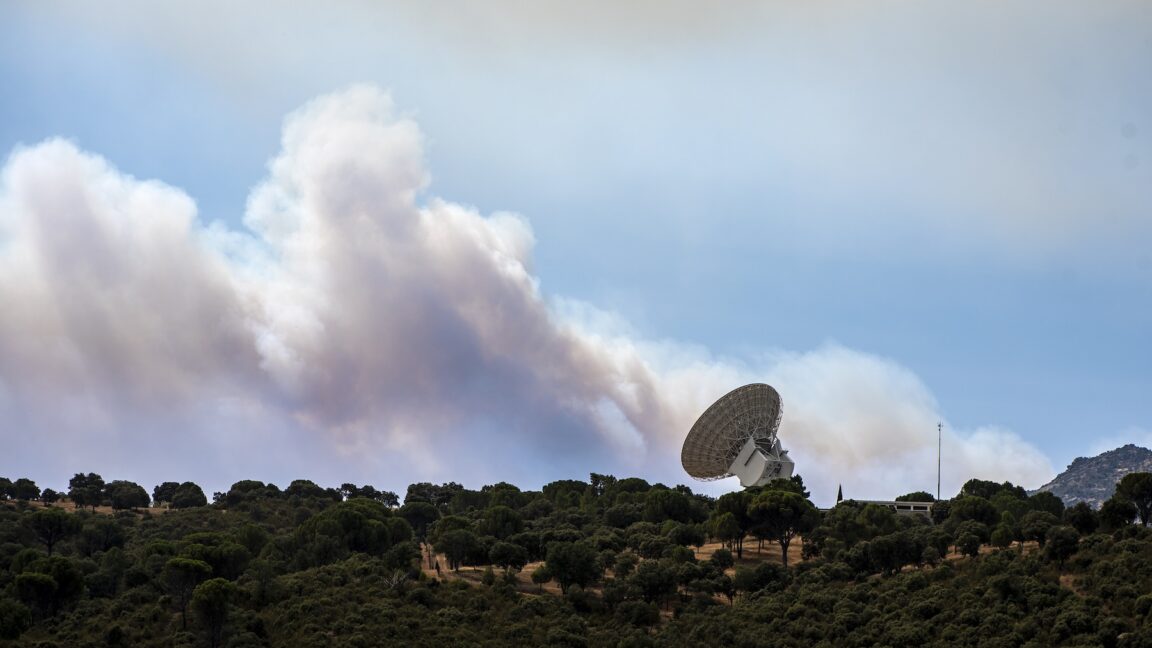
For the Juno mission at Jupiter, the loss of the Madrid station complicates the timing of data downlinks. Juno travels in a highly elliptical orbit, and its most valuable data is collected during "perijove" passes—brief windows when it flies close to the gas giant’s cloud tops. If these passes occur when the spacecraft is only visible from the Madrid longitude, the data must be stored on the spacecraft’s internal memory for longer periods, risking data loss if an onboard anomaly occurs before the next available downlink window in Australia or California.
The Voyager missions face an even more precarious situation. Voyager 2, which is more than 12 billion miles from Earth, requires the immense sensitivity of the 70-meter dishes to receive commands and transmit its findings on the nature of the heliopause. The current situation forces NASA to prioritize which missions receive time on the remaining operational antennas, a "triage" system that can delay scientific discoveries and increase the risk to aging spacecraft.
Artemis and the Future of Human Spaceflight
While the current outages are manageable for robotic missions through careful scheduling, the long-term health of the DSN is a critical concern for the Artemis program. NASA’s push to return humans to the lunar surface requires a level of communication reliability and bandwidth far exceeding that of robotic probes.
The Artemis III mission, which will see the Orion capsule test critical docking procedures in low-Earth orbit with commercial landers from SpaceX and Blue Origin, is currently targeted for late 2026 or 2027. This mission will require constant telemetry and high-definition video feeds for mission control and public engagement. However, the true "stress test" for the DSN will be Artemis IV, the first planned lunar landing of the 21st century, currently scheduled for no earlier than 2028.
Human spaceflight missions cannot afford "blind spots." The requirement for continuous voice and data contact with astronauts means that all three DSN nodes must be fully operational and upgraded to handle the newer Ka-band frequencies that offer higher data rates. The current outages in California and Madrid serve as a wake-up call for the agency regarding the fragility of the "umbilical cord" connecting Earth to its explorers.
Climate Change and Infrastructure Resilience
The wildfires in Spain are part of a broader trend of extreme weather events that are increasingly threatening critical scientific infrastructure. The combination of a summer heatwave and chronic drought in the Mediterranean is a direct consequence of shifting global climate patterns. For NASA and other space agencies, this necessitates a re-evaluation of how ground stations are protected.
Historically, deep space stations were placed in remote, arid regions to minimize radio interference and atmospheric moisture, which can degrade signals. However, these same environments—such as the California desert and the scrublands of central Spain—are becoming increasingly prone to wildfires. The 2020 bushfires in Australia previously threatened the Canberra complex, highlighting that no node in the network is immune to environmental risks.
Moving forward, NASA officials are looking into "resiliency upgrades," which may include enhanced firebreaks, independent water supplies for firefighting at the sites, and the construction of additional 34-meter antennas to provide more redundancy. By having a larger number of smaller dishes, the network can lose one or two antennas to maintenance or local emergencies without losing the ability to communicate with the entire fleet of spacecraft.
Timeline of Recent DSN Challenges
- Late 2025 – Early 2026: Record-breaking drought conditions begin in central Spain and the American Southwest.
- June 2026: The "over-rotation" accident occurs at Goldstone’s DSS 14 antenna, causing a 200,000-gallon glycol and water spill.
- July 15, 2026: A major heatwave settles over Western Europe, with temperatures in Madrid exceeding 42°C (107°F).
- July 22, 2026: Wildfires break out in the mountains west of Madrid, near the Robledo de Chavela and Cebreros stations.
- July 24, 2026 (Morning): Spanish authorities order the evacuation of 19,000 residents as the fire spreads toward the NASA facility.
- July 24, 2026 (Afternoon): NASA officially suspends operations at the Madrid Deep Space Communications Complex.
- Present: Repair efforts continue at Goldstone; fire crews in Spain work to create a perimeter around the Madrid complex.
Conclusion and Outlook
The shutdown of the Madrid Deep Space Communications Complex is a stark reminder that the frontier of space exploration begins on the ground. While the loss of the station is currently classified as a temporary emergency, the cumulative impact of the California outage and the Spanish wildfires has left the Deep Space Network in its most vulnerable state in decades.
NASA engineers and international partners are working around the clock to redistribute the communication load across the remaining antennas. In the short term, the focus remains on the safety of the Spanish personnel and the protection of the multi-billion dollar hardware at Robledo de Chavela. In the long term, the agency must navigate a challenging path of costly repairs and climate adaptation to ensure that as humanity reaches further into the cosmos, the lines of communication back to Earth remain unbroken. For now, the world waits for the smoke to clear over the Spanish hills, hoping that the vital link to the stars remains intact.
Related posts: