Dinosaur killing impact crater might have been teeming with life for millions of years following the cataclysmic asteroid strike

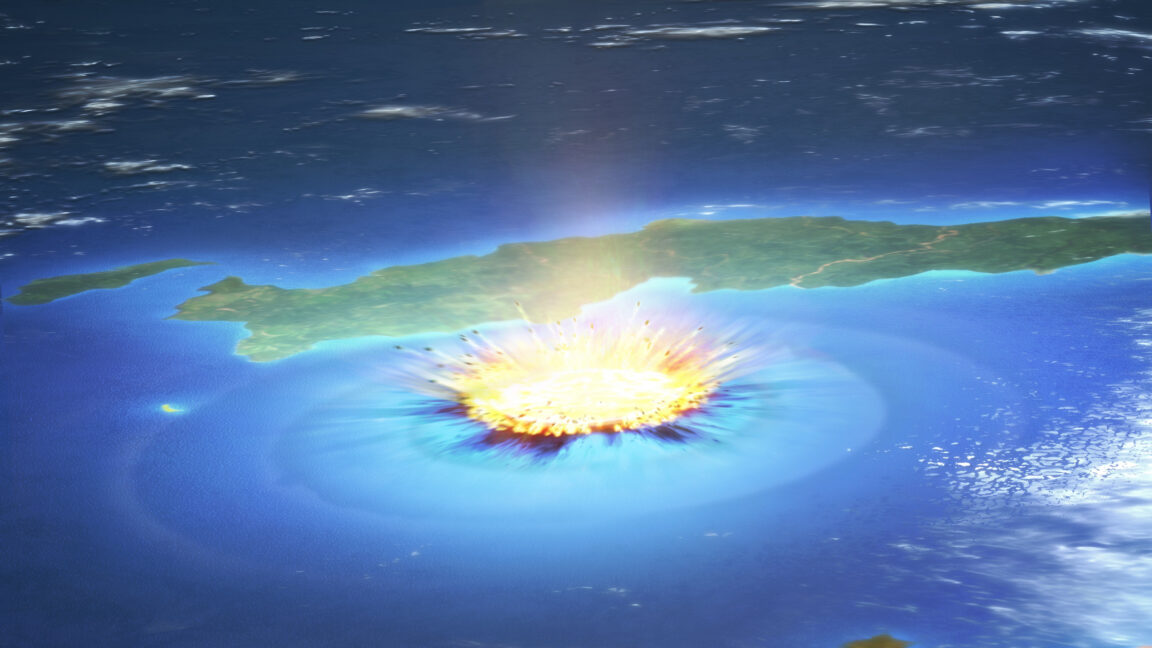
Sixty-six million years ago, the Earth underwent a profound biological transformation when an asteroid, now identified as the Chicxulub impactor, slammed into the Yucatan Peninsula. The collision, which triggered tsunamis of unprecedented scale and atmospheric firestorms, is widely recognized as the primary driver of the Cretaceous-Paleogene (K-Pg) extinction event. This catastrophe wiped out approximately 75% of all species, including all non-avian dinosaurs. However, a new study published in the journal Communications Earth & Environment suggests that the aftermath of this cataclysm was not exclusively defined by destruction. Beneath the scarred surface of the impact zone, a massive, long-lived hydrothermal system emerged, potentially serving as a sanctuary for microbial life.
Unearthing the Subsurface Legacy
For decades, researchers have focused on the surface-level devastation caused by the asteroid. Yet, the physical mechanics of the impact—an event that released energy equivalent to billions of atomic bombs—extended far deeper into the Earth’s crust than previously understood. Geological surveys and drilling projects, most notably the 2016 expedition to the Chicxulub crater, have provided scientists with a rare window into the subterranean effects of such a massive collision.
The impact deformed the Earth’s crust to a depth of at least 35 kilometers. This intense kinetic energy melted vast volumes of rock, which, when exposed to seawater, became highly porous. As cold ocean water permeated these fractures and came into contact with the lingering geothermal heat of the impact site, a robust hydrothermal system was ignited. For years, the scientific consensus held that this system was a relatively short-lived phenomenon, likely lasting no more than two million years. However, new isotopic analysis conducted by a team led by Dr. Annemarie Pickersgill of the University of Glasgow has fundamentally challenged this timeline, revealing that the system remained active for at least 8 million years.
The Chronology of an Oasis
The timeline of the Chicxulub hydrothermal system is a testament to the immense energy dissipation required for a planetary-scale impact. According to the research, the system was born in the immediate aftermath of the strike 66 million years ago. Through potassium-argon dating of feldspar samples—a technique used to determine the age of geological formations by measuring the radioactive decay of potassium-40 into argon-40—the team successfully mapped the thermal history of the crater.
The chronology of the system’s cooling process provides a clearer picture of its habitability:
- 0–2 million years post-impact: The crater floor maintained extreme temperatures, likely too high for most biological life.
- 2–5 million years post-impact: Temperatures stabilized in a range between 50°C and 90°C (122°F to 194°F). This window represents the prime period for thermophilic microorganisms to colonize the porous rock, utilizing the nutrient-rich, mineral-laden fluids flowing through the subsurface.
- 5–8 million years post-impact: Thermal activity began to wane, with fluid flux significantly decreasing until the system eventually went dormant around 58 million years ago.
This 8-million-year lifespan is a critical discovery. It implies that the crater was not merely a site of death, but a long-standing environmental niche that persisted through the recovery period of the early Paleogene.
Implications for Habitability and Prebiotic Chemistry
The significance of an 8-million-year-long hydrothermal system extends beyond the specific context of the Chicxulub crater. Hydrothermal systems are widely considered one of the most likely cradles for life, both on Earth and on other planetary bodies. They provide a stable source of chemical energy, essential minerals, and protection from the harsh environmental conditions of the surface.
Dr. Pickersgill noted in her study that extended windows of hydrothermal activity provide the necessary time for prebiotic chemical reactions to transition into biological complexity. While the research does not definitively confirm that the Chicxulub system was inhabited, it proves that the conditions for life were present for a duration sufficient for colonization. "Longer periods of hydrothermal activity will generate extended windows of opportunity for prebiotic chemical reactions to occur, life to develop, and micro-organisms to thrive and propagate beyond their point of origin," the study asserts.
This discovery highlights the "habitable impact" hypothesis. While impacts are generally associated with extinction, they may also serve as localized "hotbeds" that support life during global cooling or environmental collapse. By concentrating heat and minerals in an otherwise cooling planet, the Chicxulub crater could have acted as a refugium, allowing certain microbial lineages to persist or even thrive in the wake of the mass extinction.
Comparative Planetary Science
The findings at Chicxulub also inform our understanding of early Earth and the potential for life on other planets. The Chicxulub impact, while devastating, is considered relatively modest compared to the massive impact basins that characterized the Hadean and Archean eons of early Earth. If a crater of this size could sustain a hydrothermal system for 8 million years, the implications for larger, more ancient impacts are profound.
"Chicxulub is still relatively small compared to the impact basins expected on early Earth and observed on other planetary bodies," Pickersgill observed. "It is therefore possible that these larger impacts could have created even longer-lived hydrothermal systems and, hence, could have been able to maintain the temperatures and fluid flux required for habitable environments for a minimum of several million years."

This research provides a new framework for astrobiology. When searching for life on Mars or the moons of the outer solar system, scientists often look for evidence of past water. The Chicxulub study suggests that they should also prioritize looking for evidence of long-term hydrothermal activity within impact craters, as these sites may have provided the necessary conditions for life to gain a foothold in otherwise inhospitable environments.
Methodological Rigor and Future Directions
The use of potassium-argon dating on feldspar samples represents a rigorous approach to reconstructing the thermal history of the impact. The ability of argon gas to escape from molten rock provides a reliable "reset button" for the geological clock, allowing researchers to accurately pinpoint when the rock solidified after the impact. By combining this empirical data with advanced computer simulations of hydrothermal cooling, the research team was able to create a highly accurate model of the crater’s thermal evolution.
Despite these advancements, the question of whether the Chicxulub crater was actually inhabited remains a subject of ongoing investigation. Finding direct evidence of 66-million-year-old microbial life in such a geologically active environment is an immense challenge. However, the study provides a vital "proof of concept": the environment was undeniably habitable. Future research will likely focus on biomarkers and isotopic signatures within the rock that could definitively link the hydrothermal activity to the presence of ancient colonies of microorganisms.
Broader Scientific Context
The scientific community has reacted with significant interest to these findings, as they bridge the gap between geology, chemistry, and biology. By re-evaluating the long-term consequences of the asteroid strike, the study shifts the narrative of the K-Pg extinction from one of absolute finality to one of complex biological transition.
Furthermore, this research aligns with a growing body of work that emphasizes the role of geological events in shaping the trajectory of life. Rather than viewing the asteroid as a singular, binary event—life versus death—scientists are increasingly seeing the impact as a multifaceted process that altered the planet’s internal and external environments for millions of years.
As we look toward future missions—whether they involve deep-sea drilling on Earth to recover further samples or the eventual exploration of impact craters on other worlds—the lessons learned from the Chicxulub crater will serve as a guide. The "death from above" that ended the reign of the dinosaurs may have, in its own subterranean way, provided the conditions necessary for the next chapter of life on Earth to begin. The persistence of the Chicxulub hydrothermal system underscores a fundamental truth about the history of our planet: life, when provided with a source of energy and a stable environment, is remarkably resilient and persistent, even in the shadow of the most violent events.
Related posts: