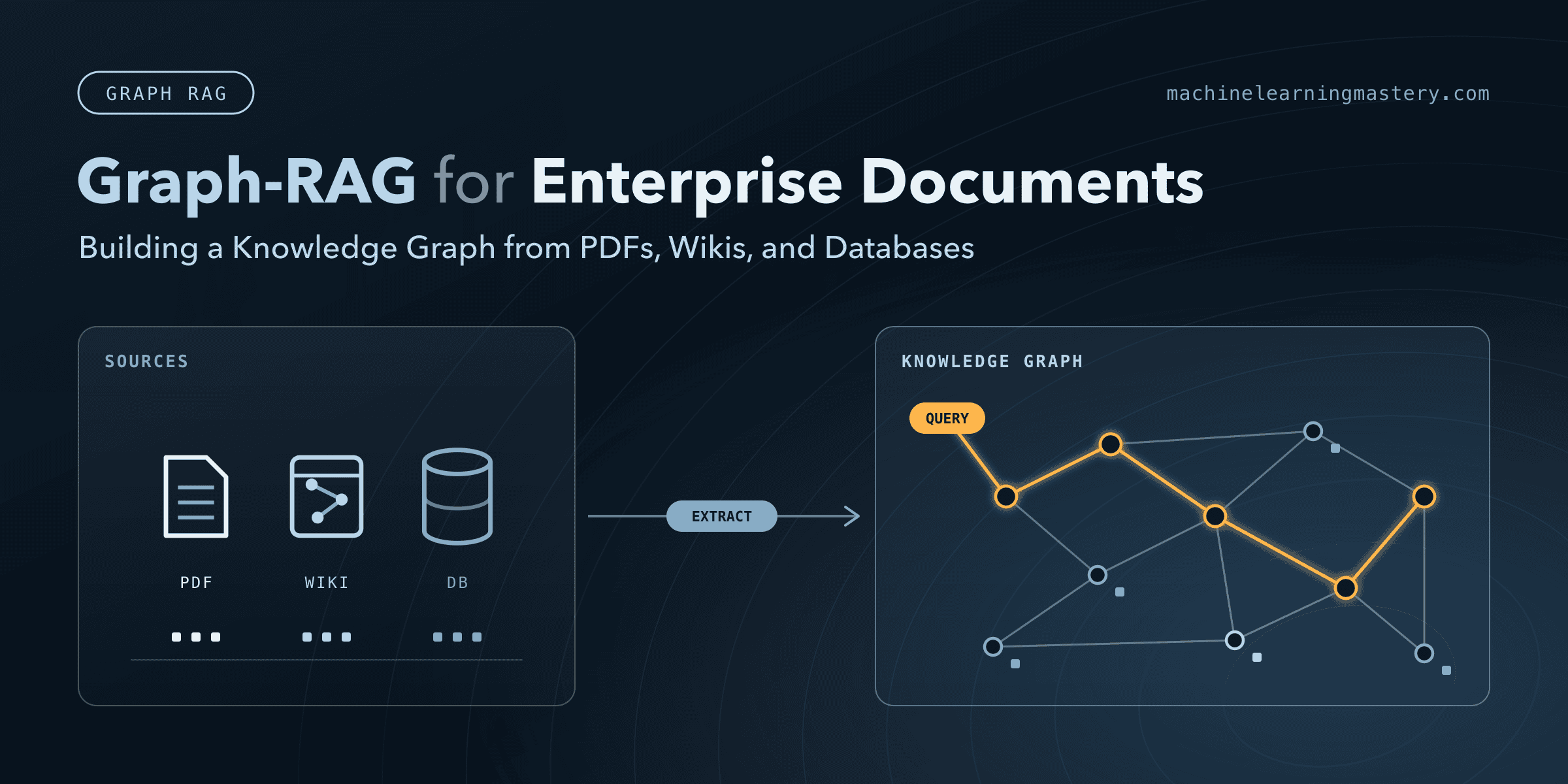
Graph-RAG for Enterprise Documents: Building a Knowledge Graph from PDFs, Wikis, and Databases

In the modern enterprise environment, artificial intelligence assistants are increasingly relied upon to serve as the primary interface for internal knowledge. However, a significant technical hurdle remains: the "truth" is often distributed across disparate systems with varying degrees of reliability. An engineer might query an internal AI about an on-call rotation, only to receive conflicting information because the system treats a four-month-old wiki page, a static PDF, and a live database with equal weight. This phenomenon, often referred to as "RAG hallucination," occurs when Retrieval-Augmented Generation (RAG) systems fail to distinguish between static documentation and real-time operational data. By implementing a three-tiered Graph-RAG architecture, organizations can move beyond simple vector search to create a deterministic system that prioritizes truth based on data freshness and source reliability.
The Challenge of Distributed Truth in the Enterprise
The fundamental problem with standard RAG implementations is their reliance on semantic similarity within a vector database. When an AI searches for information, it looks for the closest mathematical match in "embedding space." If multiple documents mention the same subject—such as a specific software service—the model may surface all of them. If these sources contain contradictory facts, the language model is often unable to resolve the conflict, leading to inaccurate outputs.
For example, consider a "payments-service" at a fictional technology firm. The service registry database, acting as the system of record, lists the current on-call engineer as Amara Chen. Simultaneously, an outdated wiki page from a previous rotation lists Jordan Blake. If the AI retrieves both, it may inadvertently provide the user with incorrect contact information. This is not merely a technical glitch; it is a failure of logic in retrieval. Research from industry analysts, including an IDC study sponsored by Neo4j, suggests that grounding generative AI in graph-based context can reduce hallucination rates by an average of 44 percent, with some organizations in the life sciences sector reporting reductions from 40 percent down to as low as 2 percent.
Architectural Framework: The Three-Tiered Approach
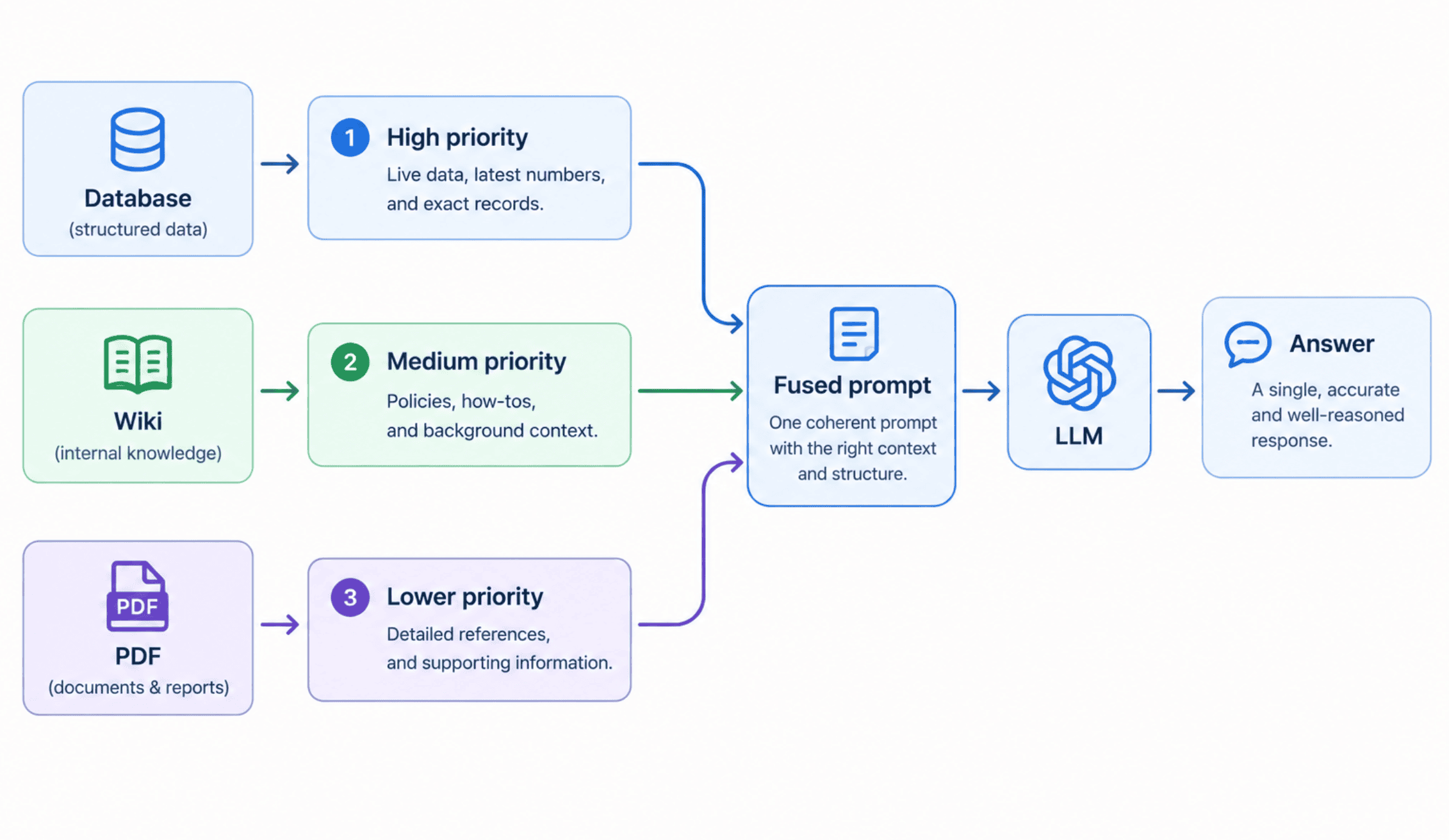
To solve this, developers are shifting toward a tiered retrieval architecture. This approach categorizes information based on its inherent reliability and update frequency. By explicitly defining these tiers, the system can use a "fused prompt" strategy to enforce logic during the final generation phase.
Priority 1: The Live Knowledge Graph (CMDB)
The first tier is the Configuration Management Database (CMDB) or a live service registry. This is the "absolute truth." In a technical implementation, this data is structured into a Subject-Predicate-Object-Context (SPOC) format. Because this data is queried live from a relational database—such as PostgreSQL or SQLite—it represents the current state of the infrastructure. Any data retrieved from this tier is prioritized above all others by the LLM.
Priority 2: The Semi-Structured Wiki
The second tier consists of documentation, such as runbooks and internal wikis. While highly detailed, these documents suffer from "data drift." They are treated as secondary to the live database. The system uses regex-based extraction or lightweight LLM parsing to identify key-value pairs, ensuring the data is structured enough to be compared against the primary tier. If a conflict arises between this tier and the CMDB, the system is explicitly instructed to discard the wiki information.
Priority 3: Unstructured Vector Fallback
The final tier is the vector store, which houses unstructured documents like PDF postmortems, SLA agreements, and architectural white papers. These documents provide the narrative depth that structured databases cannot capture. Because these documents contain historical context—such as "how" an incident was handled on a specific date—they are invaluable for troubleshooting but are never permitted to override the primary, live facts of the CMDB.
Implementing the Deterministic Retrieval System
The construction of this system involves a coordinated pipeline of ingestion and retrieval. First, the QuadStore acts as the central repository for structured facts. By tagging each piece of data with its source (e.g., "cmdb" or "wiki"), the system maintains a clear audit trail. When a user submits a query, the application uses Natural Language Processing (NLP) libraries like spaCy to extract entities (such as "payments-service") from the prompt.
The system then performs a parallel retrieval: it fetches structured facts from the CMDB and the wiki, and simultaneously performs a semantic search against the vector database. The magic of the architecture lies in the final system prompt. Rather than leaving the LLM to its own devices, the developer writes a strict set of instructions:
- Prioritize the CMDB for all operational facts.
- If the wiki contradicts the CMDB, ignore the wiki entirely.
- Use the vector database for narrative context only.
- Do not list conflicting sources; provide a single, definitive answer.
This deterministic approach ensures that the assistant acts as an authoritative source rather than a conversational aggregator that simply reports every result it finds.
Impact and Operational Implications
The transition from standard vector-based RAG to a tiered, graph-based system has profound implications for enterprise operations. In high-stakes environments, such as incident response, the cost of an inaccurate AI response is high. When an assistant is integrated into an on-call rotation, providing the wrong engineer’s name can delay critical system recovery.
Furthermore, the auditability of this system is a major advantage for compliance and security. By labeling data by source, organizations can trace any AI-generated claim back to the specific document or database row it originated from. This "traceability" is essential for debugging the assistant’s behavior and ensuring that data privacy constraints are met. If a user does not have permission to view certain documents, the retrieval layer can filter those results before they are ever passed to the LLM, a task that is significantly harder to enforce in a purely vector-based system.
Challenges and Future Considerations
While the three-tiered approach offers significant improvements in accuracy, it is not without challenges. One of the primary hurdles is the "refresh cadence." While the CMDB is live, the wiki and PDF tiers require periodic re-ingestion. If the automated pipeline responsible for updating these tiers fails, the system risks relying on stale information. Consequently, organizations must implement robust monitoring for their ingestion jobs.
Additionally, as the scale of the enterprise grows, moving from a simple file-based approach to a dedicated graph database—such as Neo4j or ArangoDB—becomes necessary. These platforms provide advanced capabilities for handling complex relationships, such as identifying dependencies between microservices, which a simple key-value store cannot manage.
The shift toward deterministic, graph-grounded AI also necessitates a change in how developers write prompts. The prompt is no longer just a set of instructions; it is the "logic layer" of the application. By explicitly forbidding the model from mentioning conflicting sources, the developer forces the model to synthesize information according to corporate policy rather than probabilistic likelihood.
Conclusion
As generative AI moves from the prototype phase to core enterprise utility, the demand for reliability will outpace the demand for sheer conversational capability. The architecture described herein offers a path toward that reliability. By treating information as a tiered, hierarchical resource, organizations can build assistants that are not only helpful but also demonstrably accurate. The trade-off—a slightly more complex ingestion pipeline and the need for explicit prompt engineering—is a small price to pay for the reduction in hallucination and the increase in operational trust. In an era where AI can provide answers in seconds, the ultimate goal is not just to provide an answer, but to provide the correct one every single time.