Tool Calling vs. Code Execution for AI Agents: Choosing the Right Action Primitive

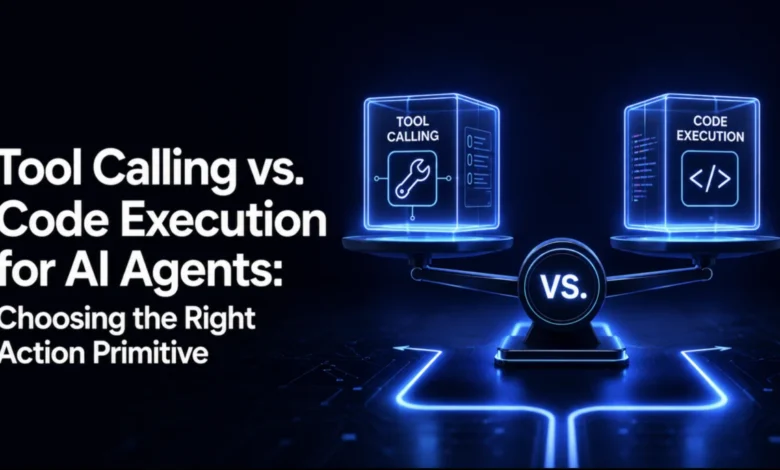
The evolution of autonomous AI agents has reached a critical juncture where the primary challenge is no longer whether an agent can perform a task, but how it physically executes that task within a digital environment. As enterprises move from prototype to production, the choice between tool calling and code execution has emerged as a fundamental architectural decision. This choice carries significant weight, impacting operational costs, system latency, and the overall accuracy of agentic workflows. To understand this, one must view these methods not as stylistic alternatives, but as distinct technical primitives that govern how a model interacts with external data and software ecosystems.
Defining the Action Primitive
An action primitive represents the bridge between an AI model’s reasoning capabilities and the external world. Whether an agent is updating a database, querying an API, or reading a complex file, it must rely on a specific interface to bridge that gap.
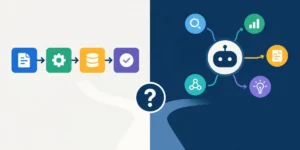
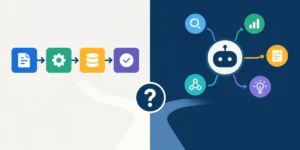
Tool calling, the industry standard for the past several years, operates on a request-response cycle. In this paradigm, the Large Language Model (LLM) generates a structured JSON request that is interpreted by the host application. The application executes the function, retrieves the data, and feeds that result back into the model’s context window. This creates a loop: the model decides, the tool executes, and the model observes the result.
Conversely, code execution represents a shift toward more autonomous, programmatic interaction. Instead of requesting a single data point, the model generates a sequence of instructions—often in Python or TypeScript—that runs in a secure, isolated sandbox environment. The model effectively offloads the logic to a runtime environment, receiving only the final, processed output. This eliminates the "chatter" of intermediate results, allowing the model to focus on high-level reasoning rather than managing the granular flow of data.
The Architectural Shift: From JSON to Python
The transition toward code execution was accelerated by the introduction of Programmatic Tool Calling in late 2025. This innovation allows developers to define "allowed callers," effectively granting the model permission to utilize a sandbox to perform operations that would otherwise require dozens of back-and-forth API calls.
Consider the hypothetical scenario of auditing Q3 travel expenses for twenty employees. A standard tool-calling approach would require the agent to fetch expense line items for each individual one by one. If each employee has fifty entries, the agent must process over 1,000 data points through its context window. This results in "context bloat," where the model is forced to hold thousands of tokens of raw data just to perform a simple summation. In this case, the cost is not just financial; it is cognitive. The model’s attention is divided, increasing the likelihood of arithmetic errors.
By contrast, an agent utilizing code execution would generate a single script. It would import the necessary tools, iterate through the employee data within the sandbox, perform the arithmetic, and return only the final calculation to the user. The model never sees the thousands of line items; it only sees the result. This architectural efficiency is a key driver in the recent shift toward agentic frameworks that prioritize execution environments over simple function calls.
Quantitative Impacts and Efficiency
Industry data suggests that the move to code execution is not merely a preference for cleaner code, but a necessary optimization for complex tasks. Research conducted by Anthropic and other leading AI labs has demonstrated that shifting to code-based workflows can reduce token consumption by nearly 40% in complex research scenarios.
Furthermore, the performance improvements are measurable. The GAIA benchmark—a rigorous test for general AI assistants—has shown that agents utilizing executable code for multi-step reasoning tasks outperform their tool-calling counterparts by approximately 5% to 20%. This is largely attributed to the reduction in "reasoning drift," where a model loses track of intermediate variables when forced to manage them within its own natural language processing.
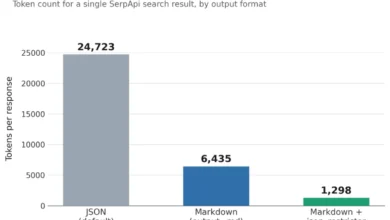
The financial implications are equally stark. In enterprise settings, high-token usage translates directly into higher infrastructure costs. By offloading data processing to a sandboxed environment, organizations can significantly reduce the amount of data passed to the model. A study of a real-world document-processing pipeline revealed a 98.7% reduction in token usage when shifting from standard tool-calling to a code-execution model, as the model no longer needed to "read" full meeting transcripts that it was only using to derive a single metric.
When Tool Calling Remains the Superior Choice
Despite the clear advantages of code execution at scale, tool calling remains the superior choice for specific use cases. Simplicity, auditability, and latency are the primary factors that keep tool calling relevant.
For single-shot tasks—such as checking the current weather in a specific city—the overhead of initializing a sandboxed environment is counterproductive. The time required to spin up a secure execution space, transmit the script, and retrieve the output often exceeds the latency of a single JSON tool call.
Furthermore, auditability remains a significant hurdle for code execution. In regulated industries like finance or healthcare, every action taken by an agent must be logged and explainable. Tool calls are inherently discrete and easy to log. A model writing a complex, multi-step script creates an "opaque" process. If an error occurs, debugging a generated script is significantly more challenging than reviewing a series of discrete, human-readable JSON inputs and outputs.
The Hybrid Future of Agentic Workflows
The most advanced production-grade agents are currently adopting a hybrid approach, dynamically selecting their action primitive based on the nature of the task. They utilize a decision-making layer that evaluates the complexity of the request before choosing an execution path.
- Simple Lookups: The agent utilizes standard tool calling for speed and transparency.
- Data Aggregation: The agent switches to code execution when it identifies a need for "fan-out" operations, where multiple parallel requests are required.
- Sensitive Data: The agent uses sandboxed code execution to handle PII (Personally Identifiable Information), ensuring that sensitive data never enters the model’s context window, thereby enhancing security and privacy compliance.
This "adaptive architecture" reflects the broader maturity of the AI field. We are moving away from the "one-size-fits-all" model of agent design toward a sophisticated, nuanced approach that treats infrastructure as a strategic asset.
Implications for Future Development
The shift toward code execution necessitates a change in how developers approach tool design. Tools must now be built to be "code-friendly," meaning they must be well-documented and accessible via standard libraries. The "allowed_callers" configuration, pioneered in late 2025, is becoming a standard feature in agent development frameworks.
As we look toward the next phase of agent development, the focus will likely shift to the security of these sandboxed environments. Since the model is generating code that executes in a real-time system, robust isolation is no longer optional—it is a foundational requirement. Organizations that successfully implement secure, scalable sandboxes will likely see a competitive advantage in the speed and accuracy of their automated workflows.
Ultimately, the choice between tool calling and code execution is an exercise in resource management. By understanding the mechanical differences between these primitives, developers can build agents that are not only more efficient and cheaper to operate but also more reliable in their decision-making. The goal is to create systems that spend less time "reading" and more time "doing," allowing the AI to focus on the high-level analysis that provides the most value to the end user. As the technology matures, the ability to discern when to use a simple tool and when to leverage the power of a script will define the next generation of AI engineering excellence.