The Netherlands Launches DAWO as a Strategic Pivot Toward Digital Sovereignty in Response to Geopolitical Risks


The Dutch government has officially initiated the development of the Digitaal Autonome Werkomgeving Overheid (DAWO), or Digital Autonomous Work Environment for Government, marking a significant transition in national administrative infrastructure. This comprehensive framework, designed to replace proprietary, U.S.-based software stacks, represents a decisive shift toward open-source reliance. The initiative is built upon a foundation of NixOS, a Linux distribution renowned for its declarative, reproducible configuration management, and aims to secure the Dutch state’s digital operations against the volatility of international sanctions and external corporate dependencies.
The Catalyst: Geopolitical Vulnerability and the ICC Sanctions
The impetus for the DAWO project can be traced directly to early 2025, when the United States government imposed restrictive sanctions on the International Criminal Court (ICC), which is headquartered in The Hague. The immediate impact of these sanctions was not merely political; it was profoundly operational. The U.S.-based entities providing the ICC’s digital backbone—most notably Microsoft—were compelled by domestic regulations to terminate access to their services.
This move effectively cut off the ICC’s chief prosecutor and staff from their primary email systems, collaborative cloud platforms, and internal communication tools. Simultaneously, the freezing of financial assets in jurisdictions under U.S. influence paralyzed the organization’s ability to conduct routine administrative and legal functions. For the Dutch government, which hosts the ICC, the event served as a stark, real-time demonstration of "vendor lock-in" risks. Officials realized that their critical administrative infrastructure was not autonomous but rather leased, subject to the shifting regulatory and geopolitical whims of foreign powers. This vulnerability prompted the Ministry of the Interior and Kingdom Relations (BZK) to prioritize the creation of a sovereign digital environment that could function independently of external administrative control.
The DAWO Architecture: A Sovereign Digital Stack
DAWO is not merely a replacement for an operating system; it is a holistic architecture for government operations. The project encompasses the entire digital stack, including the operating system, office productivity suites, collaborative communication platforms, cloud storage, IT management infrastructure, and integrated artificial intelligence tools. By choosing NixOS as the core, the developers have prioritized two critical features: reproducibility and immutability.
NixOS utilizes a functional programming language to define system configurations. Because packages are installed into isolated, immutable directories, the entire state of a machine is defined by its configuration file. This allows for near-perfect consistency across thousands of workstations, reducing the technical debt typically associated with manual updates and configuration drift. For the Dutch government, this means that a standard "work environment" can be deployed across dozens of agencies with high fidelity, ensuring that a system configuration tested at one ministry will function identically in another.
Furthermore, the project team—led by experts including Victor Gevers, Rutger Putter, and Bram Buijs—has explicitly rejected commercial Linux distributions like openSUSE or Fedora. While these systems are open-source, the government determined that their underlying ownership structures (SUSE’s commercial interests and Red Hat’s ownership by IBM) posed potential future risks to sovereignty. By selecting the community-governed NixOS, the Dutch government is insulating its core infrastructure from the corporate decision-making of multinational technology conglomerates.
Timeline of Implementation
The movement toward DAWO gained formal momentum following the ICC incident, transitioning from theoretical discussion to official policy in July 2025. The chronology of the project reflects the urgency felt by the Interdepartmental Commission for Government Business Operations (ICBR):
- Early 2025: ICC sanctions reveal critical dependencies on U.S. cloud and software services, triggering a security review of Dutch government IT infrastructure.
- Spring 2025: Feasibility studies are conducted, comparing various open-source operating systems, including Debian, openSUSE, and NixOS.
- July 2025: The ICBR issues a formal directive mandating the development of a sovereign digital work environment.
- Late 2025: Tasking is divided among the government’s three primary IT service providers: SSC-ICT, DICTU, and DUO-ICT.
- Early 2026: Launch of pilot programs across eight municipalities via the Association of Dutch Municipalities (VNG), utilizing repurposed hardware.
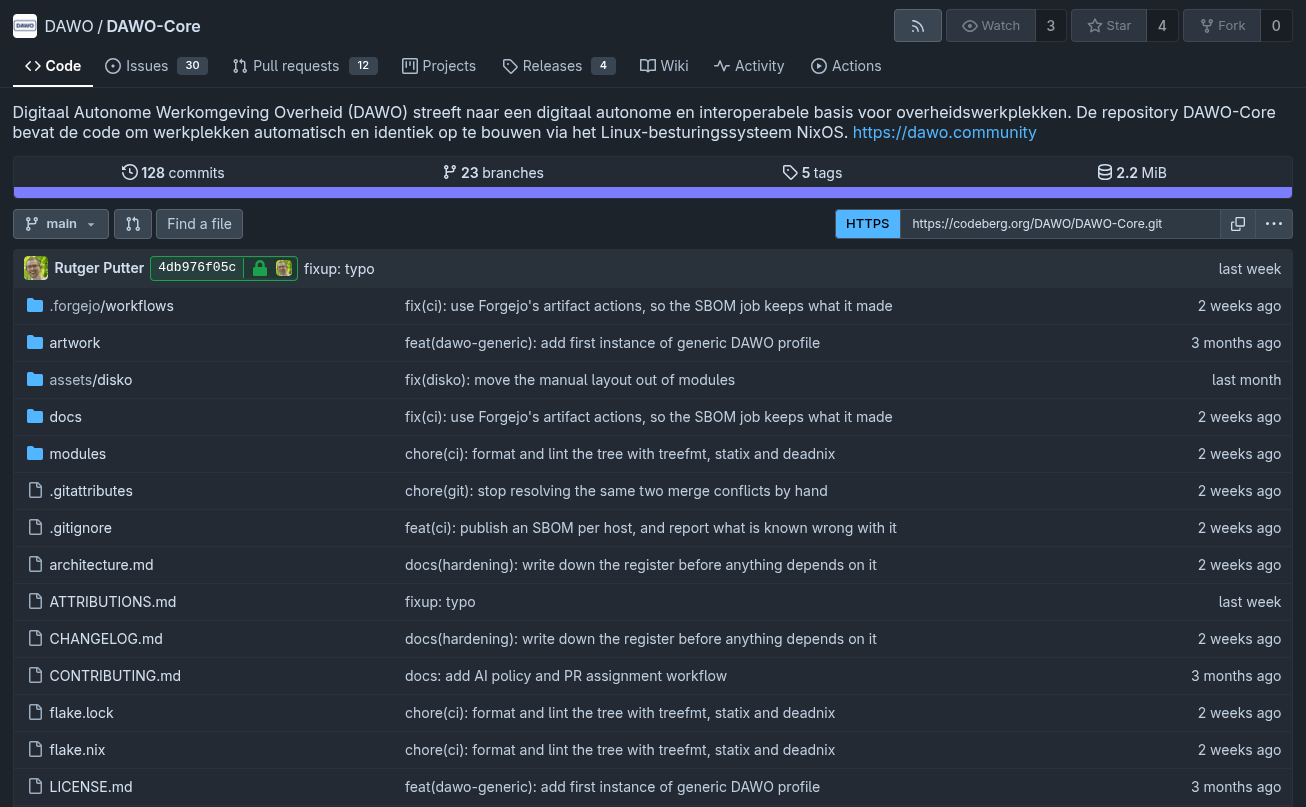
- Mid-2026: Consolidation of development on the Forgejo platform, moving away from GitHub and GitLab to ensure full code hosting sovereignty.
Strategic Infrastructure and Economic Implications
The decision to utilize decommissioned hardware for the initial pilot phase underscores a secondary benefit of the DAWO project: fiscal efficiency and sustainability. NixOS is noted for its ability to run efficiently on hardware that is no longer supported by Windows 11 due to stringent hardware requirements (such as specific TPM or CPU generation mandates). By repurposing older laptops, the Dutch government is demonstrating a model of circular economy IT, extending the lifespan of taxpayer-funded hardware while simultaneously reducing the overhead associated with mandatory upgrades to proprietary systems.
The move also signals a broader trend within the European Union. The Dutch government is not acting in isolation; it is part of a growing cohort of European entities seeking to reclaim digital autonomy. The state of Schleswig-Holstein in Germany has been a pioneer in this regard, moving away from Microsoft Windows to Linux-based environments and reinvesting former licensing fees back into the local open-source economy. Similarly, France has initiated a massive transition for its health insurance employees, and Denmark’s Road Traffic Authority has moved to replace proprietary road management software with open-source alternatives.

From an economic perspective, this shift represents a move from a "subscription-based" model to an "investment-based" model. Instead of paying perpetual licensing fees to foreign firms, the Dutch government is investing its IT budget into the development of local expertise and the sustainability of the open-source projects they utilize. This creates a feedback loop where the government contributes code back to the community, improving the software for all users while maintaining internal control over their specific configurations.
Analysis of Potential Challenges
While the technical advantages of NixOS are well-documented, the transition to DAWO is not without significant challenges. The primary hurdle is organizational inertia and the "compatibility gap." Government operations are deeply integrated with proprietary file formats and specialized legacy software that may not have native Linux support. To mitigate this, the DAWO team is focused on building a robust ecosystem of web-based alternatives and compatibility layers that can handle the transition period.
Another challenge is the cultural shift required for civil servants. Adapting to a new interface and a different workflow, regardless of how efficient it may be, requires comprehensive training. The ongoing pilot programs with the eight municipalities are designed specifically to gather user feedback and refine the user experience (UX) to ensure that the transition does not hamper productivity.
Furthermore, the issue of "Code Sovereignty" is being addressed through the migration to Forgejo, a self-hosted, open-source alternative to proprietary code-hosting services. By controlling the platform where their code is stored and developed, the Dutch government ensures that even if external platforms were to change their terms of service or accessibility, the government’s digital foundation would remain intact and accessible to its developers.
Looking Toward the Future
As the Dutch government approaches the release of the first stable version of DAWO in 2027, the international community is watching closely. The project serves as a high-profile case study in "digital sovereignty"—a concept that has gained significant traction in EU policy circles in the wake of the Digital Markets Act (DMA) and the Digital Services Act (DSA).
If successful, DAWO could become the blueprint for other European nations facing similar pressures. The model demonstrates that digital sovereignty is not just about protectionism; it is about architectural resilience. By decoupling national infrastructure from the influence of foreign commercial entities, the Netherlands is positioning itself as a leader in the next generation of government IT.
The implications for the broader tech industry are also profound. If major government clients globally shift their preference toward NixOS and other open-source, sovereign-focused stacks, it will force a re-evaluation of how proprietary software companies engage with the public sector. The era of "blind reliance" on foreign digital infrastructure appears to be waning, replaced by a preference for systems that offer transparency, reproducibility, and, above all, independence. As the DAWO team continues to iterate on their framework, the success of this endeavor will likely hinge on their ability to maintain the balance between high-level security requirements and the everyday usability required for a diverse, non-technical government workforce.
Related posts: