The landscape of generative artificial intelligence is undergoing a significant architectural shift as researchers move beyond the traditional autoregressive paradigm that has defined the large language model (LLM) era. While models like GPT-4 and Claude have achieved remarkable fluency by predicting the next token in a sequence one step at a time, a new class of architectures known as diffusion language models is challenging this serial dependency. By utilizing iterative refinement processes rather than linear generation, these models aim to solve the inherent latency bottlenecks of autoregressive systems, potentially offering a more parallelizable approach to text synthesis.
The Architectural Divide: Autoregressive vs. Diffusion
To understand the evolution of this technology, one must first examine the constraints of the dominant autoregressive architecture. Standard LLMs operate on the principle of probability factorization, where the likelihood of a sequence is determined by the product of conditional probabilities. Mathematically, this is expressed as $p(x) = prod_i=1^N p(x_i mid x1, dots, xi-1)$. During inference, this creates a "serial dependency problem": the model cannot generate the fifth word of a sentence until it has fully finalized the preceding four. This latency is a primary factor in the perceived "speed" of current chatbots.
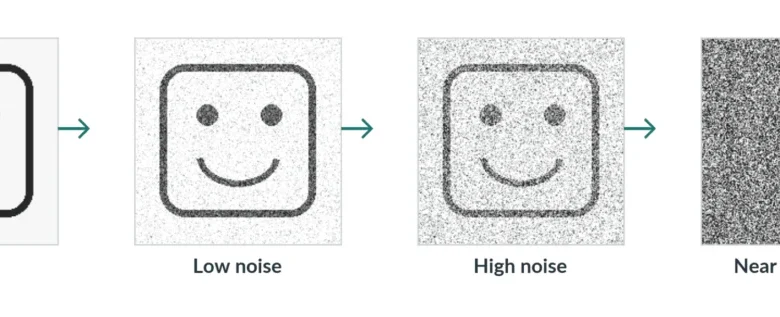
Diffusion models, conversely, originate from the domain of computer vision. The foundational research—most notably the 2020 paper Denoising Diffusion Probabilistic Models—demonstrated that image generation could be achieved by taking random Gaussian noise and progressively stripping it away to reveal a coherent image. Applying this to text has proven historically difficult because text is discrete; while a pixel can be slightly adjusted in value, a token ID does not exist on a continuous spectrum. Replacing a word with "a little bit of noise" is not a meaningful operation in linguistics.
Recent breakthroughs in 2025 and 2026, specifically through projects like LLaDA, Mercury, Gemini Diffusion, and Google’s DiffusionGemma, have overcome this by treating the text generation process as a "masked" sequence problem. Instead of predicting the next token, these models start with a "canvas" of masks and fill in multiple positions simultaneously, refining the entire sequence through multiple passes.
A Chronology of Innovation
The pivot toward diffusion-based language generation follows a clear trajectory of refinement in the field of deep learning:
- 2020–2022 (The Visual Foundation): Denoising diffusion models establish dominance in image synthesis (e.g., Stable Diffusion, DALL-E 2), proving that iterative refinement is more stable than generative adversarial networks (GANs) for high-fidelity outputs.
- 2023–2024 (The Discrete Constraint): Researchers struggle to adapt diffusion for text. Early attempts focus on embedding space manipulation, but these methods often suffer from high perplexity and loss of grammatical structure.
- Early 2025 (The Breakthroughs): The emergence of LLaDA and Mercury introduces effective masking strategies. By defining corruption as the systematic replacement of tokens with a
[MASK]token, researchers successfully apply denoising objectives to discrete text. - Late 2025–2026 (Industrial Adoption): Google’s release of DiffusionGemma signals that industry leaders are moving from theoretical research to practical, scalable architectures. This phase focuses on optimizing the "sampling" process—the number of rounds required to reach a stable, coherent sentence.
The Mechanics of Denoising Inference
The inference process in a diffusion language model differs drastically from the "greedy" or "beam search" decoding used in GPT models. The procedure generally follows a four-stage cycle:
- Initialization: The model begins with a sequence of placeholders, often entirely masked or seeded with low-confidence noise.
- Vocabulary Distribution: The transformer architecture analyzes the context of the entire sequence at once, assigning probability distributions to every masked position simultaneously.
- Confidence-Based Commitment: Unlike autoregressive models that must commit to a token, diffusion models use a confidence metric. If the model is 95% sure of a word, it may "commit" it to the sequence. If it is only 30% sure, it leaves the position masked for the next iteration.
- Iterative Revision: The model performs subsequent passes. Advanced samplers even allow for "remasking"—a process where a previously generated token is deleted if the evolving context of the sentence suggests it was an error.
This process transforms the generation task from a linear "path-finding" exercise into a "global optimization" task. The model is not just building a sentence; it is solving a constraint-satisfaction problem across the entire length of the output.
Comparative Analysis: Efficiency and Trade-offs
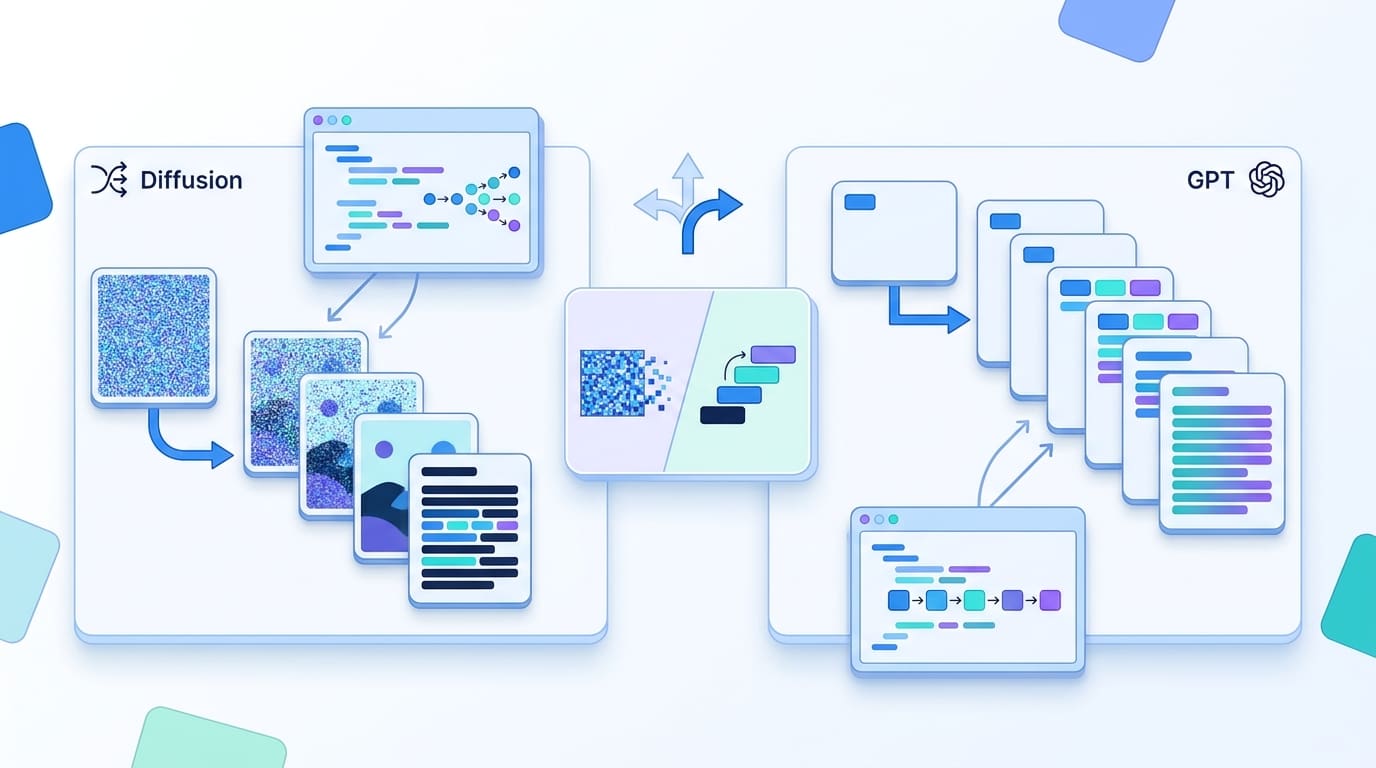
The primary argument for diffusion language models is the potential for non-left-to-right generation. In an autoregressive model, the time cost grows linearly with the length of the output. In a diffusion model, the time cost is tied to the number of sampling steps, which can theoretically be kept constant or significantly reduced through architectural optimization.
However, data from early implementations suggests significant trade-offs:
- Computational Intensity: While diffusion models can be parallelized, they require multiple passes over the same sequence. If a model requires 20 iterations to finalize a paragraph, the total compute cost might exceed that of a single-pass autoregressive model.
- Logical Consistency: Autoregressive models are inherently better at maintaining long-range causal links because they build upon their own history. Diffusion models must be carefully trained to avoid "hallucinating" middle segments that contradict the beginning or end of a paragraph.
- Training Complexity: Training a diffusion model to understand the manifold of human language is significantly more complex than training a next-token predictor. The loss functions required for denoising are computationally demanding and require larger datasets to achieve the same level of coherence.
Broader Implications for AI Infrastructure
The research community remains divided on whether diffusion will eventually replace autoregressive models. The current consensus among lead researchers is that we are likely heading toward a "hybrid" future.
"Diffusion is not necessarily an automatic replacement for GPT-style architectures," notes one industry analyst. "It is a new tool in the toolbox for allocating computational resources."
For tasks that require extreme speed—such as real-time voice synthesis or high-frequency code completion—the parallel nature of diffusion models offers a clear advantage. Conversely, for complex creative writing or deep reasoning tasks where each word must logically flow from the last, the autoregressive model’s serial nature remains a strength, providing a deterministic structure that diffusion models are still struggling to match.
Conclusion and Future Outlook
The rapid progression from 2025’s LLaDA to the 2026 rollout of DiffusionGemma indicates that the industry is heavily invested in overcoming the limitations of current generative architectures. While the mathematical complexity of these models is significant, the intuition is clear: if we can train machines to refine their thoughts in a parallel, global fashion, we may move past the limitations of the "next-token" bottleneck.
As developers continue to refine sampling techniques and decrease the number of iterations required for coherent text, the gap between the two approaches will likely narrow. Whether this leads to a total paradigm shift or a nuanced diversification of model architectures, the rise of diffusion in language processing marks a definitive step forward in the quest for more efficient and capable artificial intelligence.