AlmaLinux revolutionizes enterprise hardware and software certification with a streamlined, community-driven ecosystem


The landscape of enterprise Linux adoption is undergoing a significant shift as the AlmaLinux OS Foundation announces a comprehensive overhaul of its certification framework. By decoupling validation from mandatory OS installation and introducing a high-speed, automated testing suite, AlmaLinux is aiming to lower the barriers for vendors and individual users alike. This initiative, which centralizes both software and hardware validation into a single, publicly accessible catalog, represents a strategic move to provide the transparency and compatibility verification necessary for large-scale production deployments.
The Evolution of Enterprise Validation
Historically, certifying hardware and software for enterprise-grade Linux distributions has been a cumbersome, resource-intensive process. Vendors often faced lengthy turnaround times, proprietary restrictions, and the requirement for specific, pre-configured environments to ensure compliance. For independent software vendors (ISVs) and hardware manufacturers, these hurdles frequently translated into significant costs, often deterring them from officially supporting community-driven distributions like AlmaLinux.
The AlmaLinux OS Foundation, recognizing these bottlenecks, has sought to democratize the validation process. By moving toward a decentralized, community-verified model, the project seeks to establish a repository of trust. This shift effectively transitions certification from a "gated" process controlled by a central authority to an "open" process driven by crowd-sourced verification and automated diagnostics.

Chronology of the Certification Overhaul
The path to this new certification framework has been marked by a series of technical refinements aimed at improving the efficiency of the alma-certify tool. Over the past several months, the development team focused on three core pillars: portability, speed, and ease of use.
The development trajectory began with the realization that the original certification tool was too rigid, requiring a full installation of AlmaLinux, which discouraged potential testers from verifying hardware they were currently using for other workloads. By re-engineering the underlying architecture to support live-media execution, the team significantly broadened the scope of eligible test environments.
This culminated in the recent release of the rewritten alma-certify suite. The tool, now optimized for modern hardware, boasts execution times of under 10 minutes, a stark improvement over the hours or even days required for legacy enterprise testing suites. The introduction of QR-code-based machine registration represents the final piece of this workflow, simplifying the transition from physical hardware discovery to cloud-based result submission.
Technical Deep Dive: Inside the alma-certify Tool
The efficacy of the new system lies in its granular diagnostic capability. When a user runs the alma-certify utility, it performs a comprehensive audit of the machine’s architecture. This is not merely a high-level compatibility check; it is a deep-dive analysis that probes:

- Computational Integrity: Stress testing CPU performance and identifying potential memory errors that could compromise enterprise stability.
- Storage Health: Evaluating controller responsiveness, read/write latency, and SMART data to ensure hardware longevity.
- Networking and Drivers: Confirming that network interface cards (NICs) operate within expected parameters and that kernel-level drivers are properly mapped to the OS state.
- Virtualization and Peripherals: Verifying that hardware-accelerated virtualization is enabled and that specialized peripherals, such as GPUs and high-speed I/O controllers, maintain consistent communication with the kernel.
By capturing this metadata—including specific firmware and driver versions—the tool ensures that the catalog provides a detailed "fingerprint" of the hardware configuration. This level of detail allows enterprise IT administrators to compare their own hardware specifications against the verified list, minimizing the risk of deployment failures in production environments.
The Centralized Catalog and API Integration
The central repository for these findings, the AlmaLinux Certification Catalog, serves as the single source of truth for the ecosystem. Every entry is categorized by the specific major version of AlmaLinux being tested, ensuring that administrators can verify compatibility for specific OS lifecycles.
For organizations that manage vast fleets of servers, the inclusion of a read-only, public-facing API is a critical feature. This API allows DevOps teams to programmatically pull data from the catalog, integrating it into their own procurement or automation pipelines. For instance, an infrastructure manager could use the API to cross-reference a vendor’s quote against the AlmaLinux catalog to confirm that the hardware is pre-validated for the intended AlmaLinux deployment.
Strategic Implications for the Open Source Ecosystem
The decision to make these certifications entirely free is a direct challenge to the traditional enterprise Linux business model, where certification was often used as a lever to generate service revenue. By removing the financial barrier, AlmaLinux is positioning itself as the most accessible "Enterprise-Grade" Linux distribution.
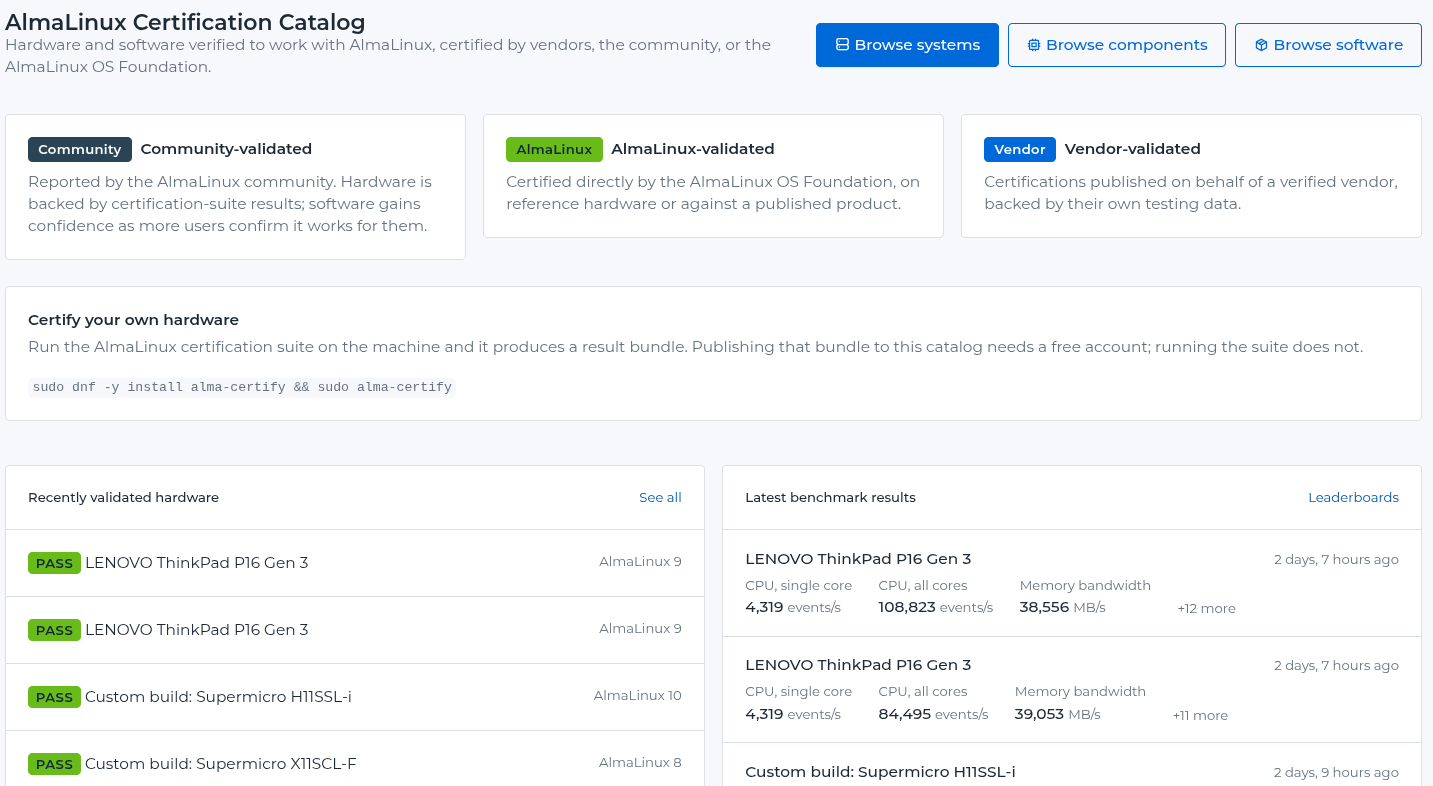
Jonathan Wright, the Infrastructure Lead for AlmaLinux, has framed this as a mutual benefit for both the community and the vendors. From the vendor perspective, the barrier to "officially supporting" AlmaLinux is now virtually non-existent. An ISV no longer needs to enter a complex partnership agreement to have their software listed; they simply need to confirm its functionality across different hardware and software configurations.
This "stackable" validation model—where multiple users can confirm the success of the same hardware/software combination—adds a layer of social proof. As more users report successful deployments, the confidence in that configuration grows, effectively creating a self-reinforcing loop of compatibility data.
Analysis: Market Impact and Future Outlook
The broader implication of this shift is the potential for increased market share in data centers that previously relied solely on RHEL (Red Hat Enterprise Linux) for the sake of "certified" hardware support. While Red Hat remains the industry standard for commercial support, the AlmaLinux approach targets the segment of the market that prioritizes technical compatibility over vendor-specific service contracts.
Furthermore, by moving the burden of verification to the community and automated tools, AlmaLinux is essentially "scaling" its support infrastructure without the associated cost of hiring thousands of manual testers. This allows the foundation to focus its resources on core development while the community handles the "long tail" of hardware and software testing.
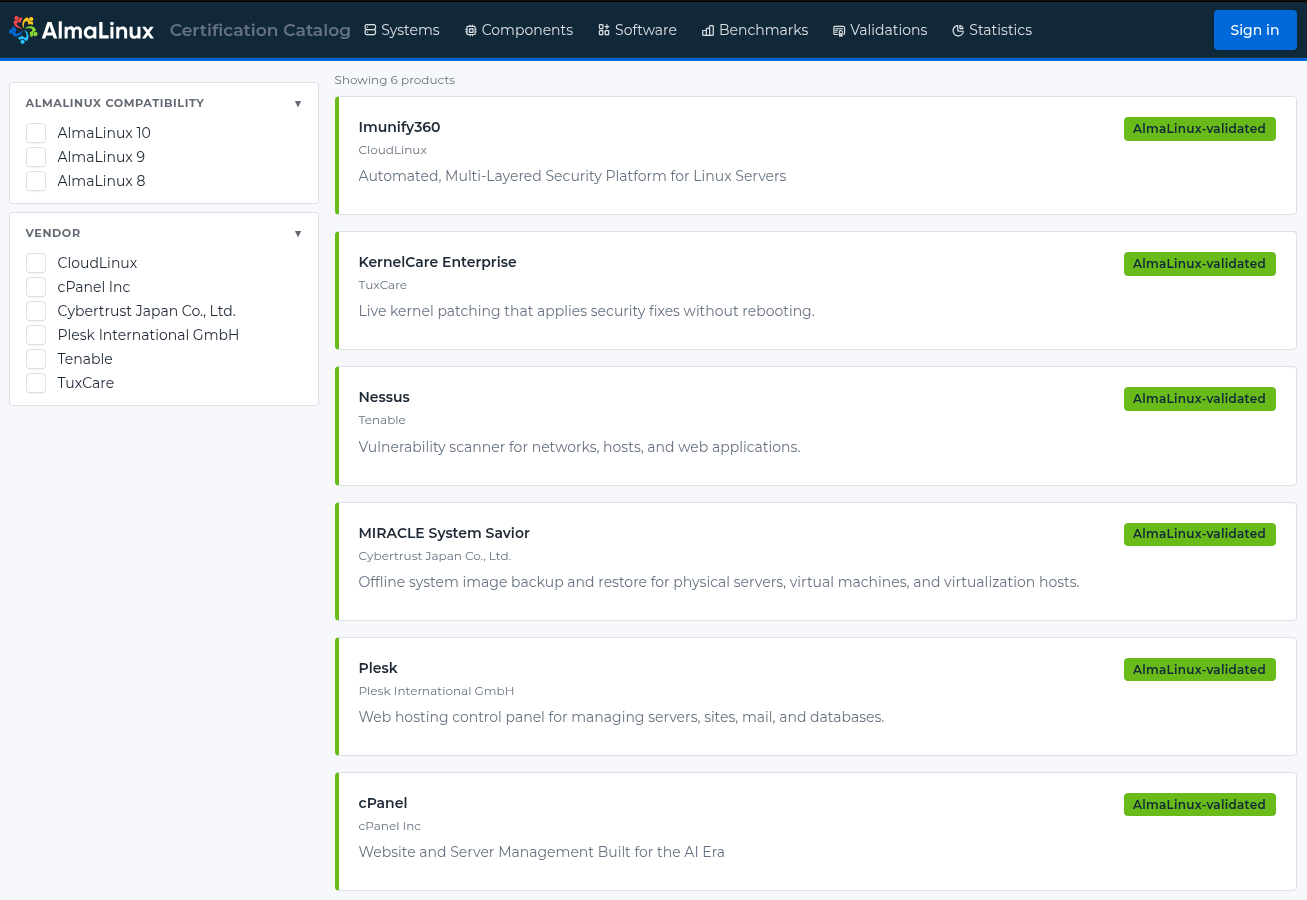
However, the success of this model is predicated on participation. For the catalog to remain accurate and useful, it requires a constant stream of contributions from system administrators, hobbyists, and vendors. If the volume of submissions remains low, the catalog may suffer from "stale" data, potentially misleading users. The success of the project will likely depend on the foundation’s ability to maintain an engaging and intuitive user experience that incentivizes regular reporting.
Conclusion: A New Standard for Transparency
The transformation of AlmaLinux certification is a significant milestone in the maturation of community-driven enterprise Linux. By leveraging automation and open data, the project has created a framework that addresses the core requirement of any enterprise OS: the need for predictability.
As the IT landscape continues to move toward more flexible, hardware-agnostic environments, the ability to rapidly verify infrastructure will become an increasingly valuable asset. Through this initiative, AlmaLinux is not only proving that community software can keep pace with proprietary alternatives, but that it can often outpace them in terms of agility, accessibility, and transparency. For the end user, the result is a more informed procurement process and a more reliable deployment experience, ultimately reinforcing the viability of AlmaLinux as a robust, enterprise-ready solution.
With the tools now available to anyone with a machine and an interest in the ecosystem, the future of hardware-OS certification appears to be shifting firmly into the hands of the people who actually build and manage the infrastructure. Whether this leads to a widespread industry shift toward open certification remains to be seen, but the groundwork has undoubtedly been laid for a more collaborative and transparent era of Linux computing.
Related posts: