FOSS Weekly Report: Immutable Systems, AI-Driven Kernels, and Enterprise Shifts in the Linux Landscape

The open-source ecosystem is currently experiencing a period of rapid architectural evolution, characterized by a shift toward immutable infrastructure, AI-assisted kernel development, and significant enterprise migrations away from proprietary virtualization platforms. As the industry grapples with security challenges and licensing instability, developers and organizations are increasingly turning to novel solutions that prioritize system integrity, compatibility, and long-term sustainability.

The Rise of Immutable Foundations
Amutable has officially opened signups for design partners to evaluate its new immutable, image-based operating system. This project, spearheaded by the engineering talent responsible for the widespread adoption of systemd, represents a fundamental shift in how system states are managed. Unlike traditional Linux distributions that rely on package managers to modify the root filesystem in real-time, Amutable utilizes an image-based approach where every system modification is bundled as a cryptographically signed update.
This architecture is designed to mitigate the "configuration drift" that often plagues large-scale deployments. By leveraging hardware attestations, the system verifies the integrity of the machine’s state before allowing any deployment. This process ensures that the software stack remains identical across all nodes in a cluster, a requirement for high-availability environments. The move toward immutability is consistent with broader industry trends, such as Fedora Silverblue and Vanilla OS, which prioritize predictable updates and rollback capabilities.

Innovation via AI: The Emergence of Ginux
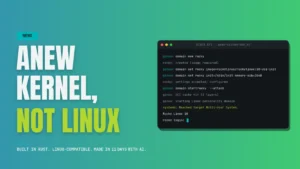
In a landmark development for kernel architecture, Gregory Kurtzer’s Ginux project has demonstrated the feasibility of creating a functional, Linux-compatible kernel without relying on a direct fork of the mainline Linux kernel. Over an intensive 11-day period, an AI agent successfully generated approximately 139,000 lines of code. The resulting kernel is capable of executing standard Linux binaries, effectively bypassing the need to inherit the massive, legacy-heavy codebase of the traditional Linux kernel.
This achievement challenges the long-held assumption that a Unix-like kernel requires decades of collective human effort to reach parity with existing standards. While Ginux remains in its nascent stages, the use of AI to accelerate the development of low-level system software suggests a new paradigm for "clean-room" implementations. By avoiding the technical debt of the original Linux source, Ginux may provide a more modular and secure foundation for specialized hardware and containerized environments.

Data Integrity and File System Research
The Linux kernel mailing list has been the site of intense technical discourse surrounding the introduction of BeamFS. Submitted as a Request for Comments (RFC), the file system is engineered with a primary focus on data integrity in environments where hardware-level corruption is a concern. Unlike legacy file systems that may silently serve corrupted data, BeamFS prioritizes the detection of anomalies.
Developers have issued warnings regarding existing data loss bugs, suggesting that the project is not yet suitable for production environments. Furthermore, while the file system is theoretically robust, it has yet to be stress-tested in high-radiation environments—such as space-faring hardware or high-energy physics labs—where bit-flips are common. The development of BeamFS highlights a growing recognition that as storage densities increase, file system-level validation is becoming as critical as physical error correction.

Corporate Shifts: Tesco’s Strategic Migration
The enterprise sector is witnessing a significant migration away from VMware following the company’s acquisition by Broadcom and the subsequent restructuring of its licensing model. Tesco, the international retail giant, has announced a planned transition from VMware to Proxmox, a move driven by both financial and operational concerns.
The transition follows Broadcom’s decision to terminate perpetual license support, which effectively mandated a shift toward subscription-based pricing. Reports indicate that the change resulted in a 175% cost increase for many enterprise customers. Tesco’s migration strategy, which involves a multi-year roadmap concluding by the end of 2027, illustrates the risk associated with vendor lock-in. By adopting Proxmox, an open-source alternative based on KVM (Kernel-based Virtual Machine), Tesco gains greater control over its infrastructure stack, reducing exposure to unilateral pricing shifts from proprietary vendors.
The Evolution of the Linux Desktop
The discussion surrounding the Linux desktop environment continues to be shaped by the needs of professional workflows. Mirko Brombin, the lead developer behind the Bottles project, has recently emphasized the necessity of achieving native-like performance for Microsoft Office on Linux. Brombin argues that for many users, the transition to Linux is contingent upon the availability of specific industry-standard applications, noting that while LibreOffice provides a functional suite, it often lacks the feature parity required by corporate environments.
This stance marks a shift in the philosophy of Linux desktop development. Rather than focusing solely on open-source clones that mimic proprietary software pixel-by-pixel, there is a growing movement to ensure that essential software runs reliably within the Linux ecosystem. This pragmatic approach is intended to lower the barrier to entry for users transitioning from Windows, addressing the "last mile" problem that has historically hindered Linux adoption in business sectors.

Historical Context: The Linux "Crypt" and Legacy Systems
As the open-source community celebrates seasonal traditions, it is also a time to reflect on the history of the Linux kernel and its associated projects. The evolution of Linux is marked by the "death" and "resurrection" of numerous distributions and tools. Projects like the legacy scp command, which was widely rumored to be deprecated, continue to see usage despite newer alternatives like rsync or SFTP.
The history of Ubuntu itself provides a lens into this process of iteration; the distribution has famously discontinued several ambitious projects—such as the Unity 8 convergence dream—in favor of maintaining a stable and sustainable roadmap. This cycle of innovation, where older projects are sunsetted to make way for modern alternatives, is a fundamental characteristic of open-source development. The recent emergence of "new generation" versions of legacy apps and the active maintenance of X11-compatibility layers demonstrate that, in the open-source world, software is rarely permanently abandoned if there remains a community need.
Hardware and Homelab Advancements
The hardware space remains equally dynamic, with the introduction of the ArmSoM Sige7s board. By integrating the Rockchip RK3588S chip, the board offers 6 TOPS (Tera Operations Per Second) of NPU performance, catering to the growing demand for edge-based AI processing. With support for up to 32GB of RAM and modern connectivity standards like Wi-Fi 6 and HDMI 2.1, the board serves as a powerful development platform for embedded Linux projects.
In addition to single-board computers, the modular hardware movement continues to gain momentum. The crowdfunding of a new USB-C hub, designed to be compatible with Framework laptop expansion cards, underscores the demand for hardware that is as repairable and customizable as the software it runs. These advancements in the homelab sector are indicative of a broader trend: the desire for consumers to move away from "black-box" hardware in favor of transparent, modular, and extensible systems.

Future Implications for the FOSS Ecosystem
The convergence of these events—ranging from the rise of AI-generated kernels to the mass migration of enterprise workloads—suggests that the Linux ecosystem is entering a period of significant consolidation and professionalization.
The emphasis on immutable, verified updates addresses the security vulnerabilities that have long plagued open-source deployments. Meanwhile, the enterprise migration away from legacy proprietary software suggests that open-source solutions like Proxmox are no longer viewed as mere "alternatives," but as primary infrastructure components capable of supporting large-scale, high-stakes operations.

Furthermore, the integration of AI into both the kernel development lifecycle and the desktop user experience suggests that the next decade of Linux development will be defined by automation. As developers continue to balance the need for backward compatibility with the desire to innovate, the FOSS community remains a resilient and adaptable force in the global technology landscape. Whether through the creation of new kernels or the preservation of legacy software, the open-source community continues to provide the essential infrastructure that powers the modern digital economy.