Building a Serverless ChatOps Bridge: Integrating Kiro CLI into Slack for Seamless Engineering Workflows

In modern software development, the context switch between communication platforms and development environments has become a significant source of operational friction. Recent data suggests that for a typical engineering team of ten developers, the constant movement between Slack and the terminal to debug issues or analyze service logs results in over 12 hours of lost productivity per week. To mitigate this, developers are increasingly turning to ChatOps—a methodology that integrates internal tools directly into messaging platforms. By leveraging AWS serverless architecture and headless authentication, organizations can now trigger complex Kiro CLI operations directly from Slack, eliminating the need for manual terminal intervention and streamlining incident response.
The Cost of Context Switching
The traditional workflow for an engineer tasked with investigating a failing test or a memory leak is inefficient by design. An engineer must exit their communication channel, navigate to the local repository, execute specific CLI commands, wait for output, and then copy-paste that information back into a team thread. Even for experienced developers, this process takes roughly 30 seconds; for those less familiar with the codebase, the process can extend to five minutes or longer. When aggregated across multiple engineers performing these tasks fifteen times daily, the "hidden" cost of developer productivity loss is substantial. This latency does more than just waste time—it disrupts the "flow state" required for high-level problem solving and can delay critical incident resolutions.
Technical Foundation: Headless Authentication and Serverless Execution
The transition to a frictionless ChatOps model relies on the concept of headless authentication. In a standard development environment, Kiro CLI typically requires an interactive login, often involving browser-based OAuth flows that are incompatible with serverless environments like AWS Lambda. By utilizing API key-based authentication, developers can now run Kiro CLI in a headless state, where the system authenticates silently using a stored key.
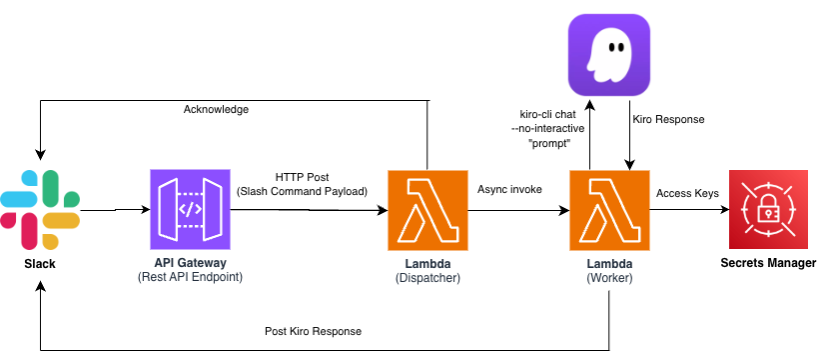
This architecture is secured through AWS Secrets Manager, which stores the Kiro API key, Slack signing secret, and GitHub Personal Access Tokens (PATs). Because these keys are injected into the Lambda environment at runtime, they are never exposed to the end-user, ensuring a robust security posture while maintaining operational agility.
Architecture and Workflow Chronology
The integration utilizes a dual-Lambda approach to adhere to Slack’s strict response time requirements. When a user types a command such as /kiro analyze auth-service, the process follows a precise sequence:

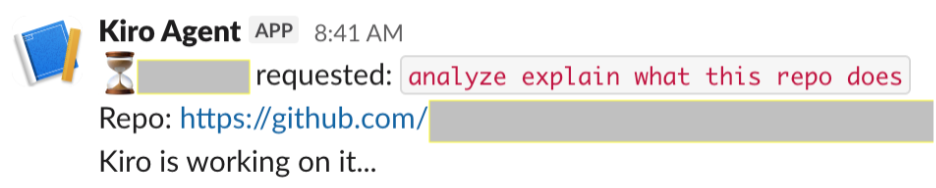
- The Dispatcher (The Acknowledgment Layer): Slack requires a response within three seconds of a slash command being issued. The Dispatcher Lambda validates the incoming request using the Slack signing secret, extracts the necessary payload, and triggers an asynchronous event. It then immediately sends a 200 OK acknowledgment to Slack, informing the user that the request is being processed.
- The Worker (The Execution Layer): Because Kiro CLI analysis can take anywhere from 10 to 60 seconds, the Worker Lambda operates independently. It is deployed as a container image to accommodate the CLI’s dependencies—such as git, NSS, and specific system libraries—that exceed standard Lambda layer size limits. The Worker clones the repository, executes the Kiro CLI command in a sandboxed environment, and uses the Slack
response_urlto post the final analysis directly back into the original thread.
This "fire-and-forget" pattern ensures that even if a repository is large or a prompt is computationally expensive, the Slack interface remains responsive, preventing timeout errors while ensuring the user receives the output as soon as it is generated.
Prerequisites and Implementation Strategy
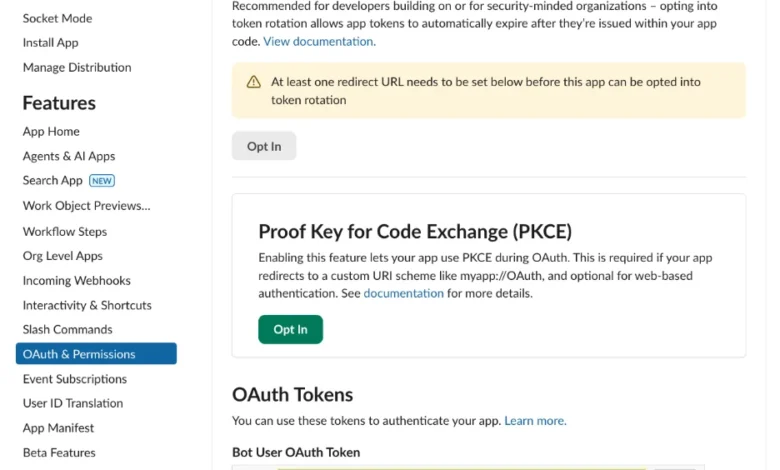
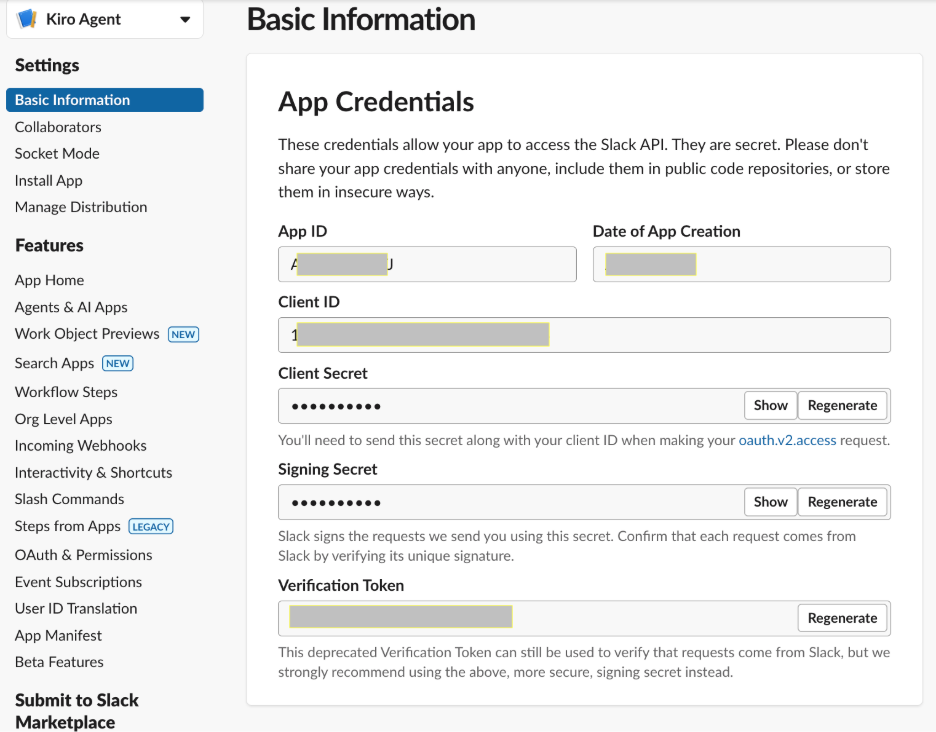
To deploy this infrastructure, engineering teams must first centralize their credentials. The process begins by gathering the Kiro API key, a Slack signing secret, and a GitHub PAT. These are pushed to AWS Secrets Manager using IAM-scoped access, which ensures that only the authorized Lambda functions can retrieve them.
The implementation of the Worker Lambda requires a carefully constructed Dockerfile. Developers must ensure that the Kiro CLI binary is moved to /usr/local/bin/ because the standard Lambda user lacks the permissions to execute from /root/. Furthermore, because Lambda environments are ephemeral and read-only, developers must explicitly set the HOME environment variable to /tmp and ensure that all temporary repository clones are purged at the end of every execution. This cleanup is critical to prevent the 512 MB of ephemeral storage from being exhausted during warm starts, which could otherwise lead to service failure.
Security and Governance
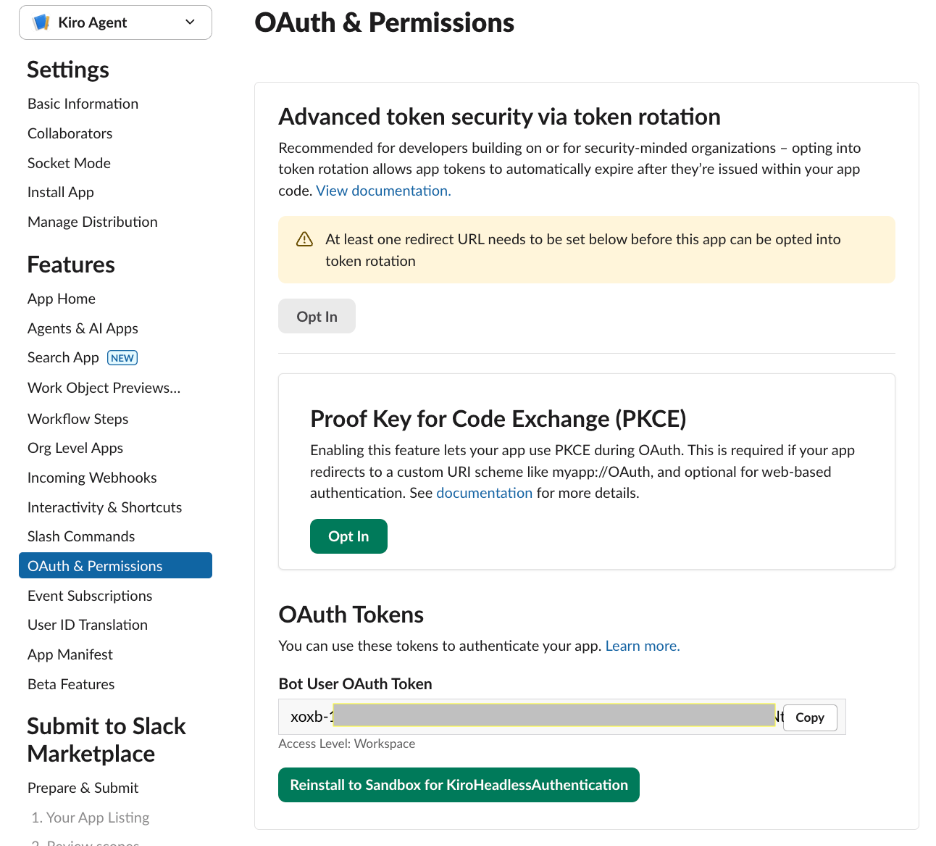
Security is a primary concern for any organization integrating AI-driven CLI tools into a public or private messaging channel. By utilizing HMAC-SHA256 signature verification within the Dispatcher Lambda, the system ensures that only requests originating from an authenticated Slack workspace are processed. Additionally, the implementation of a 5-minute threshold for request timestamps protects the system against replay attacks.
For larger organizations, API key governance is essential. Many Kiro Pro and Enterprise subscribers require that an administrator enable API key authentication at the organization level before individual developers can begin integrating it into their workflows. This layer of oversight ensures that AI usage remains compliant with company policy and that access to the source code analysis tools is audited.
Broader Implications for Engineering Culture
The shift toward AI-assisted, chat-based development has implications that extend beyond mere time savings. When complex analysis is performed in a public Slack channel, it becomes a shared knowledge resource. A junior engineer who might be hesitant to run a deep diagnostic command can see the results of a senior engineer’s request, fostering a culture of transparency and continuous learning.
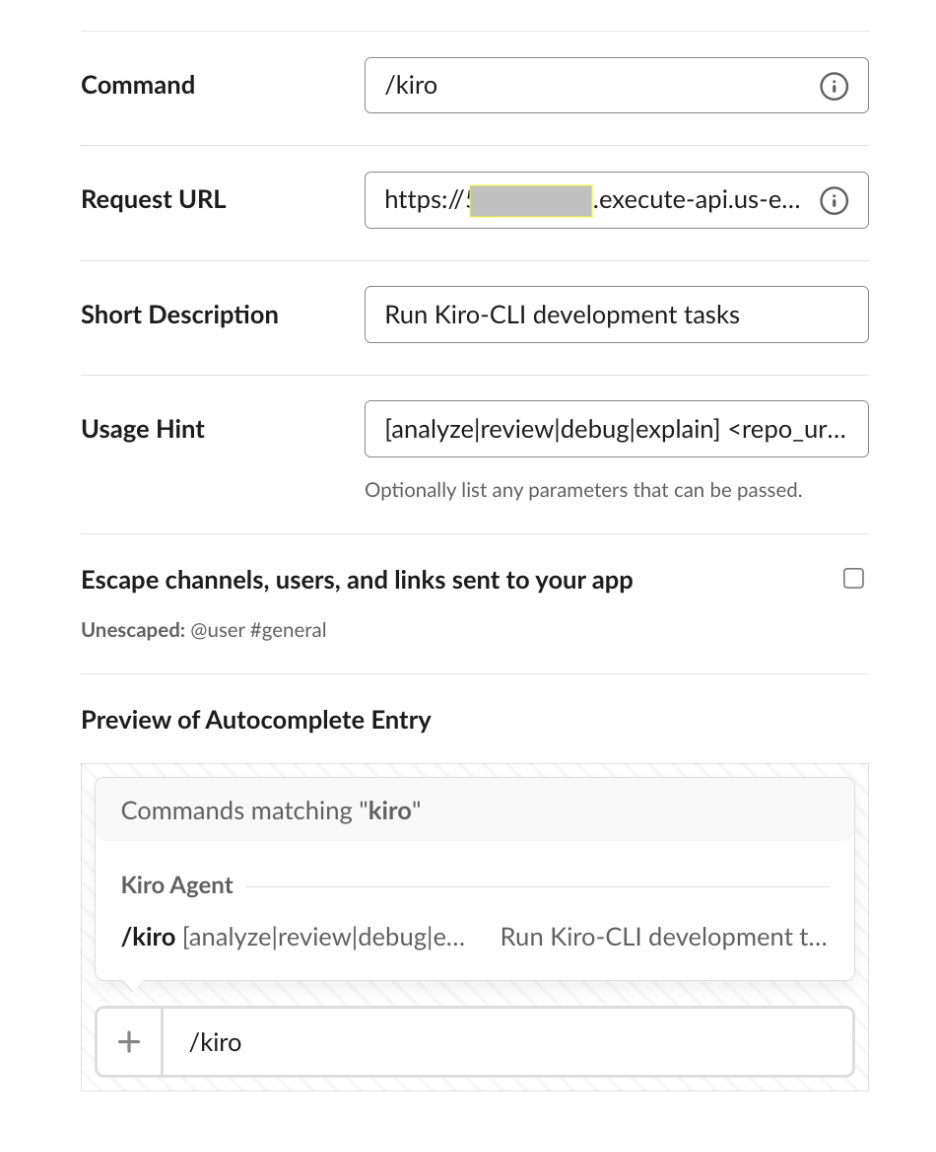
Furthermore, this pattern can be extended to support more complex workflows, such as:
- Approval Workflows: Integrating interactive Slack buttons to allow managers to approve Pull Requests or infrastructure changes generated by the CLI.
- Audit Logging: Exporting every query and response to Amazon DynamoDB for post-incident reviews or trend analysis on recurring technical debt.
- Multi-Repository Scaling: Dynamically fetching repository metadata from the command string to allow a single Slack integration to serve an entire organization’s codebase.
Operational Constraints and Trade-offs
While the serverless approach offers scalability and cost-efficiency, it is not without constraints. Slack’s response_url is ephemeral, expiring 30 minutes after the initial command, and it supports a maximum of five responses. Therefore, developers must design their implementations to be concise. If a process requires long-running, multi-part updates, developers must transition from a slash command response to a dedicated bot-token-based messaging system.

Additionally, while the use of container images in Lambda provides flexibility, it introduces a cold-start latency. Engineering teams must balance this against the benefits of having a fully managed, zero-server infrastructure that does not require the maintenance of a persistent virtual machine or Kubernetes cluster.
Conclusion: The Future of ChatOps
The integration of Kiro CLI into Slack via AWS Lambda is a blueprint for the future of developer tooling. By removing the physical and mental barriers of the context switch, organizations can transform their communication channels into powerful command-and-control centers. As AI-assisted development tools become more pervasive, the ability to trigger these tools through simple, natural language commands in a collaborative space will likely become the standard for high-performing engineering teams.
For teams looking to adopt this model, the initial investment in setting up the Dispatcher and Worker functions is minimal compared to the long-term gains in developer velocity. By starting with a single, high-frequency command, engineering leads can identify exactly where their teams face the most friction and iteratively build a suite of tools that automate the mundane, allowing developers to focus on building, shipping, and maintaining high-quality software. The transition to this model is not just a technical upgrade; it is a fundamental shift in how teams share information and solve problems in real-time.