The landscape of artificial intelligence is undergoing a profound transformation, driven by the development of new protocols designed to bridge the gap between advanced AI models and the vast array of tools and data they need to interact with. At the forefront of this evolution is the Model Context Protocol (MCP), a groundbreaking initiative aiming to replicate the paradigm-shifting impact of the Language Server Protocol (LSP) on programming languages and developer tools, but for the burgeoning world of AI. Just as LSP standardized communication between code editors and language-specific functionalities, MCP seeks to standardize how AI models access and utilize external resources, promising to unlock unprecedented capabilities for AI agents and applications.
The Challenge of AI Tool Use and Agentic Behavior
Contemporary frontier AI models, while remarkably sophisticated, possess inherent limitations that curtail their full potential. These models, despite their impressive generative and analytical prowess, often struggle with real-time data retrieval and the execution of complex, multi-step tasks that require interaction with the external world. This is where the concept of "tool use" emerges as a critical enabler. Tool use, in the context of AI, refers to the ability of a language model to identify when it requires external information or functionality, formulate a request for that tool, receive the output, and then integrate that information into its response or subsequent actions.
Consider a common scenario: a user requests a limerick about the current weather in Portland, Oregon. An advanced AI model, recognizing its inability to directly access real-time weather data, must be equipped with a mechanism to obtain this information. This is where the client application, acting as an intermediary, plays a crucial role. The client, aware of available tools, might inform the AI assistant about a "Get Weather" tool, specifying its function and the type of input it requires – in this case, geographical coordinates.
The AI, through its internal reasoning process, identifies Portland’s coordinates (45.5155° N, 122.6789° W). It then formulates a structured request to the client to invoke the "Get Weather" tool with these parameters. This interaction is often visualized as a "thinking" process, where the AI outlines its logical steps. The client, upon receiving this request, may first seek user confirmation before executing the tool call. Upon successful execution, the tool returns the requested data, such as the temperature, atmospheric conditions, and humidity. The AI then leverages this real-time information to craft an accurate and contextually relevant limerick, demonstrating a tangible instance of tool use.
While this example showcases a functional application of AI tool use, the current implementation often involves a degree of friction and inefficiency. The process can be slow and resource-intensive, especially when compared to simpler, direct methods like a web search or a quick physical check. However, the significance of tool use extends far beyond mere data retrieval. It lays the foundation for AI "agency" – the ability of an AI to act autonomously and proactively to achieve goals. As the number and complexity of available tools increase, the potential for AI systems to tackle increasingly challenging problems grows exponentially. The adage "quantity has a quality all its own" rings particularly true here; providing AI with access to a vast ecosystem of tools, including potentially tools for creating other tools, could lead to systems capable of solving an astonishing range of problems.
The M x N Problem: A Familiar Challenge in a New Domain
The development of MCP addresses a fundamental challenge that has historically hindered technological progress: the "M x N problem." This problem, famously articulated in the context of the Language Server Protocol, describes the complexity of connecting ‘M’ editors with ‘N’ programming languages. Without a standardized protocol, each editor would need to implement specific integrations for every language, leading to a fragmented and unwieldy ecosystem. LSP elegantly solved this by introducing a common language, allowing any LSP-compatible editor to communicate with any LSP-compatible language server, thus transforming the M x N problem into an M + N scenario – a significant reduction in integration complexity.
MCP faces an analogous M x N challenge in the AI domain. It aims to connect ‘M’ AI clients (applications, agents) with ‘N’ resources (data sources, APIs, tools). Without MCP, each AI application would be compelled to develop custom integrations for every external service it needs to access. This leads to a similar fragmented ecosystem, where developers must expend considerable effort building and maintaining bespoke connections for each AI tool or data source. This not only slows down development but also limits the interoperability and scalability of AI systems.
MCP, much like LSP, proposes to overcome this by establishing a standardized communication protocol. Instead of each AI application needing to understand the unique interface of every available resource, it only needs to adhere to the MCP standard. This standardization allows a single AI client to seamlessly interact with any MCP-compatible resource, thereby unlocking access to a vast and growing network of data and functionalities. This transition from an M x N complexity to an M + N simplicity is crucial for fostering a robust and interconnected AI ecosystem.

Under the Hood: How Model Context Protocol Works
MCP adopts a client-server architecture, mirroring the successful model of LSP. This architecture facilitates a clear division of responsibilities: the client acts as the initiator of requests and the orchestrator of interactions, while the server provides access to specific resources or functionalities. Communication between these components is built upon the widely adopted JSON-RPC 2.0 specification, ensuring a robust and standardized data exchange format. The actual transport of these messages can occur over standard input/output (stdin/stdout) for local communication or via HTTP with Server-Sent Events for more distributed or web-based interactions.
A critical aspect of the MCP protocol is the negotiation of capabilities. When a client initiates a connection with an MCP server, it sends an initialize message. This message conveys information about the client’s supported protocol version and its capabilities. The server then responds with its own initialization message, outlining its supported features and protocol version. This handshake ensures that both parties are operating within compatible parameters.
Following the initialization, the client can query the server about the specific features it offers. MCP defines three primary categories of features that a server can expose:
- Tools: These are callable functions or services that the AI can invoke to perform specific actions or retrieve data. This directly addresses the "tool use" paradigm discussed earlier.
- Data Sources: These represent repositories of information that the AI can query or access. This could range from structured databases to unstructured text collections.
- Knowledge Graphs: These provide structured, interconnected information that AI models can leverage for deeper understanding and reasoning.
To illustrate how this works in practice, let’s revisit the weather limerick example. The client, empowered by MCP, can query the server for available tools. This is achieved through a tools/list request, formatted in JSON-RPC:
  "jsonrpc": "2.0",
  "id": 1,
  "method": "tools/list",
  "params":
A server configured to provide weather information would respond with a list of its available tools, including their names, descriptions, and input schemas. For the get_weather tool, the response might look like this:
  "jsonrpc": "2.0",
  "id": 1,
  "result":
    "tools": [

        "name": "get_weather",
        "description": "Returns current weather conditions for the specified coordinates.",
        "inputSchema":
          "type": "object",
          "properties":
            "latitude":  "type": "number" ,
            "longitude":  "type": "number"
          ,
          "required": ["latitude", "longitude"]


    ]
This detailed schema allows the AI client to understand precisely how to invoke the get_weather tool, including the required parameters (latitude and longitude) and their data types. The client can then present this information to the AI model. When the AI decides to use the get_weather tool, the client sends a tools/call request to the server, populating the arguments field with the specific coordinates:
  "jsonrpc": "2.0",
  "id": 2,
  "method": "tools/call",
  "params":
    "name": "get_weather",
    "arguments":
      "latitude": 45.5155,
      "longitude": -122.6789
The server processes this request and returns the tool’s result. MCP allows for rich results, including structured data and annotations that can guide the AI’s interpretation. The server might respond with:
  "jsonrpc": "2.0",
  "id": 2,
  "content": [

      "type": "text",
      "text": ""temperature": 12, "conditions": "cloudy", "humidity": 85%",
      "annotations":
        "audience": ["assistant"]


  ]
This structured output, which can include both raw data and metadata, is then passed back to the AI assistant. The assistant integrates this weather information into its creative process, ultimately generating the limerick. The client then delivers this final output to the user.
The Rise of AI Agents and the MCP Ecosystem
The implications of MCP are far-reaching, particularly for the development of sophisticated AI agents. By standardizing access to tools and data, MCP lowers the barrier to entry for creating agents capable of complex task execution and intelligent decision-making. This fosters an environment where developers can focus on building innovative AI applications rather than wrestling with bespoke integration challenges.
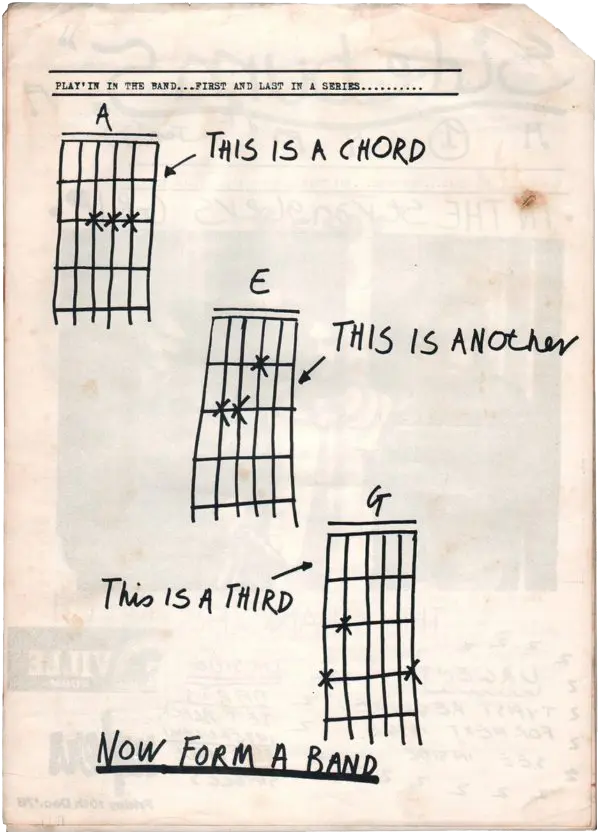
MCP’s design principles, emphasizing extensibility and interoperability, suggest a future where AI systems can fluidly access and leverage a diverse range of services. This could include everything from personal productivity tools like calendars and contact lists to enterprise-level databases and specialized scientific simulators. The ability for AI to seamlessly interact with such a broad spectrum of resources marks a significant step towards truly intelligent and autonomous agents.
Emerging Tools and Initiatives
The development of MCP is an ongoing effort, with a growing community of contributors and projects emerging to support its adoption. Anthropic, a leading AI research company, has been instrumental in the development and promotion of MCP. Their flagship product, Claude Desktop, serves as a capable platform for demonstrating MCP’s capabilities. Users can explore a variety of example servers to understand how MCP facilitates interaction with different types of resources.
Beyond the core protocol, several complementary projects are being developed to accelerate MCP adoption:
-
iMCP: This macOS application aims to bridge the gap between the Apple ecosystem and AI, providing MCP access to local data such as calendars, contacts, and iMessage data. This initiative highlights the potential for MCP to bring AI intelligence to deeply integrated personal data, a long-standing desire for many Apple users frustrated by limitations in existing Apple intelligence features. The project’s success in accessing iMessage databases underscores the technical challenges and innovative solutions being applied within the MCP framework.
-
mcp-swift-sdk: For developers preferring Swift, this Software Development Kit provides tools for building both MCP clients and servers. This is particularly valuable for developers within the Apple ecosystem who are accustomed to Swift development environments.
-
hype: This Python framework aims to simplify the process of exposing Python functions as various types of APIs, including MCP servers. By using a simple decorator, developers can instantly create MCP endpoints for their Python code, further democratizing the creation of MCP-compatible services. The
hypeproject’s ability to generate HTTP APIs, CLIs, and GUIs alongside MCP servers demonstrates a comprehensive approach to service exposure. -
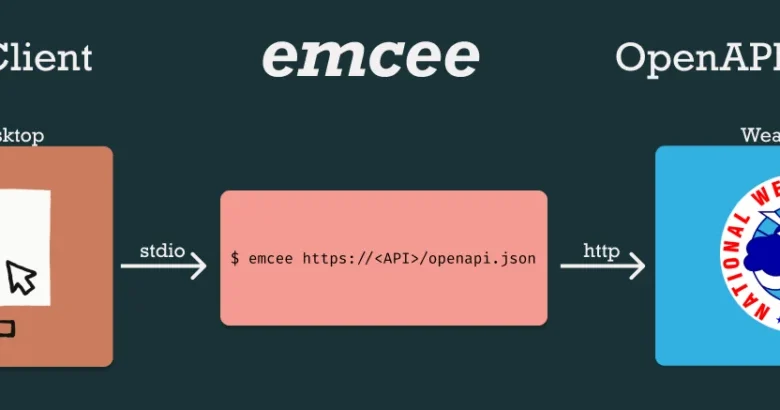
emcee: This tool is designed to automatically generate MCP servers from existing web applications that expose an OpenAPI specification. This is a significant development for organizations with established web services, allowing them to quickly integrate with the MCP ecosystem without requiring extensive custom development. The visual representation of
emceesuggests a user-friendly approach to service integration, reducing the need for manual configuration.
These projects collectively illustrate the dynamism of the MCP ecosystem and the commitment to making AI tool integration more accessible and efficient. The emphasis on diverse programming languages and existing web standards signals a strategic approach to broad adoption.
The Future of AI Integration
The Model Context Protocol represents a pivotal step in the ongoing quest to create more capable and integrated AI systems. By providing a standardized language for AI to interact with the external world, MCP is poised to unlock a new era of AI agency and utility. As the protocol matures and its ecosystem expands, we can anticipate a future where AI seamlessly collaborates with humans across a vast array of applications, driving innovation and solving complex challenges that were previously beyond our reach. The "punk rock" ethos attributed to MCP suggests a disruptive potential, a challenge to the status quo of fragmented AI tool integration, and an invitation to build a more interconnected and intelligent future.