React Native 0.79 Officially Released With Major Performance Boosts, Metro Enhancements, and Ecosystem Updates

The cross-platform mobile development ecosystem has reached another significant milestone with the official rollout of React Native 0.79. Developed and maintained by Meta alongside an active global community of open-source contributors, this latest stable release brings substantial speed enhancements, foundational cleanup, and modernization initiatives aimed at large-scale applications and monorepos alike. Representing the culmination of intense collaborative development that saw over 944 commits contributed by roughly 100 developers, version 0.79 focuses heavily on reducing startup latency, streamlining native module registration, and refining the framework’s API surface to align with modern JavaScript standards.
As older versions such as 0.76 transition out of active support under React Native’s formal lifecycle policy, version 0.79 steps in as the new standard-bearer for enterprise and indie developers. Ecosystem frameworks like Expo are already poised to incorporate the release as the foundation for their upcoming SDK 53 rollout. This comprehensive overview examines the core architectural shifts, performance metrics, breaking changes, and broader industry implications accompanying the React Native 0.79 release.
Chronology and Release Context
The trajectory leading to React Native 0.79 reflects a multi-year modernization effort by Meta and the open-source community to overhaul the framework’s core architecture. Following the monumental introduction of the New Architecture—featuring JSI, TurboModules, and Fabric—subsequent minor releases have focused on stabilizing these foundational blocks while optimizing developer experience and runtime execution speeds.
Planning for version 0.79 began shortly after the stabilization of version 0.78, with core contributors targeting persistent developer pain points: slow development server boot times in large monorepos, Android application startup latency caused by resource decompression, and deep architectural fragmentation in native module configuration on iOS. Throughout late 2024 and early 2025, release candidates were vetted within major production codebases, including heavy testing by optimization partners such as Margelo on high-profile applications like Discord. The stable version 0.79 release officially drops legacy debugging utilities while codifying modern ecosystem standards, continuing the framework’s steady march toward a leaner, faster core engine.
Core Performance Enhancements: Metro and Android
Performance optimization sits at the very heart of the 0.79 release, targeting two critical bottlenecks in the mobile development lifecycle: local bundling speed and mobile application launch times.
Metro Bundler Acceleration via Deferred Hashing
For developers working within large enterprise monorepos or complex multi-package codebases, starting the development server has historically been a time-consuming process. React Native 0.79 integrates Metro version 0.82, which fundamentally alters how file asset caching and dependency resolution are initialized.
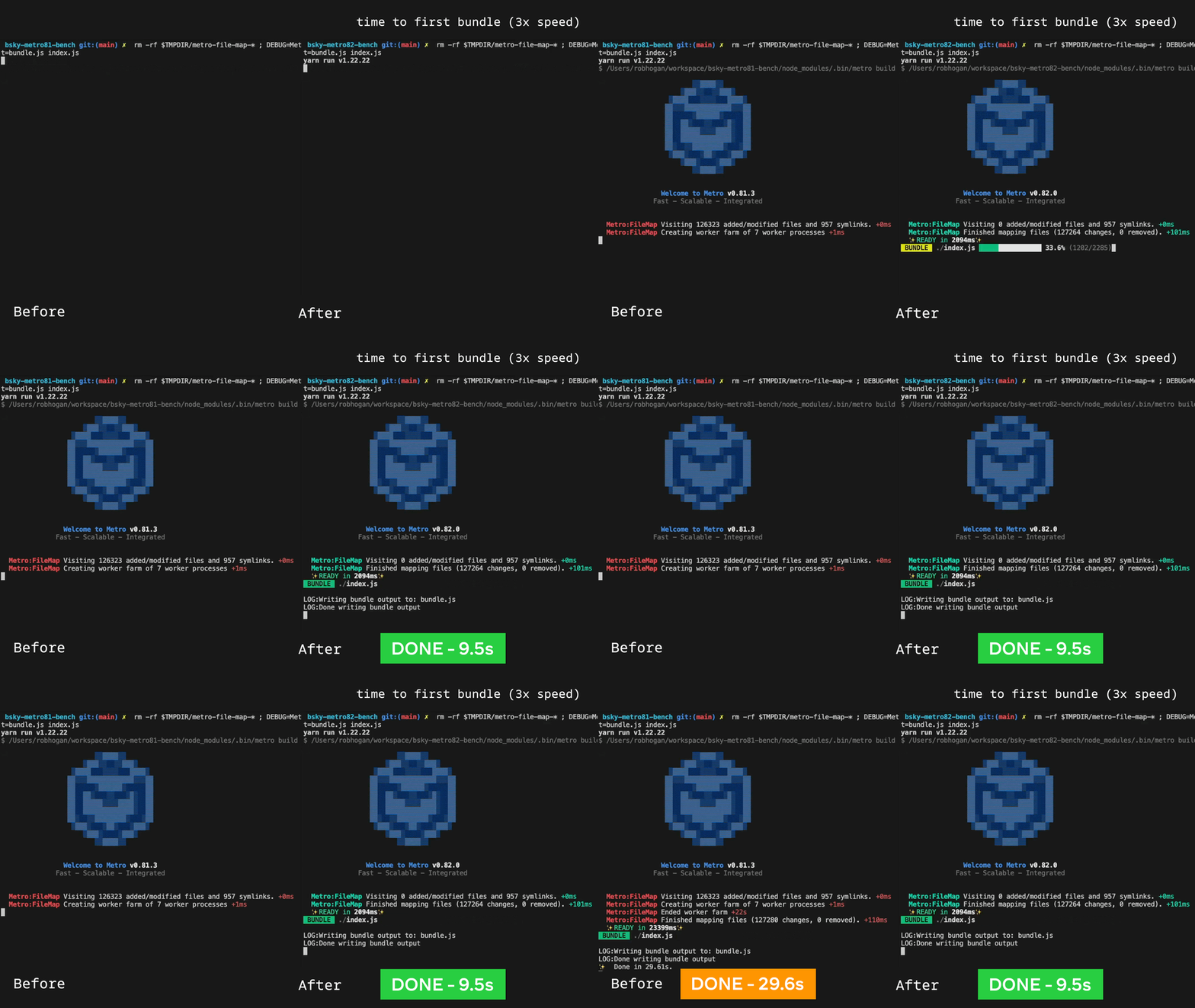
By implementing deferred hashing, Metro 0.82 drastically accelerates the initial execution of commands such as yarn start. Benchmarks provided by the core team indicate that first-time startup speeds can improve by over threefold, with even more dramatic reductions observed in expansive enterprise monorepos. This optimization directly enhances everyday developer productivity and accelerates continuous integration (CI) build pipelines where test suites frequently spin up and tear down development servers.
Furthermore, Metro 0.82 promotes package.json exports and imports field resolution from experimental status to fully stable. Initially introduced in React Native 0.72 for exports and later expanded via community contributions for imports, this resolution logic is now enabled by default. This change brings React Native closer to modern Node.js and npm dependency standards, enabling stricter encapsulation and more modular project organization. However, the core team has acknowledged that this transition may introduce breaking changes for certain legacy third-party dependencies—such as specific configurations of Firebase and AWS Amplify—prompting active collaboration with upstream library maintainers to resolve compatibility issues at the source.
Android Startup Optimization and Uncompressed Bundles
On the mobile execution front, Android applications built with React Native 0.79 benefit from a profound shift in how JavaScript bundles are packaged within the APK. In previous iterations, the Android operating system was forced to decompress the embedded JavaScript bundle at runtime during application launch, introducing a noticeable latency spike before the UI thread could become interactive.
Starting with version 0.79, React Native ships the JavaScript bundle uncompressed by default. Real-world validation conducted by the mobile engineering firm Margelo on the Discord application running on a Samsung A14 demonstrated a time-to-interactive (TTI) reduction of 400 milliseconds—representing an immediate 12% performance boost achieved through a single-line configuration change.
While this optimization significantly improves user experience by accelerating cold starts, it comes with a trade-off: an increase in the installed application size on user devices. Recognizing that storage constraints vary across global markets, the React Native team has exposed a flexible toggle within the app/build.gradle file. Developers can explicitly set enableBundleCompression = true to prioritize reduced storage consumption at the cost of startup speed, or retain the new uncompressed default (enableBundleCompression = false) for maximum performance. Crucially, because app distribution stores typically compress binaries during network transmission, end-user download sizes remain largely unaffected.
Architectural Refinements: iOS Native Modules and Lean Core
Beyond raw execution speed, version 0.79 continues the systematic modernization of React Native’s internal architecture, streamlining how native code bridges with the JavaScript runtime on both Apple and Android platforms.
Swift-Compatible Native Module Registration on iOS
A recurring friction point for iOS developers has been the rigid nature of native module registration, particularly when attempting to combine pure C++ Native Modules with modern Swift-based AppDelegate implementations. Version 0.77 introduced limitations that complicated these setups, prompting the core team to completely revamp module registration in 0.79.

The new approach unifies native module registration with the configuration patterns already established for React Native components via Codegen. Developers can now declare native modules directly within the package.json file by introducing a modulesProvider field under the ios configuration block:
"codegenConfig":
    "ios":
        "modulesProvider":
            "JS Name for the module": "ObjC Module provider for the pure C++ TM or a class conforming to RCTTurboModule"
During the build phase, Codegen automatically generates the necessary bridging boilerplate. For pure C++ Native Modules, developers implement a concise Objective-C++ adapter class conforming to the RCTModuleProvider protocol. This abstraction completely eliminates the need to manually modify the application’s AppDelegate, ensuring seamless compatibility whether the host application initializes via Swift or Objective-C. This unification provides library maintainers and application developers with a uniform interface, ensuring long-term maintainability on Apple’s ecosystem.
The Lean Core Transition: JavaScriptCore (JSC)
In alignment with React Native’s broader "Lean Core" initiative—designed to reduce the framework’s core repository size and decouple auxiliary runtimes—the JavaScriptCore (JSC) engine is actively being transitioned into a community-maintained package: @react-native-community/javascriptcore.
Applications utilizing the modern Hermes engine remain entirely unaffected by this transition. For projects still relying on JSC, React Native 0.79 continues to provide a fallback version within core, but developers are strongly encouraged to migrate to the standalone community package by following updated README documentation. Decoupling JSC from the primary React Native release cycle empowers the open-source community to ship frequent updates, security patches, and modern feature sets for JSC independently of major framework upgrades.
Breaking Changes and Modernization Initiatives
Every major React Native release involves deprecating legacy utilities to reduce long-term maintenance overhead. Version 0.79 implements several notable breaking changes that developers must address during migration.
Removal of Remote JS Debugging
The legacy Remote JavaScript Debugging method via Google Chrome has been officially removed in version 0.79. Deprecated and converted to a runtime opt-in feature in React Native 0.73, this outdated debugging mechanism relied on executing bundle code within a remote browser context, introducing synchronization bugs and performance degradation.
The framework now exclusively champions modern, high-performance tooling built around React Native DevTools and modern debugging protocols. Consequently, version 0.79 breaks compatibility with legacy community extensions such as the standalone react-native-debugger project. Developers requiring integrated ecosystem tooling like Redux DevTools are encouraged to transition to Expo DevTools Plugins or standalone monitoring applications.
Internal Module Exports and API Modernization
As part of an ongoing initiative to align the internal JavaScript codebase with modern ECMAScript standards, approximately 46 internal implementation modules within the react-native package have been updated to utilize standard export syntax instead of legacy module.exports.
While projects written in TypeScript utilizing standard import syntax will experience minimal disruption, codebases relying on deep require() statements or direct path imports may encounter type errors or undefined exports. The core team strongly advises all developers to strictly use root-level imports from the primary 'react-native' package:
// Recommended approach
import  ImageBackground, BlobRegistry  from 'react-native';
Deep imports and legacy CommonJS access patterns are scheduled for formal deprecation in the immediate successor release, making this cleanup an essential milestone for future-proofing codebases.
Ecosystem Impact and Upgrading
Industry analysts and engineering leads view React Native 0.79 as a robust consolidation release. By addressing critical operational pain points—such as Metro initialization overhead and Android startup latency—Meta has demonstrated a continued commitment to enterprise-grade scalability.
Upgrading existing applications to version 0.79 can be efficiently managed using the official React Native Upgrade Helper, which maps file-by-file diffs across framework versions. For teams building greenfield projects, initialization is executed via the updated command-line interface:
npx @react-native-community/cli@latest init MyProject --version latestWith comprehensive documentation, active community support, and impending integration into foundational toolkits like Expo SDK 53, React Native 0.79 provides a stable, high-performance foundation for mobile engineering teams worldwide.
Related posts: