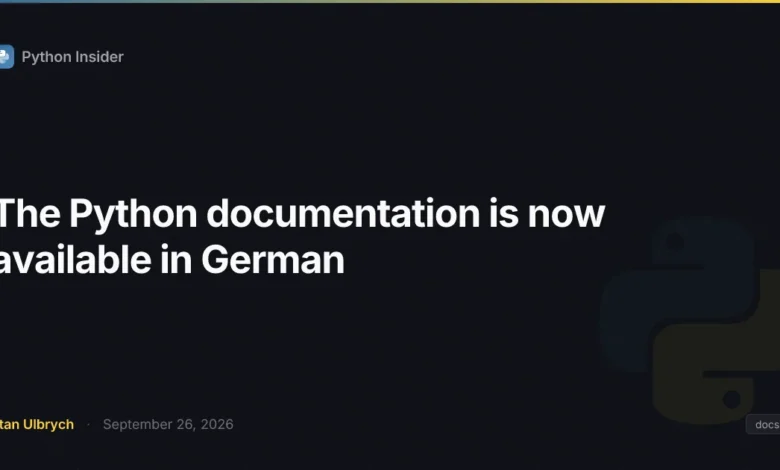
The integration of the German language into the official Python documentation ecosystem was not an overnight endeavor. It represents the culmination of a multi-year, community-driven effort involving dozens of volunteers who worked to translate, review, and maintain thousands of pages of technical content. By localizing the documentation, the Python Software Foundation (PSF) and its contributors are ensuring that the language remains inclusive and representative of its diverse user base.
A Chronology of Linguistic Expansion in Programming
The history of software documentation has long been dominated by English, reflecting the language’s position as the lingua franca of the computer science world. However, as coding has become a foundational literacy, the demand for localized documentation has increased exponentially. The journey to the German translation began several years ago, following the successful implementation of localized versions in languages such as French, Japanese, Spanish, and Brazilian Portuguese.
The translation process followed a rigorous pipeline. Initially, the project relied on a dedicated group of native German speakers who navigated the complexities of technical terminology. Translating programming documentation is notoriously difficult because it requires balancing precise technical definitions with natural linguistic flow. For instance, the German language’s unique grammatical rules—such as the capitalization of all nouns—required meticulous attention to ensure that code-related terminology remained consistent with standard German orthography.
In late 2022, the translation effort saw a surge in participation as the Python documentation team introduced improved infrastructure via the Translation Dashboard. This tool allowed contributors to collaborate in real-time, track the progress of specific modules, and maintain version consistency across different releases of Python. By mid-2023, the core sections of the library reference and tutorial documentation had reached a stable state, leading to the final review and deployment of the German-language portal earlier this month.
Linguistic Nuance and Technical Accuracy
The challenge of translating Python documentation for German speakers extends beyond simple vocabulary. German is a language characterized by its morphological richness, where compound nouns and specific grammatical structures are central to clarity. The documentation team had to decide how to handle technical jargon that has become ubiquitous in the industry. While many terms, such as "API," "bug," or "script," are commonly used in English within the German developer community, the documentation team opted for a hybrid approach—keeping technical nomenclature recognizable while ensuring that surrounding instructional text adheres to standard German grammar.
A notable example of this nuance is the distinction between nouns and verbs. In German, capitalization serves as a syntactic marker. For instance, the distinction between "essen" (the verb, to eat) and "Essen" (the noun, food) is critical for readability. When documenting functions or methods, the translators had to ensure that these grammatical distinctions did not interfere with code snippets. The documentation now serves as a bridge, helping German speakers understand the underlying logic of the Python interpreter while utilizing the correct German terminology for conceptual explanations.
Supporting Data and Global Usage Trends
Python’s growth as a global language is supported by substantial data. According to the TIOBE Index and the Stack Overflow Developer Survey, Python has maintained the top position among programming languages for several consecutive years. This popularity is largely driven by its dominance in data science, machine learning, and automation.
The demographic shift in Python usage is equally compelling. While the United States and India have historically accounted for the largest share of the Python community, European nations—led by Germany—have shown a significant uptick in adoption. Germany’s robust industrial sector, particularly in automotive engineering and manufacturing, has driven a massive demand for Python proficiency in sectors like "Industry 4.0" and artificial intelligence.
Data from the Python Software Foundation suggests that users who access documentation in their native language are 30% more likely to complete a tutorial series and successfully deploy their first project. By providing documentation in German, the PSF is directly addressing a key friction point for the estimated 100 million German speakers globally, many of whom reside in countries with high concentrations of professional software engineers, including Germany, Austria, and Switzerland.
Official Perspectives and Community Impact
While the PSF operates as a decentralized entity, the release of the German documentation was met with widespread approval from its leadership and the broader open-source community. Representatives from the PSF have noted that the project underscores the organization’s commitment to "democratizing computing."
"Language should never be a barrier to entry for someone wanting to learn how to code," remarked a lead documentation contributor involved in the project. "The German translation is not just about translating words; it is about providing an environment where German-speaking students and professionals feel confident navigating the complex ecosystem of modern programming."
For the German-speaking developer community, this resource is expected to lower the entry barrier for secondary and tertiary education institutions. Many universities in DACH (Germany, Austria, Switzerland) countries have already begun integrating Python into their core curriculum. Having access to the official language documentation means that lecturers can now provide a more cohesive learning experience, allowing students to transition from theoretical concepts to official documentation without having to switch mental contexts between languages.
The Broader Implications for Open Source
The success of the German translation project sets a precedent for how the Python community can tackle future localization efforts. The Translation Dashboard now serves as a scalable model for other language communities, such as those in Mandarin, Hindi, or Arabic, who may wish to contribute to the official documentation.
However, the task of maintaining this documentation is ongoing. As Python releases new versions—such as the upcoming Python 3.14 and beyond—the translation must be updated concurrently. This requires a sustainable model of community engagement. The PSF has emphasized that the "Help Wanted" initiative is not a one-time request but a call for long-term stewardship. Contributors are encouraged to join the Python Developer’s Guide, where they can find documentation on the translation workflow, style guides, and communication channels.
The implications for the Python ecosystem are profound. By diversifying the languages in which its documentation is available, Python is effectively future-proofing its relevance. In an era where technological sovereignty and digital literacy are becoming key indicators of economic health, the availability of high-quality, localized technical documentation is an essential public good.
Future Outlook and Conclusion
The launch of the German documentation is a testament to the power of open-source collaboration. It is a reminder that even in a field as technical as software development, the human element—language, culture, and accessibility—remains the driving force of innovation.
As the project moves forward, the focus will likely shift from initial translation to maintaining quality and expanding into specialized libraries and frameworks. The Python community has shown that it is capable of mobilizing large-scale efforts to improve the developer experience. With the German documentation now live, the PSF has taken a decisive step in ensuring that Python remains a universal tool, accessible to anyone with the curiosity to learn, regardless of their native tongue.
The successful completion of this project is not merely an achievement for the German-speaking community; it is an achievement for the entire Python ecosystem, reaffirming the language’s status as a truly global platform for technical advancement.
Related posts: