AWS CloudFormation Enhances Pre-Deployment Validation Across All Stack Operations


Amazon Web Services (AWS) has significantly advanced its infrastructure-as-code (IaC) capabilities by extending pre-deployment validation to automatically run on every CreateStack and UpdateStack operation within AWS CloudFormation. This crucial update, announced today, ensures that developers and automated systems receive immediate feedback on potential template errors, dramatically accelerating development velocity and bolstering deployment reliability across the cloud ecosystem. The enhancement builds upon previous iterations of pre-deployment validation, which were initially introduced for change set creation, and now covers all primary deployment paths without requiring any additional configuration.
This expansion is complemented by the introduction of three new validation checks: Service Quotas limit exceeded, AWS Config Recorder conflicts, and ECR repository delete readiness. To provide granular control, AWS has also rolled out a new DisableValidation parameter, allowing for operation-level override when necessary. Furthermore, the AWS Cloud Development Kit (CDK) now integrates these capabilities through the cdk validate command, offering a unified validation experience with valuable construct-level source tracing for CDK developers.
The Foundation of Modern Infrastructure: AWS CloudFormation and IaC
AWS CloudFormation stands as a cornerstone for managing cloud infrastructure. It enables users to define, provision, and manage AWS resources using JSON or YAML templates, treating infrastructure as code. This paradigm offers immense benefits, including consistency, repeatability, version control, and auditability for complex cloud environments. Tools like the AWS Cloud Development Kit (CDK) further abstract this process, allowing developers to define infrastructure using familiar programming languages. However, the power of IaC comes with its own set of challenges. Errors in templates, whether syntactic or logical, can lead to failed deployments, lengthy rollback processes, and significant wasted developer time, often occurring minutes or even hours into a deployment cycle.
The concept of "shift-left" validation has gained prominence in DevOps practices, advocating for the detection of issues as early as possible in the development lifecycle. For infrastructure deployments, this means catching template errors before any resources are provisioned. Traditional CloudFormation deployments, prior to these advancements, would only uncover many errors during the resource provisioning phase. This often resulted in partial deployments, resource state inconsistencies, and the necessity for time-consuming rollbacks, hindering rapid iteration and increasing operational overhead. Industry analysts consistently highlight that early error detection can reduce the cost of fixing defects by orders of magnitude compared to finding them in production.
A Chronology of Validation Evolution
The journey towards robust pre-deployment validation in CloudFormation has been progressive, reflecting AWS’s commitment to enhancing developer experience and operational efficiency. Initially, developers relied on manual template checks, static analysis tools, or the arduous process of deploying and rolling back to identify issues. This often meant waiting for the CloudFormation engine to attempt resource creation or modification, only to fail minutes later with a cryptic error message.
A significant leap forward occurred with the introduction of pre-deployment validation during change set creation. This initial phase allowed CloudFormation to catch common issues such as property syntax errors, resource name conflicts (where a template specified a resource name that already existed in the account), and S3 bucket emptiness constraints before the change set was executed. This marked a crucial step in shifting validation left, providing a preview of potential deployment failures and allowing developers to rectify them proactively. Developers widely adopted this feature, reporting reduced debugging cycles and improved confidence in their deployments.
Today’s announcement represents the most comprehensive expansion of this validation strategy. By embedding these checks directly into CreateStack and UpdateStack operations, AWS ensures that every deployment path—whether direct stack creation, updates, or those orchestrated through CI/CD pipelines and AI agents—benefits from immediate, no-configuration-required pre-execution checks. This eliminates the need for developers to manually create a change set solely for validation purposes, streamlining workflows further.
Deep Dive into Expanded Validation Capabilities
The updated CloudFormation pre-deployment validation suite introduces several powerful features designed to catch a broader range of potential issues:
-
Automatic Validation on All Stack Operations: The most impactful change is the automatic execution of validation checks during
CreateStackandUpdateStackoperations. This means that as soon as a deployment is initiated, CloudFormation performs a series of checks on the template. If critical errors are detected, the operation is halted before any AWS resources are provisioned, preventing unnecessary resource creation, partial deployments, and subsequent rollback costs. This "fail-fast" mechanism is critical for maintaining infrastructure integrity and accelerating feedback loops. -
New Validation Checks for Enhanced Proactivity:
- Service Quotas Limit Exceeded: This new warning-mode validation proactively identifies if a proposed resource creation or update would cause an AWS service quota to be exceeded. For instance, attempting to create a sixth VPC when the account limit is five would trigger a warning. This is invaluable for capacity planning and preventing unexpected service disruptions due to hard limits. Developers can review the warning, request a quota increase if necessary, and then proceed with confidence, rather than encountering a hard failure during provisioning.
- AWS Config Recorder Conflicts: AWS Config recorders are essential for monitoring resource configurations and ensuring compliance. A conflict arises if a template attempts to create a Config recorder when one already exists or in a way that interferes with existing configurations. This validation helps maintain the integrity of governance and compliance frameworks.
- ECR Repository Delete Readiness: Deleting Amazon Elastic Container Registry (ECR) repositories can have significant implications, especially if they contain critical images. This check helps ensure that an ECR repository is in a safe state for deletion, preventing accidental data loss or disruption to containerized workflows.
-
Understanding Validation Modes: FAIL vs. WARN: CloudFormation pre-deployment validation operates in two distinct modes:
- FAIL Mode: When validation fails in this mode, the stack operation (CreateStack, UpdateStack) is immediately stopped. This is typically reserved for critical errors that would undoubtedly lead to a failed deployment or an inconsistent state, such as property syntax errors or resource name conflicts. The goal is to prevent the provisioning of any resources until the template is corrected.
- WARN Mode: In contrast, WARN mode allows the stack operation to proceed even if validation identifies a potential issue. This mode is used for scenarios where the issue might not be a hard blocker but warrants developer attention, such as exceeding a Service Quota. Developers can review the warning, assess the risk, and decide whether to proceed or take corrective action. This flexible approach ensures that critical operations are not unnecessarily blocked while still providing valuable pre-deployment insights.
-
The
DisableValidationParameter for Operation-Level Control: While pre-deployment validation is now enabled by default, there might be specific scenarios where disabling it is necessary. The newDisableValidationparameter provides this control at an operation level. This feature is particularly useful for:- Temporary Workarounds: In highly specific and rare cases, a valid template might trigger a false positive, or an urgent deployment might necessitate bypassing a non-critical warning.
- Debugging Complex Scenarios: For advanced users debugging intricate template interactions, temporarily disabling validation might help isolate issues.
It is crucial to note that disabling validation means sacrificing early error detection. AWS strongly advises using this parameter judiciously and only when the trade-off between deployment speed and early error detection is fully understood. Relying on this as a default practice would negate the benefits of shift-left validation.
Enhanced Developer Experience with cdk validate
For developers leveraging the AWS Cloud Development Kit (CDK), the cdk validate command introduces a unified validation experience that seamlessly integrates these new server-side CloudFormation checks. The CDK allows developers to define cloud infrastructure using familiar programming languages like TypeScript, Python, Java, and C#, abstracting away the underlying JSON/YAML of CloudFormation.
The cdk validate command works by synthesizing the CDK application into CloudFormation templates, creating a temporary change set to invoke the server-side pre-deployment validation, collecting the results via the DescribeEvents API, and then producing a comprehensive report. What makes cdk validate uniquely powerful is its "construct-level source tracing." Instead of simply showing a CloudFormation logical resource ID for an error, cdk validate maps the error back to the specific construct and even the exact line of code in the developer’s CDK application. This granular feedback significantly reduces debugging time, allowing developers to pinpoint and fix issues directly within their preferred programming environment without having to mentally translate CloudFormation errors back to their CDK code. This level of integration represents a major step forward for developer productivity and the overall CDK experience.
Impact on Automated Workflows and AI Agents
The enhancements to CloudFormation’s pre-deployment validation are particularly transformative for automated workflows and the burgeoning field of AI agents managing cloud infrastructure. CI/CD pipelines, which are the backbone of modern software delivery, can now integrate these fast feedback loops directly into their deployment stages. When an automated pipeline attempts a deployment, validation errors are returned in seconds, preventing the pipeline from proceeding to resource provisioning and costly rollbacks that can take minutes or even longer. This rapid feedback allows pipelines to fail fast, provide immediate alerts, and potentially even trigger automated remediation.
The benefits extend profoundly to AI agents and other intelligent automation tools. An AI agent tasked with provisioning or modifying infrastructure can now receive structured, machine-readable error messages within seconds if a template is malformed or violates a constraint. This enables the agent to parse the error, identify the problematic section of the template or CDK code, attempt a self-correction, and retry the deployment almost immediately. This capability transforms what used to be multi-minute debugging cycles (requiring human intervention to analyze logs and correct templates) into second-level iteration loops managed autonomously by AI. AWS has even released a CloudFormation agent skill as part of the AWS Agent Toolkit, specifically designed to empower AI agents with the ability to create stacks, validate templates, and iterate on errors using this pre-deployment validation feedback. This signals a future where infrastructure management becomes increasingly self-healing and efficient.
Practical Examples and User Experience
While the original blog post provided detailed CLI outputs, the practical impact for users is evident in several key scenarios:
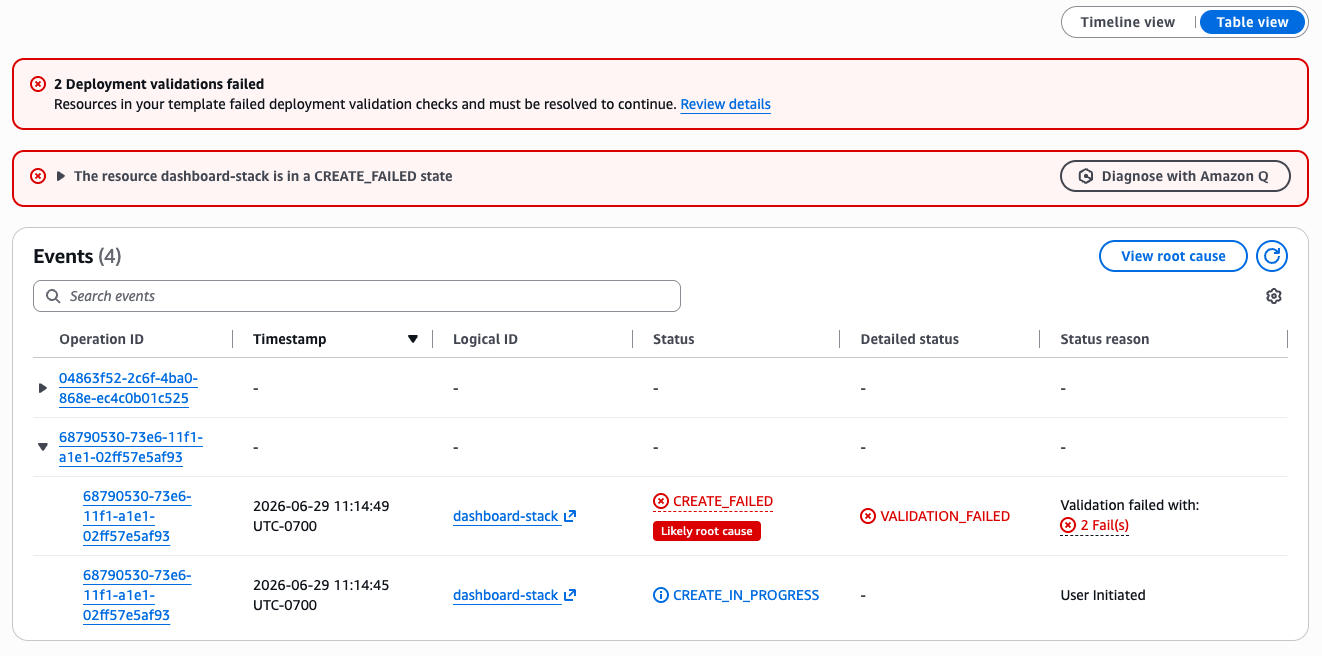
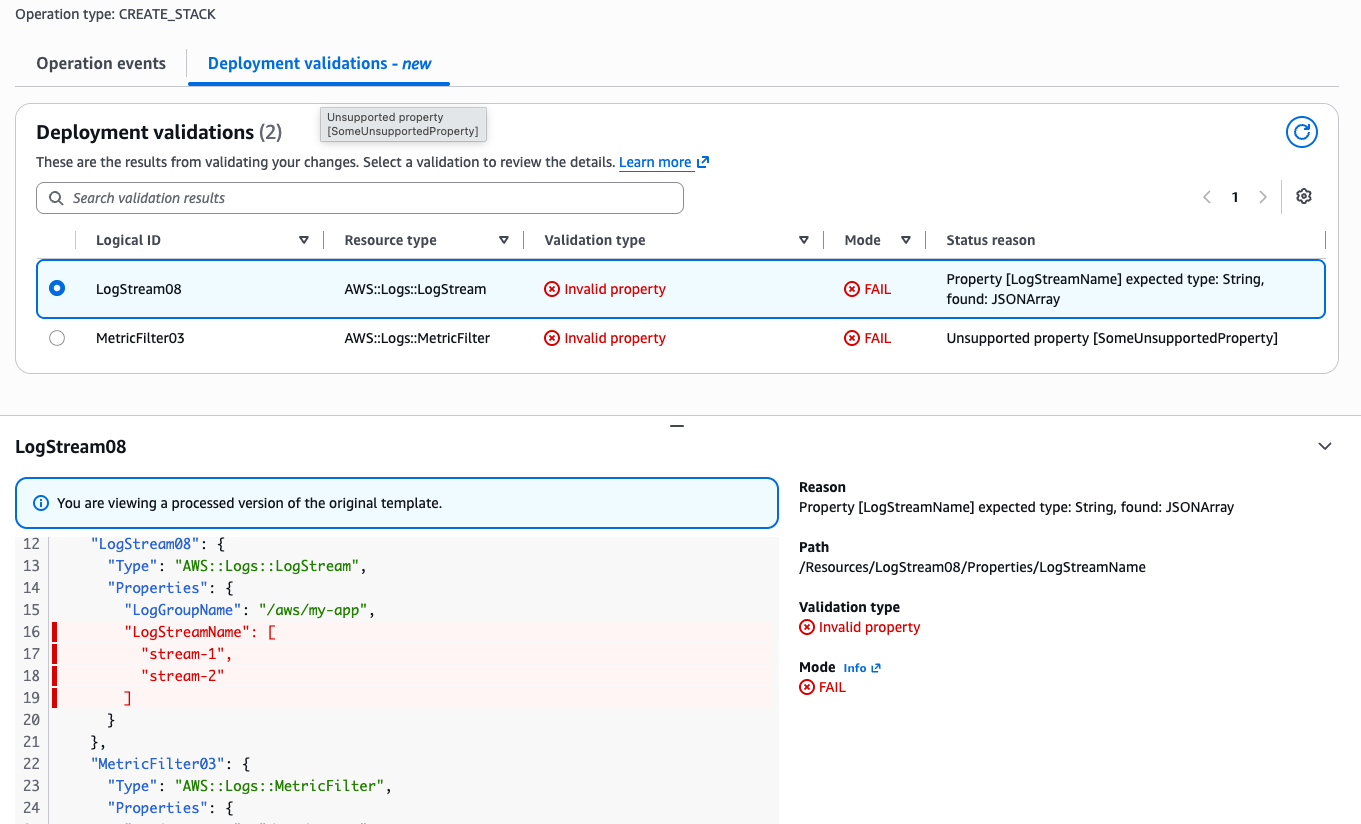
- Property Validation: A developer creating a new CloudWatch Dashboard might accidentally provide an array where a string is expected for a property, or include an unsupported property. Previously, this would likely cause a deployment failure after some resources were provisioned. Now, the
CreateStackoperation is immediately halted, and thedescribe-eventsAPI or the CloudFormation console’s "Deployment validations" tab clearly indicates the logical resource ID, resource type, and the precise reason for the property validation failure. This prevents any resources from being provisioned incorrectly. - Resource Name Conflict: During an
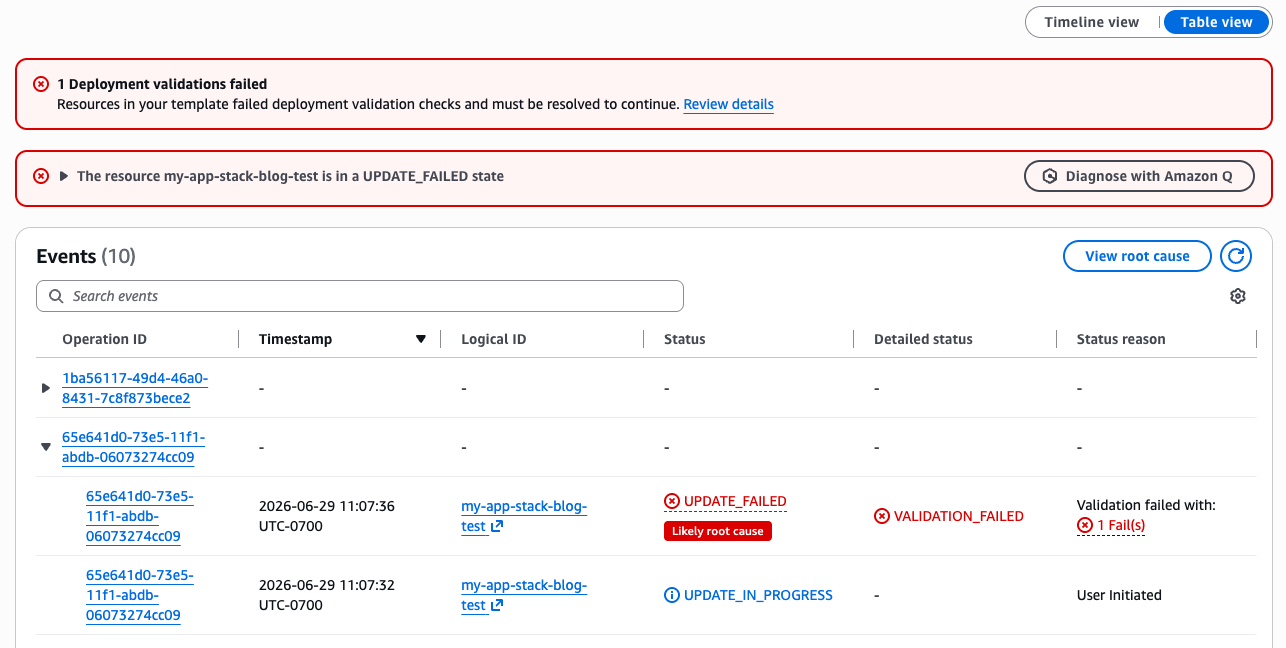
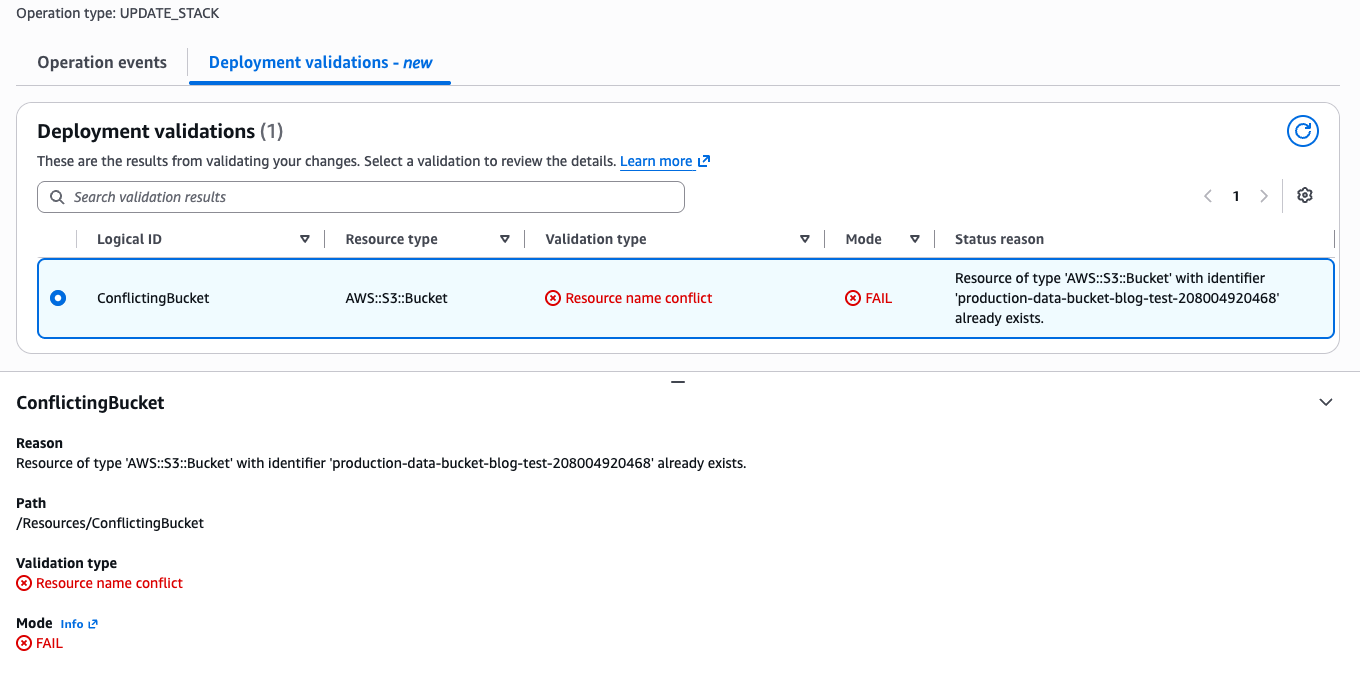
UpdateStackoperation, a developer might unknowingly add an S3 bucket with a name that already exists globally in their account. This would traditionally lead to a deployment failure. With the enhanced validation, theUpdateStackis stopped before any modifications occur, clearly flagging the name conflict and preventing the update from proceeding until the conflict is resolved by renaming the resource or removing the existing conflicting resource. - Service Quota Warning: When adding multiple VPCs to an existing stack, a developer might exceed the default VPC quota for their account. The
CreateChangeSetoperation would now generate a warning. The change set is still created, but the warning alerts the developer to a potential issue that could cause the execution to fail later, allowing them to proactively request a quota increase before executing the change.
In the CloudFormation console, users can navigate to the stack’s Events tab or the dedicated Deployment validations tab within the Operation view to review all validation results, including detailed status reasons and paths to the problematic resources. This centralized view greatly simplifies troubleshooting.
Getting Started and IAM Permissions
The beauty of this update is its seamless integration: pre-deployment validation runs automatically on all CreateStack, UpdateStack, and CreateChangeSet operations without any configuration required. To immediately benefit, users simply need to continue their existing CloudFormation workflows.
For the new validation checks introduced during change set creation (Service Quota, AWS Config Recorder, ECR Repository Delete Readiness), specific IAM permissions are required for the IAM role performing the stack operation. If these permissions are not granted, the corresponding validation checks will be gracefully skipped without blocking the overall operation, ensuring backward compatibility and operational flexibility.
- Service Quota Check: Requires
servicequotas:GetServiceQuotaandec2:DescribeVpcs(or relevantDescribepermissions for other resources). - Config Recorder Check: Requires
config:DescribeConfigurationRecorders. - ECR Repository Delete Readiness Check: Requires
ecr:DescribeRepositoriesandecr:ListImages. - S3 Bucket Empty Check: Requires
s3:ListBucket.
For CDK users, running cdk validate before deployment will leverage these advanced server-side checks, providing a comprehensive pre-deployment report.
Best Practices for Leveraging Advanced Validation
To maximize the benefits of these enhanced validation capabilities, AWS recommends several best practices:
- Integrate Validation Early: Make pre-deployment validation an integral part of your development workflow, running it as early as possible.
- Review Validation Outputs: Regularly examine validation results in the CLI or CloudFormation console to understand common issues and improve template quality.
- Educate Teams: Ensure all team members are aware of the new validation types and how to interpret their outputs.
- Leverage
cdk validate: For CDK projects, makecdk validatea mandatory step in your local development and CI/CD pipelines. - Automate Feedback: Configure CI/CD pipelines to automatically fail or warn based on validation results, providing instant feedback to developers.
- Use
DisableValidationJudiciously: Reserve theDisableValidationparameter for rare, specific scenarios where its use is thoroughly justified and understood.
Broader Implications and Industry Context
This significant enhancement to AWS CloudFormation’s pre-deployment validation strategy underscores a broader industry trend towards "shift-left" development and proactive risk mitigation in cloud operations. By catching errors in seconds rather than minutes, AWS is not only improving developer productivity but also contributing to higher operational excellence and reliability for cloud infrastructure.
The implications are far-reaching:
- Cost Savings: Avoiding failed deployments means saving on compute resources consumed during partial provisioning and subsequent rollbacks. More importantly, it saves countless developer hours that would otherwise be spent debugging, analyzing logs, and rectifying issues post-failure.
- Accelerated Innovation: Faster feedback loops empower developers to iterate more quickly on infrastructure changes, reducing the friction associated with deploying new features or services. This speed directly translates into accelerated innovation for businesses.
- Enhanced Security and Compliance: Proactively checking for issues like Config Recorder conflicts or ensuring ECR delete readiness contributes to a more secure and compliant cloud environment.
- Empowering AI: The structured and immediate feedback provided by these validations is a critical enabler for the next generation of AI-driven infrastructure management, paving the way for truly autonomous and self-healing cloud systems.
Conclusion
The automatic execution of pre-deployment validation on all CreateStack and UpdateStack operations represents a pivotal advancement in AWS CloudFormation’s commitment to a shift-left validation strategy. By proactively identifying common deployment errors in seconds, before any resources are provisioned, this capability dramatically reduces rollback cycles, accelerates development workflows, and enhances the overall reliability of cloud infrastructure.
Coupled with the cdk validate command’s unified experience and construct-level tracing, and the flexible DisableValidation parameter, developers now wield a comprehensive toolkit for managing the delicate balance between validation coverage and deployment speed. For AI agents and automated pipelines, the provision of structured, machine-readable feedback unlocks the potential for immediate self-correction, transforming what were once laborious debugging processes into near-instantaneous iteration loops. This update solidifies CloudFormation’s role as an intelligent and robust platform for managing infrastructure as code, ensuring that AWS users can build, deploy, and manage their cloud environments with unprecedented speed and confidence.
Pre-deployment validation is now universally available in all AWS Regions where CloudFormation is supported, requiring no configuration or opt-in. For further details, users are encouraged to consult the official "Validate stack deployments" section of the AWS CloudFormation User Guide.
Related posts: