Automated Incident Remediation: Closing the Loop from Detection to Deployment with AWS DevOps Agent and Kiro CLI

The landscape of modern cloud operations is undergoing a profound transformation, driven by the increasing complexity of distributed workloads and the imperative for rapid, efficient incident response. For organizations leveraging Amazon Web Services (AWS), the challenge of mitigating operational disruptions has traditionally involved significant manual effort, often stretching incident resolution times into hours, particularly for critical issues occurring outside standard business hours. However, a new paradigm is emerging: automated incident remediation, which promises to convert investigation findings into deployed fixes without the laborious manual intervention that has long plagued operations teams. This advancement represents a significant leap forward, moving beyond mere incident detection and root cause analysis to encompass the entire remediation lifecycle, culminating in a deployed solution with minimal human touchpoints.
The Evolving Challenge of Incident Response in Distributed Systems
In today’s highly distributed and dynamic AWS environments, an incident firing at 2 AM typically triggers a cascade of manual tasks for the on-call engineer. This process often begins with correlating telemetry data scattered across disparate sources such as Amazon CloudWatch metrics, deployment pipelines, and application logs. Once the root cause is identified, the engineer must then manually craft, test, and deploy a fix—a sequence that routinely consumes hours, impacting service availability and operational costs. The human element, while indispensable for complex problem-solving, introduces variability, potential for error, and significant stress, contributing to what is commonly known as "operational toil."
Industry data underscores the severity of this issue. According to various studies, the average Mean Time To Recovery (MTTR) for critical incidents can range from several hours to even days, depending on the complexity of the system and the maturity of the operations team. A report by Gartner indicated that the average cost of IT downtime can be as high as $5,600 per minute, translating to over $300,000 per hour for many enterprises. Beyond the financial impact, prolonged outages erode customer trust, damage brand reputation, and can lead to regulatory scrutiny. Consequently, reducing MTTR and enhancing the efficiency of incident resolution has become a top priority for IT leadership.
The Rise of Agentic AI in Operational Intelligence
The advent of Agentic AI has begun to revolutionize how enterprises approach operational intelligence and incident management. Agentic AI refers to intelligent systems designed to perform tasks autonomously, often involving complex decision-making, learning from environments, and interacting with other systems. In the context of IT operations, these agents can analyze vast quantities of data, identify patterns, diagnose issues, and even propose solutions with unprecedented speed and accuracy.
AWS has been at the forefront of this innovation with the introduction of the AWS DevOps Agent. This specialized agent is designed to autonomously investigate incidents, pinpoint root causes, and generate comprehensive mitigation plans within minutes. During its preview phase, early adopters and partners reported remarkable improvements, including up to a 75% reduction in MTTR, an 80% acceleration in investigation times, and an impressive 94% accuracy in root cause identification. These metrics highlight the profound impact Agentic AI can have on the initial phases of incident response, significantly alleviating the burden on human operators.
Bridging the Gap: From Mitigation Plan to Deployed Fix
Despite the significant advancements offered by AWS DevOps Agent in autonomous investigation and mitigation planning, a critical gap remained. While the agent could deliver detailed recommendations, the actual implementation—the writing, testing, and deployment of the fix—still necessitated manual intervention. This "second half" of the incident response story often remained a bottleneck, requiring human engineers to translate the agent’s findings into actionable code changes and then shepherd those changes through the deployment pipeline. The question then became: could this final, crucial stage also be automated?
Previous efforts had laid the groundwork for integrating AWS DevOps Agent into a more automated workflow. A prior blog post, "Leverage Agentic AI for Autonomous Incident Response with AWS DevOps Agent," detailed how to configure the agent for application monitoring, autonomous investigation triggering, and adherence to production deployment best practices. Complementing this, an AWS sample code repository demonstrated how investigations could be automatically initiated upon the triggering of an Amazon CloudWatch alarm, seamlessly producing a mitigation plan. These foundational steps established the ability to detect issues and generate solutions autonomously.
Kiro CLI: The Catalyst for Automated Remediation
The missing piece in achieving a truly closed-loop system for incident remediation has now been addressed through integration with Kiro CLI. Kiro CLI (Command Line Interface) is a powerful tool designed to apply fixes directly to a codebase, creating pull requests for human review and orchestrating subsequent deployments upon approval. By integrating AWS DevOps Agent’s mitigation plan output with Kiro CLI, running in headless mode on AWS CodeBuild, the entire remediation loop can be closed end-to-end.
This integration marks a pivotal moment in cloud operations. When AWS DevOps Agent successfully completes a mitigation analysis, an event-driven pipeline automatically routes the detailed findings to Kiro CLI. Operating within a robust CI/CD environment, Kiro CLI then takes the reins, applying the necessary fixes to the codebase, generating a pull request for human oversight, and initiating deployment once the changes are approved. The net effect is a dramatic reduction in the time and effort required for L1/L2 incidents, transforming the process from detection to deployed fix into a streamlined, largely automated sequence where the only mandatory human intervention is the final pull request approval.
A Detailed Look at the Solution Architecture and Workflow
To illustrate this groundbreaking integration, a comprehensive solution has been developed using a sample CloudFormation application. This includes the requisite infrastructure code, scripts for anomaly generation to simulate incidents, event routing mechanisms, and the crucial Kiro CLI steering configuration that orchestrates the entire process. All source code for this implementation is publicly available in the accompanying aws-samples repository.
Consider a typical web application architecture on AWS: a frontend served behind an Application Load Balancer, backend compute instances running on Amazon EC2, and a relational database managed by Amazon RDS. The application’s source code and CloudFormation templates are version-controlled in AWS CodeCommit. When an operational anomaly or incident occurs within this environment, the integrated solution chains together two frontier AWS agents: AWS DevOps Agent for autonomous investigation and mitigation, and Kiro CLI for automated code remediation. This entire process is facilitated by a fully serverless, event-driven bridge designed to transition the application from an incident state to a fully restored and fixed state.
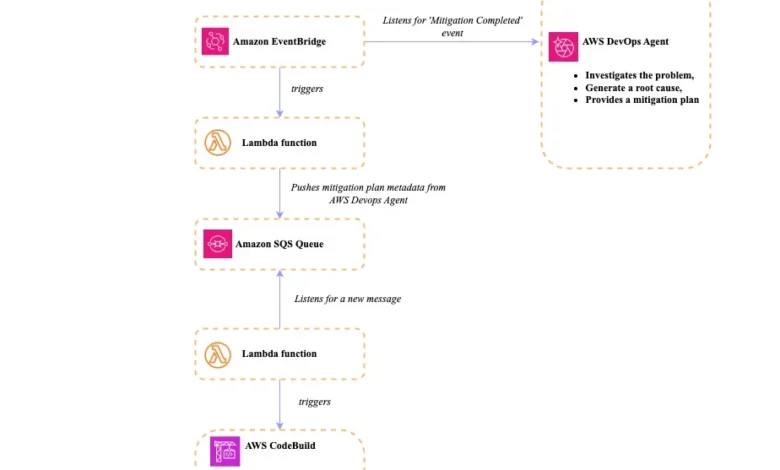
The solution architecture can be visualized as a sophisticated orchestration of several AWS services:
- Incident Detection: An anomaly or critical event triggers an Amazon CloudWatch alarm. This alarm serves as the initial signal for the automated response system.
- Autonomous Investigation: The CloudWatch alarm automatically triggers an investigation by the AWS DevOps Agent. The agent autonomously collects and correlates telemetry data, identifies the root cause, and formulates a detailed mitigation plan.
- Mitigation Event Capture: Upon successful completion of a mitigation analysis, AWS DevOps Agent publishes a lifecycle event to the Amazon EventBridge default event bus. This event uses the source
aws.aidevopsand a specific detail-type, such asMitigation Completed. - Event Routing and Data Extraction: An Amazon EventBridge rule, specifically configured to match the
Mitigation Completeddetail-type, invokes a dedicated AWS Lambda function. This Lambda function extracts crucial metadata (e.g.,agent_space_id,task_id,execution_id) from the event payload. It then uses this metadata to interact with the AWS DevOps Agent API, retrieving two key objects: the mitigation summary (outlining the proposed action and its rationale) and the execution plan (providing step-by-step instructions for the fix). This structured payload is then published to an Amazon SQS queue for subsequent processing. - Headless Remediation with Kiro CLI: The arrival of a mitigation payload in the Amazon SQS queue triggers another AWS Lambda function. This Lambda function initiates an AWS CodeBuild execution, passing the SQS message body as an environment variable to the build environment. AWS CodeBuild is an ideal environment for this task, offering on-demand compute, native integration with AWS CodeCommit, and requiring no persistent infrastructure.
- CodeBuild Orchestration: The AWS CodeBuild buildspec follows a precise sequence of operations:
- Checkout Repository: It checks out the application and infrastructure repository from AWS CodeCommit.
- Install Kiro CLI: It installs the Kiro CLI tool within the build environment.
- Authenticate Kiro CLI: It authenticates Kiro CLI using an API key securely stored in AWS Secrets Manager. Kiro CLI 2.0’s headless mode is critical here, enabling programmatic execution within CI/CD pipelines without requiring an interactive terminal.
- Execute Kiro CLI: It executes Kiro CLI, passing the mitigation summary and execution plan as a prompt. Kiro CLI, guided by its steering file, applies the prescribed changes to the codebase.
- Commit and Push: It commits the changes to a new feature branch within AWS CodeCommit.
- Create Pull Request: It then creates a pull request for these changes, ready for human review.
- The Steering File: Guardrails for Automated Remediation: Central to Kiro CLI’s effectiveness is its
steering file. This file, committed directly to the repository, provides Kiro with persistent, project-specific knowledge. It defines critical parameters such as repository structure, established coding conventions, and decision frameworks. For this solution, the steering file acts as the guardrail for automated remediation, ensuring Kiro CLI makes targeted, predictable changes rather than broad, potentially disruptive refactors. It specifies which files Kiro is allowed to modify, the preferred style guides, and any architectural constraints. This ensures that the automated fixes align with the organization’s existing development practices and standards. - Human-in-the-Loop: Pull Request Review: At this juncture, the automated pipeline has completed its work. Kiro CLI has analyzed the mitigation plan, modified the appropriate files, and created a pull request on a feature branch. The pull request description is meticulously crafted, detailing what was changed, the rationale (directly sourced from AWS DevOps Agent’s reasoning), and the agent space and execution IDs for complete traceability back to the original incident. This is the deliberate human-in-the-loop gate. A developer reviews the pull request, verifying that the proposed change is correct, appropriately scoped, and safe for deployment. This approval step is paramount; while the agents are trusted to investigate, analyze, and propose fixes, the ultimate deployment decision rests with a human expert.
- Deployment: Once the pull request is approved and merged into the main branch, the organization’s established deployment pipelines automatically implement the approved changes in the target environment. This final step completes the full cycle, from incident detection to a deployed, verified fix.
Broader Implications for DevOps and Cloud Operations
The entire cycle, from a CloudWatch alarm to a fully deployed fix, can now be completed in minutes rather than hours, with the only manual step being the critical pull request review. For organizations grappling with high volumes of L1/L2 incidents, this translates directly into significant reductions in operational toil, faster recovery times, and ultimately, improved service reliability and customer satisfaction.
This paradigm shift has several profound implications for DevOps and cloud operations:
- Enhanced Operational Efficiency: By automating repetitive and time-consuming tasks, engineering teams are freed from reactive incident response, allowing them to focus on innovation, feature development, and strategic projects.
- Reduced MTTR and Downtime: The drastic reduction in MTTR directly translates to less service downtime, mitigating financial losses and reputational damage associated with outages.
- Improved Consistency and Accuracy: Automated remediation minimizes human error, ensuring fixes are applied consistently and accurately according to predefined guidelines and agent intelligence.
- Scalability of Operations: As cloud environments grow in complexity and scale, manual incident response becomes increasingly unsustainable. This automated approach provides a scalable model for managing incidents without proportionally increasing operational staff.
- Proactive Resilience: The system encourages a shift from reactive firefighting to a more proactive stance, where incidents are not just resolved quickly but also analyzed to prevent future occurrences, feeding into a continuous improvement loop.
- Standardization and Best Practices: The use of steering files in Kiro CLI enforces coding standards and architectural best practices, ensuring that automated fixes adhere to organizational guidelines.
Measurable Impact and Future Outlook
The integration of AWS DevOps Agent and Kiro CLI delivers tangible benefits for enterprise operations:
- Significant reduction in Mean Time To Recovery (MTTR): Incidents are resolved with unprecedented speed.
- Reduced operational toil: Engineers spend less time on manual incident resolution and more on value-added activities.
- Increased application stability: Faster, more accurate fixes contribute to more resilient and reliable applications.
This innovative approach heralds a new era of autonomous operations, where intelligent agents collaborate seamlessly to maintain the health and performance of complex cloud infrastructures. The future of DevOps undoubtedly lies in augmenting human capabilities with sophisticated AI, creating systems that are not only resilient but also self-healing. The journey towards fully autonomous systems is ongoing, but solutions like this integration represent significant milestones, demonstrating the power of Agentic AI to transform the operational landscape.
Getting Started and Resources
For organizations ready to embrace this advanced form of automated incident remediation, the path forward is clear. Clone the aws-samples repository for the complete implementation details and source code. Visit the AWS DevOps Agent documentation to configure your first Agent Space and begin leveraging its autonomous investigation capabilities. Explore the Kiro CLI documentation to gain a deeper understanding of steering-file-driven code generation and its potential. This powerful combination of technologies empowers operations teams to move beyond traditional, reactive incident management towards a proactive, intelligent, and highly efficient future. For questions, feedback, or to share adaptations of this pattern, engage with the community by leaving comments or opening issues in the provided repository. The collective knowledge and experience will further refine and expand the capabilities of this cutting-edge solution.