Empowering European Public Sector AI: Insights from Graph Day Brussels on Connected Intelligence, Digital Sovereignty, and Trustworthy Systems

In November 2026, technology leaders, policymakers, and public-sector officials gathered in Brussels for the high-profile Graph Day European Institutions conference. Co-hosted by Neo4j and the GraphAware Intelligence Solutions team, the summit served as a critical forum for exploring the intersection of connected intelligence, digital sovereignty, and trustworthy artificial intelligence within the European Union. As government agencies across the continent grapple with the complexities of adopting modern AI frameworks, the event underscored a fundamental reality: the success of public-sector technology initiatives relies heavily on transparency, rigorous data governance, and the ability to seamlessly connect fragmented information across borders and bureaucratic silos.
The central thesis of the Brussels gathering addressed a persistent operational hurdle for public institutions. While artificial intelligence offers immense potential to streamline administrative tasks, enhance regulatory oversight, and accelerate investigations, deploying these tools effectively requires more than simply selecting a powerful large language model or establishing local data hosting environments. Investigators, customs officials, and food safety regulators operate in environments where critical data points are frequently isolated in legacy systems, cross-border databases, and disparate document repositories. Without a cohesive structural framework to map how these records relate, even the most advanced AI algorithms risk delivering incomplete or misleading insights.
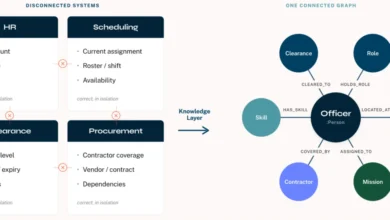
To understand the gravity of this challenge, one must examine the operational realities faced by modern regulatory bodies. Consider a cross-border public health emergency, such as a multi-jurisdictional food-safety alert. Tracing the origin and distribution of a contaminated product typically involves analyzing supply chains that span numerous nations, involving dozens of suppliers, transportation logistics firms, and local distributors. Traditional relational databases often struggle to surface complex, multi-hop patterns hidden within such vast volumes of interconnected records. Knowledge graphs, however, explicitly represent entities and their intricate relationships, bridging the gap between raw data and actionable intelligence. By structuring information into a connected network, these systems enable both human analysts and automated AI agents to reason over complex webs of evidence, ensuring that conclusions are traceable, verifiable, and legally defensible.
A Prime Example of Connected Intelligence in Action: The European Commission TraceMap Initiative
A cornerstone of the discussions at Graph Day Brussels was the European Commission’s TraceMap initiative, a practical, real-world deployment of connected intelligence powered by the Neo4j GraphAware Intelligence Analysis solution. Officially made available to competent authorities across all EU Member States in March 2026, TraceMap was designed to revolutionize how public authorities investigate food safety risks, track supply chain anomalies, and detect potential fraudulent activities.
The genesis of TraceMap lies in the Commission’s ongoing effort to harness existing EU-wide information systems more efficiently. By aggregating data pertaining to food operators, specific product categories, and individual shipping consignments, the platform constructs a comprehensive knowledge graph that illuminates hidden connections. Public officials utilizing the tool can rapidly trace the lineage of suspect goods, evaluate the scope of potential contamination, and coordinate swift cross-border responses.
The practical efficacy of this technological approach was notably demonstrated during a high-stakes pre-deployment pilot phase. According to official announcements from the European Commission, the pilot played a pivotal role in helping investigators identify and successfully execute the recall of infant formula products linked to contaminated ARA oil. This real-world application underscored the vital value of combining robust graph databases with analyst-centric intelligence platforms. Nevertheless, European officials and technical experts at the Brussels conference maintained a balanced perspective: while technology can drastically accelerate discovery, the ultimate reliability of any investigative finding remains inextricably linked to the integrity of the underlying data and the rigorous, expert judgment of human investigators.
Bridging Raw Data and Investigative Insight: The Mechanics of Graph-Powered Analysis
The technological architecture underpinning modern public-sector investigations relies on a synergistic blend of data storage, querying capabilities, and advanced analytical tooling. Neo4j functions as the foundational knowledge layer, providing the scalable infrastructure required to map, store, and query complex relationships across massive datasets. Built upon this platform, the Neo4j GraphAware Intelligence Analysis solution introduces specialized capabilities tailored specifically for investigative workflows. These include advanced data integration modules, dynamic visual exploration interfaces, entity resolution algorithms, and comprehensive analytical toolkits.
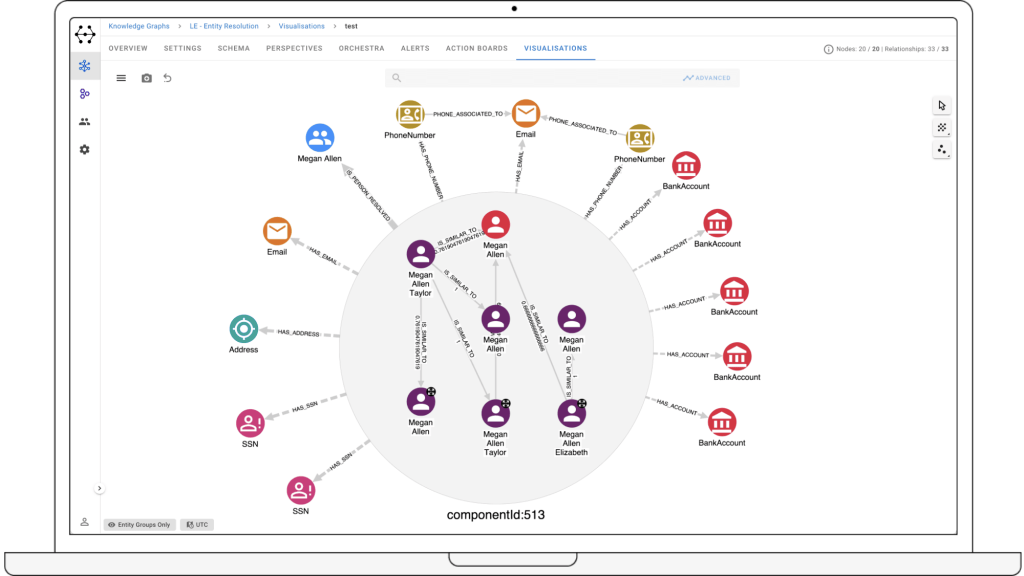
Entity resolution represents one of the most critical functionalities within this ecosystem. In many public-sector operating environments, records concerning the same real-world entity—whether a person, an organization, a vessel, or a location—frequently exhibit inconsistencies due to typographical errors, translation differences, or alias usage across disparate national databases. Entity resolution algorithms systematically analyze these fragmented entries to determine whether they refer to the same underlying entity, allowing police forces, customs agencies, and anti-fraud units to consolidate disparate records into a unified profile. Crucially, as experts emphasized throughout the Brussels summit, these automated tools are designed to augment human capability rather than replace it. The objective is to make complex networks of association easier to examine, verify, and present in a court of law, preserving the indispensable role of human investigative judgment.
Collaborative Innovation and European Digital Sovereignty
Beyond individual software deployments, Graph Day Brussels provided a collaborative platform for examining how specialist European technology partners can integrate their respective capabilities to build comprehensive, secure AI architectures for the public sector. Public institutions often require a multifaceted technology stack encompassing connected data management, advanced document retrieval, intuitive analyst workflows, and stringent data protection mechanisms that safeguard sensitive information while it is being actively processed.
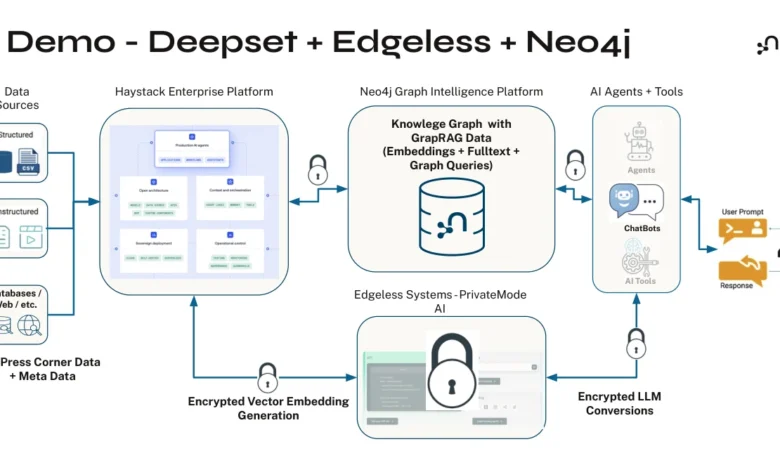
To illustrate how these disparate components can work in harmony, the Neo4j GraphAware team presented an illustrative joint technology demonstration architecture alongside prominent European partners deepset and Edgeless Systems. It is important to note that this architecture represented an exploratory framework rather than the exact deployment utilized for the Commission’s TraceMap initiative. Within this collaborative model, the Neo4j GraphAware Intelligence Analysis solution—backed by the core Neo4j platform—drives investigative data processing and relationship mapping. Concurrently, deepset’s Haystack framework supports sophisticated document retrieval and AI workflow orchestration, while Edgeless Systems contributes cutting-edge, confidential-computing-based large language model (LLM) technology designed to protect sensitive data against unauthorized access during runtime processing.
This collaborative approach highlights a broader strategic priority for European institutions: achieving digital sovereignty through technological diversity and open interoperability. By fostering an ecosystem where specialized European technology providers can integrate their solutions seamlessly, public authorities gain greater flexibility in procurement, reduced vendor lock-in, and enhanced long-term maintenance options. Furthermore, such partnerships ensure that security assurances are baked into the architecture from the ground up, aligning technical execution with the stringent regulatory standards mandated by European data protection laws.
Broader Implications for Public-Sector Transformation
The discussions and demonstrations at Graph Day European Institutions reflect a maturing consensus regarding the role of artificial intelligence in government. The initial wave of uncritical enthusiasm for generalized AI models has given way to a pragmatic, mission-focused approach that prioritizes explainability, governance, and verifiable utility. When public-sector agencies deploy tools like TraceMap or explore multi-vendor architectures involving Neo4j, deepset, and Edgeless Systems, they are not merely adopting software; they are establishing new operational paradigms for democratic accountability and regulatory enforcement.
From an analytical perspective, the shift toward graph-based connected intelligence addresses fundamental vulnerabilities in traditional data processing. In domains ranging from financial crime and counter-terrorism to public health and environmental protection, the ability to connect the dots across geopolitical boundaries is paramount. Knowledge graphs provide the structural clarity required to make sense of multivariate problems without sacrificing transparency. Because every node and edge in a graph database represents a tangible, queryable fact or relationship, analysts can trace the provenance of an insight directly back to its source material. This auditability is indispensable for public institutions that must justify their regulatory actions and administrative decisions to oversight bodies and the public.
Looking ahead, the success of initiatives like TraceMap and the collaborative dialogues fostered in Brussels suggest a clear trajectory for public-sector technology adoption. As institutional needs continue to evolve in response to emerging transnational challenges, the primary benchmark for success will remain practical utility. European authorities are increasingly demanding systems that they can thoroughly understand, rigorously assess, and independently govern. By combining the relationship-mapping power of graph technology with advanced analytics, confidential computing, and robust European partnerships, the public sector is laying the groundwork for a more resilient, transparent, and sovereign digital future.
Related posts: