Neo4j Announces General Availability of Document Intelligence in AuraDB, Revolutionizing Enterprise Knowledge Graph Creation

The intersection of unstructured enterprise data and artificial intelligence has long presented organizations with a formidable bottleneck. While businesses accumulate vast repositories of PDFs, contracts, reports, and word-processing documents, the critical insights hidden within these files frequently remain isolated from operational systems and large language models (LLMs). Addressing this structural limitation in enterprise data architecture, graph database pioneer Neo4j has officially announced the general availability (GA) of Document Intelligence within its fully managed cloud service, Neo4j AuraDB. Available across Free, Professional, and Business Critical tiers, the updated feature empowers engineers, data scientists, and business analysts to transform unstructured document collections into structured knowledge graphs entirely code-free.
By automating the transition from raw text, tables, and embedded images to interconnected entity models, Neo4j aims to bridge the gap between static enterprise documentation and dynamic, context-aware AI applications. The commercial rollout follows an extensive and successful preview period, during which early adopters tested the platform’s capacity to streamline document processing and graph modeling directly inside the Aura console. With the transition to general availability, Neo4j has significantly expanded the feature set to support enterprise-scale data volumes, complex multimodal document elements, and robust entity resolution capabilities that integrate seamlessly with existing database instances.

Evolution from Preview to General Availability: Scaling Up for the Enterprise
The journey toward general availability for Document Intelligence represents a strategic maturation of Neo4j’s generative AI ecosystem. During the initial preview phase, the primary objective was to validate the core concept: merging document parsing, graph modeling, and data extraction into a unified, user-friendly interface. Feedback gathered from developers and enterprise architects during this testing period highlighted a clear demand for greater scalability, enhanced multimodal comprehension, and deeper integration with pre-existing database schemata.
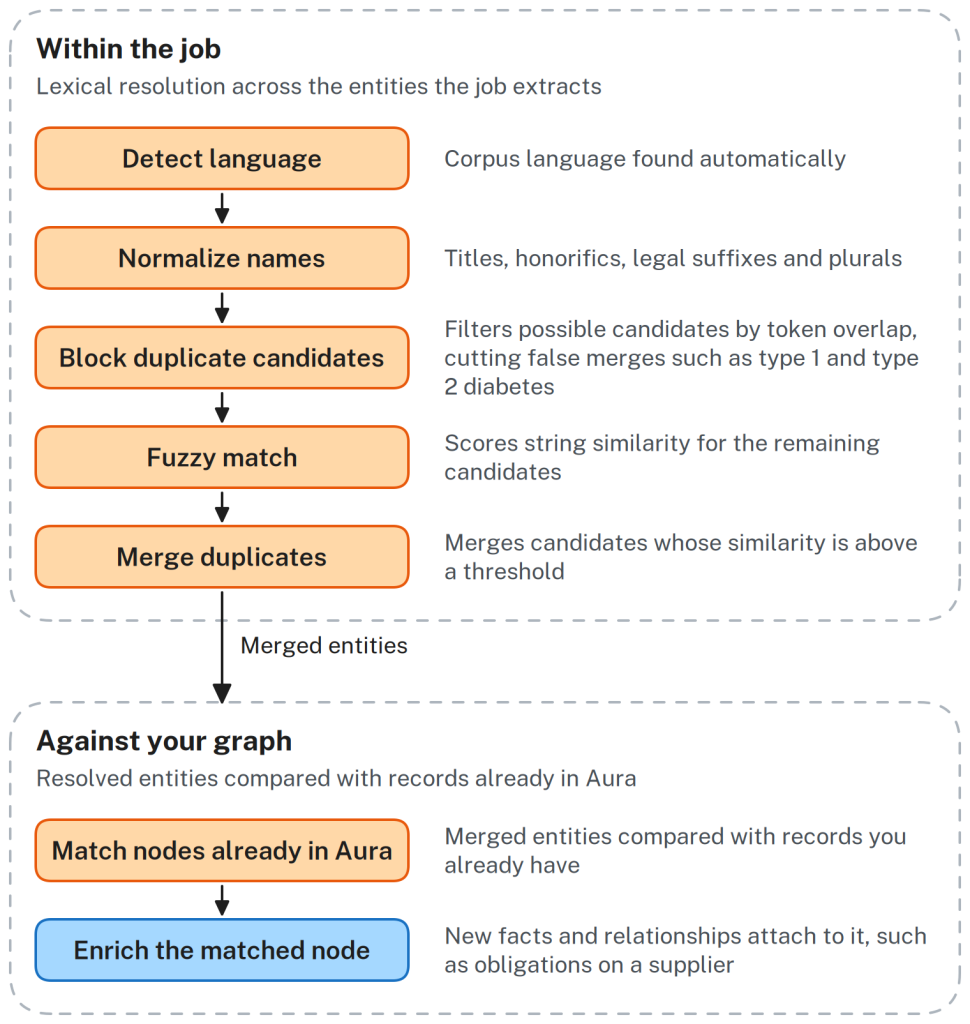
In response, the general availability release introduces managed background processing jobs capable of handling hundreds of documents simultaneously. This architectural enhancement ensures that larger, evolving collections—such as corporate compliance archives, regulatory filings, or multi-jurisdictional supply chain contracts—can be ingested reliably. Furthermore, the incorporation of automated job status tracking, error management, and retry protocols addresses the operational friction typically associated with heavy batch-processing workloads.
Beyond mere scaling, the GA release broadens the semantic scope of what Document Intelligence can ingest. Whereas early iterations primarily focused on plain text extraction, the updated system can interpret and analyze visual elements, including tables and embedded images. Because critical corporate data is frequently presented in financial grids, architectural diagrams, or visual charts, this capability ensures that vital information is not lost during the extraction phase. Consequently, the resulting knowledge graphs offer a far more comprehensive digital twin of the enterprise document ecosystem.
Core Architecture: How Document Intelligence Works
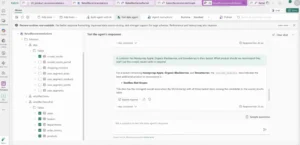
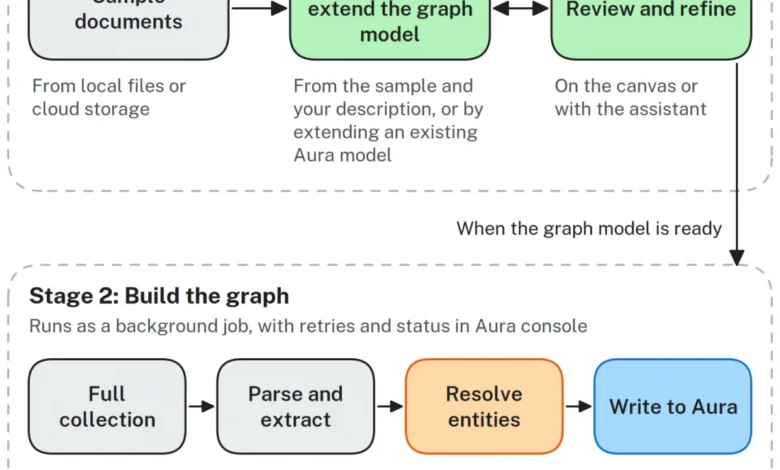
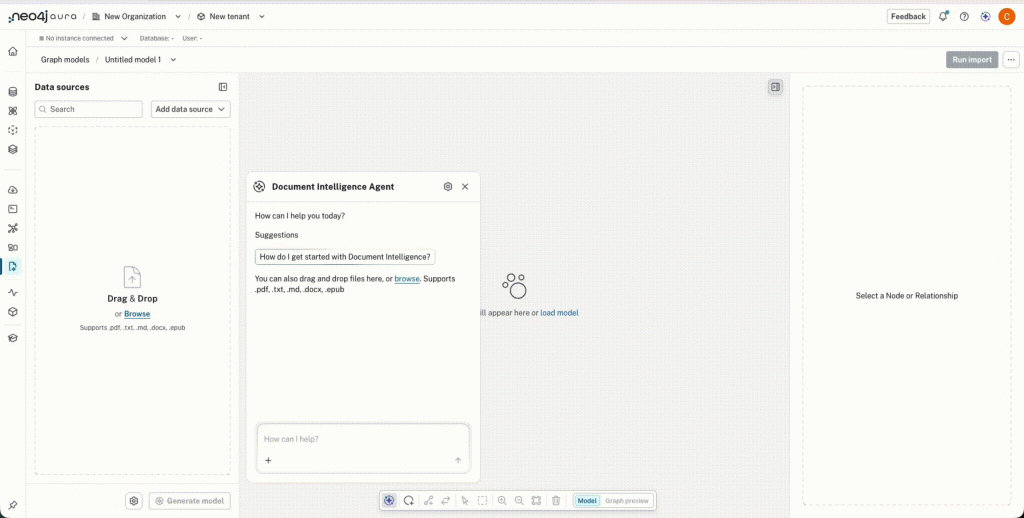
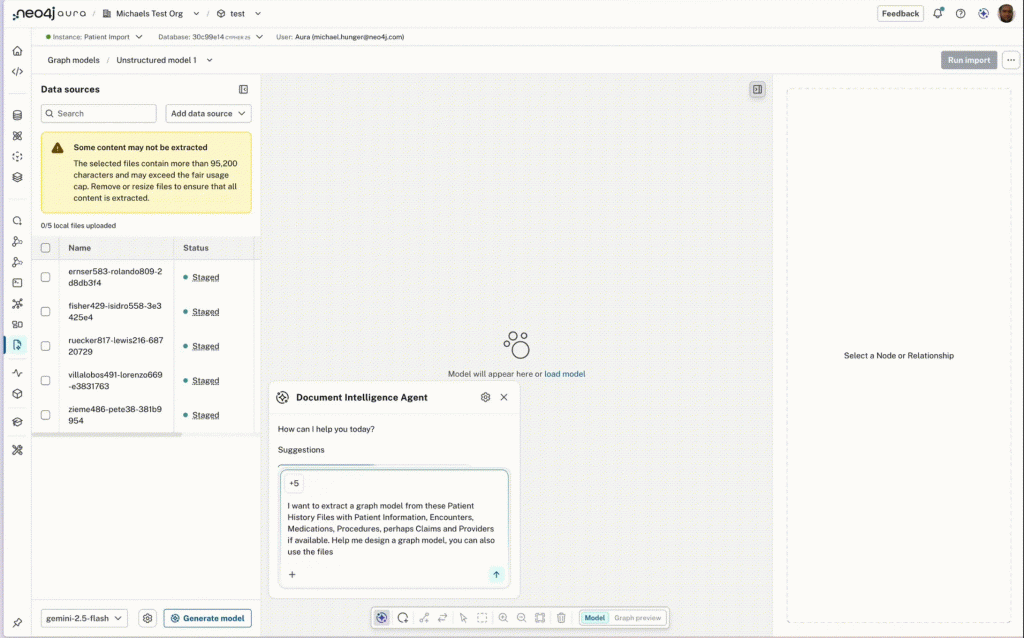
At its technical core, Document Intelligence operates through a sophisticated two-stage pipeline designed to balance automated efficiency with precise human oversight. The first stage involves collection sampling, during which the system analyzes a representative subset of the target document repository. Leveraging an interactive built-in assistant, the platform generates a proposed graph model—defining nodes, properties, and relationships—tailored to the specific topical domain of the files.
During this phase, users can interact with the assistant via natural language dialogue. If an administrator wishes to emphasize specific business entities, modify relationship parameters, or verify whether the proposed schema can answer complex operational queries, they can do so iteratively. The system maintains conversational context, ensuring that modifications made through dialogue are reflected immediately on the visual canvas.
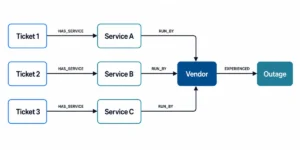
Once the graph model is finalized, the second stage initiates the bulk ingestion of the full document collection. Document Intelligence parses the files, extracts designated entities, and constructs a dual-layered graph structure inside AuraDB. This architecture uniquely combines an entity graph with a lexical graph layer. The lexical layer preserves document and chunk nodes—complete with vector embeddings stored directly on text chunks to facilitate similarity search and retrieval-augmented generation (RAG) workflows. Meanwhile, the entity layer links extracted concepts—such as suppliers, risks, obligations, and financial assets—back to their original source passages.
This dual structure provides application developers and AI agents with a remarkably clean signal. When an LLM queries the database, it can traverse precise entity relationships while instantly retrieving the exact source passages required to verify facts, thereby drastically reducing token overhead and mitigating hallucinations.
Entity Resolution and Schema Extension
One of the most technically challenging aspects of automated document ingestion is entity resolution—the process of determining whether disparate mentions across multiple files refer to the exact same real-world entity. For instance, a contract might reference "Acme Corp," a subsidiary might refer to "Acme Corporation," and an email report might list "ACME."
Document Intelligence addresses this challenge through an advanced normalization and scoring pipeline. Within each ingestion job, the system normalizes entity strings, intelligently narrows down comparison candidate pairs, calculates similarity scores based on configurable thresholds, and merges matching nodes. Crucially, the GA release allows Document Intelligence to extend existing graph models rather than building them in isolation.
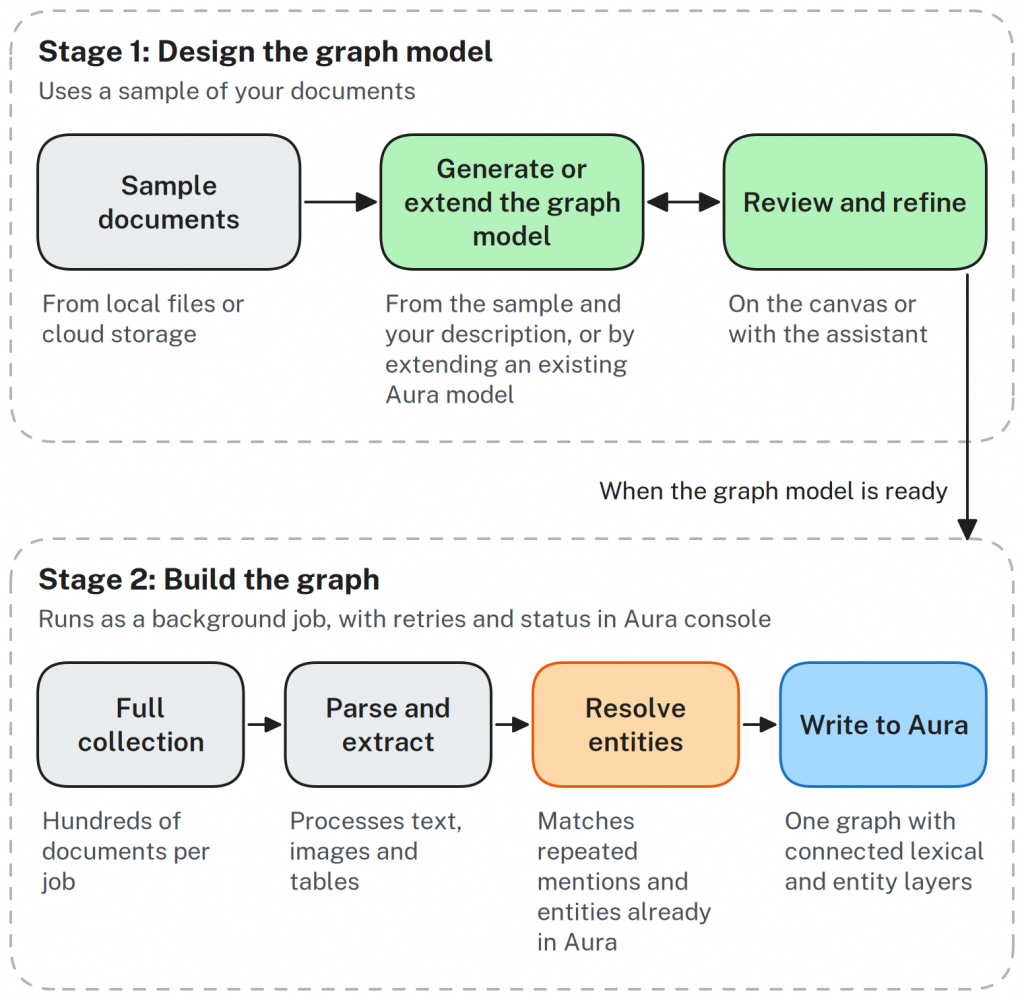
Newly extracted entities and relationships can be resolved directly against records already maintained within AuraDB. For example, if an organization already possesses a master supply chain graph connecting verified vendors to manufactured goods, newly imported procurement contracts can automatically append fresh obligations, compliance exceptions, and delivery timelines to those pre-existing corporate records. This continuous enrichment prevents data fragmentation and ensures that the knowledge graph evolves dynamically alongside the business.
Industry Implications and Strategic Analysis
From a strategic perspective, the commercial rollout of Document Intelligence aligns with broader macroeconomic shifts in enterprise software adoption. As organizations move past the initial experimental phase of generative AI, the primary constraint on enterprise productivity is no longer model capability, but data grounding and context relevance. Traditional Retrieval-Augmented Generation (RAG) models often struggle with complex, multi-hop queries that require synthesizing information distributed across numerous disconnected documents.
By structuring unstructured text into explicit knowledge graphs, Neo4j provides a deterministic framework that complements probabilistic AI models. Industry analysts note that combining vector search with graph traversal—often referred to as GraphRAG—represents the cutting edge of enterprise AI architecture. With Document Intelligence now baked directly into the AuraDB console on standard cloud tiers, Neo4j has effectively democratized access to GraphRAG technology, removing the prohibitive barrier of custom pipeline engineering that previously kept such capabilities out of reach for mid-market enterprises.
Roadmap and Future Outlook
Looking ahead, Neo4j has outlined an ambitious roadmap designed to extend Document Intelligence beyond the confines of the Aura console. Future updates will introduce programmatic access points, including dedicated APIs, command-line interface (CLI) integration, and support for the Model Context Protocol (MCP), enabling seamless embedding into automated CI/CD pipelines and autonomous AI agent workflows.
Additional features slated for development include natural language-driven graph model initialization derived solely from high-level business descriptions, enhanced job cancellation and monitoring controls, finer-grained parameterization of entity resolution algorithms, and automated re-import protocols for updated source documents. Furthermore, Neo4j is actively exploring broader enterprise deployment options, including dedicated customer cloud environments and self-managed deployments, to accommodate strict regulatory and data residency requirements.
With Document Intelligence now generally available across Free, Professional, and Business Critical tiers of Neo4j AuraDB, organizations can immediately begin converting passive document archives into active, queryable operational assets. Enterprise teams can access the feature directly via the Neo4j Aura console, supported by comprehensive technical documentation detailing supported file formats, workflow configurations, and integration best practices.
Related posts: