
The evolution of modern software architecture often begins with simplicity, only to succumb to the "creeping feature" phenomenon. In many professional Python environments, a standard function—such as one designed to load embeddings from a local store or fetch a vocabulary from an internal service—often starts as a lean, singular piece of logic. However, over a development lifecycle of weeks or months, these functions frequently become bloated with "boundary code." This auxiliary logic, responsible for timing execution, implementing retry mechanisms, caching results, and validating input, often accounts for a significant percentage of the codebase. When this code is manually injected into every function, it introduces inconsistencies, maintenance burdens, and subtle bugs.
Python decorators offer a structural solution to this challenge. By abstracting cross-cutting concerns into reusable wrappers, developers can maintain clean, focused business logic while ensuring that systemic requirements are applied uniformly across an entire application.
Understanding the Mechanics of Decorators
At its core, a Python decorator is a function that takes another function as an argument and returns a new function, typically a wrapper. This mechanism is essentially syntactic sugar for function reassignment. When a developer marks a function with the @ symbol, they are instructing the Python interpreter to execute the decorator at definition time, effectively replacing the original function object with the output of the decorator.
The technical foundation of this behavior lies in the way Python handles function definitions. Decorator expressions are evaluated in the scope where the function is defined. This means that if a decorator performs an action—such as registering a function in a database or initializing a logger—it happens exactly once at import time. The return value of the decorator is then bound to the original function name. A critical pitfall for developers is failing to return the wrapper function from the decorator; this results in the original function being replaced by None, leading to immediate runtime errors upon the first invocation.
The Role of Closures and State Management
The power of a decorator lies in its ability to utilize closures. When a wrapper is defined inside the outer decorator function, it maintains access to the original function object. This ensures that even after the outer function has completed its execution, the wrapper retains the ability to call the original logic.
Effective decorators rely on the *args and **kwargs syntax to ensure they can forward arguments to the wrapped function without altering its interface. A common oversight in custom implementation involves failing to preserve function metadata. Without the use of functools.wraps, the decorated function loses its original name, docstring, and signature, which can severely complicate debugging, stack tracing, and automated documentation generation. By using @functools.wraps(func), developers ensure that the wrapper inherits the metadata of the original function, maintaining the integrity of the development environment.
Implementing Boundary Behaviors: A Systematic Approach
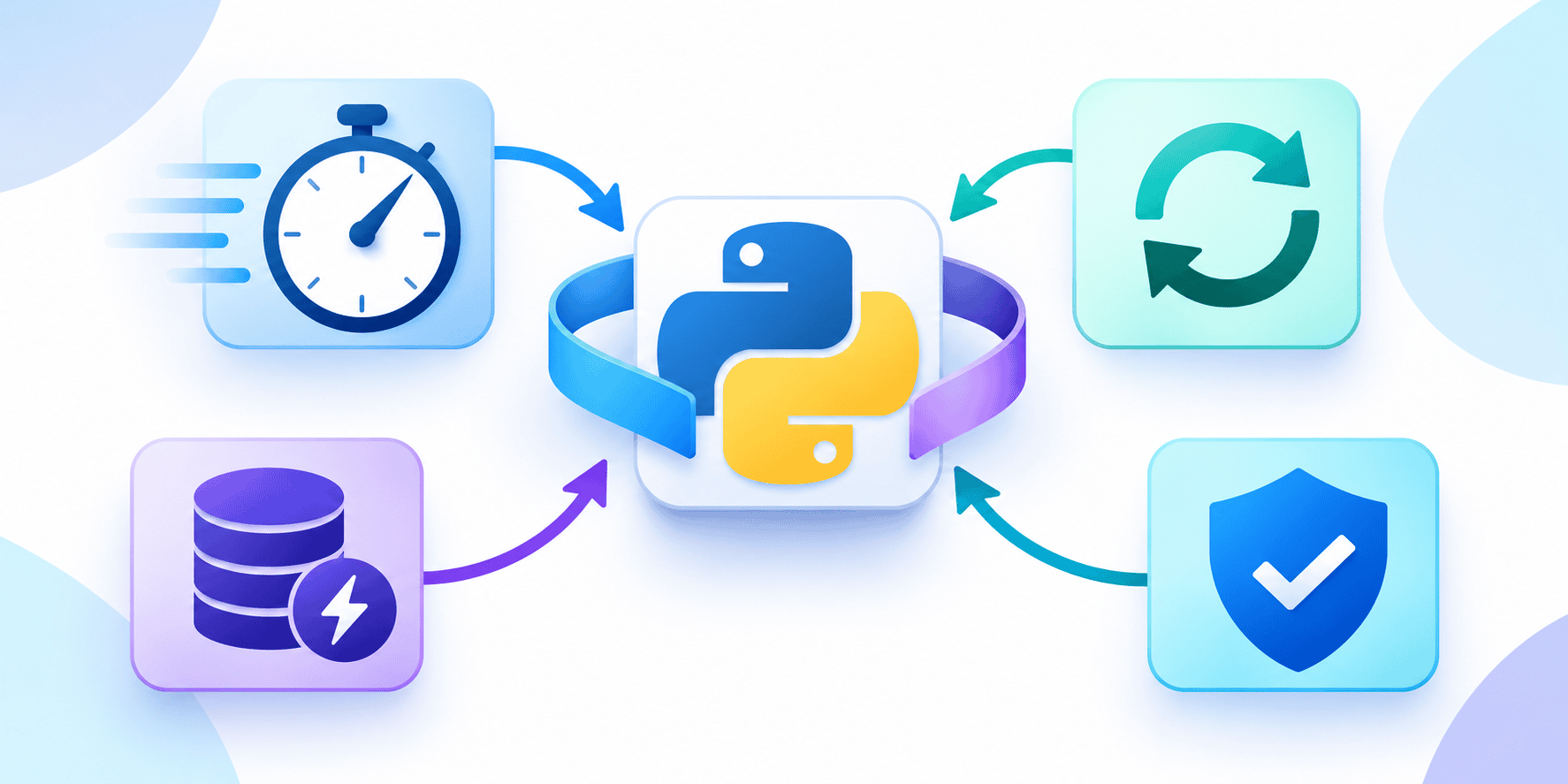
To move beyond the ad-hoc injection of boundary code, developers should implement four primary patterns: timing, retries, caching, and validation.
1. Precision Timing with Contextual Observation
While developers often rely on time.perf_counter() to measure performance, the manual implementation of these timestamps is prone to error. A robust timing decorator utilizes a try...finally block. This ensures that even if an execution fails or triggers an exception, the duration of the attempt is captured. This data is vital for identifying bottlenecks in production pipelines, such as slow tokenizer steps or high-latency network requests, without obscuring the original function’s logic.
2. Building Resilient Retry Logic
Retries are essential for distributed systems where network instability is a known variable. A production-grade retry decorator should act as a factory, accepting arguments such as max_attempts, delay, and a tuple of target exceptions. By confining the retry logic to specific, transient exceptions—like TimeoutError—developers avoid the common mistake of retrying on logic errors, such as KeyError or ValueError, which would never be resolved by a second attempt. It is crucial to note that retries should only be applied to idempotent operations; applying this pattern to functions that perform non-idempotent side effects, such as processing payments, can lead to catastrophic data duplication.
3. Efficient Caching Strategies
The standard library’s functools.lru_cache provides a highly optimized, thread-safe implementation of memoization. By caching results based on function arguments, developers can avoid redundant computations. However, this tool requires careful management of memory. If a function is called with a vast range of unique arguments, the cache can grow unchecked, potentially leading to memory leaks. Furthermore, developers must ensure that only pure functions are cached; functions that return mutable objects or rely on external state are unsuitable for this pattern, as they risk returning stale or corrupted data.
4. Strict Input Validation
Input validation at the function boundary is the most complex of the four patterns because it requires deep inspection of the function’s signature. Using the inspect module, developers can bind arguments to the function signature at runtime, allowing the decorator to validate inputs before the function body is even entered. This approach is superior to manual checks within the function because it enforces invariants at the interface level. While Python annotations provide documentation, they do not enforce runtime constraints; therefore, explicit validation decorators provide a necessary safety net for critical system parameters.
Broader Implications for Engineering Standards
The shift from manual boundary code to decorators represents a broader trend in Python engineering toward declarative, maintainable code. By abstracting infrastructure concerns, teams can reduce the cognitive load on developers, allowing them to focus on business logic.
However, there is a limit to this abstraction. When decorators become too deeply nested or when a single decorator attempts to handle too much logic, they can become "magic"—hidden behavior that is difficult to debug or predict. As a rule of thumb, when the order of stacked decorators creates complex, unpredictable side effects, or when a decorator begins to read arguments to fundamentally alter control flow, it is a sign that the design has overextended its usefulness. In such cases, explicit function composition or a more robust architectural pattern, such as a middleware pipeline, may be required.
Conclusion
The utility of decorators in professional software engineering is defined by their ability to uphold the principle of separation of concerns. By implementing timing, retries, caching, and validation through a standardized set of decorators, organizations can achieve a more consistent and observable codebase. The success of this approach depends on the developer’s commitment to the fundamental contract: preserving function metadata, ensuring transparent argument forwarding, and never masking errors unless explicitly intended. When implemented with discipline, these patterns provide a powerful framework for building resilient, high-performance Python applications capable of scaling alongside the complexities of modern production environments.