Amazon S3 Tables Introduces Managed Migration Capabilities to Seamlessly Transition Apache Hive Workloads to Apache Iceberg Without Downtime

Modern enterprise data architecture has reached a crucial inflection point as organizations continually seek ways to manage petabyte-scale datasets with greater efficiency, flexibility, and reduced operational overhead. Today, cloud infrastructure and data management systems are undergoing a rapid evolution, shifting away from legacy storage frameworks toward open table formats that offer advanced capabilities like time travel queries, schema evolution, and hidden partitioning. Addressing this growing industry demand, Amazon Web Services has announced the launch of a streamlined, highly cost-effective managed migration pathway for data lake modernization. Amazon S3 Tables now officially support the fully managed migration of legacy Apache Hive tables directly into Apache Iceberg, eliminating the historic hurdles of custom pipeline development and heavy infrastructure provisioning.
This newly introduced feature targets Parquet-formatted tables residing within Amazon S3 that are currently registered in the AWS Glue Data Catalog. By shifting the complexity of data transformation and migration orchestration onto the cloud service provider, engineering teams can upgrade their underlying data lakes while production analytical workloads continue to run uninterrupted. The move underscores a broader industry consensus: Apache Iceberg has firmly established itself as the open standard for large-scale analytics datasets, granting enterprises the freedom to query massive volumes of data using any compatible query engine without being locked into proprietary storage frameworks.
Background Context of the Data Lake Evolution
To understand the significance of this development, one must examine the historical trajectory of data lakes over the past decade. Initially, organizations constructed data lakes using low-cost object storage combined with file-based formats such as Apache Hive. While these setups democratized data storage, they notoriously suffered from performance bottlenecks, lack of ACID (Atomicity, Consistency, Isolation, Durability) transaction guarantees, and cumbersome file management as datasets scaled into the petabytes.
To overcome these limitations, open table formats like Apache Iceberg emerged, introducing a table abstraction layer on top of raw data files. Iceberg brought relational database-like reliability and performance to object storage data lakes. However, adopting these modern formats traditionally presented a formidable engineering challenge. Migrating legacy Hive tables to Iceberg required weeks, sometimes months, of painstaking development work. Engineers had to build custom data pipelines, manage compute clusters, handle complex data type conversions, write extensive validation scripts, and design reliable rollback mechanisms in case of failure.

For many enterprises, the operational risk and engineering cost of executing these massive table conversions acted as a major deterrent, locking valuable corporate data into aging architectures. The new managed migration capability by Amazon S3 Tables directly dismantles these barriers, transforming what was once a disruptive, multi-week engineering project into a streamlined, API-driven administrative operation.
Operational Mechanics and Workflow of S3 Tables Migration
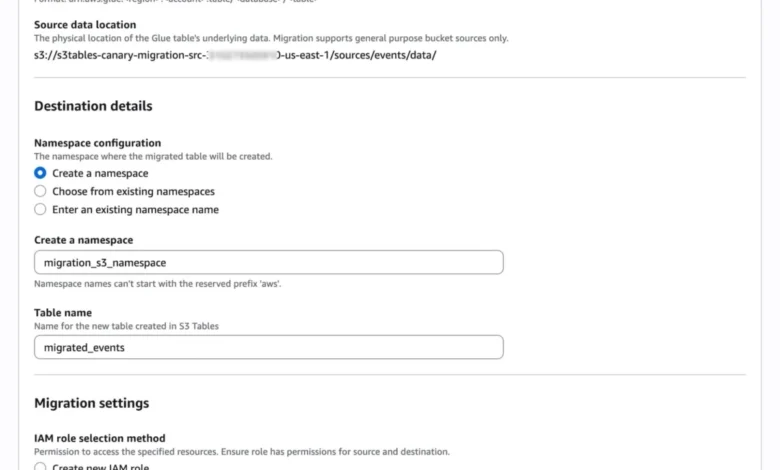
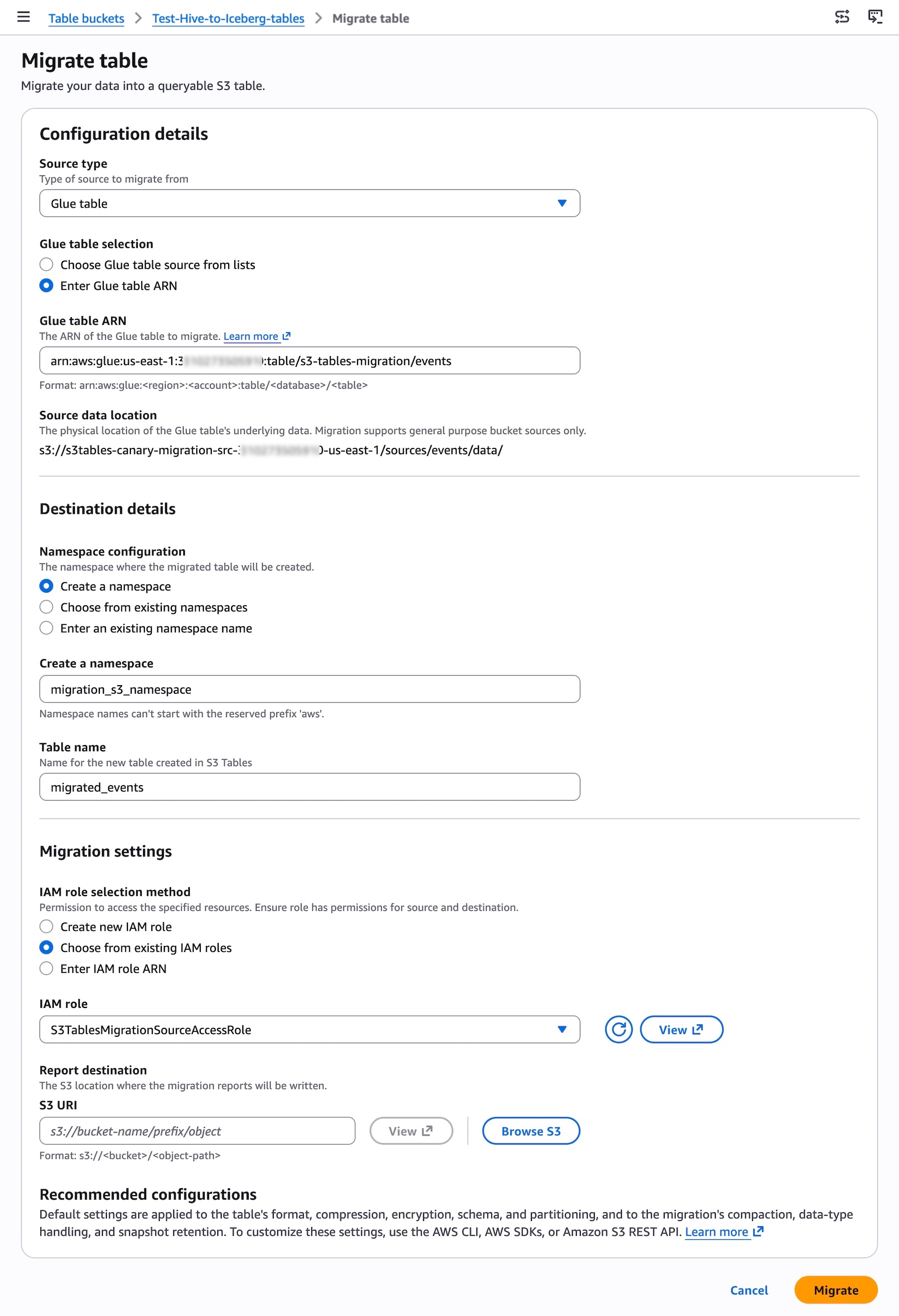
The technical architecture behind the Amazon S3 Tables managed migration feature has been engineered to minimize operational friction and eliminate the need for manual resource provisioning. When initiating a migration, the workflow is handled entirely by S3 Tables, which automates critical steps including data validation, source-to-destination compatibility checks, data type conversions, file recompression, and compaction.
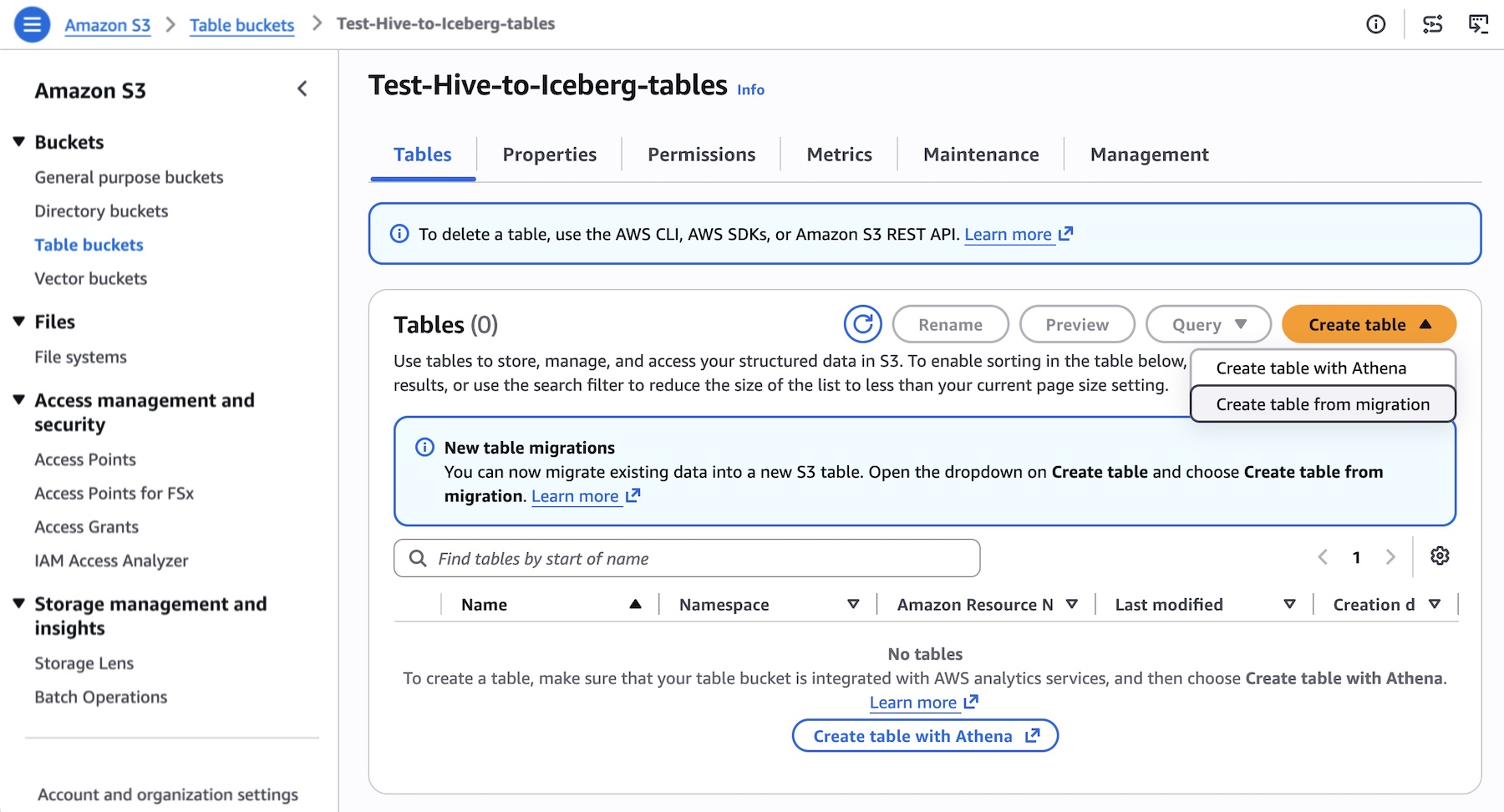
The process begins directly within the Amazon S3 console or through programmatic interfaces such as the AWS Command Line Interface (AWS SDKs), AWS SDKs, and the Agent Toolkit for AWS. Users select their destination table bucket and initiate a "Create table from migration" request. Before a single byte of data is physically copied, S3 Tables meticulously scan every source object in scope to generate a comprehensive compatibility report. This proactive validation ensures that potential schema mismatches or incompatible data values are identified early, allowing database administrators to address discrepancies before the cutover phase.
A standout feature of this managed workflow is its iterative synchronization capability. Rather than requiring a complete, one-time data dump that forces production workloads offline, the system allows administrators to execute a start-table-migration command followed by successive calls to sync-table-migration. Throughout this synchronization phase, write operations to the source Hive table can continue uninterrupted. Each sync operation intelligently copies only the data that has changed since the previous iteration.
The destination Iceberg table remains in a read-only state during the background copy process. Once the initial data transfer is complete and the destination is caught up with the latest source modifications, a final cutover occurs. During this brief window—typically lasting only a few minutes—the source writes are paused, the destination table is promoted to read-write status, and the migration is finalized. This design effectively reduces table downtime to a negligible window, safeguarding business continuity for mission-critical analytics pipelines.

Financial Implications and Cost Structure
Data migration initiatives are frequently scrutinized for their hidden costs, particularly regarding compute resource consumption, data transfer fees, and storage tier disruptions. AWS has structured the S3 Tables managed migration pricing model to directly address these enterprise concerns.
Under the new policy, customers incur charges exclusively for the net data copied to the destination Iceberg tables. There are no additional fees levied by AWS for the underlying conversion process from Hive to Iceberg. Furthermore, for organizations utilizing S3 Intelligent-Tiering to optimize storage costs for their data lakes, source objects remain securely within their current access tiers throughout the migration process, avoiding unnecessary retrieval charges or storage class transitions.
In addition to direct conversion savings, the resulting Iceberg tables are hosted on Amazon S3 Tables, which provides purpose-built, fully managed storage designed to maintain optimal performance and cost-efficiency as datasets scale. Built-in automation features—such as automated compaction, snapshot management, and maintenance settings configured during migration—ensure that storage footprints remain lean and query performance remains high without requiring manual tuning by database administrators.
Integration with Modern Analytics and AI Tooling
The completion of a table migration is merely the first step in unlocking the value of modern data lake architectures. Recognizing this, AWS has ensured that newly migrated Apache Iceberg tables are immediately accessible across a wide array of analytics and artificial intelligence environments.
Direct, native integrations allow data engineers and data scientists to begin querying and manipulating their newly minted Iceberg tables instantly using Amazon Athena and Amazon SageMaker Unified Studio directly within the AWS management console. Moreover, because Apache Iceberg relies on an open standard specification, any analytics engine or business intelligence tool compatible with the Apache Iceberg REST API can connect and query the tables without proprietary restrictions.
For developers and organizations integrating advanced automation into their workflows, the feature supports programmatic management via the AWS CLI and SDKs. Additionally, developers leveraging coding agents such as Kiro and specialized tooling like the Agent Toolkit for AWS can utilize dedicated skills—such as the migrating-hive-tables-to-s3-tables skill—to receive step-by-step migration guidance embedded with built-in safety guardrails. Teams utilizing the AWS MCP Server and associated plugins can also query documentation, verify regional availability, and troubleshoot operational parameters using natural language AI interfaces.
Initial Regional Availability and Scope
At launch, the Amazon S3 Tables managed migration capability is rolling out across a robust selection of global AWS Regions. Supported regions include US East (N. Virginia, Ohio), US West (Oregon), Asia Pacific (Mumbai, Singapore, Sydney, Tokyo), and Europe (Frankfurt, Ireland, Stockholm).
The initial release specifically supports AWS Glue-registered Hive tables stored in Parquet format where both the source data and destination S3 Tables bucket reside within the same AWS account and AWS Region. This scope covers a substantial portion of enterprise analytical repositories currently housed within the AWS ecosystem, offering an immediate modernization pathway for a vast user base.
Industry Implications and Future Outlook
The introduction of managed Hive-to-Iceberg migrations by Amazon S3 Tables represents a significant milestone in the broader maturation of cloud-native data management. By removing the technical friction that has historically hindered data lake upgrades, AWS is accelerating the industry-wide transition toward open table formats.
For data-driven enterprises, the ability to modernize petabyte-scale data lakes without custom pipeline engineering or prolonged production downtime translates directly into lower total cost of ownership, improved query performance, and greater architectural agility. As organizations increasingly demand real-time analytics, robust governance, and seamless interoperability between traditional business intelligence tools and modern machine learning frameworks, managed migration capabilities of this caliber will likely become an essential baseline service in cloud data infrastructure.
Industry analysts note that as open table formats like Apache Iceberg become ubiquitous, cloud providers will continue to compete on the elegance, speed, and cost-efficiency of their ingestion and migration pathways. With this release, AWS has established a strong benchmark for simplifying legacy data retirement, empowering organizations to focus their engineering talent on deriving insights from data rather than wrestling with low-level storage translations.