AWS Announces Major Upgrade to Amazon EventBridge with Enhanced Custom Event Buses for Multi-Account Architectures

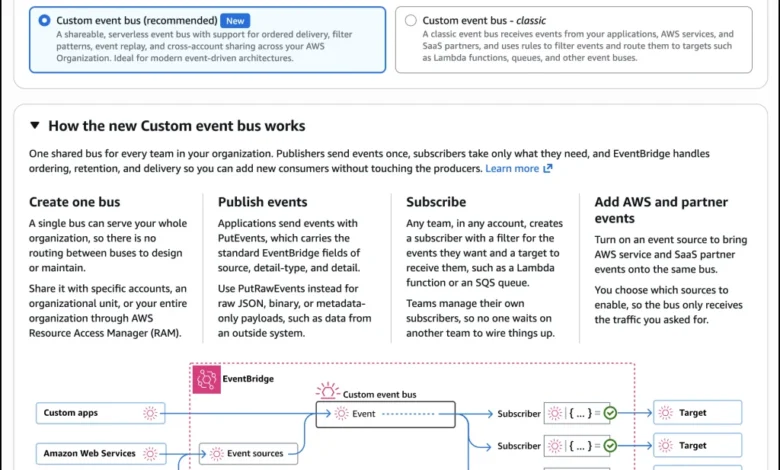
Amazon Web Services (AWS) has officially announced a significant architectural enhancement to Amazon EventBridge, introducing a new enhanced custom event bus designed specifically to streamline event-driven applications across complex, multi-account organizational structures. Historically, as serverless adoption scaled within enterprises, development teams frequently encountered operational friction when attempting to route events across disparate AWS accounts. The launch of the enhanced custom event bus addresses these long-standing architectural bottlenecks by replacing cumbersome, multi-bus workarounds with a unified, organization-wide event backbone that incorporates native event ordering, simplified subscriber management, and an updated economic model.
Background Context and Evolution of Serverless Event Routing
To fully understand the significance of this release, it is necessary to examine the evolution of event-driven architectures (EDAs) within modern cloud computing. In the early stages of serverless adoption, organizations typically constructed event-driven workflows using a single custom event bus located within a solitary AWS account. This centralized paradigm functioned effectively when architecture ownership was consolidated under a single engineering team.
However, as cloud adoption matured, enterprise best practices strongly favored decentralized, multi-account environments orchestrated through AWS Organizations. In these multi-account landscapes, individual product teams operate within dedicated, isolated accounts to enforce security boundaries, manage blast radii, and maintain autonomous deployment cycles.
To bridge communication gaps between these isolated accounts, system architects previously had to deploy multiple custom event buses interconnected via intricate webs of cross-account resource policies, IAM permissions, and bus-to-bus routing rules. Over time, this workaround inadvertently reintroduced the exact operational complexity that serverless frameworks were engineered to eliminate. Platform engineering teams lost critical visibility into event subscription topologies, cross-account data transfer costs compounded unpredictably, and workloads requiring strict message sequencing were forced to implement cumbersome custom buffering logic or abandon serverless paradigms altogether in favor of alternative technologies.

Core Features of the Enhanced Custom Event Bus
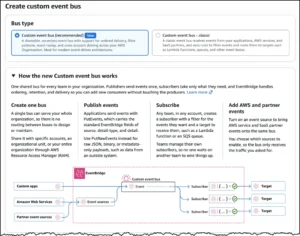
The newly introduced enhanced custom event bus directly targets these operational pain points by establishing a centralized, shared event-routing layer that spans all designated AWS accounts within an organization. Rather than fragmenting event infrastructure across departmental boundaries, platform administrators can now provision a single, high-capacity event bus capable of supporting up to 10,000 distinct subscribers by default—with higher quotas available upon request.
Organization-Wide Sharing via AWS RAM
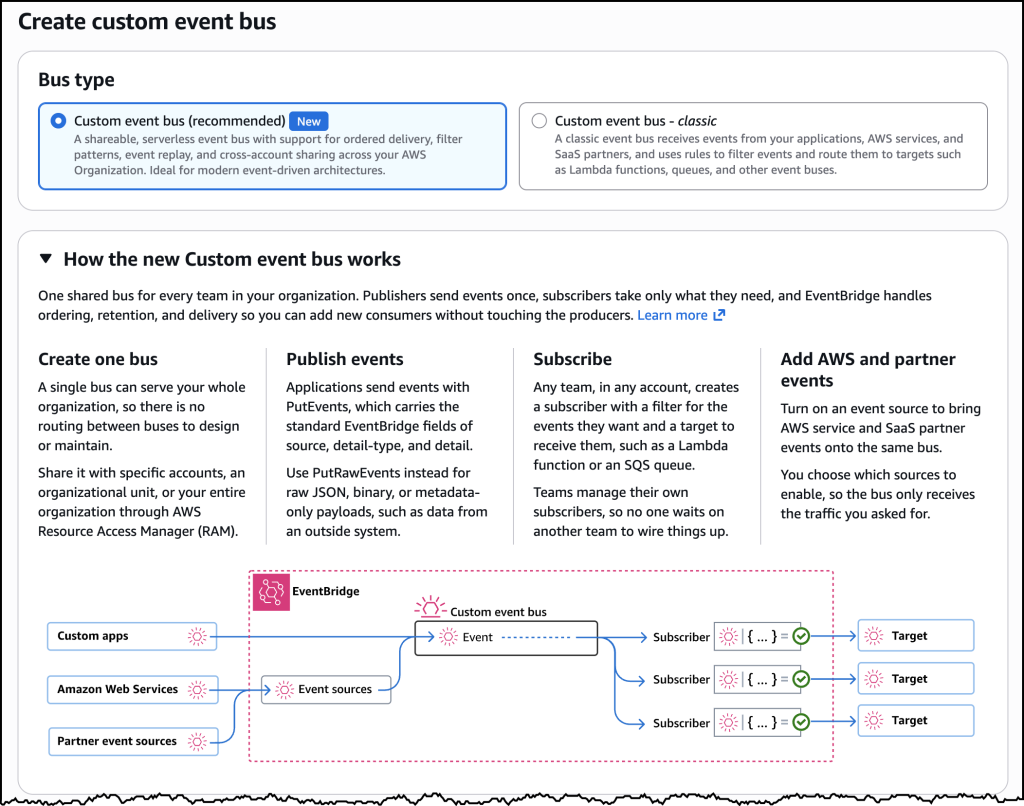
A foundational capability of the new offering is its deep integration with AWS Resource Access Manager (AWS RAM). Platform teams can establish a shared event bus and securely grant publication and subscription privileges across an entire enterprise, specific organizational units (OUs), or targeted AWS account IDs. This eliminates the manual overhead of writing complex cross-account resource policies. Publishers can broadcast domain events without needing prior knowledge of downstream consumers, while application teams can independently configure their own subscriptions as business logic dictates. Platform engineers retain comprehensive visibility and fine-grained governance over overall event flows.
Advanced Event Ordering and Synchronous Processing
While asynchronous, out-of-order event processing is a primary strength of event-driven systems, certain enterprise domains—such as logistics, financial transaction processing, and inventory management—demand strict message sequencing. For example, in a real-time fleet tracking system, sequential driver location updates are vital; out-of-order processing can cause geographic routing algorithms to operate on stale coordinates.

The enhanced custom event bus resolves this challenge by supporting dual-processing paradigms on a single bus. Publishers can attach an EventGroupId metadata attribute to outgoing payloads. EventBridge subsequently guarantees sequential delivery for all events sharing the same identifier to subscribers configured for ordered consumption, while simultaneously allowing other asynchronous subscribers to process the same event stream concurrently.
To facilitate reliable sequential workflows, AWS has also introduced native synchronous invocation support for targets such as AWS Lambda. In synchronous mode, EventBridge confirms successful target execution prior to acknowledging event receipt, effectively removing the traditional architectural pattern of interposing Amazon Simple Queue Service (SQS) queues between an event bus and compute functions merely to guarantee ordered execution.
Streamlined Subscriptions and Advanced Payload Handling
The architecture introduces a unified resource known as the Subscriber. This resource consolidates event filtering patterns, target endpoint configurations, retry policies, and dead-letter queue destinations into a single manageable entity. Previously, achieving this level of control required coordinating multiple independent rules, targets, and parameter sets. Furthermore, the new Subscriber resource features variable start-time configurations, simplifying data hydration, application onboarding, and historical event replay during disaster recovery scenarios.
To optimize data payload management, the system introduces native content-based deduplication. EventBridge algorithmically hashes meaningful payload attributes, automatically collapsing duplicate transmissions arriving within a five-minute window. This grants publishers exact-once delivery semantics for erratic sources lacking native idempotency tokens. Additionally, integrated JSONata expression support empowers subscribers to transform, reshape, and filter incoming payloads directly at the routing layer before they reach downstream APIs, while integrated deserialization handles Apache Avro and Protocol Buffers formats seamlessly.
Economic Model and Pricing Shift
Alongside structural enhancements, AWS has rolled out a modernized pricing structure tailored for scale. The enhanced custom event bus transitions away from traditional per-event models toward an ingress and egress throughput pricing framework. Under this structure, publishers incur costs based strictly on events ingested, while subscribers pay for events successfully delivered. This realignment prevents the compounding cost inflation historically associated with multi-bus, cross-account routing topologies.
Industry Implications and Strategic Analysis
From an industry perspective, this release signifies a mature acknowledgment by cloud providers that enterprise governance and developer autonomy must coexist within serverless ecosystems. By shifting the burden of cross-account routing, deduplication, and message ordering into the foundational infrastructure layer, AWS reduces the custom code burden previously shouldered by platform engineering teams.
Analysts note that while existing workloads running on classic event buses will remain fully supported without mandatory modifications—appearing distinctively in the management console as "Custom event bus – classic"—new greenfield implementations will likely standardize rapidly on the enhanced paradigm to optimize operational expenditure and architectural clarity.
Availability and Deployment
The enhanced custom event bus is generally available today across a broad footprint of global AWS Regions, including US East (N. Virginia, Ohio), US West (Oregon), multiple European locations (Ireland, Frankfurt, Stockholm, Spain), and key Asia-Pacific markets (Hong Kong, Malaysia, Mumbai, Singapore, Sydney, Thailand, Tokyo). Engineering teams can provision and manage these new resources immediately using the AWS Management Console, the AWS Command Line Interface (CLI), or programmatic EventBridge APIs.
Related posts: