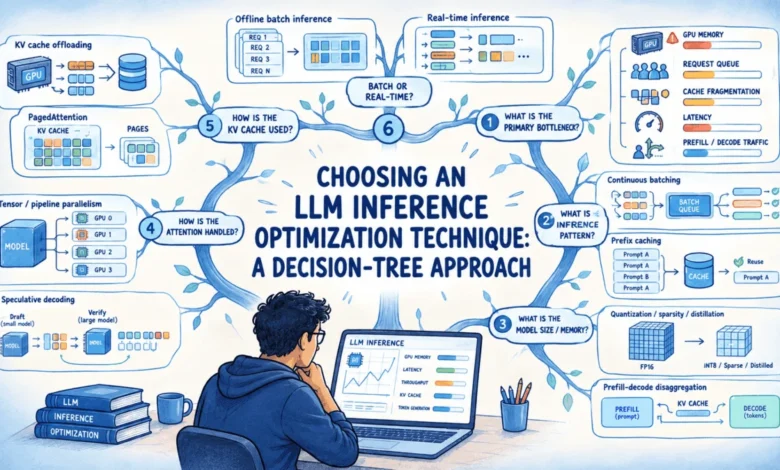
As Large Language Models (LLMs) transition from experimental research projects to the backbone of enterprise software, the challenge of deploying them at scale has shifted from model training to inference optimization. Organizations are increasingly facing a "latency-throughput wall," where the cost of serving tokens grows exponentially with traffic. Effectively navigating this landscape requires more than just hardware upgrades; it demands a systematic approach to identifying where the specific bottleneck lies within a workload. By applying a six-question decision tree, developers can match the right optimization technique—from PagedAttention to speculative decoding—to the actual constraints of their infrastructure.
The Anatomy of the Inference Bottleneck
To understand why inference stalls, one must look at the hardware utilization profile. LLM inference is primarily memory-bound. During the "prefill" phase, the model processes the input prompt, which is compute-intensive. During the "decode" phase, the model generates tokens one by one, which is memory-bandwidth intensive. As traffic scales, these two phases compete for GPU resources. When GPU memory becomes saturated with the Key-Value (KV) cache—the stored intermediate states of previous tokens—the system begins to thrash, leading to high tail latencies and dropped requests.
Historically, the industry treated inference as a monolith. However, since the introduction of the Transformer architecture in 2017, the complexity of serving these models has evolved. In 2023 and 2024, the widespread adoption of techniques like PagedAttention and continuous batching fundamentally altered the performance ceiling for open-weights models like Llama 3 and Mistral. Today, the choice of optimization is not merely about speed; it is about economic viability.
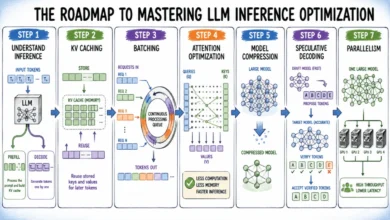
A Systematic Decision Framework
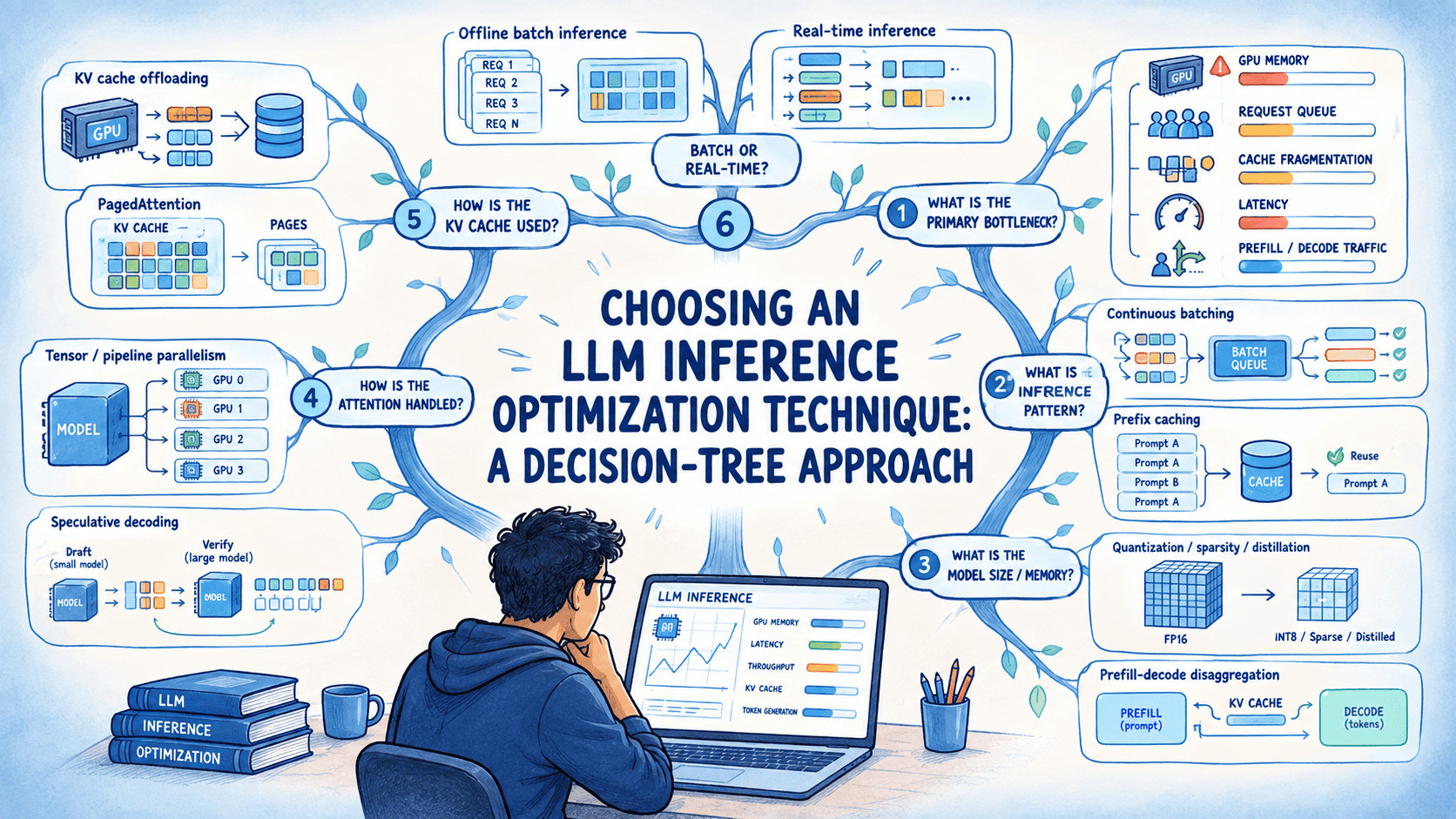
The following six-question framework serves as a diagnostic tool for infrastructure engineers. By answering these sequentially, teams can isolate the primary constraint of their inference pipeline.
1. Assessing Model-to-Hardware Fit
Before adjusting the serving software, engineers must ensure the model fits within the physical memory limits of the GPU. If the model occupies 90% of VRAM at rest, there is no "breathing room" for the KV cache to accommodate incoming requests. This leads to immediate performance degradation. If the model is too large, the first step is model-level compression: quantization (reducing precision to 4-bit or 8-bit), sparsity (pruning unnecessary weights), or distillation (training a smaller model to mimic a larger one). These techniques are foundational; without them, no amount of scheduling optimization can solve the underlying hardware deficit.
2. Identifying Structural Redundancy in Prompts
Modern AI applications, particularly those utilizing RAG (Retrieval-Augmented Generation) or persistent chat sessions, often process the same system prompts or conversation history repeatedly. If a significant percentage of traffic shares an identical prefix, prefix caching is the most potent optimization available. By caching the KV states of these recurring prompts, the system avoids redundant compute, effectively "skipping" the prefill phase for known data. This is particularly transformative for agentic frameworks where the "system prompt" may be thousands of tokens long.
3. Resolving Scheduling Inefficiencies
In a naive serving environment, requests are processed in a "first-in, first-out" queue. If a short request arrives behind a long-generation request, it is forced to wait, creating an idle GPU. Continuous batching addresses this by allowing the system to insert new requests into the batch as soon as others finish, rather than waiting for the entire batch to complete. This technique has become a standard requirement for production-grade inference servers, as it minimizes the "dead time" where GPU compute units sit idle.
4. Managing Memory Fragmentation
Even with efficient scheduling, the KV cache can cause memory fragmentation. If a system allocates a fixed, maximum-length block of memory for every request, it will run out of space even if the actual responses are short. PagedAttention, modeled after virtual memory management in operating systems, allows the KV cache to be stored in non-contiguous, fixed-size pages. This allows for significantly higher batch sizes, enabling the server to handle more concurrent users on the same hardware.
5. Prioritizing Token Streaming Latency
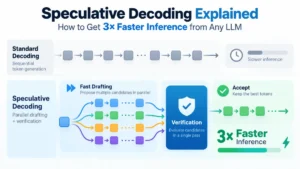
For user-facing applications, the perceived quality of service is defined by the "Time to First Token" (TTFT) and the inter-token latency. Speculative decoding can reduce this by using a small, lightweight "draft" model to predict the next few tokens, which a larger "target" model then verifies in a single parallel pass. If the draft model is accurate, the system achieves the speed of a smaller model with the intelligence of a larger one. However, this is highly dependent on the draft model’s acceptance rate; if the draft model is inaccurate, the overhead of verification can actually slow the system down.
6. Scaling Architectures via Disaggregation
At the highest levels of production scale, prefill and decode phases can be decoupled entirely. This is known as prefill-decode disaggregation. By separating these two processes, organizations can dedicate specific hardware to the compute-heavy prefill task and different hardware to the memory-heavy decode task. While this adds complexity due to the need to transfer KV cache states over a network, it allows for granular scaling that is impossible in a unified architecture.
Comparative Analysis of Optimization Techniques
| Technique | Primary Benefit | Potential Trade-off |
|---|---|---|
| Quantization | Reduced memory footprint | Potential accuracy degradation |
| Prefix Caching | Faster TTFT for recurring prompts | Strict requirement for exact prompt matching |
| Continuous Batching | Higher throughput | Increased implementation complexity |
| PagedAttention | Maximized memory utilization | Slight increase in computational overhead |
| Speculative Decoding | Lower inter-token latency | Requires a high-quality draft model |
| Disaggregation | Optimized resource allocation | Network latency for cache transfer |
Implications for Future Infrastructure
The shift toward these specialized optimization techniques reflects a broader trend in the AI industry: the transition from "model-centric" to "system-centric" AI development. As models become more commoditized, the competitive advantage is shifting to those who can serve them most efficiently.
However, engineers must be wary of "optimization sprawl." Adding multiple layers of complexity—such as combining speculative decoding with disaggregated hardware—can make debugging significantly more difficult. A common pitfall is the failure to properly profile the system; for instance, many teams implement quantization to save memory, only to find that the bottleneck was actually an inefficient network configuration or a lack of continuous batching.
Ultimately, the most successful deployments are those that align the optimization strategy with the specific traffic pattern of the application. High-throughput, offline batch jobs require a vastly different architectural approach than low-latency, real-time chat interfaces. By utilizing the six-question decision tree, organizations can ensure that their infrastructure investment is directed toward the most meaningful bottlenecks, resulting in faster, more cost-effective, and more reliable AI services. As the ecosystem matures, the focus will likely shift toward automated, self-optimizing systems that can switch between these strategies dynamically based on real-time load, further abstracting the complexity from the end user.